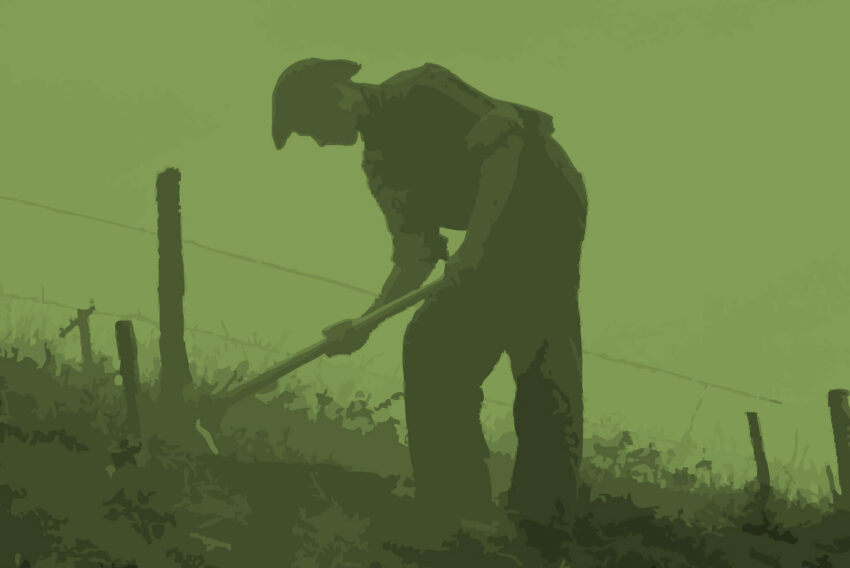
The poems assembled in this folio speak to workaday experiences: those of factory employees, teachers, doctors, and other laborers. Whereas many poets might elide the details of wage labor in favor of more romantic ones, these writers plainly explore the life of the grind. They remind us of the power of the worker’s voice at a moment when sweeping new federal policies threaten the livelihoods of so many.
In addition to previously unpublished work by eight living poets, this selection also includes a poem from our April 2000 issue by the late onetime U.S. poet laureate Philip Levine. Born in Detroit, Levine made his name by writing unsparingly about the auto industry, where he took his first job at the age of fourteen. New poems by Paisley Rekdal, Will Brewer, and Carrie Johnson build on Levine’s legacy, describing life on the assembly line and manual labor’s toll on the body.
The work in this folio also illustrates unavoidable ironies at the heart of our economic system. In Laura Kolbe’s “Knowledge,” a tech executive monetizes human waste by building futuristic toilets; in Andrew Wildermuth’s “We’re Teaching Comp Only,” a sanitized curriculum causes a writing teacher to lose his grasp on language itself. Edward Salem’s “The Precipice” recalls a tunnel in Gaza where men risked their lives just to bring “chocolates // and cigarettes” to rich customers. Poems by Alyssa Moore and Aiden Heung feature speakers who first succumb to, then escape, the lure of corporate conformism. On the job, these speakers are materially sustained and spiritually destroyed at once.
Work kills us; work keeps us alive. Steady employment remains most Americans’ only path to health care and housing—yet the current Trump administration has already gutted a range of social services, eliminated thousands of federal jobs, and embraced policies that endanger many others, including those in farming, science, construction, and journalism. Taken together, and read in light of our political moment, these poems capture the necessity and the impossibility of working today.
—the editors