Consider two New York Times headlines published on November 4, 2024, the eve of the presidential election:
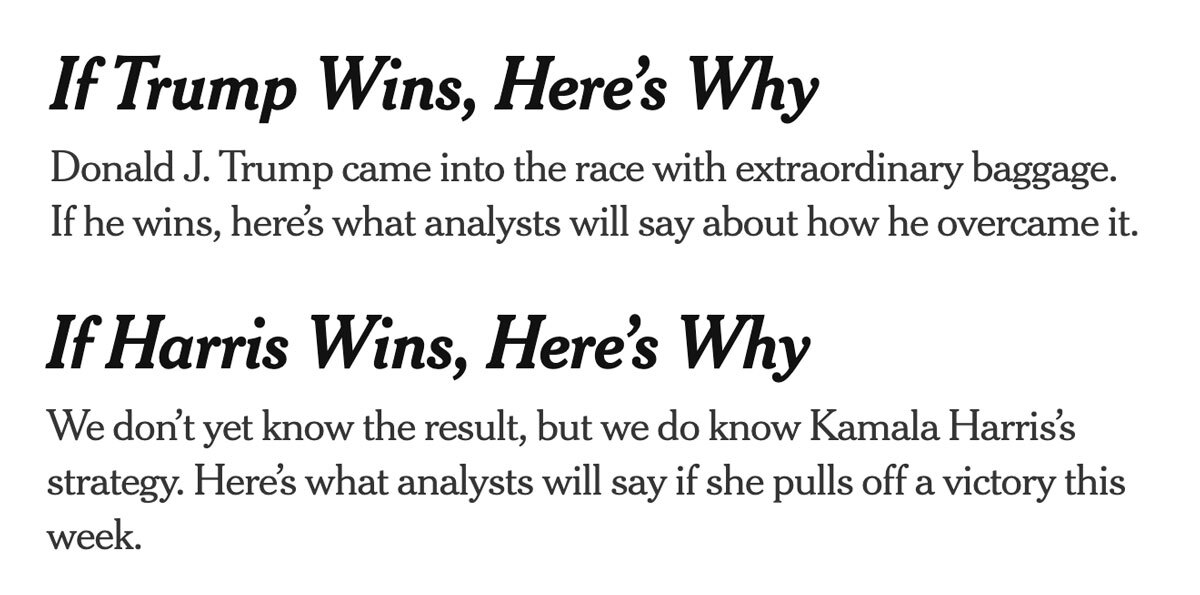
This offering speaks to the demands of today’s dizzying circuitry of media, capital, public consciousness, and political authority. Writing at the height of the Cold War, philosopher Hans Blumenberg observed with disquiet “a behavioral pattern on the part of the superpowers, in which words are increasingly passed off as realities.” These mirrored headlines mark a new knot in the pattern. Words reach beyond reality, folding pasts into futures that cannot, yet do, coexist. Explanations, predictions, fantasies, incantations—the difference has never been less clear.
Blumenberg defined reality as an experience of resistance: the real is what resists or outpaces our efforts to imagine, communicate, express. The real is the other of the fictive, the made-by-the-mind, the word. Once made, however, fictions also become real. And the more we mind a particular fiction, the less made-up it becomes. The escalation of political rhetoric, Blumenberg warned, could change the way reality felt. What becomes of the appetite to be informed when virtual realities and alternative facts—and headlines like the above—dominate our consciousness? What does authority look like, sound like, write like in a media culture saturated by the sense that even the most trustworthy account is just someone’s story?
The contributors to this folio explore spectacles of ambiguity at different scales of social life in which power, knowledge, and fantasy are interwoven. We asked them to think about reality without getting hung up on trying to define it. We invited them to reflect on how they maintain a sense of the real, or find it troubled, and write from there.
Each of the following pieces draws us into a scene in which realities intermingle heavily with fictions and even impossibilities. For Jesse Damiani, Abou Farman, and Sheila Heti, this activates the mind and calls for a voice capable of drawing finer, more plastic distinctions. For Mona Oraby and Joanna Radin, confusion is the place to be, a site of charismatic unfolding that’s oblique—and essential—to the ordering of everyday life.
Exploring these new knots of fact and fiction can yield pleasure as well as a more faithful accounting of the multiple worlds we inhabit. Yet these pieces also reveal a desire for mooring that persists through the play. And they remind us: anything we rely on as this still point can be co-opted by those seeking control—over others, or themselves.
—Noreen Khawaja and Lisa Messeri