In A Closer Look, a writer annotates a piece of art or an archival object.
What Irony Makes Visible
Fifty years later, Stephen Shore's photographs reveal an impending crisis
Aaron Matz
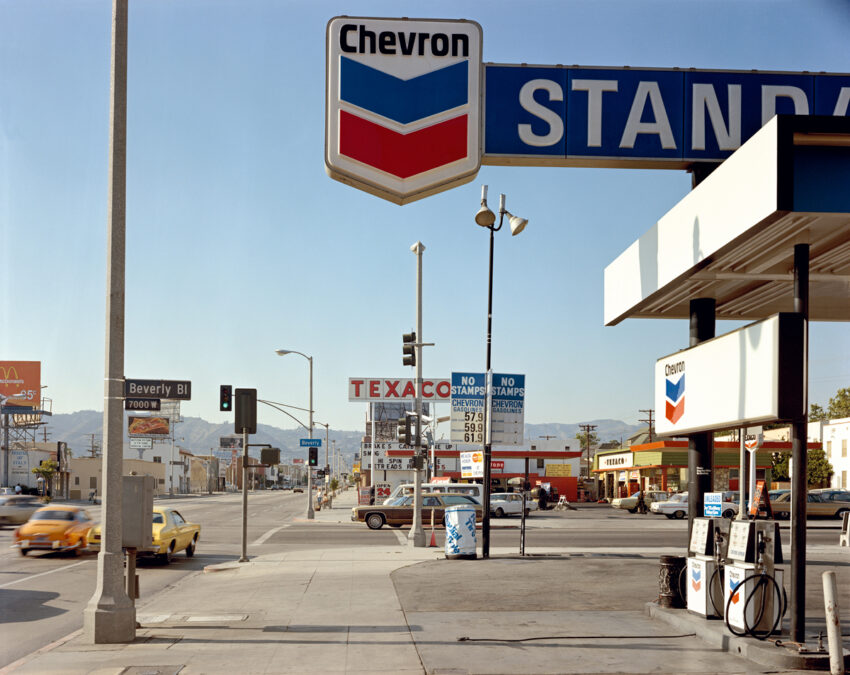
The photograph shows a street corner in central Los Angeles: the intersection of Beverly Boulevard and La Brea Avenue, as it looks facing north from the sidewalk on the southeast. Up ahead is Hollywood and the ridgeline of the Hollywood Hills; a few blocks east, beyond the boundaries of the photograph, is Hancock Park; the Fairfax District is to the west. The angle of the sunlight and the direction of the shadows suggest late afternoon. There is little traffic. The light on La Brea has just turned green, and the yellow car in the right northbound lane has crept into the intersection. The orange Karmann Ghia in the left lane is already accelerating, its speed generating the one blur in the image.
The picture was taken by photographer Stephen Shore and shown in 1977 at the documenta 6 exhibition in Kassel, Germany. It was later published in Shore’s 1982 collection Uncommon Places, which gathered images taken during his road trips across the U.S. Shore was by then exerting a significant influence on American photography. His use of color—still considered heterodox by many critics and photographers—and of a large-format view camera provided a new means of depicting American vernacular life. This composition exemplifies the brilliance afforded by color. It has become one of Shore’s most famous pictures, featured in retrospectives and imitated by admirers. Discussing it years later in an interview for his 2017 retrospective at New York’s Museum of Modern Art, Shore remarked that the photo attained something he called “clarity.” This quality “should not be confused with sharpness,” he said. “An eight-by-ten camera will produce sharpness, but clarity is a psychological aspect.”
We might ask what kind of psychological aspect it reveals, and what kind of clarity. Like many of Shore’s landscapes and streetscapes of the period, this picture is basically devoid of people. The view of Los Angeles includes only a few discernible human figures, all tiny and distant. The psychology of the photograph presumably resides not in a mental state represented by subjects within it but in the beholder of its bright, meticulous, and impassive scene. Perhaps that experience or sensation entails a stark clarity of presence. We know where we are (the street signs tell us) and what we are looking at. We may feel the clarity of a person who, as if standing on the sidewalk, is so absorbed in the ordinariness that it seems numinous.
But is the picture’s clarity the same to us today as it was to Shore when he took it? Or does the image now allow us to understand something that was disguised at the time? The photograph is titled Beverly Boulevard and La Brea Avenue, Los Angeles, California, June 21, 1975. The specificity of location is paired with a precision of date, unusual in the history of photograph titles. For some viewers, this might read as merely documentary. For me, it is nothing short of uncanny. I was born twenty-three days after this photo was taken, and upon leaving the hospital, I was brought home to my family’s house, nine blocks away from this corner. In looking at this image, I am practically looking at the moment I came into existence, and at the place where I first encountered the world.
One’s origins in the 1970s can seem unremarkable from one angle, world-historical from another.
I have driven through and walked across this intersection many hundreds, perhaps thousands, of times over the past half century. But when I look at Shore’s picture, I do not think of even the most recent of those experiences. What I am confronted with is that instant: the specific second of summer 1975 that Shore captured with his eight-by-ten, an instance, perhaps, of Henri Cartier-Bresson’s concept of “the decisive moment.” This is a testament to the solidity of the photographic image, its insistence on being entire, self-contained, anti-metaphoric. The second part of Shore’s title—June 21, 1975—is not ancillary to the first part but fully equal to it.
June 21 that year was a Saturday; Shore returned the next day to take another picture of the same corner. On Sunday, he tilted his view to the west and shot the southwest and northwest corners, even while retaining the same pattern of traffic heading north on La Brea. Seven years later, in Uncommon Places, Shore would include this second photo alongside the other, with the title Beverly Boulevard and La Brea Avenue, Los Angeles, California, June 22, 1975. The complemental June 22 photograph allows something closer to a panorama of the intersection but does not trouble the basic impression of the scene. A gas station presides over the first image: a Chevron/Standard, with its precise horizontal sign creating a counterpoint to the verticality of the adjacent streetlamp pole and floating above the white canopy, which points diagonally toward Beverly. Directly across the boulevard is a second gas station, a Texaco. In Shore’s second photograph, a continuity: we can see that the other two corners are also occupied by gas stations, Gulf on the southwest and Exxon on the northwest.
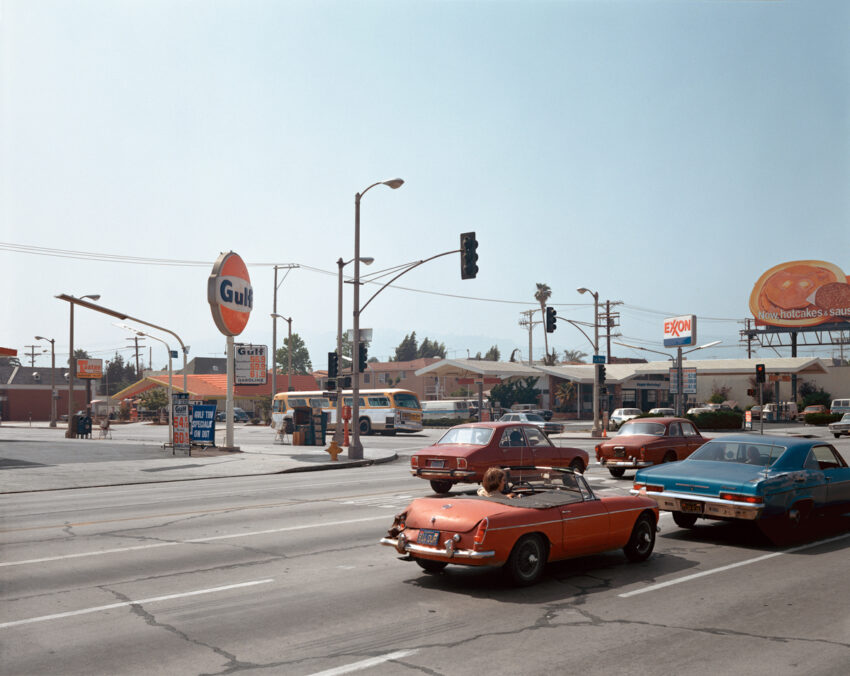
In 1975, it was hardly unusual for a Los Angeles intersection to be flanked on all sides by gas stations. But Shore’s choice of this corner, reinforced by his return there the following day and marked by his widening of the view, only hardens the presence of these stations within the scene. In the first image, the gas station provides a beautiful form: the Chevron, with its elegant namesake logo, serves as a perimeter for half the view; the absence of commercial activity—the pumps are not being used—deepens the photograph’s stately quiet. But in the second image, with its asymmetries and disregard for the classical composition of its predecessor, those gas stations seem less like handsome monuments outlining an elegant geometry and more like what they simply are. The pairing of these images makes every part of the streetscape appear more tightly interwoven: the roads, the cars, the signage, the stations. The cumulative effect is to consolidate an arrested point in time, rather in the manner of Virginia Woolf’s Mrs. Dalloway: life, Los Angeles, this moment of June.
My feeling of uncanniness, looking at these twinned photographs, arises from two related phenomena. The first is like the one Vladimir Nabokov describes at the beginning of his memoir, Speak, Memory. The time before our birth, the “prenatal abyss,” can create a distinct unease. Nabokov tells the story of an acquaintance faced with the image of his not-yet-existence,
a young chronophobiac who experienced something like panic when looking for the first time at homemade movies that had been taken a few weeks before his birth. He saw a world that was practically unchanged—the same house, the same people—and then realized that he did not exist there at all and that nobody mourned his absence.
Looking at Shore’s 1975 photographs is, for me, like staring into a breach. Am I there? Not quite yet—I must wait another twenty-three days—and surely part of the eeriness of the experience comes from the same anxiety around nonexistence that so disturbed Nabokov’s friend. Any photograph may produce in us this unsettling sense of presence and absence, but a photograph that seems to capture the moment of our inception is likely to produce it all the more intensely.
Yet there is a second kind of disturbance too, one which arises from our distance from that June day. We may still have the banal experience of seeing a perimeter of gas stations, maybe even at the corner of Beverly and La Brea. That Chevron station still sits on the southeast corner. If we went there today and filled our cars with gasoline, we would recognize with shame that we were about to send carbon dioxide into the atmosphere. But when we look at the photograph of that station in 1975, we feel not shame, exactly, but something closer to irony. To try to fathom the picture is to become ensnared in an incongruity, a disunity caused by a rift in the history of the earth’s climate. The artwork’s constitutive elements (cars, gas stations, pavement, sky) do not behave as they once may have; they do not operate with their former coherence. They now enable not Shore’s “clarity” but a different one.
let us consider the irony that defines this present-day encounter with the photograph. It is not to be confused with outdatedness: gasoline at around sixty cents a gallon; the languid architecture and open spaces that do not yet reflect the density and infill of contemporary Los Angeles. The real ironies are also retrospective, but they are the least visible. We see the cars; we know they are emitting carbon dioxide. We see the gas stations; we know they provide the cars’ petroleum. Those realities are no more perceptibly represented than the extraction of fossil fuels from the earth, the refining of crude into fuel for cars, and the transport of that liquid material to gas stations. All are implied elements in the image, and even these unseen things are unexceptional: any complex photograph includes concealed associations and processes.
Beverly Boulevard and La Brea Avenue leaks a more basic irony than any of these. The background of the image is laden with it: the irony hovers in the air. As so often in landscape and streetscape photography, the sky takes up more space than any other component while being easily overlooked. It makes Shore’s composition even more interesting than he could have known at the time. There is a scheme hiding in plain sight, constituted vertically and amounting to a kind of action. It begins underground, where the petroleum is stored. It continues at street level, where the petroleum is burned in the engines of the cars going north on La Brea. Then it moves above that, to the atmosphere rising invisibly from the concrete of the intersection and bleeding past the top of the image. The story of carbon emissions moves inexorably from bottom to top of the photograph—indeed, it begins beneath it and continues beyond it.
Shore’s sky is notably blue, and bluer as it rises. It seems to become ever more unfathomable, like the sky at the end of Philip Larkin’s poem “High Windows”: “the deep blue air, that shows / Nothing, and is nowhere, and is endless.” Shore’s blue sky also seems to mark a realm beyond intelligibility. But does it show nothing? If we stare long enough, the visual order of the image—streets, cars, signs, buildings, and finally sky—soon blurs out of focus, the sky now commanding our attention. The sky in Shore’s decades-old photograph bears a complicated relation to the sky that hangs over Beverly and La Brea right now. It is both the same (no visible transformation has occurred in it, unlike in the street scene below) and utterly different: in 1975, carbon dioxide concentration in the atmosphere was at 331 parts per million, and today it is at around 422.
The sky in the photograph does not reveal what is already underway. Yet a transformation is already underway: carbon dioxide levels in 1975 were still low by our current standard, but the accumulation had already begun its relentless rise. If we survey the photograph today, the sky no longer seems to be an ark cradling the earth below; it looks instead like an expanding repository of that earth’s contamination. Shore, standing on the southeast corner of the intersection in June 1975, presumably did not know this, even though he certainly would have been aware of something called “air pollution.” (Los Angeles smog in the 1970s was notorious; 1975, meanwhile, was the year that the EPA began requiring cars in America to be outfitted with catalytic converters. The bright blue above La Brea is not the brownish gray we might expect.) But it was still thirteen years before James Hansen, then director of NASA’s Goddard Institute for Space Studies, testified to Congress that carbon dioxide emissions were causing global warming—the earliest public testimony about the greenhouse effect.
Shore later wrote that this picture required “imposing an order on the scene in front of me.… I was figuring out where precisely to position my camera to make sense of all of the visual relationships I was trying to coordinate.” Yet what we may now understand to be the truly significant relationships between elements in the photograph were not visual or visible then. Whatever order the artist could impose at the time yields to a different order produced by retrospect; the artwork’s delayed-release irony ultimately overcomes the artist’s discipline and organization. Beverly Boulevard and La Brea Avenue is like a crime-scene photograph that contains clues so minuscule no detective of the day can perceive them; only a future investigator can gain the forensic advantage. The picture is silent and sphinxlike while nevertheless cataloging a disaster.
If an image of an ordinary city street can produce this deferred effect, maybe the phenomenon is more widespread across the history of art than we know. The sky is everywhere in photography and, before that, in painting. Is carbon dioxide stealthily accumulating in the canvases of John Constable, Caspar David Friedrich, and J. M. W. Turner? Those painters, drawn to the variations of the skies above Europe, all reached artistic maturity in the early nineteenth century, just as traces of industrial-era carbon really began issuing into the atmosphere. But the accumulation is not exactly happening, not quite yet—certainly not as it is in Edgar Degas’s circa-1890 Landscape with Smokestacks, or even in Eugène Atget’s Parisian cityscapes from the same period, which show slices of sky in between buildings and above rooftops. (There is fossil-fuel carbon there, even if we cannot see it.) Still, those later nineteenth-century pictures are different. In 1890, we are still long before the Great Acceleration of the postwar era, which marked a new spike in anthropogenic warming.
How grotesque that our lifetimes more or less correspond to the Keeling Curve.
In this sense, there is a distinctive irony skulking in the atmosphere of 1970s photography. Maybe Shore’s picture is no different from any other photograph taken anywhere in the world on June 21, 1975. A different photograph could produce the same response in a different viewer: someone born that summer near the brown coal mines of North Rhine-Westphalia might now look at a fifty-year-old image of a western German sky and realize that being born meant coming into a world of carbon dioxide accumulation concurrent with the span of their life. If the specific picture does not matter that much, it is because the magnitude of the irony is so immense—it is everywhere in the atmosphere. And since the history of photography essentially tracks with the history of anthropogenic carbon emissions, the sky in every photograph of the past nearly two hundred years is ironic—even when it does not hover above a gas station, even when it seems to frame a more stable and familiar pastoral. The climate irony of photography always threatens to turn up as the uninvited guest in any photograph, poking through the scrim of whatever appears to be the image’s manifest subject. But though the scale is enormous, the phenomenon is experienced individually.
looking back at childhood from middle age is not a new exercise. But does our current predicament make it different? One’s origins in the 1970s can seem unremarkable from one angle, world-historical from another. Any nostalgia is compromised when one’s lifespan happens to coincide with a rise in atmospheric carbon dioxide to levels last reached three or four million years ago. What a shock, what a disenchantment, to realize that this saeculum is one’s own saeculum. How grotesque that our lifetimes more or less correspond to the Keeling Curve.
Certainly, the upheavals of modern history have created ironic ruptures before. World War I, for example, was for Paul Fussell “more ironic than any before or since.” That war generated an utter disparity between intention and consequence, projection and result. “Every war is ironic because every war is worse than expected,” Fussell writes. “Every war constitutes an irony of situation because its means are so melodramatically disproportionate to its presumed ends.” But the Great War was an ultimate case, for it marked a reversal of the ideals of progress and meliorism that fed it. It held forth one idea and then epitomized its opposite. In Britain, the war’s beginning was conspicuously, then notoriously, innocent: the warm, glorious summer of 1914; the horseback displays; the volunteers lining up for recruitment, as in Larkin’s “MCMXIV,” without knowing that there would be “[n]ever such innocence again.”
But the Great War is also exemplary for the way we might now hold it in view. Irony is not only a fact inherent in the great cataclysm but also the best instrument for reckoning with it: “[T]errible irony,” Fussell argues, is the “appropriate interpretive means.” Fussell begins with Thomas Hardy, master of the “satire of circumstance,” whose cosmic irony floats above the awareness of living human figures, constituting a kind of precondition. It is through a detached and supreme irony that the writer witnesses human action that begins in innocence and culminates in devastation. This, for Fussell, provides the template for our condition ever since: “[T]here seems to be one dominating form of modern understanding,” and “it is essentially ironic.”
The irony that defines this sense of rupture extends far beyond Fussell’s British emphasis. We can see it as a prevailing way of comprehending lives in history, and as the basis for some of the most significant works of modern literature. It is impossible to imagine the splendor of Thomas Mann’s The Magic Mountain, to give a superlative example, without it. The self-enclosure, restraint, and discipline with which Mann draws his portrait of a Swiss sanatorium can make it appear, for more than seven hundred pages, like a place outside time, impervious to history’s vagaries. But in the novel’s foreword, published as part of the first edition in 1924, Mann allows a sly acknowledgment:
[T]he extraordinary pastness of our story results from its having taken place before a certain turning point, on the far side of a rift that has cut deeply through our lives and consciousness. It takes place, or, to avoid any present tense whatever, it took place back then, long ago, in the old days of the world before the Great War, with whose beginning so many things began whose beginnings, it seems, have not yet ceased. It took place before the war, then, though not long before. But is not the pastness of a story that much more profound, more complete, more like a fairy tale, the tighter it fits up against the “before”?
Then the novel begins, and we are immersed in Hans Castorp’s seven years at the sanatorium. If there is a world beyond the mountain, it is only by implication, for we never leave the alp. But in the last four pages, Mann plunges us into the flatlands of war: fire and muck, bodies piled in the mud. We see Castorp running across the soggy earth and singing until he is laid low by a shell. And there Mann ends his novel. What has been sandwiched between these two acknowledgments of the war, between foreword and final scene? Everything else about human life: intellectual ferment, friendship, sickness and health, eros and hatred. The novel takes place on “the far side of a rift that has cut deeply through our lives,” but its pastness is all the more profound for being so close. The entirety of The Magic Mountain is cast into the shade of irony: framed by a lurking cataclysm that has given it shape but whose imminent arrival is never announced outside Mann’s foreword. The novel’s ironic retrospect disfigures its own delicacy—its representation of prewar lives—by pulling back to show the looming expiration of those lives and their fantasies of endurance. Irony for Mann, as for Fussell, is revealed to be the only “appropriate interpretive means.”
Can these ways of thinking about World War I provide a model for understanding ourselves and our art within the history of climate? There is, alas, no easy analogy in the present disaster to the summer of 1914. I have isolated one image—a photograph of Los Angeles on June 21, 1975—that might serve as a representative candidate, at least for me. Certainly, the origins of the climate crisis date back well before then: to the beginning of the Great Acceleration following World War II; or to the late eighteenth and early nineteenth centuries, with the rise of steam power; or even to the early modern period. I do not mean to find a source, though; I mean to identify something closer to a point of cognizance—a moment when human activity and awareness of its climatological effects were about to intersect.
The hidden element in Shore’s picture, this proximity of attendant death, lurks quietly in a scene of otherwise brilliant color and vibrancy.
The 1970s seem as good a period as any to stand for this point. The Blue Marble, a photograph of Earth taken from space by the crew of the Apollo 17 mission in December 1972, became a spur and an emblem for the nascent environmental movement. The picture is famous for evoking the planet’s fragility, but as a portrait of the earth floating in a vast emptiness, complete and integral, it actually produces a cosmic ironic effect: great distance reveals the smallness of all human activity. The Blue Marble depicts both grandeur and triviality, the stateliness of Earth and the vanity of human wishes. The unity of the planet entire was a characteristic idea of the time: it was, after all, also in the 1970s that scientist James Lovelock published his first articles on the Gaia hypothesis, arguing that Earth is a self-regulating complex system.
If we are moved to consider the history of the climate emergency as a subject of irony, then the 1970s can be a useful fulcrum. They were an era when a problem already in progress was coming to be understood as such, even if only by a small number of people. Their distance from us now might, in this sense, resemble the time before the Great War as seen from Mann’s perch in The Magic Mountain. Like that prewar pastness, the pastness of June 1975 seems to exist on the far side of a profound rift of consciousness. But our current predicament can now be seen to have been latent. The artwork that holds this latency teeters between pastness and proximity. The number of parts per million of carbon dioxide, invisible in Shore’s Los Angeles sky, is an index of climate in time.
gas stations have long been a popular subject in Los Angeles photography; in the 1960s, Dennis Hopper and Ed Ruscha found special amusement in the city’s Standard stations. Their pictures are often called “deadpan”; there is a sense of quiet menace, of something not said, in a work such as Ruscha’s 1963 artist’s book, Twentysix Gasoline Stations. There seems an incongruity in the fact of petroleum repositories at the center of a metropolis, where pumping fuel from underground storage tanks mimics the original act of extracting crude from the earth. But there is no incongruity. Los Angeles has been home to active oil fields since 1892, when Edward Doheny struck his well near downtown and made his fortune. La Brea Avenue, named for the tar that continues to seep from pits just to the southwest of Shore’s intersection, still runs past oil wells a few miles south of Beverly, where it rises into Baldwin Hills and where derricks stand next to soccer fields. The photographer’s deadpan posture coolly assimilates this oddity. There is a chasm but also a commerce between the aboveground and the belowground—between the quiet order of edifices on the surface and the unruly bituminous liquids underneath.
Fossil material, concealed under the pavement, supports the life that transpires above it. The hidden element in Shore’s picture, this proximity of attendant death, lurks quietly in a scene of otherwise brilliant color and vibrancy, this scene that may be for us, who see in it the apparent innocence of a prelapsarian childhood, a kind of private arcadia. This may be the ineluctable irony of the photograph, and of so much of the art made in recent decades alongside the gathering emergency. The arcadia is built on decay, an ironic pastoral. Beverly Boulevard and La Brea Avenue is like Nicolas Poussin’s famous painting, made in 1637–1638, of shepherds gathered around a tomb in ancient Arcadia. It shows an idyll containing its own omen: a memento mori reminding us of Death’s presence there. And Death says to those who look at the scene: Et in Arcadia ego.
These days, it is no revelation that devastation loiters everywhere: photographs supply continuous documentation. The notorious 2017 image of golfers in North Bonneville, Washington, putting calmly on a green while an enormous wildfire blazes behind them will stand as a classic of the genre. But a photo like Shore’s bears a melancholy that is subtler and finally more powerful than the cartoonishness of that picture, for it confirms the profound affinity between photography and death—Susan Sontag’s idea that “all photographs are memento mori,” Roland Barthes’s view that looking back at any photograph is to be made aware of “a catastrophe which has already occurred”—while renewing it for our contemporary predicament. Death in Shore’s photograph is obscured by concrete and tailpipes, but it becomes perceptible in the image retrospectively.
Irony is the interpretive means that allows us to see these things: it imposes a discontinuity that troubles the photograph’s integrity. Indeed, given the stakes, it can feel awkward to resort to older ways of evaluating the work. We may no longer want to fall back on familiar aesthetic or formalist principles. If we look at the image and see carbon dioxide, if we look for the scene’s vitality but see death, how can we bang on without embarrassment about the elegance of Shore’s arrangement, the affordances of the large-format view camera, the richness of the blues and reds? Would it be obscene to do so?
Ever since Friedrich Schlegel and Søren Kierkegaard in the nineteenth century, it has been conventional to emphasize irony’s paradoxical and negating quality, and that would seem to be the case here, as it replaces equilibrium with rupture. But perhaps this resilient mode alone reveals the delusion that has always propped up that equilibrium. Irony can be clarifying, in both senses of the word: it can make something understandable, and, as with a liquid, it can purify the material, ridding it of blockages and corruptions. Irony can allow us to return to a familiar photograph while granting us a fresh recognition of its actual complexity. If the artwork does not acknowledge what it is revealing, we might now finally be able to behold it capably and satisfactorily. Far from being an obstacle, irony can be a spur against despair, even as our situation deteriorates. Irony has something in common with carbon dioxide: it is everywhere, swirling all around us even if we cannot see it, gaining in parts per million.
We should acknowledge that it is there. It reveals a breach that we must be able to recognize—in our lives and in the art of our age. Irony will help us see our own place in time, not only with respect to a past era but in relation to a future moment too. If I take a photograph at the southeast corner of Beverly and La Brea today, it will represent only an arbitrary flash in time, with atmospheric carbon dioxide at 422 parts per million, and I will know that a future beholder of that picture may recognize the scene but feel it is antique. I would want that person to know I expected such a reaction. For this may be irony’s final lesson—that it is the only way of anticipating a future retrospective view.
Aaron Matz is the Frederick Hard Chair in English Literature at Scripps College in Claremont, California. He is the author of Satire in an Age of Realism and The Novel and the Problem of New Life.
Featured
What Happened When I Began to Speak Welsh
By learning my family's language, I hoped to join their conversation.
Dan Fox
When Does a Divorce Begin?
Most people think of it as failure. For me it was an achievement.
Anahid Nersessian
You Might Also Like
Ed Ruscha's "Every Building on the Sunset Strip"
Why the artists' book is a reminder of freedom
Jim Lewis
The Role of the Modern Writer
In his work for The Yale Review, Thomas Mann grappled with an artist’s relationship to society
Morten Høi Jensen
A Literary Gift in Print
Give a year of The Yale Review—four beautifully printed issues featuring new literature and ideas.
Give a Subscription