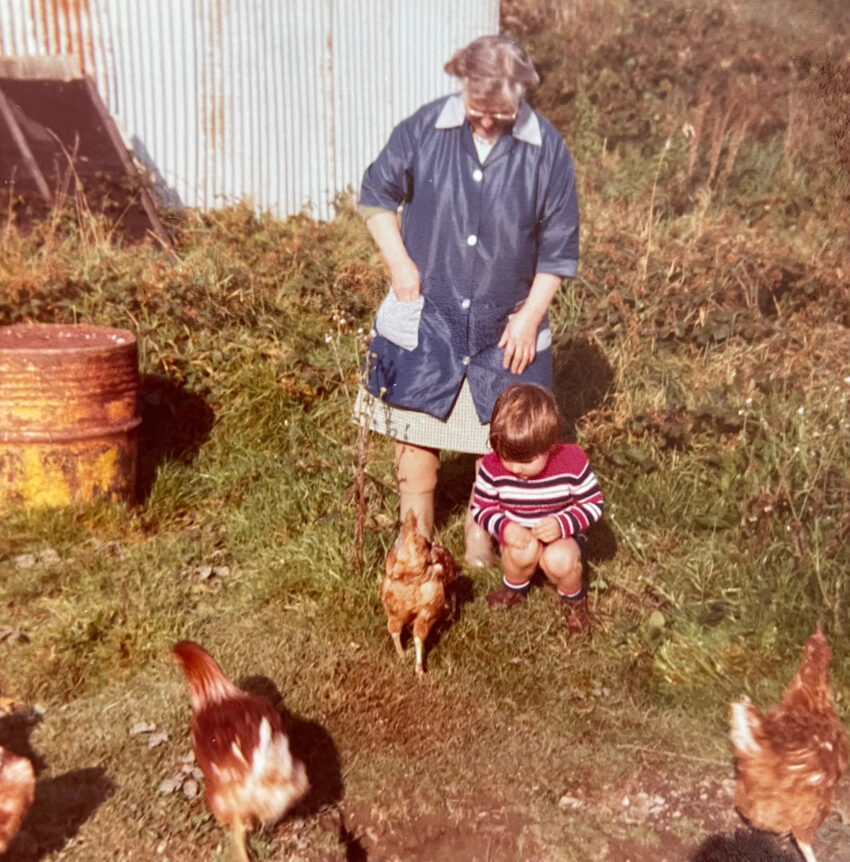
Dan Fox as a child with his nain, or grandmother, in the yard of Siambr Wen, near Llanrwst, North Wales, UK. Courtesy the author
My maternal grandmother died twenty years ago. The funeral was held in a small Methodist chapel in the lush Conwy Valley of North Wales. Her entire life—she had almost reached one hundred—was spent in these hills. The drizzle that morning had slicked the trees and turned the slate of the chapel black. Our family, gathered under umbrellas, entered in order of seniority: Mum, now the family elder, with Dad on her arm, then my six aunts and uncles with their spouses, and finally the cousins, led by my brother Mark and me.
The room was austere. White walls, sturdy wooden furniture, a plain cross on the wall. Our family squeezed into box pews in the center of the chapel. A couple of older men among the crowd reminded me of my grandfather, who had died decades earlier: similar thatches of black hair; dark, weathered complexions; history-book faces.
The funeral was conducted in Welsh. It was my grandmother’s first language. Mum’s too. I didn’t understand a word. I followed the congregation when they stood to sing and sat to pray, but my grief remained isolated in English and the music of sniffly noses and creaky pews. Near the end of the service came a hymn. I recognized the melody, “Cwm Rhondda” (“coom ronda”), so rousing and anthemic that Welsh rugby fans belt it out from the terraces before big matches. At the end of each verse, the lines repeat, step higher, and split into harmonies—everyone knows how these go, tenors climbing on baritones, sopranos atop altos. At its peak, the melody slows dramatically, voices at full power, before making a stately descent to its resolving chord.
I knew the tune well enough to hum along. The air seemed to tremble in that small and intimate room. I heard myself embedded in the chorus, but outside the language. In the final soaring bars of the hymn, I looked at my grandmother’s little coffin resting in the aisle, and something between a thought and a sensation ran through me: I am part of her language. I must not let it go.
i called her Nain. Pronounced like “nine,” nain means “grandma” in Welsh. I would have been one or two when I picked it up. A little older, having learned to put my scrawl on drawings and Christmas cards, I spelled it with a capital N and believed it was her given name. Taid, “grandad,” sounds close to “tide.” These were my first Welsh words and, for a long time, my only ones.
I didn’t need more. My grandparents could speak English, and I grew up in the South of England, where almost nobody knew Welsh. Mum, born in the late 1930s in Llanrwst, a pretty market town two miles north of where Nain’s funeral was held, had left Wales in the 1960s, shortly after my brothers were born, moving first to Canada, then back to Britain after the end of a short-lived marriage. In search of work, she landed in Oxford, where she met my father, who came from an Irish Catholic family in the North of England. They married, settled in a nearby village, had me. When I was a baby, Mum sang Welsh lullabies. Heno, heno, hen blant bach (tonight, tonight, little children). Occasionally, Welsh words became family slang—“I’m going to the cyfleusterau [“kuh-vluh-ste-rai”],” meaning “conveniences, bathroom”—but we always spoke English. Dad, conversant in Italian, French, Latin, Greek, and German, never picked up much Welsh. At home, Mum’s sovereign tongue was reserved for long phone calls with aunties and uncles and, to my delight, being able to say the longest place-name in Europe: Llanfairpwllgwyngyllgogerychwyrndrobwllllantysiliogogogoch.
I often heard English people dismiss Welsh as a jumble of consonants, a nuisance to tourists, a dying language. I took the insults personally, feeling protective of Mum and the family, like a guard stationed outside castle walls, loyal to the life inside. Growing up in England with a Southern accent, I was different from my Welsh cousins, but I seldom thought about why I couldn’t speak their language.
The Welsh call their country Cymru (“kum-ree”), which derives from an early Brittonic word for “compatriots.” Welsh—Cymraeg (“kum-raig”) to those who speak it—belongs to the same family of Celtic languages as Cornish and Breton, spoken in the British Isles and Brittany before the arrival of what became English. In 1536, when Wales was brought under English law, officials sought to restrict the use of Welsh in legal and government affairs, but it remained the vernacular. Several decades later, new translations of the Bible standardized the language in its modern form.
I came to associate Welsh with voices close to the ear, in small spaces heated by gas fires.
The language’s decline began during the Industrial Revolution, which brought English-speaking workers to Welsh coal mines as Welsh-speaking families moved away in pursuit of a better life. New money and new inequalities fomented civil unrest. In 1847, an infamous government report on education in Wales blamed the “evil effects” of the Welsh language for indolence, illiteracy, and violence. As a consequence of the report, English was aggressively pushed in schools, putting Wales on an expansive path of bilingualism. When Nain was a girl, children caught speaking Welsh at her school were made to wear a wooden paddle around their necks—the so-called Welsh Not. The last one tagged with the Not at the end of the week was beaten. Welsh was cast as subaltern, the impediment to prosperity; English became the tongue of modernity and opportunity, spread through laws, commerce, and quiet acceptance. By 1911, when Nain was two, only 43 percent of the country spoke Welsh. By Mum’s infancy in the late 1930s, that number had sunk to almost 30 percent, and in the 1960s, when she left the country, it was down to a quarter of the population. What Welsh remained was concentrated in the rural North.
This was where Nain and Taid lived. When I was small, we traveled to their cottage in the Conwy Valley three or four times a year, during the school holidays. I remember interminable hours in the car, the narrow Welsh roads winding like loose shoelaces. Taid was a shepherd; Nain, a mother with all the auxiliary duties of a shepherd’s wife. England was barely fifty miles east, but they used English only when necessary or polite. My grandparents’ life together was conducted in Welsh: at the dinner table, on the radio, in the fields, for gossip, for poetry. Welsh was the language at chapel, where the Bible was Y Beibl.
Their home—called Siambr Wen (“shamber when”)—existed out of time, an illustration from a children’s book written before TV and plastic toys. Thick stone walls, dazzling whitewashed barns, an orchard in the back garden. Each morning, Nain would take me with her to feed the chickens and collect eggs. I wasn’t much taller than the birds, and I remember finding it pleasing when the color of the feed bucket matched the blue of Nain’s work coat. At teatime, she served wafer-thin slices of fruitcake glossed in butter, called bara brith (“ba-ra,” bread; “breeth,” speckled). I slept under thick Welsh blankets so heavy they pinned me to the bed.
Taid died shortly after I learned what to call him, too soon for me to print memories of how we spoke to each other. I remember silent images: watching him asleep on the couch, curled on his side, sunlight outlining his body. After his death, Nain moved to the coast; in the kitchen, the radio was tuned to Welsh-language stations for news and choral music. She always spoke to me in English, but if I behaved well, she’d call me hogyn da (“hog-in,” boy; “dah,” good). Llyncu mul (“thl-unky mil,” swallow a mule) if I sulked. If I made a mess, it was mochyn (“moch-in”), which means “pig.” If she was surprised, she’d exclaim, Bobol bach! (“Bob-ol,” then “bach,” like the composer)—a Welsh “oy vey.”
I understood diolch (“dee-olch”) for “thank you,” dim diolch for “no thanks,” and I intuited from birthday cards that cariad (“carry-ad”) meant “love.” Context provided the feeling, if not the definition, of basic words. I could not have told you how anything was spelled, whether I was hearing one word or ten. Instead, I heard my family’s phrases as micro-melodies and ritual refrains—big round vowels drummed by rolled r’s and split syllables that spliced new beats into the middle of words. My aunts and uncles were bilingual, but they had not lived outside Wales, and they carried strong Welsh rhythms into English. Only Mum’s accent was tempered by faraway places, by a husband and three boys who did not sound like her.
A Literary Gift in Print
Give a year of The Yale Review—four beautifully printed issues featuring new literature and ideas.
Conversation at Nain’s was aerated by interludes of quiet, filled by the steady tick of the grandfather clock in the living room. Love was strong and unconditional among the family members, yet shaped by a deep emotional privacy that, to outsiders, could seem like an extreme reserve. Disagreements were rare, but without Welsh, my busy imagination filled the pauses with drama, and I’d wonder whether a lull suggested that “something had been said,” to use a family euphemism. “Is everything OK?” I’d ask Mum, only to learn I had overheard a debate about where to take Nain for a day out.
In these gaps, the Welsh of my childhood became imbricated with the weather. I would sit at the windows and stare at snowflakes forming intricate patterns in concert with Nain’s lace curtains. I tried to identify the feeling evoked in me by passages of delicate sunshine, a certain quality of light reflecting off the nearby sea. Something like melancholy. I came to associate Welsh with voices close to the ear, in small spaces heated by gas fires. I rarely heard Welsh on TV, never saw it printed in a newspaper; it was only and always alive in the room with me.
I hit seventeen, eighteen, and visited Wales less often. Modern art was my new discovery. My compass turned to London, where I believed that over a cappuccino at Bar Italia, behind the sooty façade of what was then the Tate Gallery, I might discover the life I longed for. I wanted to make movies imitating avant-garde films I had read about but never seen, and to go to art school—not learn Welsh. Llyncu mul, as Nain would say.
By my twenties, I had a job as an art critic, in a world with its own minority language. Work took me to New York, where I lived surrounded by immigrants who spoke two languages, or four, and I was only a monoglot. Americans, I noted, liked to index their ancestry. I would explain that my mother was Welsh-speaking and wish I had a phrase to show off; nobody I met in New York had ever heard it spoken.
After Nain died, the memory of her funeral would surface occasionally, prompted by a snatch of music or stray remark. It returned over time, distilled into an image of the coffin and a fragment of the hymn’s refrain, tugging at my conscience: I had the vague sense that I was neglecting something. That “something” could not be satisfied by bara brith, or by heavy Welsh blankets. It was inside the Welsh language itself. One day I’ll learn it, I told myself, and I will understand the message carried in the memory. I’ll start tomorrow, maybe next week.
the pandemic arrived during my tenth year in New York, stranding me an ocean away from my parents. They were in their eighties and isolated in their Oxford village. On my last visit, only months earlier, I had watched Mum shuffle old photographs from a wrinkled envelope, her fingers thick with arthritis, and spread them on the cheerful oilcloth that covered the kitchen table. We often spoke through pictures. There she was at age four, little pixie hat, sandwiched between bigger kids at Sunday school in Llanrwst. “My goodness, they were rough,” she’d said. Late teens, trench coat, hair short and modern. Early twenties, posed on the doorstep of the family farmhouse, now a mother.
There were things I knew about that house. It was called Tal-y-Braich Uchaf (“tal-uh-bry-ch uh-kav”), perched on a remote ridge in the Eryri mountains, better known in English as Snowdonia. Tal-y-Braich means “high spur,” or “arm.” Uchaf means “upper.” Nine of them lived in three bedrooms. The house was lit by oil lamps. They kept food cold in the stream outside. Taid tended his sheep on the slopes, and sometimes the children would summon him in for meals with blasts from a conch shell.
To coax out more stories of Tal-y-Braich, we needed more slow afternoons at the kitchen table. Phone calls and emails were too crude. Unable to travel, I wanted another sympathetic magic with which to close the ocean between us. Dissolving into the couch one afternoon during those first months of sourdough and dread, I opened an email from my auntie Gwenda. She had sent the family a YouTube clip showing dozens of shaggy wild goats roaming the deserted streets of Llandudno, on the North Wales coast. Liberated by lockdown, they had ventured into town, nibbling garden hedges, sitting in parking lots. Taid had driven his sheep to Llandudno to graze on these headlands. I had run along the beach below as a boy. When I closed the video, I opened another browser window. With a few swipes of my thumb, I downloaded Duolingo, selected “Welsh,” and played the first quiz.
The pleasure was immediate. Familiar sounds crystallized into verbs and nouns, as if there were some base material of Welsh already within me. How slow—embarrassingly slow for a writer—I had been to see that Mum’s language was a portable inheritance. If I learned Welsh, I could take it with me anywhere: it weighed nothing, yet it held my family, and so much else, inside.
I walked around my apartment repeating fragments of tourist Welsh. “Dw i Dan” (I am Dan). “Dw i’n byw yn Efrog Newydd” (I live in New York). Efrog Newydd! There was a translation nobody needed, but what a beautiful sound. I thought of Mum. I thought of a story she had told me about having to walk for miles along the empty roads between Tal-y-Braich and school. One day, she said, she decided to bring a pocket mirror and hold it in front of her as she walked so she could see the reverse view. I asked why. For a change of perspective, she said.
there is a welsh saying I learned only recently: Cenedl heb iaith, cenedl heb gallon. A nation without language, a nation without heart. For the older generations of my family, it was self-evident. When Mum left Wales in the 1960s, nationalist sentiment that had been growing for decades took new form. It galvanized a direct-action movement to save the language—that portable inheritance—to which Welsh identity was tightly bound. Among its pioneers was Saunders Lewis, a founder of the nationalist political party Plaid Cymru, which had been agitating for self-governance in Wales since the 1920s. In 1962, Lewis—then nearly seventy—gave a landmark radio address titled “Tynged yr Iaith” (“The Fate of the Language”). He predicted that without drastic action, Welsh would vanish altogether by the twenty-first century, and he called on his listeners “to make it impossible for the business of local and central government to continue without using Welsh.”
In his speech, Lewis lambasted a proposal to construct a new reservoir in North Wales that would transfer water across the English border to Liverpool. To build it, the government planned to flood the Tryweryn Valley, drowning the entire Welsh-speaking village of Capel Celyn. Even before Lewis’s address, the project, which many saw as a symbol of English indifference to Welsh culture, had drawn anger and protest. But in 1965, the plan went forward. Cofiwch Dryweryn (Remember Tryweryn), graffitied on the wall of a ruined cottage, became the slogan for the darkening mood of Welsh nationalism. I passed the reservoir in the car as a child and was haunted by the thought of houses and shops beneath the water’s surface, traces of life floating inside them: tins of food, toys, family photos.
Tryweryn stoked long-held grievances. By the mid-1960s, acts of resistance had spread across Wales in a push for official recognition of the language. People refused to pay parking tickets or taxes and ignored court summonses if the paperwork was in English. Road signs were painted green or taken down, with demands for bilingual replacements. A new direct-action group, Cymdeithas yr Iaith Gymraeg (Welsh Language Society), organized sit-ins and roadblocks, drawing inspiration from the civil rights and peace movements. Hundreds risked arrest and trial, including my cousin Emrys, who was sent to prison with other student members of the organization. As the 1970s wore on, activism became violent: at the fringes, secessionists turned to bombs and torched English-owned holiday homes.
I grew up in the secure empire of English, but at a young age I was made aware that for some in my family, it was a foreign power.
These were grim decades for Wales: deindustrialization devastated the country in the 1980s. Mines and steelworks closed. Communities were ruined. Even as a child, I sensed the sadness. We’d drive through places Mum remembered as thriving towns, now lined with shuttered storefronts. That was a hat shop, she’d say. Over there we went for ice cream. It seemed inevitable that the Welsh language would mirror this decline. The 1981 census put the number of Welsh speakers at 18.9 percent. But the next census, a decade later, recorded only a fractional drop, to 18.7. The steep decline of the previous decades had stalled. Changes in law and policy made a difference: legislation in the late 1980s and early ’90s provided a pathway for making Welsh compulsory in schools and required bilingual road signs and official documents. In 1999, the National Assembly for Wales, a bilingual body, was established in Cardiff. Now called Senedd Cymru, or Welsh Parliament, it has control over education, health, transport, and rural affairs.
There was a cultural shift too. Small Welsh literary presses flowered during the activist years of the 1970s and ’80s. Young people drove a bilingual music scene, bringing Welsh into contact with punk and other subcultures. An official Welsh radio station, BBC Radio Cymru, began broadcasting in 1977, and after extensive campaigns—including a hijacked transmitter and the threat of a hunger strike by one politician—the TV station S4C launched in 1982. Nain, I remember, liked to watch the soap opera Pobol y Cwm (People of the Valley) on the channel.
In the twenty-first century, census figures have continued to hover near 18 percent—some 538,000 people in 2021—but the Welsh government plans to up that to one million by 2050. An optimistic target, though there are signs of hope. Today, S4C draws big audiences for sports and Welsh noir thrillers. When the Welsh soccer team qualified for the World Cup in 2022 (the first time in more than half a century), fans adopted as their anthem a 1980s protest song about Welsh survival, Dafydd Iwan’s “Yma o Hyd,” which means “still here.” A 2025 report for the Welsh Language Commissioner found that young people surveyed overwhelmingly preferred English for social media but felt “positive” about Welsh and used both languages—at school and sometimes at home. The government has pledged more support for Welsh-speaking communities. Still, for every boosterish show on BBC Radio Cymru about the music scene in Wales, there are gloomy debates about the country’s divided politics, predictions divined from rising home prices or lagging school exam results that foresee only continued struggle for the language.
I grew up in the secure empire of English, but at a young age I was made aware that for some in my family, it was a foreign power. Mum did not begin learning English until she was ten. I had just turned thirteen when my great-auntie Ceri, who had worked as an activist for Plaid Cymru in her youth, brought me to the National Eisteddfod (“eye-steth-vod”), an annual festival of Welsh literature and music that dates back to the Middle Ages and is a pillar of cultural tradition. That summer, she had tickets to the Chairing of the Bard, a major ceremony in which the Gorsedd (Throne)—a society of writers and musicians—selects the best poem written in the strict cynghanedd (“kuhng-han-eth”) meter. I was excited to learn that the Gorsedd members, dressed in colored robes, were called Druids, but I was frustrated that I could not understand the poems and songs. As we took our seats, Great-Auntie Ceri whispered in my ear—only half joking—not to breathe a word of English.
welsh has a reputation for difficulty. Llanfairpwllgwyngyllgogerychwyrndrobwllllantysiliogogogoch—Mum’s party trick for English speakers—gets wheeled out as indisputable proof. A cartoon that sometimes does the rounds on social media shows a man returning a Welsh Scrabble set to a store with the complaint that half the vowels are missing.
Thanks to Mum, in my first weeks on Duolingo, I had no fear of consonant gridlock. Here’s the thing: Welsh has more vowels than English. Its alphabet uses twenty-nine letters but no j, k, q, v, x, or z. Instead, it has ch, dd, ff, ng, ll, ph, rh, and th, all treated as separate letters. What are commonly considered consonants in English have open vowel sounds in Welsh: W is often used for “oo.” The letter y can be “ee” or “uh.” Ch is like the “ch” in “loch.” Dd makes a firm “th,” as in “these.” One of my favorite Welsh words is smwddio. Here the w is “oo,” and dd is “th,” making it “smoothio.” It means “ironing.” The hardest sound to make might be the double l. Put the tip of your tongue behind your top front teeth. Hold it there and breathe out. Let the air pass along the sides of your mouth, and let your tongue drop to make a “luh.” It should sound loose and airy. “Thl” will do fine if you can’t.
It reminded me that Welsh was ours. I simply needed a new key to the door.
Welsh grammar is comparable to quantum physics. There is a YouTube clip of the stand-up comic Rhod Gilbert, an Anglophone Welshman, describing the fate of his classmates in a thirty-person Welsh course: “One passed, three failed, and twenty-six dead.” I could believe it. There is, for instance, no single word for “yes.” It changes according to tense and context. A variety of mutations can transform m’s into f’s and c’s into g’s or even the terrifying ngh. None of this was conveyed by Duolingo, I soon realized. Mutations and syntax went unaddressed. Mistakes were met with only admonishments from the app’s bossy cartoon mascot, never explanations. And I had no use for its apparently practical phrases: “I want potatoes or chocolate.”
A year after the pandemic began, I made my first visit back to Oxford. The oilcloth-covered kitchen table remained the steady heart of our shaken world. One afternoon, I sat with Mum and talked. I saw more gray in her hair, but like Taid’s, it had remained thick and streaked with black in old age. Conversation meandered, and we often sat in quiet, watching a neighbor’s cat through the window as it prowled the garden. I tried to show off some Welsh. “Dw i isio mynd am dro yn nes ymlaen,” I said. She frowned. I repeated: “Dw i isio mynd am dro yn nes ymlaen?”—now with a doubtful upward inflection. “I want to go for a walk later.” The words were right, my pronunciation confounding. She asked to see Duolingo. Within moments, she found errors. When she heard it “speak,” she gave me a withering look that needed no translation: Delete.
I felt like a sucker for putting my faith in an app, as if I had done something disrespectful. Her disdain summoned the towering authority of lived experience, reducing the Silicon Valley gewgaw to nothing. It reminded me that Welsh was ours. I simply needed a new key to the door.
i returned to new york resolved to take my lessons seriously. But determination didn’t make the task easier. Back in the mid-nineteenth century, the city had a Welsh-language newspaper, Y Drych (The Mirror); in 2021, even in a city home to eight hundred languages, I struggled to find in-person Welsh classes. When I tried the Amikumu app, designed to locate nearby speakers of a given language, the closest Welsh speaker was in Philadelphia. I attended a meeting of the New York Welsh—a friendly group that meets regularly at a bar in Midtown—but everyone I met was an Anglophone from South Wales.
Friends asked how the Welsh was coming along. “Slowly,” I’d say, meaning “badly.” When I told people about Welsh, I was often asked about its utility, as if it were an exercise routine or a life hack. Did people speak it outside Wales? Was it useful? Yes. It gave me access to complex emotional circuits. To say even the simple word rwan (“roo-an,” now) conjured people and places. Mum, in the living room at home, signing off a phone call to Wales: “Ta-ta rwan” (Bye now). The novelist John le Carré once wrote that the decision to learn a language is “an act of friendship.” It was this feeling—not functionality—that I was looking for. Trying to learn the language in America made it hard to find.
Music helped. On the internet radio station NTS, I found the Casgliad Cymru (Welsh Collection) and went deep into a playlist for the post-punk label Ankst. I could pick out the odd word, but I was mostly content to let Welsh wash over me as it did in childhood. I liked Gruff Rhys’s gentle psychedelia. He grew up near Nain and Taid’s farmhouse and sang in a crisp Welsh that reminded me of people who would pop in to visit Nain. Running his song titles through Google Translate felt like cheating—and it was unreliable for Welsh—but I let myself use it to collect scraps of vocabulary. In a plaintive song by Kelly Lee Owens and John Cale, “Corner of My Sky,” I listened to Cale intone the phrase Dechrau yn y Gogledd: Start in the North.
Around this time, I stumbled upon an online trial lesson in Welsh offered by the company SaySomethingin. Its mission to “reverse the language shift in Wales, through the development of a totally original language learning methodology,” had an appealing nerdery. This methodology promised to teach me a sentence in just one week. The approach is simple: the teacher provides a phrase in English, the student repeats it in Welsh; the teacher adds a few words to the phrase, the student follows suit. Eventually you arrive at a complete sentence. One quiet afternoon at home, I signed up and started the first thirty-five-minute lesson. Aran, my instructor and one of the company’s founders, cracked dad jokes and gave dorky pep talks I grew to appreciate. A busy online forum made it easy to ask questions—and provided the sense that the system was run by Welsh teachers, not start-up bros. I can still remember the sentence from that first week: Dwi isio dysgu siarad Cymraeg achos dwi’n caru Cymru a dwi isio yr iaith Gymraeg barhau (I want to learn to speak Welsh because I love Wales and I want the Welsh language to continue). A mutation of parhau, the word barhau (“bar-high”) means “to continue.” It can also mean to persist, endure, survive. This was not Duolingo’s potatoes-or-chocolate Wales.
For the first twenty-five lessons of the course, I did not learn a single number, or how to ask directions to the railway station. I was drilled in metastatements about learning Welsh, such as “I want to speak Welsh with you” and “I still need to practice more.” The system didn’t explain the rules of mutations; it advised internalizing them through practice. As new vocabulary cemented rapidly, the sentences developed into mind-bending strings of social relationships: “I met someone in the pub last night who told me that she wants to speak Welsh with you,” for instance, or “I met an old woman in the pub last night who told me that she knows a young man who works with your sister.”
This felt real. It was how I had first heard Welsh: gossip at Auntie Gwenda’s house, news in Nain’s kitchen. At home, I hammed up the North Wales cadences, enjoying how the accent rolled from my mouth. I sounded like my family. I began to write emails that began “Annwyl Mam” (Dear Mum). I said “Penblwydd hapus” on birthdays and “Nadolig llawen a Blwyddyn Newydd dda” at Christmas and New Year’s. When Mum and I were on the phone, we’d play tennis with a single phrase.
“Hee-wol varr,” I’d say, mangling hwyl fawr, an informal goodbye.
“No, it’s hoo-il vawrr.”
“Hool.”
“Hoo-il.”
“Whill?”
“Hoo-il.”
Our rally would collapse into laughter.
As the eldest, Mum had helped her brothers and sisters learn how to read and write, and my uncle Dewi, born with a cleft palate, how to speak. They addressed Mum using the formal chi, for “you,” not the informal ti, as if she were a parent. In one sense, my exchanges in Welsh with Mum were family history repeating itself. They were also specific to our own relationship. She had never gone to university, but she had bought books and records for my hungry teenage mind. She took me to art exhibitions and to the movies, and wanted to talk afterward about what we had felt. Learning her language was another gentle process of discovery.
i would like to say that I have sailed into fluency and that Mum and I recite cynghanedd poems to each other on FaceTime. The truth is more complex. I am not a reliable student of Welsh. Some weeks, I dutifully complete my exercises, listen to BBC Radio Cymru while I do the smwddio. Then I let a month slip by and have to scramble to catch up. Earworms from the online courses loop through insomniac nights: Dw i ddim yn deall (“doo-ee thim un darcht,” I don’t understand).
There is a paradox to my efforts: I am learning Welsh to speak to my family and make it always alive, in the room with me, as it was in childhood, yet I often shy away from the opportunity to speak. In the presence of my aunties and uncles, and even with Mum, the sounds clog in my mouth, and I become suddenly doubtful and halting. I retreat into English. I am so used to being outside their conversations that I find it hard to give myself permission to enter. The same sentence I have repeated so many times in front of my computer goes unsaid: I want to speak Welsh with you.
The message of Nain’s funeral stays with me, the language a talisman I carry unseen in New York, and to wherever I might go next.
My parents recently moved to Chester, on the English-Welsh border. My brother Mark lives there too. When my wife and I visit, we squeeze into Mark’s car for a drive into North Wales. On our last trip, we climbed into Eryri, driving through the landscape of granite, heather, and grass. Mist often shrouds the peaks, but that day we had fine weather, the sun pulling delicate shades of yellow and brown from the rocks. Mum brought the isolated farmsteads to life. That used to be Mr. Evans’s place, she said, pointing at a distant house invisible to the rest of us in the car. He would put wooden planks on the back of his truck and drive us to chapel. I used to work in a little coffee hut on the right here. It was my job to fire the flare gun to call mountain rescue if there was an accident.
On these drives, we pass Llyn Ogwen, the ribbon lake at the mouth of the valley in which Tal-y-Braich sits, and remark how cold it looks. We talk about how hard it must have been for Taid to work in the harsh mountain weather. Mum finds new details about her childhood, and I try to commit them to memory. Who else will remember them when she is gone and my aunties and uncles are no longer around? Today, Tal-y-Braich is a vacation home, maintained by the National Trust conservation charity, with a woodburning stove, washer-dryer, and TV. You can rent it for around $700 for a minimum of three nights. There’s a Welsh word, hiraeth (“hee-rayeth”), that means something like “a longing for a place that may no longer exist.” In Wales, it’s a cliché, but I find it helpful. The message of Nain’s funeral stays with me, the language a talisman I carry unseen in New York, and to wherever I might go next.
Mum is Nain herself now. My niece and nephew live nearby, and both speak Welsh. On my last visit, they came to join us in the kitchen. My nephew wore a T-shirt with a picture of Tryfan, the mountain across from Tal-y-Braich, on it. He told us about his girlfriend, who was singing in the National Eisteddfod the following weekend. I listened to Mum and her grandson flow easily between Welsh and English—and couldn’t always keep up. Mum speaks faster in her first language than she does in English. Fedri di ddweud o eto dipyn bach yn arafach? Can you say it again a little bit slower? Sometimes I sense she is puzzled that I cannot understand her better. Yet together we are shaping our own private meaning of “learning Welsh”: we go through her 1950s Welsh novels, covered in tatty jackets with elegant woodcut designs, or the Sunday school newsletter where her photograph once ran. From these, Mum draws a family story, or a scene from mid-century Wales. I ask what the Cymraeg is for this or for that. The lesson is in texture, image, music.
When I last returned to New York, we said goodbye at the airport. Mum held my hands and said something I couldn’t quite understand—it was long, I was crying, I could pick out only fragments. It didn’t matter. We were speaking Welsh.
Dan Fox is a senior editor at The Yale Review. A former editor of Frieze magazine, he is the author of Pretentiousness: Why It MattersandLimbo, and codirector of the film Other, Like Me: The Oral History of COUM Transmissions and Throbbing Gristle.
Support Our Writers
A sustaining subscription provides vital, ongoing support for The Yale Review and the writers we publish—and includes new holiday merch.