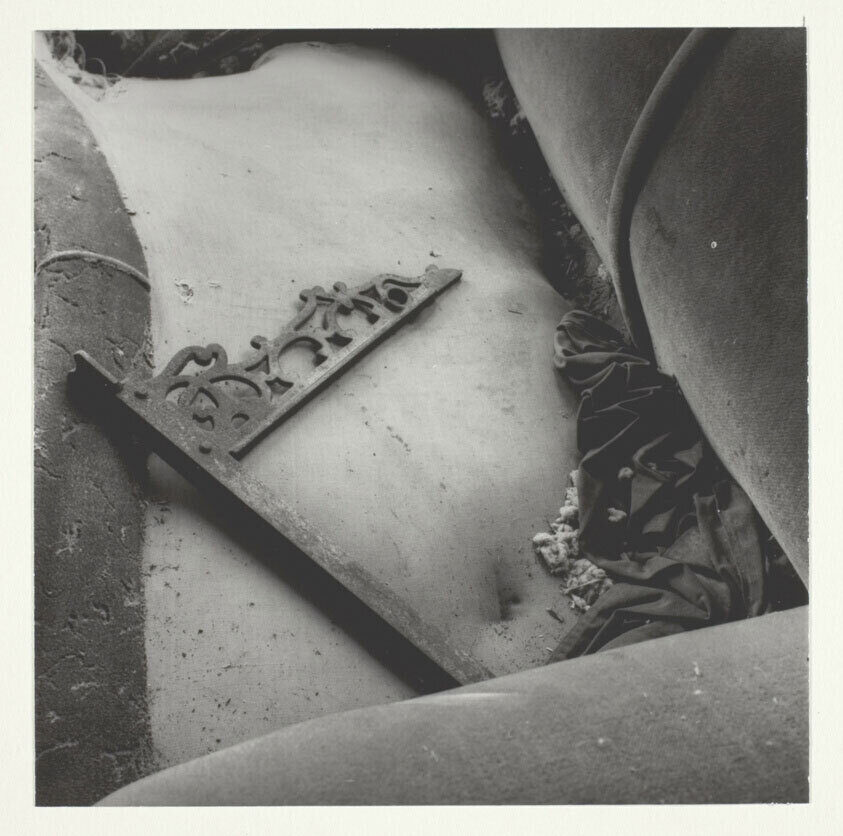
Dick Rudisill, Ruined Couch, 1964. Courtesy the Art Institute of Chicago
I needed to get rid of the loveseat.
It had been sitting in the basement for too many years. It had problems. Its light-gray armrests were browned with use. When I sat on its dark-gray seat cushion, I could feel springs poking, threatening to rip through.
Someone had thrown up on it. Someone had peed on it.
Sweat and pus and tears and blood and cum, at different points in its history.
Other liquids too. Milk and whiskey, coffee and apple juice.
A small black dog had humped both armrests.
Children had played on it, naked but for overfull diapers.
I could hardly stand to look at the loveseat. Its age, its shabbiness, a reflection of my own.
Still, one woman’s trash is another woman’s treasure, so I posted a picture of the loveseat online: FREE!!!! If you can come pick it up.
No takers.
The trash collection for bulk items took place early Monday morning, before dawn. So on Sunday night, I asked him to help me carry the loveseat to the curb.
“Are you sure?” he said.
“Three, two, one,” I counted down.
“Are you sure?” he repeated.
“Use your knees, not your back,” I muttered as we lifted.
But the loveseat wasn’t as heavy as I had anticipated, not nearly as heavy. It had been cheap. Imitation mid-century modern, with wooden legs splayed at a jaunty angle and twelve fabric buttons in a grid. It felt almost delicate as we navigated it up the stairs and out the doorway to the sidewalk.
I found a black Sharpie and scrawled TRASH on a piece of scrap paper and duct-taped it to the front of the loveseat, where it would be visible to the garbage collectors even before the sun was up.
Aside from that sign, the loveseat looked at ease out there on the curb, as though it had been given a place of honor from which to view the street. As though soon people in colorful clothing bearing amber liquids would come to sit on it, an extension cord for a lamp, a speaker, songs flowing at sublime volume, people on the loveseat and draped over it, people encircling it, a man dancing like a woman and a woman dancing like a man, and then, at the climax, someone spilling amber liquid on the armrest, shiver of pleasure.
Throughout the evening, I kept pushing the curtain aside, peeking out at the loveseat.
“What are you doing?” he said.
I dropped the curtain and turned to face him.
After some time, we went to bed. He put his leg over me, as was his habit, and though this usually made me feel safe, tonight it made me feel imprisoned. He was asleep already, so not present to either assist with or be offended by my jailbreak. I squeezed out from under the thigh and resettled myself, four inches between us.
As I lay there trying to sleep, I thought with relief of the time, so soon now, when I would wake up and that loveseat would be gone from my life forever. I had waited years for this. I would buy something new.
the clang of metal on pavement awoke me sometime later, still dark. Another clang, a crunch.
I considered the possibility that they wouldn’t take it. The instructions online were bureaucratic, the website slow, and I wasn’t confident that I had properly input the request for the bulk removal, the loading icon spinning and spinning before I ever reached a confirmation page. I just had to hope.
Two voices on the street below, words I couldn’t make out, and I was asleep again.
earliest light found me at the window, parting the curtain.
The loveseat was gone.
My bereavement was instantaneous. I struggled to breathe. I leaned against the window frame.
I needed help.
But from whom?
It was 5:26 in the morning.
He was still asleep. I didn’t dare wake him into this mistake.
Even I understood that 911 was not the appropriate choice.
Then I remembered the nonemergency city hotline. 24 hours a day, 7 days a week, 365 days a year!
“Good morning, how can we be of assistance to you?”
I was in the basement, in the dark, leaning against the wall where the loveseat had been. It was so good to hear a human voice. It was a tired female voice.
“Hi!” I said too loudly. “I scheduled a bulk pickup and—”
“Your patience is appreciated,” the voice said. “Please give the collectors until noon before reporting a bulk pickup failure. At that time, we can reschedule the bulk pickup for the next trash collection date. Have we resolved all of your issues today?”
“Actually,” I said, my heart beating so hard it distracted me, “they did pick up my bulk item, but I’ve changed my mind, and I want the item back.”
My confession was met with silence.
“Hello?” I said, after a beat.
“You changed your mind?” the voice said.
“I did.” It was a relief to declare it.
“You can’t change your mind,” the voice said. “We hope we have been of assistance to you. Have we resolved all of your issues today?”
But she hung up before she reached the second syllable of today.
I wept wildly, smearing my face along the wall.
Support Our Writers
A sustaining subscription provides vital, ongoing support for The Yale Review and the writers we publish—and includes new holiday merch.
as of 5:53, he was still asleep, and I realized there was no reason why I couldn’t call the nonemergency city hotline again.
“Good morning, how can we be of assistance to you?” Now it was a tired male voice.
“I scheduled a bulk pickup,” I said quickly, before he could start explaining that I had to wait until noon, “which was successful, very successful and prompt, and thank you for that, but now I want my item back, please.”
“No pets may be claimed as dependents on tax returns,” he said.
“What?” I said.
“Sorry,” he said. “Tired. No returns of bulk items. Have we resolved all of your issues today?”
I was too timid to do anything but shake my head no, and after an instant he hung up.
For the next forty-three minutes, I called the nonemergency hotline every ninety or so seconds. I spoke to a variety of operators, and perhaps repeatedly to some; each held their ground. I did drive one of them to drop their formal demeanor.
“You’re shitting me, right?” that operator said.
Yet I continued to call the hotline. I wondered for how many minutes and hours I would need to do so until I at last came to peace with my loss.
“Good morning, how can we be of assistance to you?” I couldn’t tell whether it was a male or female voice.
“I scheduled a bulk pickup,” I said, “which was successful, thank you, but now”— I veered suddenly off script—“I regret it horribly.”
“Oh,” the voice said, hardly even a syllable, more just a gentle release of breath. “That’s too bad.”
I pressed my head against the wall.
“What was the item, if you don’t mind my asking?”
I didn’t mind. None of the others had asked.
“A loveseat,” I said, and only then did it strike me how sweet a name it was for a piece of furniture.
“Oh,” the voice said again, that same gentle quality. “There are no returns of bulk items.”
But the operator didn’t hang up on me, and it seemed there was something in the voice, something almost wry, There are no returns of bulk items, as though the voice didn’t fully believe the phrase it had been forced to say.
“I get the sense that you’re desperate,” the voice said quietly, almost furtively.
“I am,” I said, squeezing the syllables past the swelling in my throat.
“Do you have pencil and paper?” the voice said.
I ran and snatched the grocery list from the fridge and a Sharpie from the countertop, the same Sharpie with which I had written the word TRASH.
“Yes,” I said.
The voice gave me an address. It was a street I’d never heard of during my two decades in this city.
“Seven o’clock tonight,” the voice said.
“Thank you,” I said.
“Shh,” the voice cautioned, and hung up.
all day i played it cool. When he woke up. When I went to work. Like most people, I’ve had plenty of practice concealing what roils within me.
After work, I took two subways and three buses. Each bore me farther away from the city I recognized. After a dozen stops on the third bus, I was the only remaining passenger. There were endless swaths of pavement on either side, vast empty parking lots and deserted runways. An abandoned factory with jagged windowpanes, vines pulling it apart from inside. The wind blew a plastic water bottle, a blue face mask, a Styrofoam peanut across the street.
A true story someone once told me: A young couple had a baby. They were proud and excited. They took the baby on a weekend trip to show it off to family. Before they left home, they had the idea to hide their jewelry in a package of diapers (they didn’t have much, just three or four pieces, but the jewelry was precious to them, and it was all they had). On the weekend trip, the baby died suddenly in its sleep. Some friends—in an attempt to lessen the pain just a little bit—decided to clear the couple’s apartment of all signs of the baby before they returned. The friends took the diapers and threw them away.
“last stop,” the bus driver said, eager to be done with his day. I couldn’t blame him. I got off the bus.
I stood beside the metal bus-stop sign and looked at my phone. There was a text from him, mundane, Where are the tweezers? He thought I was at work. He still believed I was relieved to be free of the loveseat. I didn’t reply.
My destination was only a thousand feet away. I could see something there, rising dark and massive before me. I started walking toward it. I passed an outburst of vegetation that had broken through the pavement. The light grew grayer by the moment.
I had the impression that I was approaching the ocean. That those looming shapes were sand dunes. That the bird cawing overhead was a seagull. I wondered why the merciful operator had sent me to the beach.
But in a thousand feet, what I came to was a dead end: a vast chain-link fence. It reached up ten feet and stretched as far as I could see in both directions. The top of the fence was crowned with loops of razor wire. The fence’s interior was draped with blue tarps that prevented anyone outside from seeing in. The gate appeared impenetrable, chained shut with three padlocks.
Soon it would be dark. A thousand feet and three infrequent buses and two subway lines stood between me and him. The merciful operator was cruel.
I had already turned to leave when I heard a chain rattling, a key in a lock, another key in another lock, a third key in a third lock.
A figure stood in the gateway. A skinny person, not much older than a teen, wearing a sweatshirt and jeans and sneakers and a baseball cap.
“Hey,” the person said.
“Hey,” I said, hanging back.
“Come on in,” the person said.
By that point, I didn’t want to enter. I felt a sense of threat, though the person was not threatening per se.
“It’s okay,” the person said in the voice one would use to speak to an animal or a timid child.
The person held open the gate, and I stepped through.
at first, i thought the hills were geological, shaped from earth, until my eyes understood that they were mountains of trash.
Air conditioners and mattresses, doors and refrigerators, bookcases and printers, car tires and cribs, toilets and loveseats.
Then, as my eyes adjusted to the gray light: a cracked mouth-guard case, a pair of headphones, a plastic horse, a garden hose, a shower curtain spotted with mildew, a child’s sneaker encrusted with mud, a string of solar-powered Christmas lights, all indistinguishable from things I had thrown away over the years, and, near my foot, a minuscule object that resembled my son’s silver baby tooth crown (the one the dentist had installed over rot I’d failed to notice), dazzling, the detritus of my own life.
somehow she had gotten a splinter from a kitchen floorboard embedded deep in the bottom of her foot. I led her over to the loveseat and called for him. He came down with the baby and hauled them both onto his lap. She was crying and so was the baby. I had to find the tweezers. We didn’t have any good ones, just the cheap pink pair that had been included in a baby care kit from the pharmacy. She wanted the dog to be on her lap while I got the splinter out, but the dog was antsy, jumping onto the loveseat and stepping on all three of them, refusing to settle. Will it hurt will it hurt! I wasn’t the kind of person who could dig a splinter out of a child’s foot with crappy tweezers, or with any tweezers at all. Yet as I stood above the loveseat, a strange calm came over them, and they all stared up at me, the six eyes of my life at that moment in time.
“what are you looking for?” the person said, pretending they hadn’t noticed my tears.
I counted four half-crunched loveseats visible from where we stood, none of them my own.
It would take a lifetime to find my loveseat again.
My phone buzzed in my pocket.
The person’s hand accidentally grazed mine. But we didn’t step away from each other. We stayed there together, only mildly awkward, studying the ruins. It was clear that the shoes on our feet, the studs in our ears, were bound for these piles.
My phone buzzed again.
on the bus, I read his accumulated texts. The old pink ones? Night surrounded the bus. Never mind found. At regular intervals, streetlights illuminated small circles of pavement. Jay asked to borrow the hose but you threw it away after the ice right? The breeze blew a yellow paper cup into an illuminated circle and then back out into the darkness. What’s your ETA?
Helen Phillips is the author of six books, including, most recently, the novel Hum. Her novel The Need was longlisted for a National Book Award. She is the recipient of a Guggenheim Foundation Fellowship, and she teaches at Brooklyn College.
Newsletter
Sign up for The Yale Review newsletter to receive our latest articles in your inbox, as well as treasures from the archives, news, events, and more.