In Objects of Desire, a writer meditates on an everyday item that haunts them.
My Mother’s Ashtray
When I lost her, I lost a world
Jonathan Lethem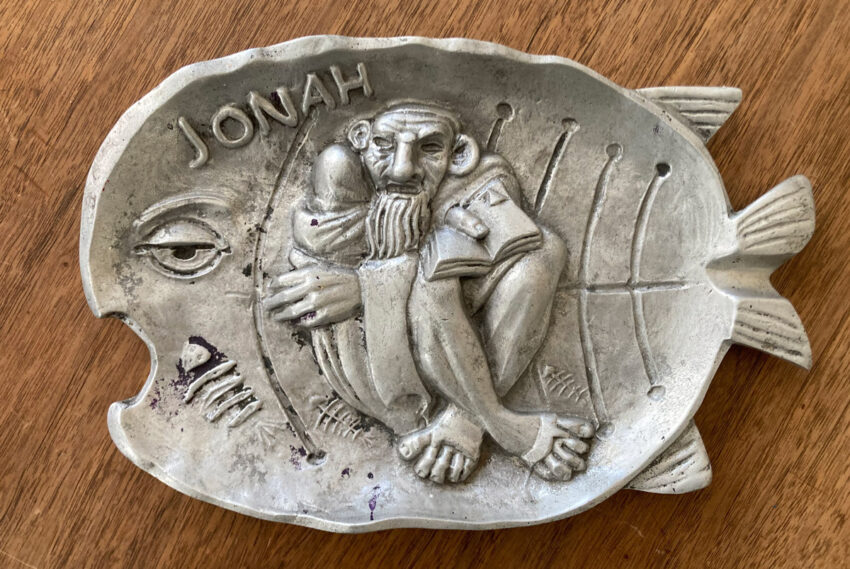
My childhood home was a palace of uncanny and singular artifacts. I took this for granted, as one does. My father was a painter, and the centrifuge of such stuff was his studio, on the top floor. It erupted with his new drawings and paintings and “assemblages”—he never called anything a sculpture—many of which he would hang for brief or sustained durations on the walls of the parlor and in the stairwells of our three-story house. Later, after contemplation, some of this artwork might retreat to the wall of his studio for further effort, then emerge changed, or it might vanish into storage.
My brain enjoyed a permanent rich strangeness, having come to consciousness amidst so much creation. (I also learned stillness by posing for paintings and drawings.) My father’s colleagues and art students brought pieces into the house as well, things he would trade for pieces of his own. My brother and sister and I slept in rooms decorated not with my father’s paintings but with artwork by others. These were smaller pictures, brightly colored, deemed appropriate for the children’s rooms. Yet they were not intended for children, particularly. They were beautiful and odd. When one friend named Hugh was a houseguest in an upstairs room, he drew all over the walls.
More enigmatic still were the functional objects that littered the house, evidence of a combination of my parents’ poverty, ingenuity, and taste for handcrafted or reclaimed objects, stuff that would now be credited to “artisanal culture.” We lived in New York City in the seventies, and I pined for the playthings that I saw advertised on television—G.I. Joe and the game Operation. Instead, I played with wooden toys that my father crafted for me, little puzzles and cars. Our Christmas tree decorations consisted of my father’s drawings on heavy stock paper, which were then carefully scissored into shapes by my mother: angels and Santas, but also giraffes, cats, and telephones. Ceramic objects were usually attributed to a maker—“Amy’s bowls,” say. Some were elegant, but if I brought home a lumpy mug or trivet I had fashioned at day camp, it was pressed into use as well.
The gaping mouth and cynical, exhausted eye suggest endurance and discomfort more than appetite.
Can treasure also be heavily used? The most functional piece of art I took for granted the longest was our ashtray, which provided routine and filthy service. It is made of pewter and depicts the biblical story Jonah and the Whale. As a child I was hypnotized by my mother’s smoking, which she fought back at some point to merely a pack a day—a pace I admired as reasonable, especially when she threw over Marlboros for Eves, marketed in Ms. magazine as a women’s cigarette (she eventually went back to Marlboros). Her smoking was not limited to cigarettes. My mother was a pothead, and something of an advocate for marijuana (I’m not sure I should call her a “dealer,” but she certainly turned a lot of people on). The Jonah and the Whale ashtray often held both an accumulation of stubbed cigarette ends, a lit cigarette or two, and a smoldering joint.
I still own it. The ashtray is lighter than it appears at a glance. The whale’s body is shaped like a candy dish, with no nod to cetacean biology, finned and tailed more like a flounder than a whale. The gaping mouth and cynical, exhausted eye suggest endurance and discomfort more than appetite. Jonah, on the other hand, looks indignant if not malicious, the prayers he recites from his open Bible obviously a pretext for his obnoxious occupation of the whale’s interior. He would not have fit through the mouth unless he had wriggled and writhed and groped his way in—anyway, what creature would desire this severe and gristly prophet in its craw? A few scattered fishbones seem to offer evidence of Jonah’s diet more than the whale’s. These bones are then echoed by the whale’s own bones, which form Jonah’s backdrop, his headquarters. The whale’s attitude suggests: When will this be over? Jonah is given top billing, true to the legend. After their fateful three days together, it will be Jonah’s story we follow, not the whale’s. Yet there is nothing memorable, really, about Jonah, except for their time together. He will dine out on that story for the rest of his life.
I do not know who made the ashtray. In the sixties my mother worked for a jeweler named Conrad, on MacDougal Street, and I associate the ashtray with her stories of Conrad and his shop. But really it was that she loved the ashtray. Also that because of its innate communal function, its place as a hub for long evenings of smoking and talk, it seemed an emblem of her life beyond the unit of our family—the constellation of old and fascinating friends she boasted, and the new ones she regularly attracted to her dinner table. Her adult life was one in which I was usually at least partly included, to a degree that would be seen as a fault by the standards of contemporary parenting. I liked to listen to the talk.
Once, at age eleven, I sat in a circle of her friends around the Jonah and the Whale ashtray as a joint was being passed around. It was handed to me by one of her daring friends, as if to provoke her. I’ll always remember how she wordlessly conveyed to me with her glance that this was my decision. I passed it on. (A year or so later I’d help myself to some of her pot brownies, but I wasn’t ready to smoke in front of her.)
My mother died of cancer in her thirties, and I never became a smoker of cigarettes. I keep the Jonah and the Whale ashtray in an obvious place, on a shelf near my writing desk, and clean, the way I seldom if ever saw it when I was a child. Like so many things, it hides in plain sight. When I am visited by smokers and they ask whether I have an ashtray, I offer it, but no one has ever assumed its use without being directed to it. Without a heap of Marlboro butts resting in its center, the thing reverts to being an artwork, its function sublimated in its peculiar specificity. I have to shove it back into the action.
Jonathan Lethem is is the author of Brooklyn Crime Novel and twelve other novels. A Different Kind of Tension: New and Selected Stories will be published in the fall by Ecco.
Featured
What Happened When I Began to Speak Welsh
By learning my family's language, I hoped to join their conversation.
Dan Fox
When Does a Divorce Begin?
Most people think of it as failure. For me it was an achievement.
Anahid Nersessian
You Might Also Like
A Literary Gift in Print
Give a year of The Yale Review—four beautifully printed issues featuring new literature and ideas.
Give a Subscription