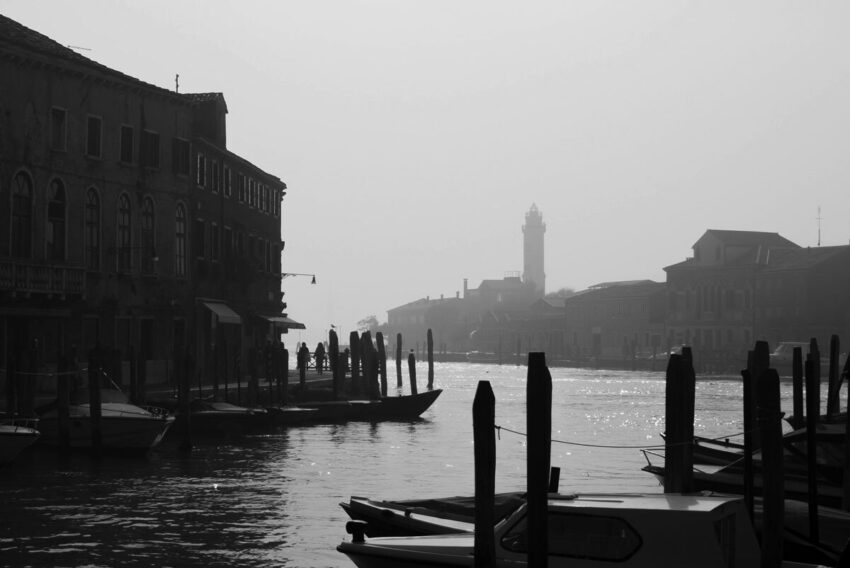
Christian Holzinger, Murano, Venice, Italy, 2017. Photo courtesy the photographer and Unsplash.
This time we arrived by water, in a little public boat that left from a dock by the airport and set us down in darkness, just as the rain came in. The waves were getting up, so there was some hefting and hoisting of luggage, a steadying arm as we disembarked. We had been preceded onto the quay by a local man in an excellent three-button, creamy-white trench—a little tight, as though bought some seasons ago—with a tan briefcase and a summer trilby of woven white straw. He was just the thing, I thought as I saw him disappear into one of those hidden laneways the city seems to deny and then provide.
My husband was looking for directions on his wet phone, and the rain was whipping up the green waters of the lagoon, through which a motorboat with circling blue and red lights approached. One of its lights flashed very white, and there was a huge noise—it seemed to happen everywhere, a whole circumference of BANG—and something slowed to a halt in me as I measured things out: the distance to the nearest wall, the distance from the lightning strike. My heart was fine. Electric storms used to put my father in the cardiac ward, but not me. Not yet. My hand was on my chest, and I was in an alleyway, precipitously tall and narrow, following the disappearing white trench, saying Oh my God, Oh no, Oh my goodness to my husband, who later said he thought someone had thrown a firework (a what?) while he had been checking the map on his phone. Why would anyone do that?
The man I married lives in a benign universe. I do not. After many years arguing all this out, I wonder if he has a point. We had not been struck by lightning. There was no disaster. Although, one day, one of us will be dead, no one is currently dead. The man in the white trench had disappeared, and in a small piazza, we sheltered under a ragged awning and listened to the storm move (one Mississippi, two Mississippi) farther on while a couple of locals ran through alleys now turned into narrow shafts of rain.
Somewhere in this town is the best thing I have never seen.
Arriving in Venice is always dramatic. The trains stop at the end of a causeway, and the buses loop back as the city carries on across water, and this change from road to canal slows the visitor into a different space: ancient, dreamy, literary as it may be, it is also one where your only speed is the speed of your feet. The maze you are in might be solved by boat, but meanwhile, from corner to corner and bridge to bridge, you are either lost or just about to be.
Mi sono perso. Ich bin verloren. I have gone astray. I was lost here as a student of nineteen, lost here as an adult of thirty-six, and lost here as a woman of a certain age, just last week. There are versions of me wandering Venice still: we glimpse one another disappearing around corners, walking through rising flocks of pigeons, pulling away in the stern of a departing boat.
There I am, at nineteen, emerging from the train station in front of the Grand Canal. It is August, and I am on a student rail trip with a friend who is following my route across Europe by bicycle. It is very hot. Instead of joining the crowds, I strike out along a quiet street and find myself in the church of San Geremia, looking at the official body of Lucy, who is my favorite saint. Already. Fifteen minutes into Venice. Patron saint of the solstice, she is the harbinger of light. She was also a dedicated virgin who responded with gory aversion to a suitor complimenting her lovely eyes by handing them to him on a plate. After Lucy, I get lost all day—not just in the streets but inside the buildings and inside the art that the buildings contain. After three hours in the Gallerie dell’Accademia, I decide I can distinguish Tintoretto from, say, Veronese by the speed of his brushwork, and this seems to me a real, and really useless, achievement.
Outside, it is hotter again. At one point, I look into the café in Piazza San Marco and wish, more than anything, that I could afford a cup of coffee there. Later, in a quiet part of town, I am harassed by an Italian man who follows me down one alley and then the next until he has me corralled in one so empty he can expose himself, just to me. Forty-four years later, I walk those same streets and realize, with a repeated glimmer of relief, that there are, in fact, very few dead ends in Venice. You think you are trapped, but there is always a surprising turn, narrow as a doorway, between the buildings. I look at the churches and think it was here, perhaps, in the black-and-white serenity of San Stae that my younger self slipped inside and found sanctuary from my pursuer. A part of me is still there, kneeling in a pew, my cropped head bowed. Later that day, I came across a local fiesta, very socialist, with red bunting and plastic jerricans of wine, where I sat in a folding chair and was benignly ignored. When my friend arrived from Padua on his bike, I did not know how to describe any of this. I told him the Accademia had been overwhelmingly good, and he said another gallery was actually the one to see; had I been to that? At least I think that is what he said, because the idea of the wrong gallery never went away. Somewhere in this town is the best thing I have never seen.
the second time I came to Venice, in the rainy October of 1998, I was with my husband, and we arrived by airport bus. As soon as I recognized the train station, I dragged him down a side street to admire the bones of Saint Lucy, and he was suitably impressed. The next morning, I found that we could actually afford a cup of coffee at Florian, the café in Piazza San Marco I had peered into those years before. Being able to order all that—the wide silver tray, the metal jug of hot water, the little creamer of frothy milk—was the most pleasurable affording, I think, that I have ever done. In the spring of 2025, we come back to find the coffee a little less pleasurable for being twelve euros per cup, the Basilica closed for Easter, and the glorious, sinking piazza some unknowable inches lower than the last time we were here. (My ghost selves seem to walk, or float, a small distance above the ground.) But the city is still the same, still exhilarating, this cake of ornate stone melting into the sea. My husband does not remember cocktails in the Hotel Danieli, though he recalls a fight we had in the Jewish ghetto, and then so do I. This was more or less identical to the one we had in the ghetto of Prague, where he read every fact and name while failing (or so I thought) to imagine any of them, and I imagined so much I could not read at all. You got upset, he says.
It is a lot, Venice. On this visit, I get one and a half days out of my bad back, which is a day and a quarter more than I could have managed before physio. We take vaporettos and sit for coffee, and I say over and over again, This town is just ridiculous. Point and click: there is never a need to move your camera in order to exclude something ugly or out of place. Everywhere you look is Venice absolute.
There are few gardens, no birdsong. The water seeps inward, filled with fish and secrets.
I think the Peggy Guggenheim Collection might be the “better” gallery I missed back in the day, so we go there and find a serene, low villa filled with art that has not improved in the years since it was collected. Finally, now, I can say no to Jackson Pollock; that Dalí always bored me; that I love early or late Picasso, but this one leaves me cold. Kandinsky still works, there is an interesting painting, new to me, by Grace Hartigan, and the Francis Bacon has a pinkish intensity at odds with the subject, which is not a blurred pope but a hunching, distorted chimpanzee. The work of Guggenheim’s two husbands is on display. I wonder how many of the rest she slept with and what that did to her curatorial eye. In a corner of the garden, she is buried with her fourteen “beloved babies,” meaning her dogs, one of which, confusingly, has the same name as one of her actual babies: Pegeen—which, when you come to think of it, is her own name, made small.
Venice feels corrupt: all those dark corners filled with damp and decay. There are few gardens, no birdsong. The water seeps inward, filled with fish and secrets. It is the city where a certain style of person feels most elevated and most mortal: Even I must die. Yes! Even I! On the way back from Peggy’s, I rejoice in the sight of an overgrown wisteria, drunk on its own scent, scrambling up a cypress tree. Twice in one day and once on the next, I see a little girl in a beribboned pink wheelchair, pushed and lifted by her parents, her bright presence a reproach to the many gloomy narratives set here—most particularly, the little girl in a hooded red coat of Nicolas Roeg’s flash-forward, flashback horror film, Don’t Look Now.
The first time we came to Venice, we had no children, and the hotel room was far from clean. This time, the room is clean, and the children are grown. They are both at home now, failing to walk the dog.
We used to argue about restaurants. My husband picks well but carefully; he is able to walk from one to the next, and then a few streets farther on to check another menu, and back again perhaps to the first, where he reads all the prices again while I am dragged away by local police, shouting What’s wrong with a bag of chips? But we are in Italy, where everything is delicious. There is no disaster. He has the internet. I have my aperitivo.
venice is the starting point for a cycling trip that will take us to Trieste and then through Slovenia to a small town in Croatia called Poreč. The route has been planned by one of those tour companies that also takes your luggage between hotels, and I have an e-bike, to level us up a bit. Even so, there is a gasp of desperation involved. We are not young and fit. These days, the “organ recital” is followed by the “joint account” as we discuss shoulders, knees, vertebrae, and hips. Our itinerary is too ambitious; it always is.
A million years ago, we decided to go biking, and Martin (not yet the eponymous husband) suggested “France,” so we ended up cycling over the Massif Central, which is not just one mountain range but several pushed together. City shoes, jeans, an old tent on the back carrier of a three-gear bike, a map we examined, saying I wonder what those arrows mean?, only to discover they mean Here, you get off and push. Epic to recount is the time I sat on a boulder outside Rocamadour and wept before smashing a Galia melon on the ground and gnawing on the flesh. He came back from that trip thinking I have to get away from that woman. I came back knowing I must marry that man.
Being a writer means I can pack a suitcase like an absolute bastard and wash anything out in a hotel sink.
I won. I continue to win, really. His need to read the information, to look at the map while ignoring the storm, means I never have to know the route. He says left, I go left. Ditto with right. We have, in a lifetime of fruitful marital discord, cleansed our conversation of all vague directions, including: The usual way, Back the way, The other way, and What the fuck is wrong with you? This means I do not know, as we cycle from Venice to Trieste, where we are going, how long the route is, or the name of the town where we will spend the night. I do know that while he looks down at the map, I can check for a distant church spire, that downhill is the way to the coast, and that the weather radar is wrong about the clouds overhead. In case of crash, accident, heart attack, or disaster, I memorize the code to his phone, because policemen expect you to know where you are going. I would (as an aside) fail those Alzheimer’s tests that require you to name the day of the week. I am a writer. This means I can get through any airport using the shortest possible route, but I have to check my boarding pass to see if I am headed to Düsseldorf or Frankfurt, and so on.
Being a writer means I can pack a suitcase like an absolute bastard and wash anything out in a hotel sink. It means that I can point to things and put a word to them. Nothing too complex—we are talking goose or hawk or gull here. I can also call out the names of plants by the roadside and sometimes anticipate them by their scent. The salt-forbearing tamarisk on the way to Lido di Jesolo gives way to a frothier, less pink version a hundred kilometers down the road. Everywhere we go, there are drab spumes of flowering ash. A bridge in Portogruaro hides a spermy linden I cannot see, while farther south, pittosporum gives citrus blossom and the wedding garlands of old. In Slovenia we duck through a copse of heavenly acacia, which is invasive here, as is the rampant Chinese wisteria. But, oh my goodness, the April scents. An early jasmine swivels my head to a passing garden; honeysuckle lifts small fingers from the hedgerow. One woodland trail is so banging with truffles, there are signs not to hunt them pinned to the trees. I shout and waggle my hand at all this by way of conversation with my left-ing, right-ing husband. Sometimes I ask how many more kilometers, then immediately forget the number he has called out.
The first days are mostly flat. Seagulls give way to white egrets rising from vineyards, and swifts and martins dart for insects over fields of rice. The rivers each have their heron; three African sacred ibises stand, comical and grave, by an irrigation canal. At a picnic bench on the way to Aquileia, he hears the drrrrt of a woodpecker, and later I see its red cap flitting through the trees. There are coypu in the water and boxing hares in the fields; on a dirt path, we stop for a sizable black snake. These sightings are all incidental, as are the Romanesque churches and baptistries, the frescoes and early Christian mosaics. We are not looking for anything other than what we see. We are not sightseeing—we are cycling, and we have thirty more kilometers to go before night. Or maybe he said twenty-eight.
On day three, I cannot lift my foot to climb a step in the hotel foyer.
On day four, I buy clippers and deal with the nail on my big toe that has been pushing into the front of my shoe as I pedal. This is all I want in life. The relief when it is done is profound.
By day five, I am in pain everywhere, but the pace of the bike is the pace of my noticing, and for half an hour at a time, I am in an ecstasy of attention. Sentences whirr, words are unloosed. I feel I should be writing; I feel I should be back at home writing. But look! Those people must be Dutch—they are not wearing helmets. Look at the escaped garden irises colonizing the ditch! Look at the beautiful child, at the shrimp nets hung over the river. Look! This is where Rilke wrote “Ein jeder Engel ist schrecklich” (Every angel is terrifying), here on this coast, looking out on this sea.
We stop at Duino for lunch, and my husband is patient with my need to get excited about the Rilke Walk, a pathway along the cliffs from the castle where the poet stayed in 1912. He does not say there is a better walk that I missed, or a better poet to like. He enjoys my enjoyment. He might sometimes say I am annoying, but he never says I am mad, even though I am, by Duino, fully maddened by delight. We take a selfie to send to old friends who taught here for a year, and there I am, a middle-aged woman in a weird helmet and cycle shorts so unflattering I hold a bag in front of me to enter a café; behind me, my middle-aged husband, handsome in his tan and beard. Don’t ask me how long we have been married; this is not the kind of information I am interested in or retain.
The road into Trieste is a long freewheel down, followed by the many abandoned warehouses of the old port. All along the route, there have been markers of Italy’s romance with big industry. Torviscosa, a town founded in 1937 for the production of viscose, boasts a theater and matching cafeteria that stand across from the old factory gates, decorated with sculptures celebrating the heroic figure of the worker. (When the first workers were called up for battle, their places were taken by prisoners of war.) Now, apparently, the factory produces chlorinated paraffins, though it seems deserted. There is no trace of pollution, and no noise. Later we pass a monumental plant without any visible logo or name, not even on the truck pulling up to the gates.
Trieste sits in a bowl of hills giving on to the Adriatic, so at every corner you catch a glimpse of the sea. These days, you cannot miss the hulking form of a superyacht in the bay that belongs to a Russian oligarch, which was seized by the Italian government after Putin invaded Ukraine. You can see it as you turn toward the ancient, bloodied Roman amphitheater: two thousand years of war can be compassed in a turn of the head. Trieste is also a truly handsome town. A free port and a zone of religious tolerance, it was here that James Joyce found refuge from Catholic Ireland in 1904. It is easy to imagine him in these streets—they are so elegant and agreeable, perfect for an intellectual renegade and flâneur. I look at tourists cozying up to his statue by the Grand Canal; a child reaches up to lay her hand on his bronze forearm, a woman in cowboy boots and a chiffon rah-rah skirt hugs him for the camera, and this makes him look very stiff, even mortified. His poor shoulder has been rubbed golden, and I wonder if there is any luck in touching the statue there. In 1907, a pain in his shoulder heralded his reactive arthritis (or second-stage syphilis, depending on your theory about all that) and decades of eye trouble. But Joyce liked Trieste; he found the people kind.
We seek out his last address and enjoy the sunset from one of his perches: the Caffè degli Specchi on the town’s main square, which opens directly onto the Adriatic. I was here alone in 1981, my snooty cyclist finally gone home, and I remember the thrill of a solo coffee in a café with Murano chandeliers on the other side of the square. This, I was told later (by a snooty Joycean), was “the wrong bar.” So I sit at the right bar, finally, with my easygoing husband: a man for whom the right thing is often the thing to hand. We look at the light as the sun sinks. I listen to an Australian couple beside us discuss her sister’s mishandling of an invitation two weeks ago and ten thousand miles away. I want to turn to them and say, You are here. Though it is hard to know what that word contains, or what a sense of hereness is—the glorious feeling of being in one place and no other.
we slip over the frontier to Slovenia like partisans, behind the border post, unnoticed and unchecked. The vast reclaimed fields of the Veneto give way to hills and woodland, and the countryside is—quite abruptly—loud with birdsong. No one checks our passports when we leave Slovenia either, though it is unclear if we have entered Croatia or not. We are in an interim zone, a sliver of disputed land between one country and another containing a huge casino in which we shelter from the rain. On the hill above it, a surveillance camera in the woods marks a definitive border line: a slipper orchid stands sentinel, and my phone beeps a welcome from a new network, which also fails to provide a signal.
We have cycled three hundred kilometers in six days, and there has been no disaster. The sea towns of the Balkans are very nice. At five in the morning, we board a fine large bus back to Venice, and it eats up yesterday’s cycle in thirty minutes. I mourn that slow route as we speed back along it: the endless causeway, the impossible last hill, that garden with two lone cabbages at the end of an empty row, the excellent trattoria we stumbled into just to dry off.
Our flight home is not until the evening, so we store our luggage. We have five hours in Venice, a city I know I will visit again. I don’t know how old I will be, or how much the waiters at Caffè Florian will charge, after they wade through lagoon water to request our biometric authentication to pay the bill. I do not know if the disaster will have happened or not, because one day it will happen. One of us will die; the other will remain.
You are tipped into the place of everything all at once: salvation, desecration, high drama, crowds, limbs, drapery, so much writhing.
I have a strong, perhaps misplaced, conviction that the gallery I had missed those decades ago was the Scuola Grande di San Rocco, which has more than sixty vast bespoke canvases by Tintoretto, including a Crucifixion said to reduce grown men to tears. The ground floor is impressive, but the real magnificence starts at the grand staircase. This opens to a long upper room like a gilt box: a complex frame for its own paintings that affords the viewer an almost modern sense of being inside the work of art.
You can’t have “too much” of Tintoretto, because each painting is already too much. One glance and you are tipped into the place of everything all at once: salvation, desecration, high drama, crowds, limbs, drapery, so much writhing. I look at whatever catches my eye and then sit and wait to try again. My neck hurts. A slender, precise girl looks down at a mirror, which she carries like a tray, so she can see the ceiling without strain. An elderly woman wearing too much makeup sits and glares, as though the place belongs to her alone. In a large side room, the Crucifixion scene has been recently restored, and the colors happen like a symphony remastered from worn tape. It is more than too much. You have to let your eye rove, I think, be entertained by the human and characterful, before stepping back to view it entire again. Each take is richer than the last. I comfort myself with the idea that awe is in the composition, interest in the detail—between the two, it is possible to survive Tintoretto.
Give me Bellini anytime, I say to Martin as we discover that the ticket for the vaporetto will also get us on the airport bus—of course it will, this is Italy!—and we cross the causeway back to the industrial mainland, leaving behind the lovely Italian and Slovenian cycle lanes, the Croatian woodland trails, and the birds who know where the border lies. I fantasize, briefly, about my washing machine. I will feed it Lycra as though tending to a sacred shrine.
Anne Enright is the author of several novels, including The Wren, the Wren. A selection of her essays, Attention, will be published next year. She is Professor of Fiction at University College Dublin.
Newsletter
Sign up for The Yale Review newsletter to receive our latest articles in your inbox, as well as treasures from the archives, news, events, and more.