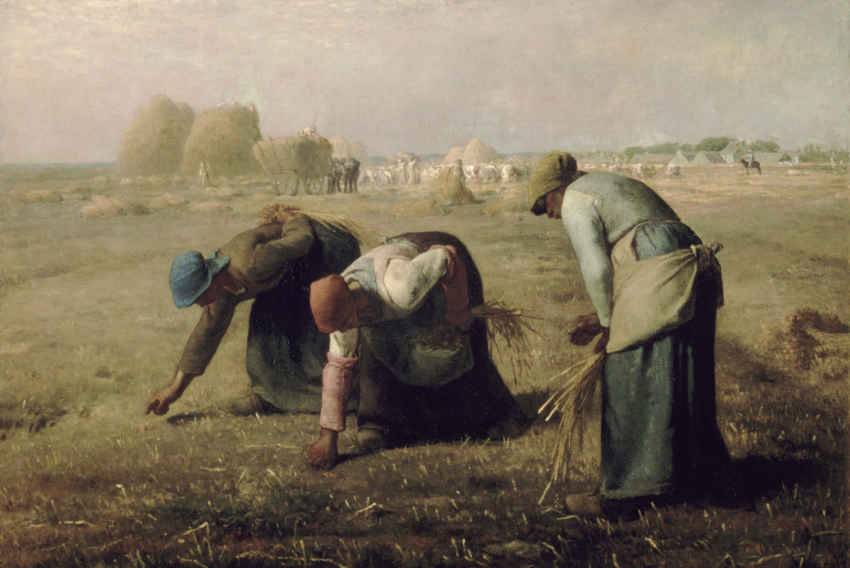
Jean-François Millet, Des glaneuses (The Gleaners), 1857. Public domain
There is a phrase to describe the first twelve weeks of human life: “the fourth trimester.” Some mammal babies slip out of their mother’s body wrapped in their own ghost, something between alive and not—a gaunt cloud, wetting the dust. A deluge of liquid and cramped muscle, sunset-colored. Within seconds, limbs flex and cohere, the spectral casing tears (sometimes licked off by a corrugated tongue), and suddenly, slowly, there is a new creature on earth. In comparison to our fellow animals, we humans are still virtually fetal for the first few months of our lives. Always born prematurely, we depend on the parent’s body for warmth, sustenance, or any significant relocation. Our flat bones still stray, like ancient continents shuffling across cranial oceans. At birth, we can’t even lift up our own heads. We can’t look around the room, let alone lollop alongside our herd, flock, pack, or pod.
This is the price humans paid for the ability to walk on two legs, although “price” implies some conscious trade. Really, it was more like this: a small bone moved, and many lived, and many died, and then another small bone moved, and so on. Deformations repeated themselves until what was once an aberration became the norm. According to one theory of our evolutionary development, when that big toe hardened and our feet were no longer hands, the pelvis and birth canal narrowed to keep us balanced as we stood upright. Our infant heads shrank to fit through this newer, smaller opening. We became born unready, into a state of urgent needfulness. Our little thumbs couldn’t even grasp our mothers’ hairy backs; we had to be wrapped up and carried like heavy, mottled gourds, like sizable eggplants that could also scream. Scream, and learn.
The need to be carried has been used to naturalize gendered divisions of labor throughout Western culture. False histories of early human life are everywhere, spread across high-school classrooms, university departments, bestseller lists, even the familiar shorthand of “caveman” behavior in cartoons and movies. Like a nebulous fog that obscures the road ahead, these impressions merge to create a hazy wall of so-called logic, disguising hard-edged exploitation: back then, someone needed to carry the baby, and it makes sense that it would have been the body that was also in charge of feeding the baby. And if the person’s hands were busy carrying, then naturally, those that weren’t busy in such a way should have been contributing to the well-being of the group in other ways, like through hunting, protecting, discovering, inventing, adventuring, ruling. This all sounds reasonable, practically magnanimous, even communal—from each according to their ability, et cetera.
This rearrangement, or rearticulation, has implications for storytelling at large.
Could this millennia-old system of domination really have germinated in a logistical problem of infant immobility? Is the battle of the sexes simply a matter of full versus idle hands? The story goes: before any concept of “home,” mothers stayed with the baby, while fathers roamed. The idea that the need to be carried would propel the full-handed carrier forward into creative thought, use of tools, and expansive, collaborative relationships with the world around her has not been incorporated into the conventional narrative of how our families work.
There is a different story to be told, but it must be cobbled together from bits and pieces, glimpsed in the interstices between different styles of imagining: the scientific and the literary. The verifiable reality of our ancestors’ lives as they were conducted five to eight million years ago is not my strict concern, for obvious reasons. (Eight million years from now, I doubt our day-to-day will be fully conceivable to whatever life-form is looking back at us.) Widening the scope of what our origins may have been, nudging the frame a little wider to let in versions of family and self that remain forcefully excluded, seems more important. This rearrangement, or rearticulation, has implications for storytelling at large. The human infant’s need to be carried has been mythologized as the downfall of an entire gender, an unfortunate but unavoidable hampering of freedom and movement. But what if it could be restaged as the first act of object-based problem-solving? What if the first human tool wasn’t a weapon of some kind—a bashing stick or a sharpened stone—but a bag, to keep one hand free for the baby and another for the world?
By broadening our speculative past, we can revalue dependency, neediness, and the feminized labor of care as generative rather than limiting. And not only generative on the personal or aesthetic level but also dynamically constructive on the level of civilization itself. This imaginative work is deeply literal, as in the work of the autodidactic feminist anthropologist Elizabeth Fisher; I’m talking about actual bags, actual babies, actual ways of moving around, noticing, carrying, wandering, and returning. But it is also metaphorical, as manifested by Ursula K. Le Guin and Oscar Wilde: a blueprint for how we move through our own senses of personhood and what we carry with us on those journeys.
in her 1979 book,Woman’s Creation: Sexual Evolution and the Shaping of Society, Elizabeth Fisher imagines backward, proposing a new account of human development that she calls “The Carrier Bag Theory of Evolution.” Her book, a fascinating synthesis of feminist evolutionary research, was nominated for a Pulitzer Prize that year, ironically losing to Edward O. Wilson’s On Human Nature, an opposing work of sociobiology. Wilson proposed that all social behavior has a biological root, developed through natural selection; this included “a genetic bias” toward women “stay[ing] at home.” He argued that even with equal educational and professional opportunities for all genders, men “are likely to continue to play a disproportionate role in political life, business, and science.”
Wilson remains lauded as our “modern-day Darwin.” These days, Fisher is all but forgotten; her Wikipedia page is short, her 1982 New York Times obituary even shorter. One gets the feeling that if she hadn’t died by suicide at fifty-seven, her death wouldn’t have made the news at all, despite the success of Woman’s Creation only three years earlier. The amnesia seems to have been almost immediate. Her name appeared briefly in The New York Times the year before her death—in a letter to the editor regarding a review of Nancy Makepeace Tanner’s On Becoming Human that called it “the first book to marshal evidence supporting the central role of gathering and females in human evolution.” The letter, sent from a fan, was simply to remind everyone of Fisher’s existence.
Before writing Woman’s Creation, Fisher was responsible for founding, in 1969, the magazine Aphra, which is considered the first feminist literary magazine in the United States. She edited it for seven years. The acknowledgments section in Woman’s Creation is a time capsule of a wonderfully specific moment in American feminism. She credits Aphra with creating the intellectual environment that allowed her to venture into the science of early human life with zero credentials or institutional backing—she relied on “the very real lift of women helping women.” In a favorite detail of mine, she thanks Gloria Dialectic, a self-named Oklahoma social worker, who “read and criticized and discussed.” (How could Ms. Dialectic do anything but!)
Such a large undertaking—perhaps the largest there is: a new history of humankind—was experienced by Fisher as both lightning bolt and slog. In an alarmingly relatable anecdote, she reminisces: “After one visionary night, I said to myself, ‘I’ve just rewritten Engels’ Origin of the Family, Private Property, and the State,’ which was patently untrue since at that moment I had written nothing.” It took her seven years, wading through the New York Public Library stacks and cross-referencing extant translations of ancient cuneiforms, but “later on it would be true and untrue.” Her approach was unfettered by scientific norms of both thought and style, proudly feelingful, crediting her lived experience as the source of hunches later backed with research. “There is no intelligence without feeling,” she writes. “In order to think you need to care. One may feel in negative, destructive ways, but hostile or positive, you cannot think without wanting to think, and that’s desire.”
So, it was handbags that produced the conditions for human intelligence.
In “The Carrier Bag Theory of Evolution,” what does Fisher desire when she thinks about beginnings? She tries to correct a fundamental misunderstanding, popularized in an assortment of works, such as Richard Lee and Irven DeVore’s collection Man the Hunter in 1968 and Robert Ardrey’s The Hunting Hypothesis in 1976. Fisher writes, “The previous explanation for human evolution gave hunting as the master behavior pattern for the human species.” In the practice of hunting, men learned to observe, problem-solve, and work together, and our advanced nervous system developed through this stimulation. Motivated by hunger, early hominids also studied animals and their habits, and felt the need to communicate subtle information to each other—“the elk are on the north side of the lake today”—precipitating experimentation in language.
Gendered labor aside, I need not linger on the deep shadow cast over us if all knowledge sprang from the wish to destroy other living things. Although this consensus has since been challenged within the field of evolutionary science, it remains widely accepted in mass culture. The fossil record has created bias toward the stone tool, often a weapon, making it hard to imagine any other potential technologies. But here, standing alone next to this ideological megalith, Fisher offers us one of the most wonderful sentences ever written: “Perhaps there is an alternative: I submit woman’s invention of the carrier bag as the take-off point for the quantum advance which created the multiplier effect that led to humanity.”
So, it was handbags that produced the conditions for human intelligence. You don’t have to tell me twice—I’ve literally never believed anything faster. Still, Fisher convinces, consolidating the thoughts of contemporaries such as Tanner, Sally Slocum, and Adrienne Zihlman, all of whom were publishing disruptions of ambered patriarchal analysis in archeology and anthropology through the 1970s. Her argument is simple: fossil evidence shows that most early hominids had vegetable-majority diets with a few protein-rich exceptions, handy and hearty, like nuts, seeds, shellfish, rodents, insects, and lizards. Our ancestors were nomadic; the earliest proof of permanently settled communities appears roughly twelve thousand years ago, which is recent. Human babies became unusually dependent on their parents as a step toward our current biological reality. What would prompt our transforming minds to fashion a new object from a found material? To alter the verdant consensus of our surroundings? Did we need a spear, a blade—for what? The pipe dream of killing an elephant?
No. What we needed was much more urgent. We required a flexible container, allowing us to roam, to hold on to what we encountered, every precious morsel from our explorations, and to carry our beloved, screaming eggplants alongside us. We needed to move around with our babies and keep our hands free.
To contribute to her fellow feminists’ political work of living with a different set of relations now, Fisher undertook the imaginative, almost literary, work of having started out differently, having had a new beginning then. Our brains learned, not from strategizing means of systematic death but from the “accumulation of botanical information,” the art of collecting, looking around, being with children, and sharing with one another. Language develops from this communal responsibility, unfolding sounds in time: “Mash these up while I go get some more” or “Wait a bit—the berries turn red and delicious when the days are longer.” Observations become intentions, projections, wonderings, fictions. Imagine the first made thing: a net sack, hooked over the elbow, brimming with closed oysters, like gray clouds clinking against each other, a synapse wedding song.
seven years later, in 1986, Ursula K. Le Guin, another feminist anthropologist but of mostly fictional worlds, wrote “The Carrier Bag Theory of Fiction,” which refashioned Fisher’s idea into a metaphor for storytelling. Le Guin’s essay has eclipsed Fisher’s work in the public consciousness. In an example of “the very real lift” Fisher describes in her acknowledgments, Le Guin writes that encountering Woman’s Creation made her feel “grounded,” offering her a narrative of early humanity that resonated with her ethical formation as a woman. If “elaborating upon” rudimentary killing devices was conceived as the primal and true origin of humankind, then that excluded most persons, including Le Guin. But, she continued,
if it is a human thing to do to put something you want, because it’s useful, edible, or beautiful, into a bag, or a basket, or a bit of rolled bark or leaf, or a net woven of your own hair, or what have you, and then take it home with you, home being another, larger kind of pouch or bag,…and then later on you take it out and eat it or share it or store it up,…if to do that is human, if that’s what it takes, then I am a human being after all. Fully, freely, gladly, for the first time.
I am struck by the quick associations here, the murmuration of commas, the potentialities that drift into her open-armed “or what have you.” The vagueness of what we have, a small gesture toward the inadequacy of language to proffer all options, the un-limits of our infinity-great-grandmother’s craft. A craft that answered to all the different ways humans need: the “useful, edible, or beautiful.” We cannot ever know what it was like hundreds of thousands of years before we were born, but we can imagine, we can even surmise, and we can feel grounded and understood by such gallivanting details. Human, yes, perhaps, us.
As a science-fiction writer, Le Guin might have been especially attuned to seeing the folkloric aspects of facts. She approached Fisher’s work as a new origin myth, having as much to do with mythmaking itself as it does with original life. Le Guin proposed a concept of “the killer story,” which follows the linear arc of a spear throw, whistling through the air from the hand of our (male) hero, culminating in mortal conflict. It ascends, strikes, wounds, and falls. It sounds familiar. You just heard it—the man-the-hunter account of evolution aligns with the killer story in both form and content. We were taught to write like this in school: inciting incident, rising action, climax, et cetera. But Le Guin followed Fisher in her turn toward a different pace and utility.
Perhaps, she writes, we might imagine narrative as a bag, a held collection of found objects that create roving juxtapositions as they jostle around from place to place. The ultimate found object is the word itself: we stumble across the means to communicate, toddle over to metaphor, pocket vocabulary for later use. “A novel is a medicine bundle,” Le Guin writes, “holding things in a particular, powerful relation to one another and to us.” The “life story,” then, is one that does not pierce but places beside—gathers rather than hunts. The bag contains, delimits, as a book does, but it is also expansive, almost magical in its pliancy—think Mary Poppins. The story stretches to carry home the fragments of experience.
Le Guin doesn’t say this, but the natural extension of her argument is that writing fiction could or should enable freedom of movement instead of monument building. “He needs a stage or a pedestal or a pinnacle,” she writes of the Hero who kills. “You put him in a bag and he looks like a rabbit, like a potato.” The pedestal is interesting because it is not merely intimidating, a stone made to elevate and distance its subject; it is, by nature, fixed in location. What is propped up there cannot stray. The potato, however, is made to be gleaned, expropriated, traveled with, and transformed. Le Guin’s line makes me think of another feminist anthropologist, Agnès Varda, and her film The Gleaners and I, in which she personally identifies with the scavenged potato—the excess of mechanized harvest—neither stolen nor bought but simply picked up, bagged, eaten, and enjoyed.
Le Guin focuses on what the writer puts inside her bag; she gathers narrative details like acorns. But there is a second language in the crafting of the early bag itself. Fisher describes large leaves folded together, damp and elastic bark, a broken ostrich egg. A decorative knot, a smartly angled snap. Maybe we did learn something from hunting—not our own but the starry traps and nests of other life-forms. Maybe we mimicked the bird’s diligent search for the right-size twig. Maybe we studied the blooming of a spiderweb, arduous and secretive in the warm, silver night. The first bag might be the first act of translation too.
Fisher’s hypothesis offered Le Guin a powerful metaphor for storytelling because it speaks not only to the prickly instincts we have about our largely obscure prehistory but also to the keen and muscular routines of contemporary life. Many of us are intuitively familiar with the hierarchy-less interior of a handbag: a nub of lip liner, inky cash, keys, medicine, mystery crumbs, a snack, a deck of accumulated identification, a leaking pen, all blindly grabbable from a cute, portable void. It is an admirable political, even spiritual, schema. It proposes ease of personal movement and the right to forage—simple ideas that contain much larger freedoms, the end of borders, prisons, and detainment, the flourishing of public space and resource—as the prerequisites for all other kinds of usefulness and beauty.
the transvaluation that fisher and Le Guin enact when they posit the handbag as a political artifact or a new architecture of narrative does not require solemn reverence. In more recent civilizations, handbags are also seen as the place where femininity’s secrets hide in plain view (never look in a woman’s purse…), which means they are objects that wink as well as roam. How might we supplement Le Guin’s theory to accommodate this aspect of bag carrying, the ribboned parcel of irony that perpetually accompanies certain self-presentations? We might turn to Oscar Wilde, another great thinker who, nearly a century before Fisher and Le Guin, proposed the handbag as a possible site of origin.
In The Importance of Being Earnest, which debuted three months before his incarceration for homosexuality in May 1895, Wilde disassembles paternity as the exclusive well from which we can draw a feeling of sourcefulness, the state of having a source. When it opened, the play was adored and dismissed for its profound frivolity, taken as an encapsulation of the era’s love of the unserious, the bratty, the girly, the witty. But the play is both that and truly classical in its comedy. Two friends, Jack and Algernon, both try to convince their crushes, Gwendolen and Cecily, to marry them by pretending to have the name Ernest, which the two women, unrelatedly and arbitrarily, require of their suitors; the false identities mushroom into increasing mishap. The Name-of-the-Father, to borrow Lacan’s term, is obscured, leaving the male characters unable to enter the symbolic order of highly classed social life, which in Wilde’s hands reveals the true silliness of the entire idea of fathers—their innate indeterminacy, their primary existence as speech acts.
Though the sociobiologists would have us believe in the father’s vital role as elephant hunter, biological dads are remarkably absent from this universe, evidently inessential, which is maybe the most relatable component of Wilde’s highfalutin, frippery-laden setting. One has siblings, cousins, uncles, grand-matriarchs, pretty women of eligible age, domestic servants, priests, adopted wards, social acquaintances, imaginary friends, and the constant companionship of wordplay, but never dads. This particular lack rings true for many. I mean, do you know anyone who has one—at hand?
Source becomes truly precarious when Jack, going by Ernest, is interviewed by Lady Bracknell after proposing to her daughter, Gwendolen. Jack reveals he has no relations and therefore no class position (although he certainly doesn’t lack money). In fact, he was not born but found. In a handbag, in a cloakroom at Victoria Station—“the Brighton line,” to be specific, a classic Wildean pun, replacing the liminal space for the biological lineage. Jack is without even the natal fixity of an infant discovered on a doorstep or church pew. The cloakroom of an urban train station is the quintessential scene of the lost item, untraceable, as everyone who passes through is, naturally, not at home.
“I was in a hand-bag—a somewhat large, black leather hand-bag, with handles to it—an ordinary hand-bag in fact,” Jack explains. The bag was mistakenly passed off to a wealthy gentleman, who named the baby Worthing, after the first-class ticket to Worthing in his pocket. (Interestingly, Worthing is the Sussex holiday town where Wilde wrote the play. Wilde might have had a used ticket to Worthing in his own pocket—the pocket, almost indistinguishable in function from a carrier bag, one must note—at the time of writing, or just before, exemplifying the foraged origins of fictional detail, and the wonky parentage of imagining people into existence. Wilde is, perhaps, the distinguished gentleman who was handed the infant-story by accident, during his travels.) Lady Bracknell responds, aghast: “To be born, or at any rate bred, in a hand-bag, whether it had handles or not, seems to me to display a contempt for the ordinary decencies of family life that remind one of the worst excesses of the French Revolution.”
Lady Bracknell’s dismay might have struck a chord with Wilde’s original audience: at the time, London was the biggest city in the world by far, with over five million residents, and anxiety about the itinerant worker, loosely tethered to a rented room, was still pervasive for the property-owning class. For that matter, the leather handbag, as carried by a woman during solo train travel, was a relatively new invention, described as an oddity in one 1841 story but becoming overwhelmingly popular by the 1890s; similar to the bicycle, it connoted the New Woman, free to whiz around or lug books or pack her things and hitch a ride out of her stifling small town. Perhaps Lady Bracknell seemed a touch less outlandish in her alarmed reference to radical family structures. The excesses of her aristocratic disparagement cloak a utopian possibility, however heavily Wilde ironizes it.
I see the stone tools of the written word, notched into history, and then I see the ghostly scrim of leaves made from women speaking.
Algernon describes families as “a sort of aggravated form of the public” in the same scene, but in Jack’s case, his family really is the entire public, the bustling crowd, embodied (or disembodied, perhaps) in the detritus of modern life: the banged-up bag abandoned in transit. Jack Worthing is nobody’s and therefore everybody’s baby, and London is the city as kin. The crowd is a kind of stretchy vessel in itself, picking up whatever it encounters, folding individuals into an unnamed intimacy. (Just as Lady Bracknell’s anxiety might have been felt by some of Wilde’s audience, one also imagines that for the gay subcultural networks that followed Wilde’s work, the feeling of being London’s son, rather than the heir to a heteronormative family structure, must have resonated.) The only other example of such circumstance that I can think of—another famous issue of parthenogenetic conception, an infant born and bred in temporary shelter during a period of rejection and transience, conspicuously unrelated to his amiable father but child of the entire world—well, Lady Bracknell would probably observe that he famously did not marry.
Lady Bracknell and the word handbag are now practically synonymous; a particular vocalization of the word by Dame Edith Evans—“A Haaaaaandbaaahg?”—is, according to critic Alastair Macaulay, “the most celebrated line-reading in theatrical history.” The claim Evans had on the role was sacrosanct, reprised many times: on stage between 1939 and 1942, on the radio, in the 1952 film, in a 1954 studio recording, and on television. Her reading of the line became a kind of camp object, diffused by mimicry throughout Britain. Dame Judi Dench and Dame Maggie Smith both whispered the line, as if in deference to the almighty utterance that preceded them. I grew up in the 1990s familiar with the word, said in that particular way, before encountering the play itself; Jerry Falwell’s homophobic response to Tinky Winky’s red handbag, in particular, was welcome fodder for Bracknell impressions. Lady Bracknell is not only a coveted role for character actresses; her glottal vibratos of high matriarchy are now often performed in drag. Rising imperiously, she glances over conventions of biological sex as negligible barriers between herself and her own flair for command, allowing those performing her to do the same. In his memoir, Come Back in September, Darryl Pinckney recalls W. H. Auden’s secondhand quip that “every actress wants to play Hamlet, just as every actor wants to play Lady Bracknell.”
When I imagine the fossil record of literary culture, I see the stone tools of the written word, notched into history, and then I see the ghostly scrim of leaves made from women speaking, the way individuals use those words. Nothing is quicker to decompose than a style. I mean a self-fashioned way of being, the passing gestures of the surveilled, the long-standing terrain and technologies of femininity, onstage or off. Wilde made that point well and often. And yet the echo undeniably lingers, bouncing off the far, flat surface of the official, printed past. As Le Guin writes, “It doesn’t come easily, thoughtlessly, to the lips as the killer story does; but still, ‘untold’ was an exaggeration. People have been telling the life story for ages, in all sorts of words and ways. Myths of creation and transformation, trickster stories, folktales, jokes, novels…” Evans folded a small echo into her version of Wilde’s word, an undulation tucked into two syllables, making “A handbag?” into a carrier bag of sound, stretched to transport her own humor and flamboyance.
the importance of being earnest ends with as many matrimonial engagements as possible, the same overabundance of closure that one associates with A Midsummer Night’s Dream or old MGM musicals. At first, this might sound consistent with the arc of the killer story, Cupid’s arrow hitting his target and then some. In fact, it’s the showy counterweight to the excessive identity mix-ups that constitute the narrative. Twinned figures crisscross intentions and assumptions, names are passed around like party hats, and the pursuit of a truer self through a false one is a recurring theme. It is almost as if Wilde’s story is so overly compliant with the killer-story structure that it becomes baggy by sheer magnitude. As everyone knows, if you follow the rules of patriarchal narrative too closely, you end up breaking them. In Earnest, almost every character has their foil, a “country” version, or an offstage (often imaginary) double, and families are disassembled and reassembled around these mirrored pairs at whim. Relatives are relative in the moral sense; they only exist from certain vantage points.
Lady Bracknell’s counterpart—another older woman, one with plenty of declarative aphorisms aimed at the younger generation—is Miss Prism, the unmarried governess of Jack’s household. The edges of the family are further smudged by the figure of the governess and her tangential yet requisite relationship to the reproduction of the upper classes. She is neither mother nor father but must often act a bit like both, creating a third zone of intimacy. This is similar to the avuncular or the aunt-ish, like Lady Bracknell, a.k.a. Aunt Augusta, but the governess blurs the boundaries to an even greater degree. She is both stranger and parent. This inside-outsideness is often depicted as almost magical in literature—we might again recall Mary Poppins—perhaps to veil the labor conditions that produce it in reality.
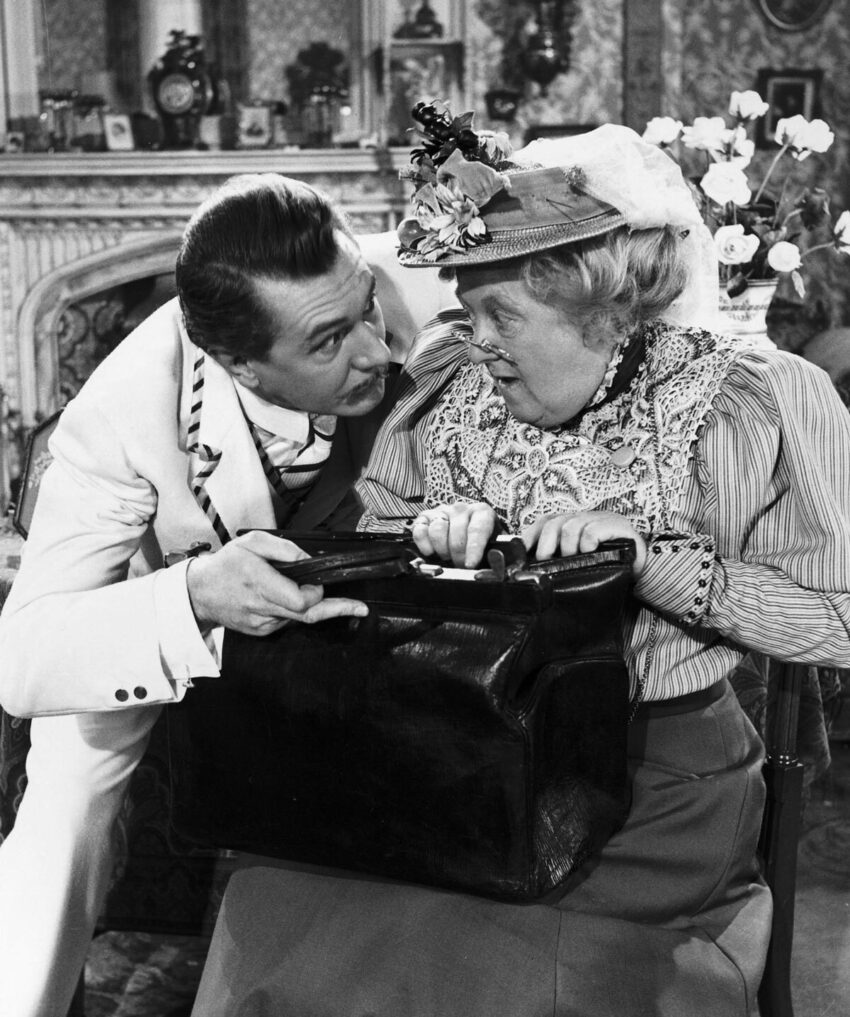
Michael Redgrave as Jack Worthing and Margaret Rutherford as Miss Prism in The Importance of Being Earnest, directed by Anthony Asquith in 1952.
Lady Bracknell accuses Miss Prism of an extreme form of this boundary-crossing: cruel and unusual dismantling of the family. “A female of repellant aspect, remotely connected to education,” Miss Prism is infamous in Lady Bracknell’s home for having lost a baby—literally misplaced one—decades before. Having departed for her daily walk with the infant in a pram, Miss Prism and the baby never returned. The pram, however, was located, and it held “the manuscript of a three-volume novel of more than usually revolting sentimentality.” Miss Prism confesses: “I had also with me a somewhat old, but capacious hand-bag in which I had intended to place the manuscript of a work of fiction that I had written during my few unoccupied hours. In a moment of mental abstraction, for which I never can forgive myself, I deposited the manuscript in the bassinette, and placed the baby in the hand-bag.” In other words, she mixed them up; they were indistinguishable to her, so much so that she laid the novel gently into the pram—swaddled, perhaps—as her true object of care.
The dyad of Lady Bracknell and Miss Prism dramatizes two sets of family values. Lady Bracknell, the sentinel at the gate of matrimony, guards the family line, whereas Miss Prism disrupts inheritance by mismanaging the output of her reproductive labor: nannying and novel-writing. Lady Bracknell represents the satirical height of heterosexual resolution—it turns out that Jack is a perfect candidate for Gwendolen because he is actually her cousin—contrasted with the feminine dissolution of Miss Prism, a literary spinster who can’t keep track of what a baby even is. The go-between is the strangely maternal object of the bag itself, which, when it is revealed and examined, verifies Jack’s relation to Lady Bracknell’s sister and allows him to marry into the family he was unknowingly already within.
Miss Prism’s dilemma might be read as that of all writers who escape the boundaries of masculinity, choosing between their draft and their (real or hypothetical) child. I am reminded that when I told my former analyst my ten-year plan—“Book, baby, book, baby”—he leaned back and said, “Did you make that up by your-self?” There is something oddly moving about Miss Prism’s switcheroo. Did the novel feel warm in her hands? Did it kick and wriggle? Did she hear the cries and murmurs from her handbag and find them fitting, appropriate to the truth of what she was writing, three volumes patched together in her “few unoccupied hours”?
I think that Wilde is perhaps offering us something slightly stranger than my made-up mantra: Book, baby, book, baby. For Miss Prism, the two words are not an either-or choice or an idealized consecutive sequence or even a muddle of priorities—they are equivalents. Two bundles of language that need to be carried. In a bag, they weigh the same, feel the same.
The cloakroom of history, or prehistory, is filled with everything we’ve lost along the way, all that’s neglected in the hustle and bustle of getting somewhere new. It is haunted by the disintegrated tools and technologies of early human life, craft to ash to soil, all the stories that were never written down, all the works of “more than usually revolting sentimentality” dreamed up by not-quite-mothers. Elizabeth Fisher posited that moving around with our babies is what helped us human beings create words, through women’s transformation of journeying, caretaking, and collecting into one simultaneous activity. Turning the raw material of nature into a surrogate limb or hand, she imagined, is what allowed the possibility of the surrogacy of language, the scattering of the inner world into externalized objects. The baby’s incontrovertible needs are the source of the book’s eventual existence. Ursula K. Le Guin proposed that this prehistoric legacy—our apparent desire to create a mutual reality and to further one another’s existence within it—is a good blueprint for novel-writing. The book and the baby can come with you as you move around. You can fill the story with things you find, odds and ends and what have you, and that can be enough. And Wilde questioned the staying still that we call the family by offering a story about a baby who was interchangeable with a book, born in a handbag, rooted to nothing but movement. Outside fixed place or paternity, kinship still appears, in ancient, unfamiliar shapes. There is no lack of selves or sentences in that realm, among the gatherers. You can fill a whole life with what you find there.
Audrey Wollen is a writer whose work has appeared in The New Yorker, The New York Review of Books, The New York Times, Bookforum, The Nation, and others.
Support Our Writers
A sustaining subscription provides vital, ongoing support for The Yale Review and the writers we publish—and includes new holiday merch.