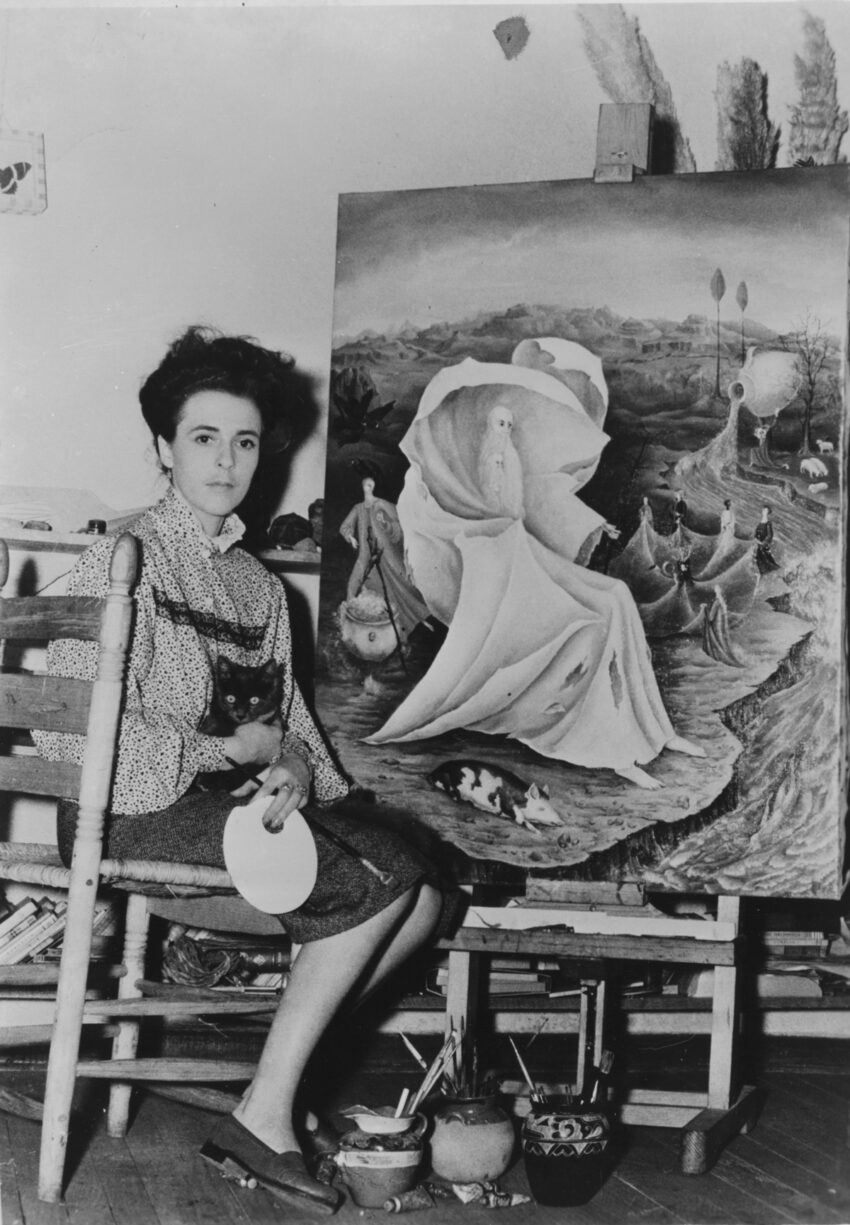
Leonora Carrington with her painting The Temptation of Saint Anthony, created for the Bel Ami International Art Competition, 1945. Digital Image Copyright The Museum of Modern Art. Licensed by SCALA / Art Resource, NY.
As an adolescent who spent most school lunch breaks on my own, counting the hours until I returned home, I always felt emboldened with my copy of Comte de Lautréamont’s Les chants de Maldoror under my arm. At my high school in Mexico City in the late eighties, few recognized the name or the title, which made it even more of a shield between me and the outside world. I also kept a little blue notebook, in my old bedroom drawer to this day, with “Notes on Lautréamont” inked on the cover. In it, I’d jot down every interesting detail I came across. On the first page, I open with “Words recurring in Maldoror.” Foul, ignominious, strophe, sinews, phenomenon. The force of these words, and their savagery, meant my shield was also my sword.
As for the man himself, whose real name was Isidore Lucien Ducasse, among the few facts I knew were that he suffered from migraines, hated Latin verse, and was pale, silent, and withdrawn. Very few photographs remain. “Je ne laisserai pas de Mémoires” (I shall leave no memoirs), he wrote in Poésies, leaving it to the rest of us to create our own, however fantastical, under the muffled contours of a sewing machine roped shut. Man Ray’s sculpture L’enigme d’Isidore Ducasse (1920) embodies the fierce mystery of its author, a thing we can only divine, inciting us to imagine what we would find were we to dare untie the twine and unwrap the thick fabric that shrouds the mysterious form underneath. The artwork alludes to Lautréamont’s line about the beauty of a chance encounter between an umbrella and a sewing machine on a dissecting table, but it is also a celebration of enigma itself.
I was drawn to the puzzle of the author and to his violent poetry, which seemed to carve open the unconscious, and to the moments of tenderness that undercut the violence and audacity, one of my favorite cantos that of the solitary hermaphrodite napping in their grove. But my attraction went further. I was drawn to the hybridity of the author. My own childhood had straddled different cultures and languages. I was the daughter of a Mexican poet and diplomat and an American mother, and had spent my childhood in Holland before moving to Mexico City at age eight. I suppose I identified with Ducasse in a distant spiritual way. As the son of a French consular officer in Uruguay, he had spent his early years in Montevideo before his father sent him to school in France. He must have maintained this aura from elsewhere, since his schoolmates at the lycée called him “le Montevidéen” and “le vampire.”
Never entirely one thing or another—isn’t that something the surrealist project embraced? Lautréamont was considered a godfather to the surrealists, many of whom emigrated from Europe to foreign lands with the outbreak of World War II, harboring the language and customs of their native countries while melding or shaping to those of the new. They became composite beings, like so many of the creatures they painted and drew.
In Carrington's presence, I was aware of the singularity of the person, and of how she was the survivor of an era—indeed, of a Europe—that no longer existed.
As teenagers in Mexico City, my sister and I saw our first Jean Cocteau films at the French Institute, and in a small arthouse cinema we lost our minds to Luis Buñuel and Salvador Dalí’s Un chien andalou—the slit eye, the hand crawling with ants, dead donkeys atop pianos being heaved across a living room. We read Juan Rulfo’s novel Pedro Páramo, forever described as spectral and surreal, and went to exhibitions of Manuel Álvarez Bravo, whose extraordinary photographs were a reminder of the startling and uncanny scenes all around us if we only looked closely enough.
The only time we ever saw our parents smoke was one day when we missed the school bus and arrived home early from a birthday party and surprised them at the dining room table, where they were sitting with a serious elderly couple. There were four ashtrays laid out, one in front of each person. Each ashtray held a lit cigarette (Gitanes, I later discovered). The guests introduced themselves: Jeanne and Luis Buñuel. We were horrified, thought our parents would die on the spot after smoking one cigarette, and ran up to our rooms. In retrospect, it seems appropriate that this bouleversement, a moment of existential confusion, was brought about by the iconoclastic filmmaker who set fire to every social convention. Had I been a few years older and already acquainted with his films, I certainly would not have run up to my room that day.
and while i rapturously devoured Lautréamont as an adolescent, I also regularly visited New York’s Museum of Modern Art and was particularly drawn to certain mise-en-scènes: Joseph Cornell’s constellations of objects speaking to each other in tiny closed universes, and Alberto Giacometti’s The Palace at 4 a.m.—those small figures, that unlikely space, a construction without walls or ceiling, assembled from slender sticks and string, everything suspended from the thread of a trembling coherence. I also loved Max Ernst’s collage-cum-sculpture Two Children Are Threatened by a Nightingale, a window onto a scene of dark enchantment, or its aftermath, most likely. At the Centre Pompidou in Paris, a city we often passed through when my father was invited to poetry festivals in Europe, I spent long whiles in front of André Breton’s wall of objects, brought back from his travels: masks, charms, and magical figures, many with a disquieting gaze. And yet I couldn’t help but notice that apart from Objet, Méret Oppenheim’s famous furred teacup (how quickly that fur would have soaked up all the tea!), nearly every surrealist work I saw was by a man. The anthologies of surrealist writing, too, had almost entirely male casts.
And then, in 1992, Leonora Carrington entered our lives, as though keeping a long-held appointment. I was visiting home from university when one Saturday, our family doctor—the wonderful Teodoro Césarman, whose patients included most of the writers and artists of the latter half of the twentieth century in Mexico City—invited us to lunch. Leonora was there too. We ended up talking from the moment we arrived till the moment we departed, and she told us to come for tea the following day. This ritual of Sunday tea would last until shortly before her death nearly twenty years later.
By the time I met Leonora, who had settled in Mexico in the early 1940s, she was often referred to as the last living surrealist. (She hated labels, and accepted this one begrudgingly.) Most of her greatest paintings hung in private collections, but I’d seen her mural The Magical World of the Maya upstairs in one of the ethnographic rooms at Mexico City’s Museum of Anthropology, and reproductions of other works in books. Over tea, whiskey, and cigarettes in her kitchen, she shared anecdotes from her past and meditations on the present, always asking my father for political gossip, then cutting him short when she began to feel disturbed. In her presence, I was aware of the singularity of the person, and of how she was the survivor of an era—indeed, of a Europe—that no longer existed. Not long after our first meeting, I continued my studies in England and later moved to Berlin, a city she still imagined in ruins.
For the few friends of mine in Europe who were familiar with Leonora’s name, her work risked being eclipsed by the facts of a sensational biography: the wealthy industrialist father and neo-Gothic home in Lancashire, a textile center in the northwest of England; the family ruptures; the romance with the much older Max Ernst (forty-six to her twenty), with whom Leonora spent nearly three idyllic years in a farmhouse in France before the Nazis took him prisoner; the infernal time that followed in the Spanish asylum where her family had her committed after she suffered a breakdown; the escape to New York (through a marriage of convenience with the Mexican writer and civil servant Renato Leduc); and the final flight to Mexico, where she would live out the rest of her days.
When I met Leonora, I had yet to read her 1970 essay “Female Human Animal,” in which she embraces the most basic taxonomy and insists on individual identity above womanhood, yet also reiterates how important it is for women to break free of patriarchal structures and biological categorization. Female human animal: she inhabited the world on these three terms. I now think back on this, and on the many things Leonora said to us then—for instance, that an artist should always leave a fingerprint, should be distinct, regardless of whether they are good or not. Many of the conceptual artists of the present, she felt, left none.
The year 2024 marks a century since the birth of the surrealist movement, or rather, one hundred years since Breton published his manifesto in 1924. The Pompidou, together with Bozar in Brussels, organized a vast retrospective, Imagine! 100 Years of International Surrealism, that will travel to Hamburg, Madrid, and Philadelphia over the next two years. There have been shows in Lausanne, Boston, Milan, London, and Stockholm, some collective and others centered around one artist, such as Dorothea Tanning, Man Ray, or Dora Maar.
Several exhibitions of Leonora’s work are in the offing too, in Europe, Mexico, and the United States. Since her death in the spring of 2011, I have watched her star ascend. And ascend. And ascend. It is remarkable how times have changed. This stratospheric rise can largely be attributed to her ecofeminist spirit, which, given our dystopian times, feels more relevant than ever, as well as to a resurging interest, especially among visual artists, in the esoteric and arcane. Between the first retrospective of her work, at London’s Serpentine Gallery in 1991–1992, and the Tate Liverpool show, which I guest-curated in 2015, she had scant presence in Britain. Now hardly a day goes by when someone does not mention her name to me. There’s at least one large exhibition a year and clusters of smaller ones, and her literary output has been steadily resurfacing too, with work that’d lain out of print for decades dusted off and republished.
This coming summer, 2025, The New York Review of Books will revive The Stone Door. Written in the early 1940s when Leonora had just moved to Mexico, it first came out in French in 1976 and then, a year later, in English. In the opening pages of this alternately exuberant and melancholy novel, we meet three scientist-mystics: an Asian man, a European, and a Jew, all gazing at the moon from their observatory. This sets the scene for a tale that reads like one of Leonora’s most populated paintings, teeming with references to religions, mythologies, and occult traditions, a crosshatching of symbols, moving backward and forward and sideways, at times dizzyingly so.
What does a door signify for an émigré who has fled, or decisively left, their homeland?
On a more personal level, the novel has been interpreted as a celebration of Leonora’s union with the Jewish Hungarian photographer Emérico Weisz, who fled the Holocaust and arrived in Mexico via Paris, where he’d been Robert Capa’s darkroom manager, and Morocco, where he obtained a visa. In the book, a Hungarian orphan dreams of a young girl and finally meets her in the flesh in a land called Mesopotamia, interpreted as an oneiric vision of Mexico, the place where dreams and reality merge. This character, named Zacharias, finds himself “in the land of the dead, on the wrong side of the great stone door.” Does a stone door open with a push or only with an abracadabra? Toward the end a stone key materializes, and then the stone door itself, “feebly lit by a large luminous egg,” but no keyhole. Zacharias produces a loud shriek with his pipe. The earth trembles as the door creaks open, only long enough for a stampede of five hundred mysterious white sheep to bound out before it is blown shut again by the wind.
Stone doors: portals, barriers, or guardians of knowledge?
i still vividly remember the coffee-brown door to Leonora’s house on Calle de Chihuahua in Mexico City’s Colonia Roma, and the number 194 that floated just above eye level. A few moments after we’d ring the bell, her face would appear from behind the door, at first opened only a crack, then fully. With horror and fascination, she would cast a glance at the wreckage across the street, at those collapsed concrete slabs, impromptu doors that were a permanent aftermath of the 1985 earthquake. And then, once she’d taken stock of the unchanging situation outside, she’d let us in.
Inside were more doors, not only to rooms but to bronze sculptures like Ing (which doubled as an oven) and Albino Hogg (a pig with long, slender legs), both of which had secret compartments. Remembering her house now, I think, too, of the paintings of her closest friend, the Spanish artist Remedios Varo, who invented dream-powered vehicles that steamed around like mental processes. Varo’s contraptions, which also had unusual doors in unusual places, possessed a convincing logic, bordering on the scientific, and looked like a cross between a child’s toy and an allegory.
What does a door signify for an émigré who has fled, or decisively left, their homeland? Leonora arrived in Mexico in 1942, riding the wave of European artists who had started arriving in the late 1930s, displaced by war. Once in Mexico, both she and Varo fell under the sway of its quotidian scenes, the spells and sorcery of the markets, the pre-Hispanic ruins in the center of town. Gérard de Nerval, who’d wandered the streets of Paris in search of a hidden magic and meaning in everything, would have been overwhelmed.
In 1938, Breton had visited Mexico on a cultural mission, but his foremost reason was to meet Leon Trotsky, who had fled Stalin’s Russia and was sequestered in his fortressed house in the Coyoacán neighborhood of Mexico City. The encounter was friendly: they met, went on a five-day excursion to Lake Pátzcuaro in the state of Michoacán, where they disagreed about the nature of dogs (Trotsky loved them, Breton didn’t), and drew up a “Manifesto for Independent Revolutionary Art,” cosigned by Diego Rivera. Upon returning to Paris after four months in Mexico, Breton dedicated the final 1939 issue of the surrealist journal Minotaure to the art and artisanry he had encountered in this place where “reality had surpassed the splendor already promised by dreams.”
Two years earlier, Antonin Artaud had sailed to Mexico too, via Antwerp and Havana. It was not an easy voyage: he was suffering from morphine withdrawal, excommunication from the surrealist fold (thanks to Breton), and profound disillusionment with European civilization. After several unsettled months in Mexico City, he headed to the Sierra Madre, the sacred mountains of the Tarahumara. (The Tarahumara call themselves Rarámuri, meaning “swift of foot.”) Drawn to their ceremonies and to the hermaphroditic roots of the peyote plant, he claimed to partake in their dances and rituals and was convinced he was witnessing, to borrow from his manifesto of the 1930s, a “theatre of cruelty.” He returned to France in a state of euphoria. Years later, from his room in the Rodez mental asylum, he wrote A Voyage to the Land of the Tarahumara, and blamed the peyote’s lingering hex for his madness.
After visiting Mexico, Breton famously called it the “most surrealist country in the world.” Dalí said he couldn’t bear to be in a country that was more surrealist than his paintings. In addition to the allure of the marvelous, Mexico’s president, Lázaro Cárdenas, opened the doors to political refugees, granting citizenship and asylum to many who were fleeing Nazis and Franco’s Spain. Leonora and “Chiki,” as Weisz was affectionately called, became part of a group of exiles that included Remedios Varo and her husband Benjamin Péret, Luis Buñuel, Alice Rahon, Wolfgang Paalen, Kati Horna, and their patron Edward James, who built himself a towering surrealist folly in the subtropical rainforest of San Luis Potosí. They were distanced from the infighting that had begun to plague the movement back in France; here was a respite from the political sabotage and excommunications.
In Leonora’s painting The Artist Traveling Incognito (1949), in which a wigged artist travels with cat, parrot, and crystal ball, she is explicit in her insistence on the notion of different selves and of endless reinvention (it’s also, perhaps, a satire on the self-importance of many of her peers). Identity is a slippery, elusive concept, forever subject to change. One of the most seductive tenets of the surrealist vision is precisely this defense of indeterminacy, a dismissal of categories and a refusal to reduce meaning to only one thing. The émigrés were all hybrid creatures of a sort, in a country that already displayed bewildering forms of creative hybridity, with a fecund syncretism of the Old World and the New, Spanish influence and Indigenous, dynamic collisions that gave birth to a whole new kind of art; Mexican baroque had been fueled by this unrest, an unrest that freed things from their aesthetic confines.
In Mexico, Leonora met Pierre Mabille, whose book Le miroir du merveilleux (1940), a compilation of magical folk traditions, which set out to prove that the marvelous could be found everywhere, had become a surrealist bible. Mabille was not only a writer but a surgeon and sociologist, and it was he who encouraged Leonora to write about her experience in a Spanish mental asylum after being pronounced “incurably insane” by both Spanish doctors and the British consul. Inspired by Mabille’s belief that a person should not repress anything, Leonora wrote her memoir, Down Below, in a four-day sleep-deprived tempest, describing in searing detail the horrors of shock therapy, Cardiazol used to induce the convulsions, and the way the doctors wrecked her mind. Dictated in French in 1942, it was translated into English a few years later.
Nearly five decades afterward, the psychiatrist who treated her wrote a report in which he questioned her “madness.” Even as a patient Leonora insisted on her surrealism, he said, and on more primitive and magical modes of thinking (a “lucid madness” not entirely different from Artaud’s). He concluded with these words: “In 1941, Leonora healed by adapting to the society of that time. Her mission was accomplished.” Artistically, it was just beginning. A few years later, in the catalogue for an early exhibition, she included the caption: “I am armed with madness for a long voyage.”
Maurice Blanchot said surrealism was a state of mind.
when reading leonora’s short stories, which number over two dozen, I am constantly reminded of how in her universe freedom is prized above all else, a freedom from constraints—social, cultural, psychological. Escape is the only salvation, whether you are an émigré fleeing a war-ravaged country, a wild animal being hunted in a forest, or an individual suffocated by convention. “Il faut créer une geographie personnelle” (One must create a personal geography) is a line of hers I return to often, as I imagine a terrain mapped by interior travels and adventures in which all borders and credentials are immaterial, an identity forged by instinct rather than constructed.
In Leonora’s writing, it is the feral spirit that prevails, and the only humans worthy of empathy are those who reject social norms and surrender to their primal nature.
“If the old woman can’t go to Lapland, then Lapland must come to the Old Woman” are the closing words of The Hearing Trumpet, originally published in 1974 and reissued by NYRB Classics in 2021. (In 2009, when Leonora was ninety-two years old, my mother asked her whether there was any place she would still like to travel to. “Lapland,” she unhesitatingly replied.) It is a novel driven by the ebullience of one Marian Weatherby, a defiant ninety-two-year-old possessor of a hearing trumpet that permits her to listen in on many an incriminating conversation. The Hearing Trumpet is a kind of cri de coeur, Leonora’s own manifesto against the destruction of the natural world, against social oppression and oppressive institutions, and against the treatment, indeed castigation, of women in old age. Here, as in many of her paintings, certain domestic activities, such as the stirring of a cauldron or the knitting of a sweater (using cat fur), function as portals to another world and allow the women moments of change and rebellion; in Leonora’s universe, the domestic and the fantastical are inextricable, a commonplace ritual often invoking more outlandish ones, convention subverted by otherworldly urges.
In her writing, it is the feral spirit that prevails, and the only humans worthy of empathy are those who reject social norms and surrender to their primal nature. Leonora embraced the pre-Hispanic belief in the nahual, or animal double. The animal kingdom—real, mythological, hybrid—was of utmost importance to her during her seventy-year career, for she considered humans the worst animals of all and lamented our arrogance on this earth.
the reason leonora liked reading detective stories, she once told us, was because they help you find the enemy within. A fictional character beloved by the surrealists was Fantômas, a notorious criminal who constantly changed guises, so popular he migrated from crime fiction to comic books, television, and film. This enticing concept of transformation, always giving the slip to presupposed ideas and authority, freights much more sinister echoes in our drug cartels, or even on the Island of the Dolls in the canals of Xochimilico, where Hans Bellmer-esque dolls dangle from trees. But it also appears more jocularly in our masked wrestlers, who vault through the air and pound the floor at the Arena México.
Leonora’s work remained strikingly different from that of the celebrated Mexican artists of her time. Less ideological than Diego Rivera’s murals, less intimate or lacerating than Frida Kahlo’s self-portraits. Her paintings continued to feature a more Renaissance architecture, and more European landscapes: flatter, less volcanic. In Mexico, what beckoned most was not the country’s folklore but its ancient civilizations.
Often when I go down to the Zócalo, Mexico City’s historic center and home to the cathedral, the presidential palace, and the Templo Mayor (the Aztecs’ great temple, forever under excavation), I pass a male Frida Kahlo impersonator sitting in a chair painting self-portraits. A few streets later, past shops with unusual juxtapositions in their windows (a shoe, a wig, a cigarette holder, a sequin star, like a deconstructed portrait or a Cornell box), there’s a row of shamans outside the cathedral giving limpias, offering to cleanse anyone’s soul for two hundred pesos. Aging organ grinders crank out their tunes nearby. I sense an unspoken continuum between everything, impossible to put into words. Many Mexicans shrug off Breton’s declaration. Is our country unwittingly, intrinsically “surrealist”? Or are we one of many ex-colonial countries where modernity emerged unevenly alongside older, more archaic forms, leading to the unruly and the unexpected? And yet I can’t help feeling there’s something particular about the Mexican imagination, and what it does with all this layering.
In a passionate essay from 1949, the Cuban writer Alejo Carpentier takes issue with the surrealist romance of Latin America. He argues that its projections usually did not take into account the history, politics, or geography of a place, and that what the surrealists considered marvelous was something inherent in the reality rather than a reality consciously subverted. “The result of willing the marvelous or any other trance,” he writes, “is that the dream technicians become bureaucrats.”
what, exactly, is surrealism then? Looking back on my adolescence and the moments of astonishment I so often experienced, it still feels like the freest of spaces, the most unshackled, a space of surrender thrown wide open, while always respecting the closed door. There’s that constant attunement to the mysterious, met by a desire to keep every enigma intact, and an ongoing dialogue, forever changing, with those writers and artists who, from early on, inspired us to pay attention to the spontaneous and uncensored and unthinkable. To those distant whispers and incantations. And a resistance to authority, however shifting and amorphous this authority may be. A quiet, continuous revolution, call it madness, a creative madness hitched to a will to disrupt. As you grow older, it all risks being subdued, a fading echo of a younger and more daring self.
Ouvre-toi, Porte de Pierre. Open, Door of Stone. The French translation of The Stone Door ends with these words. Yet the English version, published a year later, does not. Leonora apparently recanted this final abracadabra. No longer commanded to open, the stone door will remain closed, and forever preserve its mystery.