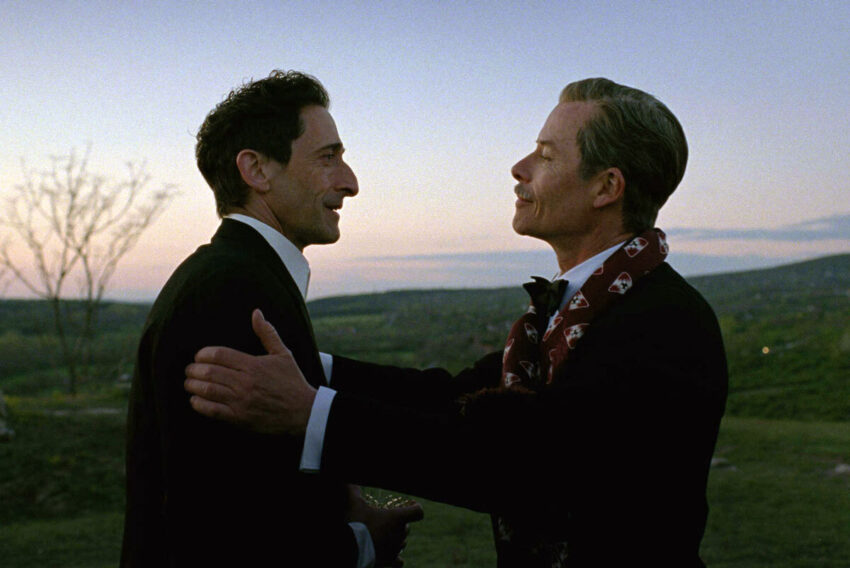
I hate to break it to my friends and colleagues in the very small world of architecture criticism, many of whom have spent the last month cataloguing the ways Brady Corbet’s film The Brutalist misrepresents the process of designing and constructing buildings, but this stem-winder of a Best Picture contender is not really about architecture. I’d argue, for starters, that the film’s title refers not to László Tóth (Adrien Brody), the Bauhaus-trained Hungarian émigré architect who serves as the film’s protagonist, but rather to Harrison Lee Van Buren (Guy Pearce), the industrialist who hires Tóth to design a mammoth community center on a hilltop outside Philadelphia before exploiting him professionally and personally. Tóth survives Buchenwald only to suffer a second trauma at the hands of Van Buren—and, ultimately, at the hands of capitalism and Cold War America.
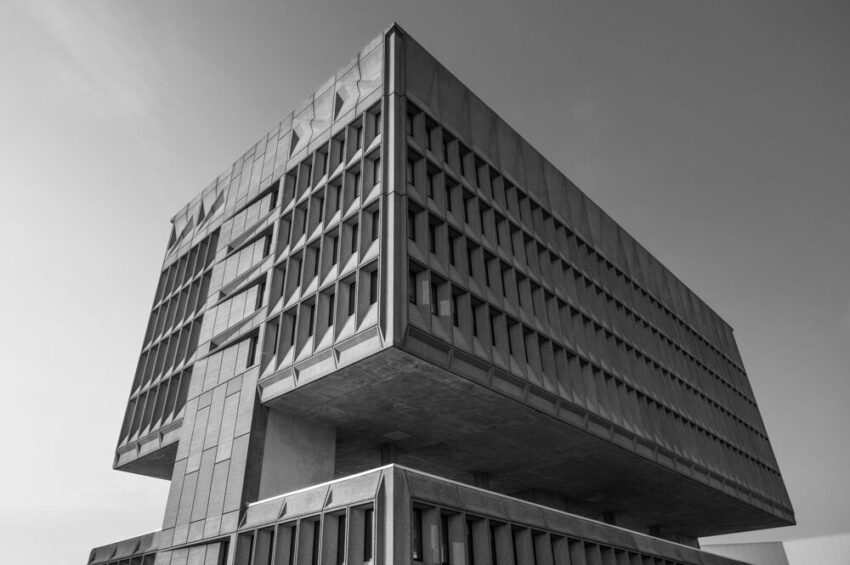
Architecture is, to be sure, central to the film’s narrative. Tóth himself is modeled on, among other figures, the Hungarian architect Marcel Breuer, whose career traced a similar arc: Breuer trained at the Bauhaus and made youthful experiments in tubular-steel furniture design and International Style modernism before arriving in the United States in advance of World War II and turning to hulking postwar expressions of High Brutalism. These include, most famously, the old Whitney Museum on Manhattan’s Upper East Side, a sublime, standoffish chunk of dark granite and concrete shaped like an upside-down ziggurat, and—for those of us who live in New Haven—the Pirelli Tire headquarters overlooking I-95 (now handsomely, if somewhat antiseptically, restored as the Hotel Marcel) or Yale’s forbidding Becton Engineering and Applied Science Center. The building Tóth designs in the film is a textbook example of the Brutalist style, which rose in the 1950s. Characterized by monochromatic expanses of unpainted concrete and what the architectural historian Reyner Banham memorably called “an abstemious under-designing of the details,” Brutalism derived its name not from the adjective brutal but from the French term le béton brut, or “raw concrete.”
The film’s storyline props up the questionable notion of the architect as lone (and typically male) genius, a trope that many of us have spent years trying to bury for good. It also makes Tóth oddly naive about his own field: every threat he rails against, from the arrival of a consulting architect brought in to cut costs to maddening delays to the construction schedule, is of a type deeply familiar and even predictable to a practicing architect, especially one with the extensive prewar European track record the script gives Tóth. In fact, it is usually wealthy patrons such as Van Buren who hold inflexible romantic notions about how architecture works. Instead, the movie asks us to believe that Tóth, by the time he arrives in America, has built some remarkable buildings but has never had a client. The film’s depiction of the architect’s working process can also be tone-deaf, or at least exaggerated for effect. At one point, Tóth builds a ridiculously oversize model of the community center that he and his associates carry around with them like pallbearers, though it’s made of cardboard, paper, and glue.
This helps explain why architecture critics have lambasted the movie as cliché, even as film critics have almost universally lauded it (The Guardian: “Backlash Builds: Why the Architecture World Hates The Brutalist”). For them, it is little more than a warmed-over, twenty-first-century version of The Fountainhead—both the 1943 Ayn Rand novel and the 1949 film adaptation, with Gary Cooper and Patricia Neal. These criticisms are not inaccurate. But they are also, in some sense, beside the point. What Corbet and Mona Fastvold, his writing partner, have created is not a modernist film about modernist architecture but a supersize Hollywood epic (with a dash of Trumpian family parable) about the conflict between an alienated immigrant visionary determined to upend aesthetic convention—and bourgeois expectation—and a complicated, hyper-rich antihero with high-minded pretensions of his own. Formally, the film is traditional and nostalgic, even classical. It begins with an overture (an excellent score by the young British composer Daniel Blumberg) and alerts the audience to this fact by stamping the word overture on the screen. A first act, intermission, second act, and (clunky) epilogue, all of them similarly declared, follow. The acting—Pearce’s especially—is intentionally exaggerated, the vowels plummy in the manner of 1940s films, often to remarkable effect. Corbet and Fastvold use architecture as a medium for, and sometimes as a cinematic battering ram to deliver, insights on the immigrant experience, poverty, xenophobia, drug addiction, and antisemitism. But, ultimately, all the stuff about the transporting beauty of unadorned concrete—all the stuff about design and style, on the whole—turns out to be a MacGuffin. The real theme is America the Brutal. And this allows the film, despite its many flaws, to meet our moment, or at least come admirably close.
Over two viewings, I warmed to The Brutalist much the way museumgoers warmed to the unpretty eccentricities of the old Whitney. Something snapped into place for me when I realized the movie’s most meaningful moments have nothing to do with the practice of architecture, with the Brutalist style, or even with the way wealthy clients and patrons exploit artists. Instead, it comes alive when it puts two kinds of vanity—of American exceptionalism and of obscenely rich men—in its crosshairs. Tóth reflects Breuer and architects like him but also notoriously stubborn perfectionists like Steve Jobs. Van Buren is a stand-in for Charles Foster Kane, Andrew Carnegie, Jay Gatsby, J. P. Morgan, Elon Musk, and the L.A. billionaire Nicolas Berggruen, who is also tilting at windmills by commissioning an austere multiuse “contemplative campus” on a hilltop, this one not far from the Getty Center and designed by the Swiss firm Herzog & de Meuron. (The project has yet to break ground.) The Brutalist suggests that architects represent, for men like these, a kind of freedom—or integrity—that the pursuit of conventional success has foreclosed in their own lives.
The movie also captures America’s relationship with immigration, as a place that has depended on the labor (and genius) of immigrants but often also despised them. The film breaks here with historical verisimilitude for effect: after arriving in the United States, Tóth takes a job designing furniture at a Philadelphia shop owned by his cousin Attila (Alessandro Nivola) rather than finding work at a university or an architecture firm, as so many Bauhaus graduates fleeing the Nazis, including Breuer, managed to do. But it works. The script’s most important speech comes when Tóth, riding in a car with his wife, spits out a complaint about their experience in America: “The people here, they don’t want us here. We are nothing. Worse than nothing!” And the most compelling shots come during the chaotic opening sequence, when the audience has no idea what Tóth does for a living—when he is simply a newly arrived migrant surrounded by others in the same literal boat. When Tóth emerges from the hold to glimpse the Statue of Liberty for the first time, Corbet and his cinematographer, Lol Crawley, arrange the shot so that the statue enters the frame upside down and sideways.
I believe this is known as foreshadowing. Even if the artist and filmmaker Steve McQueen has made this visual point already, and more powerfully, in his wordless, seven-minute 2009 video installation, Static, which shows the Statue of Liberty from a circling helicopter, revealing rivulets of dirt and grime in the folds of her gown, this version is plenty effective too. In the end, the flaws of The Brutalist mostly have to do with excess ambition, as measured against scattershot execution (and maybe its budget, too, which the film strains to the absolute limit). But its enemies are the right ones—not just for the 1950s but for 2025—and its indictments of them frequently sharp enough to break the skin.