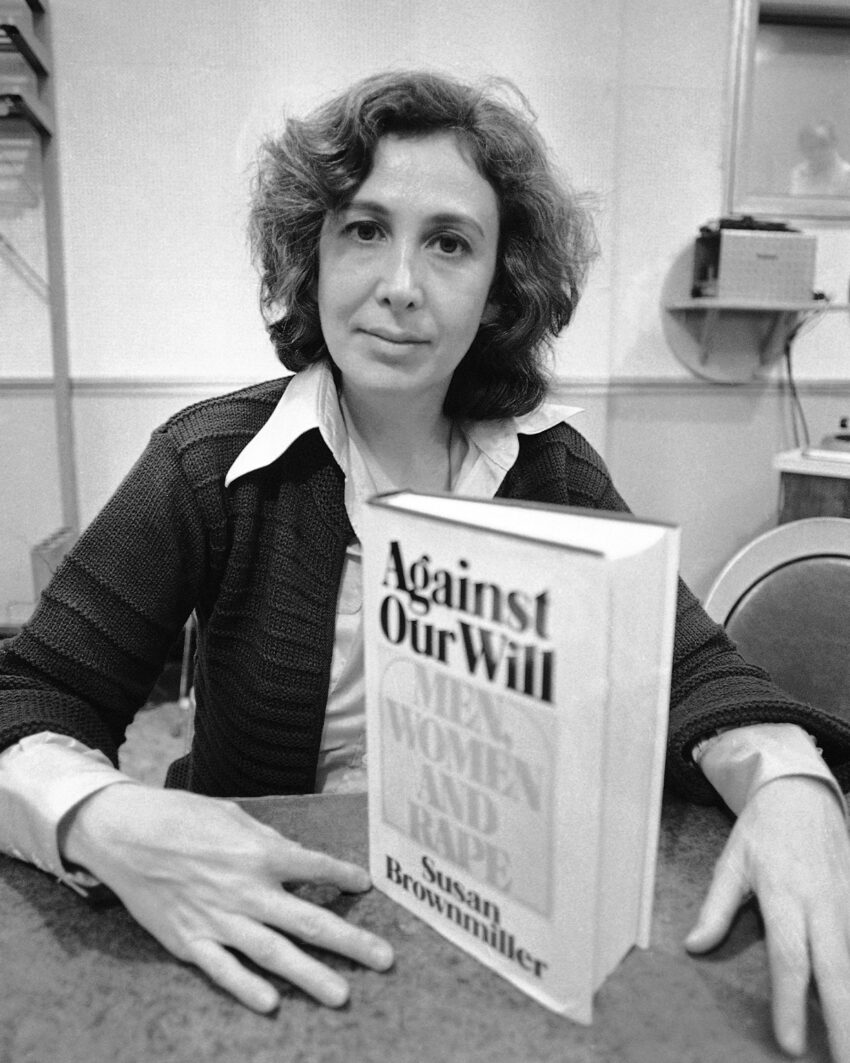
Susan Brownmiller’s Against Our Will: Men, Women and Rape became a bestseller shortly after it was published in the fall of 1975. Suzanne Vlamis / Associated Press
fifty years ago this fall, Susan Brownmiller’s Against Our Will: Men, Women and Rapehit bookstores across the United States. Her radical feminist argument—that rape is “a conscious process of intimidation by which all men keep all women in a state of fear”—was electrifying; it remains one of the best-remembered phrases to emerge from second-wave feminism. By mid-November, the book had become a bestseller, and it is still in print today.
Brownmiller, who died in May, wrote Against Our Will
to incite controversy. And it did, although not always in ways she predicted. Rape had an outsize cultural presence in 1975, one that, as Brownmiller argued, obscured the ubiquitousness of the crime. It was the basis of false charges against Black men that triggered a wave of lynchings in the century after emancipation; it was a weapon of war; it appeared plastered across the front pages as a sensational crime; or it was portrayed in pornography, and modern literature, as a shared fantasy between men and women. But outside these contexts, most rapes were not reported or even spoken of. Apart from criminologists and psychologists, who classed it as deviant behavior comparable to “exhibitionism (their hands-down favorite!), homosexuality, prostitution, pyromania and even oral intercourse,” as Brownmiller wrote, hardly anyone understood rape as worthy of study.
brownmiller’s journey to writing about rape began in the fall of 1970. At the time, she was a freelance journalist for The New York Times and TheVillage Voice, as well as a member of New York Radical Feminists (NYRF). A lifelong New Yorker and former television news writer, she lived and worked in a one-bedroom apartment in a new high-rise in the West Village. On Thursday nights, she would join sometimes as many as fifty women in an East Village office for consciousness-raising sessions, windows thrown open, regardless of weather, to let clouds of cigarette smoke escape. In Brownmiller’s telling, a member showed up one evening, threw down a copy of It Ain’t Me, Babe, a Bay Area alternative newspaper, and insisted that the group discuss a front-page article. A woman had hitched a ride to attend her first women’s liberation meeting, and as Brownmiller explained in 2017, “The guy in the truck raped her and, well, she turned around and went home. She had a boyfriend. The boyfriend said, ‘So, did you like it?’”
In Against Our Will, Brownmiller claimed to have been dumbfounded and skeptical when she read the story. She said she had no experience with rape (as “neither rapist nor rapee,” as one reviewer put it) and had to be persuaded that sexual assault was a feminist issue—something that seems counterintuitive fifty years later. Brownmiller’s background in a male-dominated Old Left had miseducated her to believe that rape was rare, and that it typically consisted of false claims made by white women against Black men—a lie that provided a calculated excuse for political terror. Sprawled throughout her apartment, the group of women went around a circle and confessed that they, too, had been raped. One sister had been gang-raped, also while hitchhiking. “When she reported it,” Brownmiller recalled, “the cops said to her, ‘Oh, who’d want to rape a nice girl like you?’”
After NYRF organized a speak-out and a conference on rape in 1971, the group issued a manifesto that redefined the crime as a feminist priority. Sexual assault took many forms; it was not “a personal misfortune but an experience shared by all women in one form or another.” It was a “political matter” and “the logical expression of the essential relationship now existing between men and women.” Brownmiller, later (and perhaps rightly) accused by group members of appropriating thoughts that did not belong to her, seized the moment and ran with it. That fall, she pitched the idea for Against Our Will to agent Wendy Weil, who sold it to a major publisher. Brownmiller couldn’t know that anyone would want to read the book, yet it was an undeniably fresh idea. She invested almost four years of her life in research and writing, initially financing the work with a few small grants. When those ran out, Brownmiller returned to freelancing, working on the book in the evenings after she had filed her stories.
The book was deeply researched and accessibly written, but much of its success was due to timing.
Brownmiller blew through her first book deadline, and desperate for money, she borrowed from a friend to finish the manuscript. Then she worked her connections as a journalist to sell the book. Against Our Will was reviewed by The New York Times twice in one week—first by Mary Ellen Gale on the front page of The New York Times Book Review, then by Christopher Lehmann-Haupt in the daily paper. Gale called the book “chilling,” “monumental,” “informed and compelling.” Lehmann-Haupt praised Against Our Will’s “facts, the statistics, the careful analysis” but seemed baffled by its conclusions. “What, aside from the fact that most perpetrators of rape are male (though their victims are not necessarily female) does rape really have to do with women's liberation?” Lehmann-Haupt grumbled. “One might as plausibly wage war on murder under the banner of human liberation.” Yet, to be fair, other men understood the significance and power of Brownmiller’s thinking. Time magazine would name her, along with eleven other women, 1975’s “Man of the Year.”
Following the success of Against Our Will, Brownmiller paid back her friend—with interest—and joined the ranks of commercially successful feminist authors: Kate Millett, Toni Morrison, Gloria Steinem, Toni Cade Bambara, Shulamith Firestone, Germaine Greer, Robin Morgan, and Alix Kates Shulman. Royalties from Against Our Will provided the only financial stability Brownmiller ever enjoyed. For two decades, she was able to live well, finance her activist projects (including a controversial war on pornography), travel, write five more books, and escape the vagaries of a freelance life. Although she had other bestsellers, she never replicated this success. “I’m very proud” of Against Our Will, she said ruefully in a 2017 interview. “But I also knew I’d peaked at the age of forty.”
she was right. The book was deeply researched and accessibly written, but much of its success was due to timing, as radical feminism’s novel intellectual interventions became court cases, laws, and policies. By 1975, liberal feminism had seized on reforms that Brownmiller and other radical women had proposed. Feminist politicians like Shirley Chisholm relaunched an Equal Rights Amendment that had languished in Congress since 1923. The ACLU’s Ruth Bader Ginsburg sued to establish “gender equality,” sometimes bringing feminist lawsuits with male plaintiffs. Against Our Will provided the larger narrative for these struggles—that women’s rights were human rights. One of those human rights was not to be routinely subjected to sexual assault, but another was for women to be listened to when they reported rape. Later in life, Brownmiller rejected the wholesale call to “believe women” no matter what, but Against Our Will made rape visible in places where it had previously been ignored or seen as a consequence of female hysteria or sheer carelessness—institutions like family, church, marriage, and prison, as well as casual encounters like dating and hitchhiking.
Its success also came amid a publishing boom in which editors, agents, and major publishing houses privileged new voices. It meant that agents like Weil, then at the Julian Bach Literary Agency, could build freestanding agencies to serve feminists like Brownmiller, June Jordan, Letty Cottin Pogrebin, and Jane Lazarre, who offered a general audience access to a counterculture upending old hierarchies.
Her achievement also stood on the shoulders of a new genre: New Journalism—narrative nonfiction that eschewed objectivity and allowed writers’ voices and experiences to enter the story. Brownmiller was not a New Journalist, but she had freelanced for publications where these writers congregated, including The Village Voice and Esquire. The book is full of “I” statements and references to her own experiences. One is particularly important. At the very beginning of Against Our Will, “A Personal Statement” about her path from ignorance to knowledge offers an intimate reveal. Brownmiller had never been raped but “may have been shortchanged here and there.” It’s a cheeky reference to orgasm that doesn’t land well in the #MeToo era, but in 1975, it established Brownmiller as a sophisticated sexual woman in the tradition of Cosmopolitan’s Helen Gurley Brown.
against our will was always an imperfect book, and its flaws are even more obvious fifty years on. Brownmiller drew lessons from her research and her ideological about-face that were simply wrong. Among them was a section on the lynching of Emmett Till that drew condemnation from Black feminists at the time. Brownmiller proposed that readers consider Carolyn Bryant’s perspective when she accused Emmett Till of the “wolf-whistle” that eventually precipitated the young man’s murder. An eagerness to prove a theory resulted in Brownmiller overlooking something she also knew but had displaced: White women did lie. We know definitively that Bryant lied, and covered for Till’s killers, for decades.
Her attempt to demystify assumptions on the left that rape accusations were not always political falsehoods against Black men blew up in her face, since it also reaffirmed racist stereotypes that white women were not wrong to fear Black men. More recently, Brownmiller’s assertion that penises are a weapon that all men would use if given the chance, a broadly held view among radical feminists and lesbian separatists in the 1970s, has today evolved into a dishonest attack on transgender women promoted by various culture warriors and policymakers.
Brownmiller’s analysis also suffered from her own contradictions: she was a complex sexual person who presented herself as straight, a woman who valued sexual freedom but within the limits of conventional femininity. Sections of the book on prostitution, homosexuality, and pornography are borderline prudish and to a contemporary reader, sometimes cruel. In a chapter on prison rape, Brownmiller asks if participating in leather culture, sadomasochism, and transgender presentation should be accepted “as a civil-libertarian right” or “an aberration masquerading as the newest issue.” At the time, such sentiments put Brownmiller and other radical feminists squarely at odds with the gay and sexual liberation movements. Now, they would not be seen as feminist at all.
for all its flaws, though, Against Our Will had material impacts in the real world. That doesn’t mean, of course, that it ended rape. But as Brownmiller had hoped, the book did change minds. Against Our Will persuaded thousands of men and women to care, to create resources, to gather statistics, and to train police forces and prosecutors to take rape seriously. As a result, we, as a society, see rape more clearly today than we did in 1975. Victims are more likely to recognize coerced sex as a crime, more likely to report rape, and more (although not entirely) likely to be believed. We know that men and children are raped, and that the perpetrators are most frequently not strangers but people known, and sometimes related, to victims.
But the stigma and shame of rape remain intransigent. Research collated by the National Sexual Violence Resource Center (NSVRC) estimates that, in any given year, as many as 60 percent of rapes and attempted rapes go unreported, and that one in five women experience such assaults during their lifetimes (a third as children or teenagers and 90 percent from intimate partners or acquaintances).
The book also represented a larger rebuke of a society that rendered women, and the violence used to keep them in check, invisible.
Rape not only persists, it also remains controversial whether women report it in good faith. A book, it seems, could simultaneously flip conventional thinking about rape, yet leave firmly in place the ideas, biases, and cultural assumptions about men and women that Brownmiller diagnosed. Even after a jury in accuser E. Jean Carroll’s 2023 civil trial found in her favor, only 37 percent of American adults believed that President Donald J. Trump had sexually assaulted her, according to a Yahoo News / YouGov poll. The idea that women lie, individually and collectively, about wealthy, prominent men remains a defense strategy in criminal trials against big names like actor Bill Cosby, producer Harvey Weinstein, musician Sean “Diddy” Combs, and disgraced financier Jeffrey Epstein.
Isn’t this failure on us, though? Against Our Will was revolutionary because it proposed a truth that we now take for granted: rape is not something that happens in a mysterious “elsewhere”—in prisons, among marginal populations, along dark alleys. The very idea of the book—that sexual violence could be publicly discussed as a political question that centered on women—broke new ground, as did Brownmiller’s proposition that rape shaped society and culture.
The book also represented a larger rebuke of a society that rendered women, and the violence used to keep them in check, invisible. “If you imagine that my research consisted of looking up rape in library catalogs,” Brownmiller wrote in a preface to the 2013 edition of the book, “you are mistaken. I would have if I could have.” Among the hundreds of thousands of three-by-five cards, neatly alphabetized in hundreds of wooden drawers, there were “almost no entries for rape.” It was as if the crime had not existed throughout history—not in wars, not during enslavement. Instead, with the help of librarians, Brownmiller looked among “the arcane subcategories in the Dewey Decimal System where historical accounts of rape might be found.” Fifty years after readers first held Against Our Will in their hands, the NYPL now boasts over 5,600 books, 133 microform resources, 35 videos, and 45 archival collections about rape.