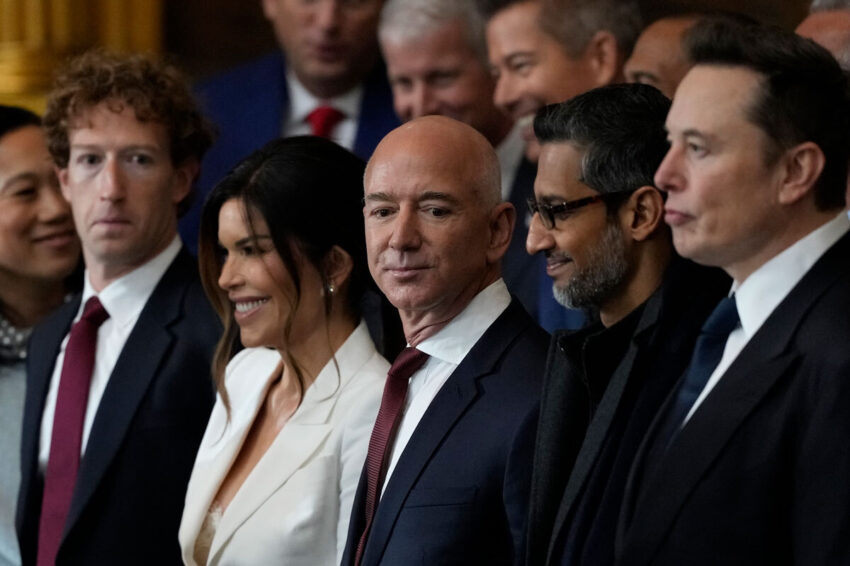
At President Trump’s second inauguration, in 2025, the tech leaders Mark Zuckerberg, Jeff Bezos, Sundar Pichai, and Elon Musk stood at the symbolic center of American power—forming what Rana Dasgupta calls “a rival form of political organization” now poised to compete with the U.S. nation-state itself. Photo by Julia Demaree Nikhinson / Pool / Getty Images.
During these first nine months of Trump’s second presidency, the question of his personal psychology has dominated the media to a level unprecedented in American political analysis. His need for flattery, his vindictiveness, his compulsion to lie, his worship of money, his misogyny—only through such intimacies, apparently, can we understand the policies of the capitalist superpower under its forty-seventh president.
It is easy to see where the obsession with personality comes from. Since Trump makes such extensive use of the executive order and ignores institutional custom, there is little to constrain his psyche, which therefore, the argument goes, becomes the central political question. But it is too convenient to imagine that America’s present upheaval springs from one man’s head. It is also the result of a deeper process, of which Trump is merely a symptom: the ongoing transformation of the American state.
A nation-state is not the same at different points in time. As it moves upward or downward in the global economic hierarchy, and as its revenue sources change, it becomes more or less aligned with the interests of its citizens—and its political system changes too. In the case of today’s United States, the state is going through a series of changes that will lead to a more antagonistic relationship with its people as a whole. This is already putting enormous pressure on democratic processes and institutions.
Trump is well suited for the accompanying dirty work. He has no qualms about undermining rival branches of government, canceling federal contracts, stripping away the state’s “unprofitable” activities, or selling reduced rights (more barriers to voting, diminished privacy, less access to abortion, disregard for noncitizens’ rights) as citizens’ victories. With or without Trump, however, the American republic is mutating away from what it was during the high-constitutional era of the late twentieth century. The real story, then, is that mutation—and the crisis from which it stems.
so, what is the crisis? First, the United States can no longer control the flow of strategic resources (oil, minerals, agricultural commodities) into the global economy. This is an essential responsibility of any capitalist superpower. In the nineteenth century, Britain’s approach was to occupy one-quarter of the earth’s surface and subject it to a coherent commercial law. After 1945, the United States tried to achieve a similar end without physical occupation, which required more complex arrangements. To guarantee the flow of key industrial resources, America had to manipulate territories it did not directly control. During the decades of the Cold War, it did so through a network of client states and through a widespread campaign of wars and coups. In the 1980s and 1990s, it arrived at what was supposed to be a final resolution: the so-called Washington Consensus, whereby supranational laws and institutions would bind all states to a single trade and property regime. The World Trade Organization was the most conspicuous emblem of this new order; there were also novel instruments for bypassing the laws and policies of individual nations (e.g., “bilateral investment treaties” and “special economic zones”). The presumption was that markets would thenceforth provide the mechanism for the free flow of global resources.
Today, that market logic is retreating before rival modes of resource acquisition that traditional capitalist brokers, such as American corporations, are ill-equipped to combat. One such mode is pursued by China, as well as by smaller players like the U.A.E.; these countries acquire resources as a kind of imperial barter. In exchange for loans, infrastructure investments, and essential supplies, they are able to access timber, metals, and other resources below market rates. Because these deals do not depend on an elaborate legal system, or even on a settled state, they may be struck in regions that American firms cannot penetrate. In Sudan, for instance, the U.A.E.’s skillful exploitation of the instability created by the country’s civil war allows it to extract, via licit and illicit channels, the majority of the country’s gold production. In such places as Myanmar and the Democratic Republic of the Congo, Chinese miners collaborate with both state and non-state militias. Such flexibility allows China to dominate many of the resources essential to the twenty-first-century industrial system, such as cobalt (located overwhelmingly in Congo; China processes 80 percent of the global total) and dysprosium and terbium (important rare earth elements, both of which are concentrated in Myanmar; China processes 99.9 percent of the former).
A Literary Gift in Print
Give a year of The Yale Review—four beautifully printed issues featuring new literature and ideas.
Allied to this is the enormous growth of illegal mining. Many criminal organizations operating in Peru, Colombia, Venezuela, Ecuador, and Brazil have shifted their focus from drugs or extortion to illegal gold mining—whose value in Peru, for instance, is almost equal to that of legal mining and more than double that of the cocaine trade. Illegal mining is one of the principal businesses of Russian mercenary armies in Africa, which constitute an important part of today’s political armory, since the money they raise helps keep the Russian state afloat even as Western countries apply economic sanctions. American firms find it difficult, once again, to access this large and growing illegal output—at least until it has been effectively laundered.
These parallel trading systems thus significantly diminish American control over the distribution of basic resources, including those most critical for growth areas like semiconductor manufacturing and renewable energy. That is to say, they diminish America’s standing as a capitalist superpower. No mainstream political voice, whether on the left or on the right, suggests the United States should abandon that position. So it is not surprising that Trump is looking to expand America’s illicit capabilities— “illicit,” that is, by the standards of the market logic it has tried to impose until now.
He is a good candidate, once again, for this task. Even before 2016, he declared his opposition to the Foreign Corrupt Practices Act (1977), under which U.S. corporations—or foreign corporations listed on U.S. exchanges—can be prosecuted for offering inducements (bribes) in return for contracts and market access. A February 2025 executive order suspended the FCPA on the grounds that it was being used in a manner that “actively harms American economic competitiveness and, therefore, national security.” In June 2025, the Department of Justice reinstated the FCPA—but with a new focus. No longer would it penalize U.S. companies for practices that were “routine…in other nations.” Instead, it would be used to target transnational criminal organizations in the interest of eliminating “conduct that directly undermines U.S. national interests.”
But corporations are most effective at accessing raw materials when they have a powerful state behind them. So the administration is also taking direct action. Emulating deals struck elsewhere by the U.A.E., Trump’s deal with Ukraine exploits war for minerals. He has also proposed actual territorial expansion, notably in Greenland, whose deposits of rare earth elements could significantly improve America’s situation. This impulse is not an idiosyncrasy of Trump and his circle: industrial security is rapidly becoming a top priority of the U.S. military establishment. These days, military insiders are little concerned with old liberal objectives, such as spreading democracy or imposing legal norms. “The only thing they are talking about today,” one analyst told me, “is minerals.”
To maintain its position, in other words, the United States might need to become a more classical imperial power, exerting direct military and political control over foreign territories. That would have profound political consequences, at home and abroad. It would bring about renewed conflict with the American people, who are leery of imperial ventures. Given everything else that is going on, it would also erase the last vestige of legal respectability by which the American order—which includes the United Nations and the system of states itself—has distinguished itself from gangsterism.
But no matter what Trump does, Western companies will never regain the level of control, particularly over minerals and metals, that they enjoyed in the twentieth century. Certainly, the United States will seek to defend its economy, and indeed the wider global economy, against the most damaging kinds of strangleholds. But China today is the undoubted industrial superpower. American authority rests on finance and technology—but in those areas, too, there are problems.
the second aspect of the crisis of the American state is that the United States can no longer guarantee the position of the dollar.
The American order has stood, before anything else, on the fact that global trade is denominated in dollars. Universal demand for U.S. currency has simultaneously inflated its value and lowered the cost of American borrowing. This has allowed the United States to slide, apparently without pernicious consequences, into significant debt. American debt in 1980 stood at about 30 percent of GDP; in 2024, the total was $35.5 trillion, or 120 percent of GDP.
The effects are already creeping in: debt servicing will cost the United States more than $1 trillion this year—more than Medicaid or defense. And there seems to be no politically acceptable way to bring debt levels down. On paper, the United States is an unviable operation: last year, a full 27 percent of U.S. government spending was financed by debt. Even Trump, who wants to disrupt everything, makes no pretense of reining in U.S. borrowing: Making America Great Again will probably explode the debt records.
As long as the dollar retains its monopoly over the international trading system, however, U.S. debt is more of a theoretical problem than a real one: America can dismiss its debt as mere tribute paid to the imperial power by vassal states. The real crisis will strike if the dollar loses that position.
China seeks exactly that outcome. This is new: until recently, China aimed to maintain the dollar’s position and suppress the value of its own currency so that Chinese manufacturers could sell their products abroad more easily. But China is now seeking the same benefits that the United States has enjoyed for so long. Exploiting its own global industrial networks, its leading position in digital currencies, and the many other sources of opposition to dollar domination, it is trying to internationalize the yuan.
By tying its destiny to them, the United States is gambling away the existing political system.
To date, its efforts have only marginally affected the dollar’s position. That is because China and the United States continue to play broadly complementary roles in the global production system. Increasingly, however, they will go head-to-head. As Chinese companies begin to attain leadership in strategic technology sectors and to cut into Silicon Valley’s global rents, China’s dependence on cheap exports will diminish, and the country will have less interest in propping up the dollar. At that point, the United States might have to confront realities from which it has hitherto been shielded. The ever-worsening ratio between American debt and tax receipts might finally lead to a loss of faith in the U.S. currency.
Investors are well aware that there is a growing risk of dollar collapse; this is why recent years have seen such dramatic appreciation in other stores of value. Gold prices have risen by 130 percent since 2020; if we reverse the axes, we can say the dollar lost 56 percent of its gold value. Cryptocurrency evangelists are fond of saying that Bitcoin represents a $2 trillion bet against U.S. currency; the dollar lost 85 percent of its Bitcoin value over the same period. Because the modern American state was set up to ensure that nothing endanger the imperial currency, such downward arcs bespeak profound instability in the ruling system. Since the beginning of 2025, the dollar’s value has fallen by more than 10 percent against other major currencies—the sharpest fall since the last major imperial crisis in 1973.
All this explains why the present administration feels such terror toward China. What Beijing does with currency is overwhelmingly more threatening to Washington than anything it could do with warships. As far as the transformation of the American state is concerned, however, the point is this: anxieties over the future of the dollar greatly expand the strategic power of Silicon Valley.
In part, that’s because tech firms supply dynamism to—and constitute about 40 percent of the value of—U.S. stock markets. The Nasdaq and the NYSE are essential to maintaining dollar demand: about $18 trillion in U.S. equities are held by foreign investors. China has no financial magnet remotely as powerful.
More important, it’s because Silicon Valley is now the main engine of American innovation. In the postwar era, the U.S. government was by far the world’s largest sponsor of scientific research. Nowadays, 78 percent of scientific research conducted in the United States is funded by corporations; just four companies—Amazon, Alphabet, Meta, and Apple—jointly exceed the U.S. government’s spending on R&D. If it is true that the dominant position of the dollar is dependent on the United States’ continued technological leadership, the future of U.S. supremacy is substantially in the hands of tech firms.
It is not certain they are up to such daunting responsibilities. The stunning pace of China’s state-led technological advance has already caused many pundits to question the supposed superiority of Western theories and institutions. An influential 2023 report argued that “China has built the foundations to position itself as the world’s leading science and technology superpower.…In the long term, China’s leading research position means that it has set itself up to excel not just in current technological development in almost all sectors, but in future technologies that don’t yet exist.” Investors got a sense of what this might mean on January 20, 2025, when DeepSeek, a Chinese start-up, launched what seemed to be a more efficient competitor to the “large language models” run by American AI firms; the value of U.S. chipmaker Nvidia plunged by $589 billion—the largest one-day dollar loss by a single company in history.
Because the competition is so intense and the stakes so high, Silicon Valley has moved to the center of the American power system. Tech CEOs are now in a position to demand that the state withdraw every impediment to corporate independence and power. Not only do their companies enjoy a significant degree of political independence; they are increasingly gaining control over the American state.
This sets up a ruling-power struggle of a sort never before encountered by the republic. Silicon Valley firms are not just moneymaking ventures. They represent a rival form of political organization—making them competitors as much as allies of the American republic. By tying its destiny to them, the United States is gambling away the existing political system. Which brings us to the last point.
third, the United States is losing its capacity to guarantee meaningful employment for its citizens. The very companies on which the state depends for technological leadership, after all, are automating much of the labor traditionally performed by human beings. This transformation of the relationship between production and work is much more consequential than most commentators acknowledge.
Until now, work provided the means for individuals to extract substantial revenues from the economy; on that basis, democracy became not only feasible but even necessary. Work, in other words, was never merely economic: the entire political system, too, was built on a twentieth-century pattern of employment. That pattern arose from industrialization and two world wars, and it has already largely disappeared. When AI converts millions of today’s well-paid jobs into a few giant vaults of aristocratic property, there will not be many people left with a concrete stake in the American project. History teaches us this: advanced states whose economic growth is largely uncoupled from the activity of the population cannot sustain democracy.
Ensuring employment for the population has been a pillar of American statecraft for the last century. When it comes to AI, however, and the coming collapse of the middle class, the state is remarkably ill-prepared. Much of the relevant information remains locked inside corporations—which is why it is tech moguls themselves, rather than elected officials, who are sounding the alarm. OpenAI’s Sam Altman, Tesla’s Elon Musk, Meta’s Mark Zuckerberg—all have advocated a “universal basic income” to mitigate the fallout from automation.
Since they are themselves the cause of the problem, such individuals will naturally underplay its dimensions. It is easier for tech CEOs to talk about cash handouts than to discuss what will happen when their oligarchy destroys democracy. One maverick, Peter Thiel—the cofounder of Palantir, which supplies national governments, among others, with AI capabilities for war, surveillance, and population management—has occasionally declared his disdain for democracy. But even he will not voice the darker questions arising from his own automation and privatization of the nation-state system. How might democracy be withdrawn without social breakdown? How will the excess population be warehoused? How should its inevitable criminality be repressed? Can troublemakers be deported to other jurisdictions?
Donald Trump has an instinct to defy those institutions that were designed to democratize political authority. Perhaps that instinct is as simple as the armchair psychologists say: he loves power and hates rivals. If so, his personal belief system is miraculously well designed for the time. Just as America’s economy approaches a direct conflict with its political system, Trump’s flurry of battles—with federal and state officials and institutions, with businesses, universities, and the media—comes along to identify the vulnerabilities in the twentieth-century political settlement. It will be significantly easier, as a result, to find answers to the “dark questions” listed above. But Trump is not only weakening what exists; his team is linked to new avenues—such as his own meme coin and various “dark money” groups—for powerful economic interests to access and influence the political system. These initiatives establish something similar to the British court of the seventeenth and eighteenth centuries, wherein cash contributions, and other favors to the Crown, could buy policy concessions.
He is not a man with a coherent vision; there is much change for change’s sake.
Neither Trump himself nor any future U.S. president will be the primary beneficiary of a democratic rollback. Here, it is crucial to point out that the rising powers of Silicon Valley are fundamentally different from the largest corporations of the postwar era—General Motors, say, or AT&T. Those companies sat within the nation-state, expanding its overall power. New tech firms do not fit so neatly. They have enormous “populations” of their own, and they replicate many of the functions of the state itself, often in a technologically superior form—so they themselves are beginning to compete with nation-states, and take their place on the geopolitical stage. As one political scientist put it in 2021: “States have been the primary actors in global affairs for nearly 400 years. That is starting to change, as a handful of large technology companies rival them for geopolitical influence.” One of the reasons investors pay a premium for Silicon Valley shares is precisely that tech firms are organizations of a new kind, possessing far greater powers to remake the world to their own advantage than traditional corporations have.
AI will prove a much more objective and incisive analyst of interlocking megasystems—political, economic, social, ecological—than the best human administrators. There will be a rout of academics, analysts, think tanks, etc., and “knowledge” will come to mean “machine knowledge.” But machine knowledge will not be disinterested. It will be produced by corporations that operate vast industrial systems and whose activities will proletarianize great swaths of society. Those corporations will be confronted, therefore, by serious problems of population management, and they will have very specific demands on the state. Their machine knowledge will be designed to ensure that the state intensifies its powers of surveillance, repression, and human warehousing.
They will also have a direct interest in withdrawing political power from the American people. And they possess equipment that is very useful in that regard. To withdraw democracy, it is not necessary to cancel elections. Elections need only be turned into rituals of organized emotion—a bit like the Two Minutes Hate in George Orwell’s Nineteen Eighty-Four. The tech firms have already overturned the information regime that was correlated with the high points of democratic achievement. What has come instead rewards the cheerleaders of phobia and moves us closer to a scenario in which politics has become divorced from the objective needs of the population.
donald trump is familiar with failure. In his business career, he acquired a few distressed enterprises; several of his own have failed. Precisely because he likes to be a winner, he is instinctively alert to the sources of failure in the America he has taken over as CEO. He has a clearer sense than his immediate predecessors that the American republic, if it is to maintain its position, must be restructured.
He is not a man with a coherent vision; there is much change for change’s sake—and it is impossible to say exactly what hypermodern state formation might emerge from his presidency. If we are to respond meaningfully to our moment, however, it is critical that we understand the meaning of this transformative urge. History can help us, for the future United States is more likely to resemble pre-twentieth-century state models than to resemble anything that has existed in living memory. In a 2020 essay for Harper’s Magazine, I drew a parallel between America in this decade and Britain in the late eighteenth century. That parallel is only clearer now.
Like America today, eighteenth-century Britain confronted major strategic challenges: it was engaged in a global struggle with France, and it faced a perennial trade deficit with China. The latter, as factory to the world, was able to impose its own currency on everyone else; this meant that Britain—whose currency was denominated in gold—was forced to scour the world for silver to pay its debts. Again, like America today, it leaned on a corporate giant—namely, the East India Company—to help it face those challenges. The East India Company’s stock provided financial leverage for wars with France, and its imperial ventures generated the silver to pay China.
This kind of corporate dependency had profound political implications. Most obviously, democracy was impossible. Because the British people at large neither contributed to the company’s success nor benefited from it, they could not be admitted to the political conversation; only a negligible number of British adults, all of them men, enjoyed the vote. Meanwhile, the company ruled Parliament to such an extent that it was impossible to legislate against it. So powerful was the grip of the corporation over the state, in fact, that many feared it would, in the absence of powerful regulation, drive the latter to downfall. And indeed, when the company’s fortunes crashed, politicians gambled the state to save it. In 1773, Parliament imposed new taxes on America to bail out the East India Company’s losses—helping instigate the revolutionary wars and the breakup of British territory.
Having its own army, navy, currency, and diplomatic missions, the East India Company was something between a state and a corporation. It was a spectacularly dynamic formation: with its geographic expansion, the capitalist system itself expanded. The international banking system was founded on East India Company stock; Britain became the leading capitalist state on the back of the company’s power. As a result of this strategic importance, the East India Company was—in terms of its scale relative to the rest of the economy—perhaps the largest joint-stock company of all time.
We may be heading into something less fatal but more depressingly entrenched than fascism.
But today’s giants are approaching that scale. At present, seven U.S. firms—Apple, Meta, Microsoft, Alphabet, Amazon, Nvidia, and Tesla—have a combined market capitalization of about $18 trillion, equivalent to two-thirds of GDP. Apple’s valuation alone is equivalent to about 11 percent. Nothing from America’s high-constitutional era came close: 1960s and 1970s giants, such as GM and AT&T, were rarely worth more than 2 percent of GDP. Even Standard Oil at its height was worth “only” 2.8 percent. We have to go all the way back to the seventeenth and eighteenth centuries to find parallels for Silicon Valley today. And those parallels are not simply numerical. Silicon Valley also expands the capitalist system. It, too, is becoming a formidable financial, military, and political force. It, too, has established a volatile relationship of dependency and competition with the leading capitalist state. And it, too, given the intensity of the struggles between nation-states today, is likely to move politics in very turbulent directions.
Those who oppose Trump often do so on the basis that he is a “fascist.” In fact, we may be heading into something less fatal but more depressingly entrenched than fascism. There have been no long-lived fascist regimes. Britain’s terrifying and brutal oligarchy, by contrast, was remarkably stable, enduring from the late seventeenth century until the first democratic concessions of the 1830s. For close to 150 years, while many pursued the seeming mirage of liberty through the state, the everyday challenge was liberty from the state. People did not fear bad policies, bad leaders, or bad parties so much as they feared the state itself, whose objectives were fundamentally opposed to their own. What brought to an end that fearful situation? Work. During the nineteenth century, industrialization moved the British masses from the periphery of the world economy to the center. As a result, they were able to bargain for political rights. What is happening in the United States today is the precise opposite of that process.
If the eighteenth-century parallel has any merit, it could change the nature of our political conversation. As the United States adapts to new conditions, we might see the violence of its attempts to arrange the world to its advantage—which for several decades has fallen almost exclusively on populations far away—falling on Americans themselves. Institutions designed to protect citizens against the state might drift toward another role entirely: insulating the state from its citizens. In that scenario, we would need to throw out much of our existing political theory, which draws its hopeful conception of statehood from the Christian image of God: all-powerful, all-knowing, and all-good. We would have to invent new conceptions of “the people,” along with new legal circuits designed to defend against state predations.
In that scenario, the nation-state would have approximately the same popular legitimacy as a criminal gang. The leader’s psyche would not much matter. The Mafia does not corrupt and kill because the boss suffered a bad childhood. It does so because that is its nature.