In the chalky atmosphere of a plane across the Atlantic, I tried to soften my grief by reading a book about how the living maintain relations with the dead. My book says we bury the dead to humanize the land, but the words seemed small and dark against the white paper, so I turned my thoughts to Bermuda, where I was heading. The following day, I would attend the funeral for N, who had been like a grandmother to me. Around thirty million years ago, a midocean volcano erupted in the North Atlantic Ocean. Lava hissed and rose and cooled until it formed the Bermuda seamount. The low-lying archipelago sits on the ridge of this underwater mountain, one of the most isolated islands in the world.
The funeral took place in a church N had recently joined—a tall, gray limestone building with a green yard studded by graves made from the same rock. The sun bore down as my mother and I moved through the grid of tombs, searching for a place from which to observe the ceremony. There was no open casket or memorial card. N kept her privacy, even in death. As the pallbearers arrived carrying that great stillness on their shoulders, I thought of a man I had noticed on the way to the service. He was standing alone in another cemetery, wearing faded jeans and a black tee. He wore a bike helmet, as though he were stopping by on his way to somewhere else. The shiny black sphere of the protective gear accentuated the tilt of his head as he looked down at the tomb, and I read his body even though I could not see his face. He stood there, silent and still. It seemed so simple, but there wasn’t much else to do in front of a stone.
As sweat formed on the pastor’s forehead in the unusually hot February sun, he eulogized N’s capacity for love. He said she’d joined his church full of regrets, and that the questions she had asked him—that she had asked God, really—circled around whether she could be forgiven for the hurt she’d caused. When he paused, I heard cars idling on the adjacent street as drivers slowed for the funeral. I was surprised by the pastor’s words: my relationship with N had been one of love, but I realized then that it had not been one of confidences. While I listened to the eulogy, entire islands of her life came into view. I could see their shores but did not know what they held.
I carried my own regrets, which emerged as soon as my mother told me the news. “It’s hard not to have regrets after a person dies,” she said after I listed all the times I should have been more present, or shown more love. N had been hospitalized three weeks earlier, but at the time, I could not contemplate the possibility of her death. The doctors had talked about discharging her. I thought she would be released. I had phoned a few days before she passed, but she was too tired to speak. “I’ll try again later this week,” I had said, my voice growing louder to compensate for the frailty of hers. That was the last time we spoke.
A tombstone denotes the end of life, and I did not want to face the reality of her death.
After the eulogy, I approached the grave for one last look. The opening in the ground was deeper than I expected, plunging into the earth like a well. The sun warmed my shoulders, but it looked cool down there. Gray limestone bricks lined the sides and fresh palm leaves lay beneath the casket. I kept my eyes fixed on the leaves and the stone, unwilling to look at the casket itself. Beside me, my mother explained that it was a Bermudian tradition to place leaves between the casket and the exposed ground. The bricks had been quarried from the heart of the island.
After the funeral, my mother and I changed out of our dark clothes and walked to Hog Bay. The path moved between plots of arable land, the island’s red soil dotted with the sprouting tops of onions, carrots, and kale. Nasturtiums bloomed at the edges of fields, and the loquat trees were full. Walking through the fields and into the forest, we passed an old lime pit. Though now filled with empty beer bottles and other litter, it once served to cook limestone and make quicklime used as mortar for the island’s bricks.
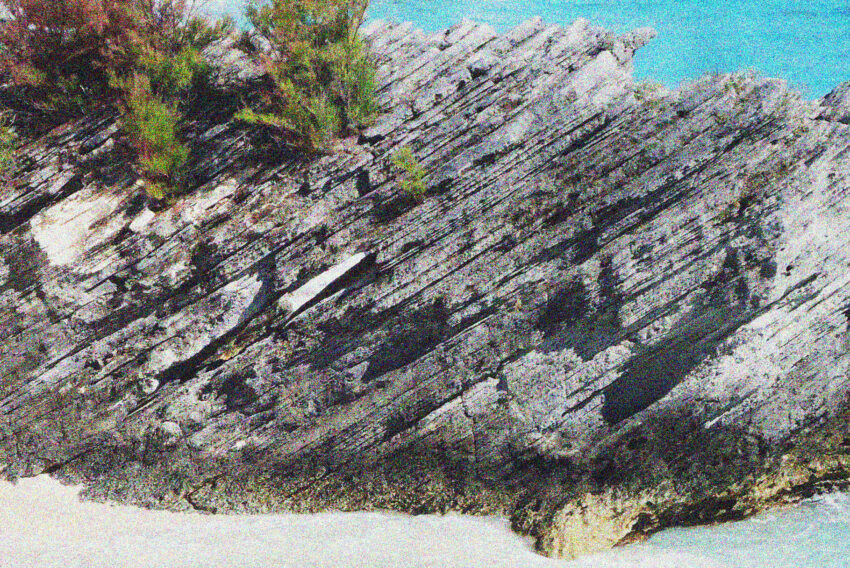
As in other marine environments, limestone in Bermuda began as deposits of loose carbonate sediment that went on to form sand dunes. The story of the dunes starts millions of years ago, with the arrival of coral, algae, crustaceans, and fish on the volcano’s seamount. When these organisms died, the waves pulverized their calcium-rich skeletons against coral reefs until they turned into sand, which accumulated into land. In the interglacial period, the sea level rose. Rain fell, and the acid in each drop altered the skeletal remains in the sand, melding and hardening them into stone. Tides, winds, and birds brought soil and seeds. Forests grew. Thus, seemingly inert limestone was not only made from life but also became host to it.
As my mother and I walked farther, the forest’s tangle of laurel, cedar, and palmetto trees opened onto a view of the ocean. Sunlight scattered across its surface. The trail descended down the hill and along the water, ending in a clearing near the shore. There was no beach between land and ocean, no sand on which to sit and admire the view. The coast was all limestone: some of it smooth, friable, and beige, some of it hard and gray. The varied colors marked different ages. Young limestone has the look of sand, with individual grains still visible. Older, harder rock has a frothier look, with melded grains pockmarked by rain.
In the twentieth century, Russian Ukrainian scientist Vladimir Vernadsky argued that apparently inert mineral strata were “continuously created by the influence of life.” As the father of biogeochemistry, he was one of the first to posit a dynamic relationship between life and the planet on which it evolves. For him, living matter altered the mineral surface of the earth, like those crustaceans whose skeletons turned to stone over time. I found comfort in his belief in the vitality of the inert.
My relationship with N had been one of love, but I realized then that it had not been one of confidences.
Walking along the shore, I noticed in the limestone round hollows filled with tidewater. According to my mother, each cavity marked the absence of a long-gone tree. Salt water had seeped into the wood, and minerals had replaced the air within. As the trunks rotted away, the negative spaces of the trees’ root balls were left behind. We began examining these craters. Most had sand at their base, along with rocks and small beings. One held clusters of shiny black mussels. Another housed clams with black-and-white patterns. Translucent anemones adorned the sides, their tentacles swaying in the water. Looking up from these pools, I became aware of traces of life hidden elsewhere on the limestone’s surface. From crevices, whelks rose like tiny pyramids. A crab’s red molt rested on a boulder. Chitons clung to the rock, and left behind deep scratches after they died.
I searched for life in these stones, but a tombstone is different. On my way to N’s funeral, when I saw the helmeted man standing before one, I had thought the act uncomplicated. But when I imagined N’s grave, and the tombstone that would eventually mark it, I dreaded the idea of being near it. A tombstone denotes the end of life, and I did not want to face the reality of her death.
My mother and I stood among the limestone hollows, which were teeming with life, just as we had stood among the limestone tombs in the cemetery. If stone was not inert matter, I thought, but a happening, or a process, perhaps a tomb could embody a similarly vibrant state.
Death was not the end of my relationship with N, only a shift. I had known her for more than thirty years. Yet at her funeral I had learned new things about her. I would keep learning, and she would keep living for me.
The thrill I had felt at finding life in stone was beginning to quiet. The sun hung low, and the air was cooler. I stood by my mother as we looked out on the ocean and inhaled the minerals in the salt-laden air. For a moment, I held the fact of N’s life and death clearly in my mind, untinged by doubt or fear. The grief ebbed briefly. Who knows what form Bermuda will take in the centuries to come, as the sea level rises and storms continue to strengthen. Each hurricane season, the island’s limestone cliffs crumble and change.
Edmée Lepercq is a writer based in London. She is working on a book of essays about memory and colonial botany called Germination Protocol.
Newsletter
Sign up for The Yale Review newsletter to receive our latest articles in your inbox, as well as treasures from the archives, news, events, and more.