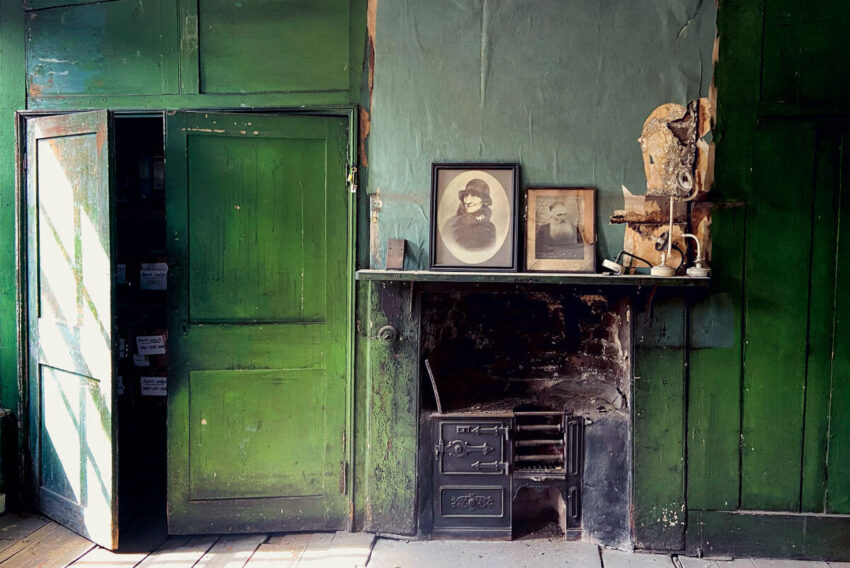
Edmund de Waal, Room, Princelet St., London. Courtesy the author
you find yourself in an archive. You are there because you are seeking something; you want revelation or affirmation. You expect order, you need order. Instead, you find instability, difficulty, and danger. Your plans fall apart and time unravels. You have been lured in; it is a labyrinth.
I’m writing this to find my way out.
Listing is a kind of archiving, a gathering up and making sense of the scattering of the world through collation, an attempt at cohesion. In starting to archive the idea of an archive, I make a list in a new notebook.
Archives are purposeful, and they are random. They record the personal and the institutional, plural and singular histories. They are passed on, inherited, stolen, plundered, and lost. They are destroyed by accident and by design. They record rewritings, rethinkings, retellings. They hold stories so they don’t disappear. They preserve information in the hope of a future.
Archives cross all the senses. They are tactile, digital, somatic, auditory. They are places of memory.
I seem to have spent years in archives. I seem to be endlessly drawn to them, to places of beginnings and places where stories end. These are archives with filing cabinets and microfiche, with ledgers on shelves, with manila envelopes of photographs and carousels of books, letters and receipts and wills and account books. Lists of acquisitions and lists of deportations, catalogs of objects and the lives of those who owned them.
I try and make an appointment, hoping someone will reply. I walk in and find some kind of chronology, some appearance of lucidity, legibility. Someone has tried to map X, put Y in order. It all feels possible. I keep coming back, notebook in hand.
So I return to Odessa, where my family starts out. I return to the places of my father’s childhood to try and find out what happened. I return to Berlin, to Paris, to Tokyo, to Stoke-on-Trent. To Bologna to watch the light change in the dust of Giorgio Morandi’s studio on Via Fondazza. I find myself in the archives of the ceramic collections of the Victoria and Albert Museum in London, tracing who acquired the porcelain, and in the stores of broken objects of the Kunsthistorisches Museum in Vienna, tracing why these things are hidden away. I try and track the route Walter Benjamin took on his walk to school in Berlin in 1903, what he was reading in the summer of 1938. I need to know what a Parisian cousin of my grandmother’s gave his friends for dinner between the wars. If I know this—if I can hold this letter and find its reply, turn the pages of the morning newspaper, run a finger down the lists of applications for visas—then I can start to piece it all together.
They are places, streets, hillsides as much as card indexes.
And in the gaps between the cataloged, here are the spaces where the letters have vanished, the crossings-out, the redacted. I keep coming back to the image of the ragpicker, the salvager of detritus, unloved, overlooked, central to Benjamin’s thinking about archives. He used the idea of the scrappy—verzetteln was his word of choice, a word that holds both “failure, fragmentary, unachieved” and “a particular method of making information manageable,” as the Benjamin scholar Erdmut Wizisla has noted. Scraps and rags are close to shards, those bits of broken pottery that survive, unregarded.
That is why, for me, archives are not confined to buildings. They are places, streets, hillsides as much as card indexes. I return to the hills where the clay used to make porcelain was discovered in China—and to Dresden, Cornwall, the Appalachian Mountains, where it was reinvented—to try and make sense of my life with this strange white material. I am ragpicking as I pick up a crescent of white from the floor of the castle in Meissen, a shard from a celadon vessel discarded some thousand years ago on a mountainside near Jingdezhen. I spend time in the house and gardens on the edge of the sea in Gaeta, Italy, where Cy Twombly worked. I want to see how the color of the sea changes. I need to reflect on his use of the color white. This is placing myself near an archive—a place of memory—and watching for response.
I do not reach conclusions. I make little attempt to tidy things up, to order them into categories. Rather than create a card index, “I have made a heap of all that I could find,” as David Jones, quoting Nennius, writes in the preface to his great poem of memory, The Anathemata. Anathemata is a word I hold dear: things that are cursed “anathema” become things that are put aside and valued “anathemata.” The making of the heap, the picking up of rags, is the start of making something new.
Archives are a putting aside.
And archives are fallible. They bear witness to incoherence and violence, elisions as well as presences. A beginning becomes an ending; an ending becomes a beginning. The fantasy of completeness is dangerous. Instead of answers, you are confronted with gaps, with the unstable and the impermanent. Instead of guidance, you are left to navigate alone, make up your own route through.
standing inside 19 Princelet Street, you sense this imperative. It is a five-story house on a street off Brick Lane in the East End of London. It is a palimpsest. It began as a Spitalfields house built for a Huguenot silk merchant in 1719. In 1869, the ground floor was turned into a synagogue. In 1969, the Jewish scholar David Rodinsky disappeared from the attic, leaving behind his entire material life—maps and photographs and writings in fifteen languages, kabbalistic diagrams and songs and Phoenician tables of time, his coats and hats, his books and crockery.
The building does not merely shelter the archival but is itself an archive. It resists definition—it has been home and asylum and school, a place of craft and worship and radical thought. It has been a meeting place for one community after another. Every wall and floor and doorway bears the traces of memory.
Their presence is also a testament to absence. There is a kind of spectrality here.
You enter and immediately encounter layer after layer of markings, of paint and wallpaper and then more paint, scratched through. A piece of tin has been tacked up over a hole. A mezuzah, guarding the homestead. A floorboard is prized up to reveal an accretion of objects, scraps of paper, dust. The benches for the synagogue are stacked together. Parts of the bimah are here too, a noticeboard celebrating donors to the synagogue, an old trunk inscribed Jerusalem Garden Tomb, a Singer sewing machine, dozens of spools of thread, a mummified rat. In the early 1980s, the repair and cleaning of 19 Princelet Street by the Spitalfields Trust surfaced lost objects: behind furniture, beneath debris, stuffed into cracks and crevices.
Text is everywhere—a name is written, a memorialization or note of a beneficiary. A date, and then another and another, carved into the doorway or painted high above your head, kinds of reckonings.
1885
3
______
5655
______
22
In memory of the late Fanny Reinnalf who died 18 April 1953
In loving memory P. Cohen
F. D. Mocatta
The place is nearly derelict, and it is absolutely alive.
The Jewish congregation of 19 Princelet Street dwindled suddenly in the 1960s. They left everything but the five Torah scrolls—even the covers remain, beautiful silk and blue velvet covers embroidered with the Lion of Judah and Star of David. Their presence is also a testament to absence. There is a kind of spectrality here.
This is an archive that, itself animate, has engendered a reciprocal animacy in its visitors. As Rachel Lichtenstein and Iain Sinclair describe in Rodinsky’s Room, the building has been continually disturbed—artifacts have gone missing, rooms have been dismantled and rearranged out of aesthetic need. Film sets, exhibitions, careless intruders. Rodinsky’s archive has now been relocated to the Museum of London.
Every alteration is a rewriting of the building. Every visitor wears away the floor a little more. Is this reductive or additive? Is the archive shrinking or growing?
there is the element, in any archive, of trespass.
Am I allowed in? What is my responsibility to the people who have been here before? How do I respect the dead and their integrity, their individuality and separateness from me?
Is archiving—the act of it—a technology of violence as well as preservation? What is excluded, suppressed, forgotten?
As I return to my family archives, I question what I am doing with them, and with my own—the many thousands of books in my home, the archive room in the studio with pots going back to my very first in the 1970s. There’s an archive of broken pots in the library, a shelf of shards. Part of the family archives has gone to the Jewish Museum in Vienna. I have handed my ceramic archives to the Victoria and Albert Museum.
And I find that difficult. Difficult because it is a ceding of control. I cannot now call things back and throw them away.
This is me not throwing things away.
Froman Archiveby Edmund de Waal, to be published by Ivorypress in June 2025.
Edmund de Waal is an artist who writes. Much of his work is about the contingency of memory: bringing particular histories of loss and exile into renewed life. This has been materialized in exhibitions worldwide, including at the Rijksmuseum, Amsterdam; the British Museum, London; the Frick Collection, New York; and the Kunsthistorisches Museum, Vienna. De Waal is also renowned for his bestselling family memoir, The Hare with Amber Eyes (2010), as well as The White Road (2015) and Letters to Camondo (2021).
Newsletter
Sign up for The Yale Review newsletter to receive our latest articles in your inbox, as well as treasures from the archives, news, events, and more.