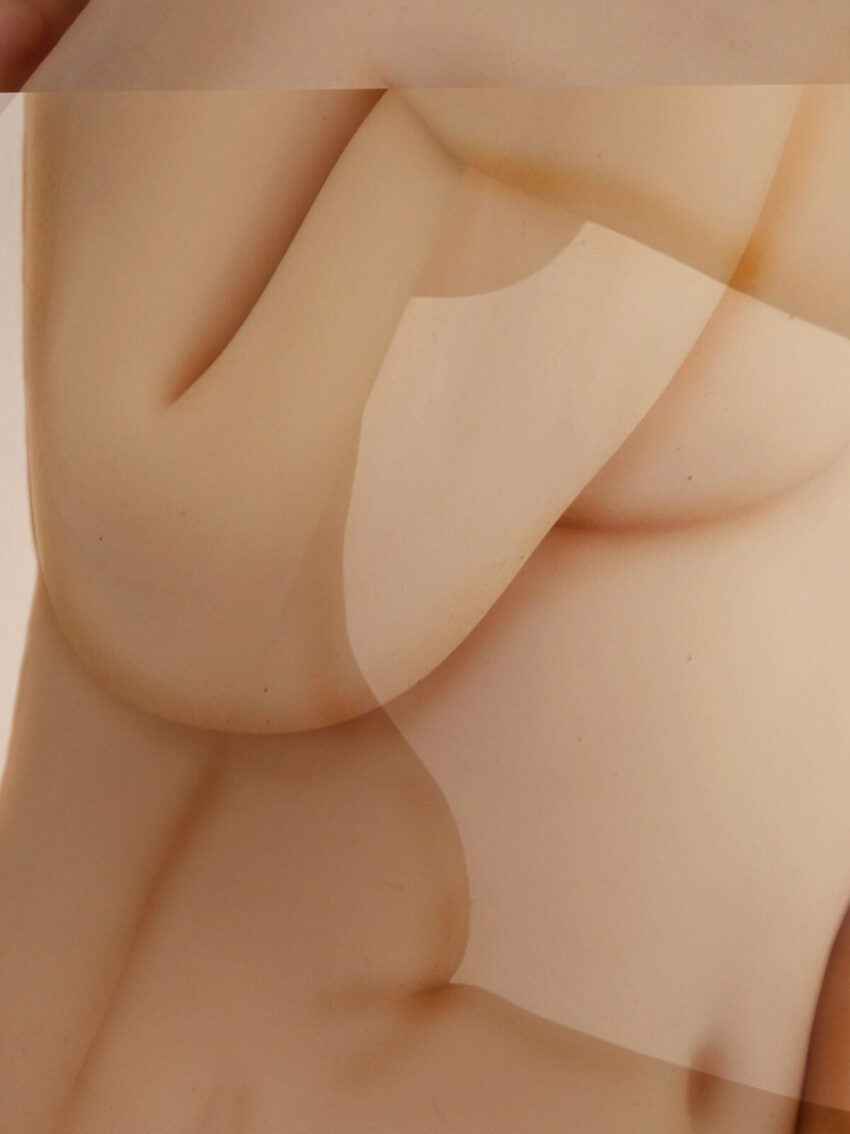
Louisa Clement, Skin Interlacion 18, 2022. Courtesy the artist and Eigen + Art Gallery
I came to all of Jane Austen’s novels late, and to Persuasion particularly so, finally discovering it in a graduate seminar on the long eighteenth century. By that time, I had fallen in love with Austen, with her comedy and her depth as a moral thinker, above all with her humaneness, the tenderness that doesn’t cancel out but nevertheless subsumes the prickly, arch, almost always delightful critique she aims at her characters, even the characters she obviously intends us to admire. So I remember my shock when, in a novel that had already won me over and that I continue to love, I came upon one of the cruelest passages in any of the books I know. It comes in chapter eight; Anne Elliot and Captain Wentworth are visiting the Musgroves. Anne and Wentworth were once in love, until Anne (under persuasion) called things off; now, for the first time in years, they’re running in the same circles again. Wentworth is bitter, and pointedly cold; in this moment they’re further separated, perched on the same sofa but with their hostess—“no insignificant barrier”—between them.
In one of the novel’s more curious choices, Austen makes a running joke of Mrs. Musgrove’s grief for her son, who died serving under Wentworth in the Napoleonic Wars. This is gentle, for the most part, but it’s clear that something about Mrs. Musgrove’s grief is ridiculous. “Anne suppressed a smile, and listened kindly, while Mrs. Musgrove relieved her heart,” we’re told; a little later, Anne detects a “transient…indulgence of self-amusement” in Wentworth. (That she is able to do so, before he quickly covers it with the respect due “all that was real and unabsurd in the parent’s feelings,” is a sign of how deeply Anne knows him.) But then the novel joins this sense of the absurdity of Mrs. Musgrove’s feelings to a sense of the absurdity of her body, and gentleness turns cruel. Certain feelings aren’t appropriate to certain bodies, the text avers, in a tone all reasonableness and common sense: “Mrs. Musgrove was of a comfortable, substantial size, infinitely more fitted by nature to express good cheer and good humour, than tenderness and sentiment.” That Mrs. Musgrove’s body is ill-fitting, forcing Anne and Wentworth apart, has already been established; now Anne’s pointedly “slender form” is contrasted with Mrs. Musgrove’s “large fat sighings over the destiny of a son.” I still catch my breath at the cruelty of this—the ugliness of reducing a mother’s grief to “large fat sighings,” of insisting that fatness renders grief so “absurd” it’s a sign of Wentworth’s enlightenment to sift anything “unabsurd” from it.
It gets worse. In that tone of imperturbable Enlightenment rationality that Austen can use so slyly (“It is a truth universally acknowledged”), the novel converts what might have been reflections just credibly specific to Anne into a statement of universal fact:
Personal size and mental sorrow have certainly no necessary proportions. A large bulky figure has as good a right to be in deep affliction, as the most graceful set of limbs in the world. But, fair or not fair, there are unbecoming conjunctions, which reason will patronize in vain—which taste cannot tolerate—which ridicule will seize.
Unbecoming conjunctions. The first two sentences, with their pretense of reasonable concession and their Enlightened talk of “rights,” only make more awful the third, wherein the pretense of rationality gives way to something very ugly. “Fair or not fair”—and here’s the slyness, the supposed comedy: that we all know, really, that our ethical, objective scruples give way before the good vernacular common sense of disgust. That disgust is so overwhelming it has to be expressed three times, with three different eighteenth-century protagonists (“reason,” “taste,” “ridicule”) edging in on the action. The sentence itself breaks down, the three clauses seeming less a well-worn rhetorical device (climactic tricolon, I think I was taught to call it) than a visceral embodiment of revulsion, the esophageal contractions of somebody throwing up.
I had strong feelings when I first read this passage. I have strong feelings reading it now. I was hurt by it; I was offended. I think hurt and offense are legitimate responses to art, though really legitimate is an irrelevant term, as they’re not willed, considered judgments. Like disgust, offendedness doesn’t knock politely and ask if now is a good time; it barges in; it swamps, at least momentarily, anything in us by which it might be judged. Once it’s settled in, the question becomes what we do with it. I mean both what we, as readers, can do with it and—since offense can be part of an intended aesthetic response, something an artist wants to provoke—what the text itself might do with it. But how do we work with feelings of offendedness? This is a question worth asking: offense has become so large and so accepted a part of our response to art that it can sometimes seem we’ve endowed it with unimpeachable authority. That’s the thing about feelings, as opposed to judgments: my feelings are mine, I have sole authority over them; they can’t be questioned, or not politely. That’s why they’re such a refuge, and why so often (I’m thinking of myself ) we begin statements that really should be prefaced by “I think” or “I believe” with “I feel like.” There’s nothing comfier than wrapping oneself up in the impregnable Snuggie of one’s subjectivity.
We do things with art, is what I mean to say; we don’t just suffer it.
I’m all for people having and honoring their feelings, and I think we should have a pretty high bar for telling anybody their feelings are wrong, especially about art. But I also think the whole point of art is to do things with our feelings. I’ve argued before that one of the key motivations for making art is to give us something to do with bad feelings—a way to take feelings that threaten to be purely negative or destructive and make them productive. This strikes me as a real source of art’s power, and suggests one way art might intervene in the world, at least our internal worlds—how it might in some decisive way be saving. But what happens when we’re experiencing art, not making it; what can we do with the bad feelings art provokes? It’s always problematic to talk about art, including offensive or politically retrograde art, as causing harm; it’s especially problematic to invoke metaphors of violence, which are almost never appropriate and have disquieting consequences. One of my concerns about casting art as harm is that it treats aesthetic reception as entirely passive. This is a way to emphasize, I think radically to exaggerate, our vulnerability to the experience of reading a book or looking at a painting; but it distorts what actually happens in our encounters with art. When that encounter is meaningful, it’s an exchange. I don’t mean to suggest some overblown theory of reader reception; I think a great deal of the meaning of a work of art inheres in the work of art, independent of us. But I also think we’re agents when we experience an artwork, and that a profound encounter with art results in a new thing—a feeling, a thought, an act in the world, a poem—that is in some way the fruit of collaboration.
We do things with art, is what I mean to say; we don’t just suffer it. Certainly we’re not defenseless before it. The whole discourse around texts presenting dangers for readers seems misguided to me, a fantasy in which books are imagined as having a power they don’t have, really; and in which readers are imagined as far more vulnerable, far more helpless, than in fact we are. Because we aren’t just prone before our feelings, even feelings as immediate and powerful as Anne Elliot’s disgust or my offendedness. We’re also analytical, reflexive creatures; we can step back from our feelings and make them objects of examination; we can submit them (and ourselves) to a process of education. As I began this essay by saying, I don’t think there’s anything wrong with being offended by art, anything unilluminated or shameful or gauche in it. The challenge is that offendedness, like disgust, doesn’t draw us nearer to an object but instead triggers a reflex of rejection. An initial, untutored response to offense is simply to shut down our perceptual apparatus, to refuse to see the thing that has offended us. Which means, if the art we’re responding to is interesting art, we may be shutting ourselves off from a value that, were we to engage with it, we might see as balancing out the pain of offendedness—or even, if it’s really interesting art, a value that is bound up with offendedness, a value we can only arrive at through offendedness, that lies on the other side of it.
I think about this often in class, when students sometimes shut down in response to offensiveness in a work of art I see as having this kind of value. I find myself using two metaphors that are a little contradictory—or maybe not contradictory; maybe they’re two steps in a process. One is a metaphor of suspension. I don’t want to shut down my students’ offendedness, I don’t want to repress it. But maybe we can try to hold it in abeyance, suspending it long enough to see if there are things to value in the work, or (if we’re in a writing workshop, say) things to learn. Such value doesn’t cancel out the offense, which is only suspended, not dismissed; we may decide that our instincts were right and the work’s value doesn’t, for us, balance out its offensiveness. That’s a perfectly appropriate response to some works of art. The second metaphor is helpful in the case of art that I think intends its offensiveness, wants to put it to work. In this case, I say to my students, what if we don’t suspend our offense but instead try to stay in it, to find a way of engaging with the art not despite but through our offendedness? I’m interested in this as a response to bad feeling, because sometimes we can find something of immense value, maybe of transformative value, on the other side of bad feeling. This is always a gamble; there’s no knowing if you’re going to find it or not; you might just be letting yourself in for the kind of unredeemed unpleasantness I find in that scene from Persuasion. But some of my most powerful experiences of art have been the result of this strategy: of dwelling in bad feeling to see if it might turn into something else. I’m writing this essay because I want to figure out how that works.
i’ve been thinking about all of this ever since reading, months ago now, a Substack essay on Miranda July’s 2024 novel, All Fours, by the writer Emma Copley Eisenberg. Eisenberg is a longtime fan of July, and she had an experience of woundedness reading All Fours that reminded me of my Persuasion wound. The essay is fascinating, written under the sign of readerly desire. Much of July’s novel plunged Eisenberg into a kind of Barthesian jouissance, its beauties reminding her “how wondrous and painful and precise and flummoxing is the work of living.” Wondrous, painful, precise, flummoxing—a perfect description of readerly cathexis. And it’s because Eisenberg was so moved by the novel that she experienced a fairly late scene in it as a betrayal. All Fours, a National Book Award finalist endlessly discussed last summer and fall, is about a woman suffering a midlife crisis. She spends a week in a room she has redone in luxurious style at a roadside motel, where she has an excruciating almost-affair with a much younger man, Davey. The narrator (nameless) is an artist; much of what we learn about her is mappable onto available information (much of it itself aesthetic or performative, like the ongoing art project of her Instagram account) about Miranda July. Hence a tendency, in discussions of All Fours, of collapsing narrator and author. This tendency may finally be unavoidable; one should resist it, I think, and also acknowledge that it’s part of a game the book is playing with its readers.
The narrator learns that Davey’s first sexual experience, in adolescence, was with a much older woman, a friend of his mother’s named Audra, who spent two years, when she was around the narrator’s current age, teaching him about sex. Eventually—the machinations of how the narrator discovers Audra’s identity are a little involved, constituting one of the most carefully plotted, novel-y aspects of the book—the narrator realizes that Davey’s first lover is now an older, plump woman who works at an antique mall near her motel. Their first meeting is antagonistic, structurally so: the narrator tries to haggle over the price of a bedspread, and Audra stands firm. The narrator flashes with anger, delivering one of the more shocking lines in the book: “Sometimes my hatred of older women almost knocked me over, it came on so abruptly.”
One of the admirable things about All Fours is that July lets her protagonist have such ugly feelings. The whole book is predicated on ugly feelings, precisely the ones that rise to the surface here: her terror of aging, her fear of her body losing its youthful shape. The narrator’s hatred is only a flash—a more reasonable side of her intervenes—but things remain prickly: Audra “wasn’t even ugly, just not young, a little chubby. Until recently she had been a better-looking woman than me and she knew this at a glance.” How July brings her characters from this moment to a complicated, sexual intimacy is worth looking at closely, both because it lays the groundwork for some of the novel’s most profound moral thinking and because, just as an example of narrative maneuvering, it’s pretty terrific. Months after her sort-of affair, the narrator returns to the little town, after first posting an Instagram dance video that she intends as a private message to Davey, a kind of summoning spell. But it doesn’t work, and by the time she runs into Audra again, she’s desperate. The narrator approaches her (accosts might be a better word), makes clear she knows her history, and asks about Davey. He’s in Sacramento, it turns out, having moved there with his wife two months earlier. The narrator collapses in tears. Audra invites her over for a cup of tea.
But here’s Audra, with her present-tense verbs, still “highly sexed” in her sixties: a refutation of the narrator’s fears.
July doesn’t engineer anything ideal or utopic in this sequence; things between these women remain, from beginning to end, a little antagonistic. Even so, their shared experience of Davey opens a door between them, which is something the narrator sees as a basic principle of social reality: “A mutual ex always draws women together like magnets.” As Audra tells the narrator about what happened between her and Davey some fifteen years before, storytelling, as it so often does, at least in literature (Paolo and Francesca, Othello and Desdemona), serves as seduction. But the story Audra tells is important in itself, too, a little parable of desire as education. Davey, cat-sitting for Audra in the afternoons, begins snooping through her things, and one day Audra comes home to find him watching a racy video she made for an old boyfriend. (In a twist of the knife, it was a video of Audra dancing, a more successful seduction than the narrator’s Instagram post.) Davey responds to being caught as many eighteen-year-olds would, by covering his embarrassment with cruelty: he laughs at her. But then, as he’s gathering his things to leave, “right in the middle of laughing he saw my face and stopped.” As Audra recalls, when Davey was confronted with Audra’s humiliation and anger, “It was like he saw I was a real person all of a sudden.” She sends him home, but the next day he’s back, and she realizes that what she first took for remorse is actually overwhelming adolescent horniness. Despite all the situation’s red flags, Audra isn’t about to refuse him: “I’m a highly sexed person,” she says, “always have been.”
The tenses in that statement are important. In the preceding weeks, the narrator’s panic about aging has been intensified by a chart she finds online of lifetime human hormone production, which shows a minor, graceful decline in testosterone for men, and for women what the narrator calls “the estrogen cliff,” a radical drop around age fifty. The narrator is forty-six; she’s convinced that she’s facing the end of her sexual life. But here’s Audra, with her present-tense verbs, still “highly sexed” in her sixties: a refutation of the narrator’s fears. When Audra brings out an old photo of her with Davey—he’s shirtless, she’s in a bra—the narrator is “winded with envy.” (Audra, for her part, is “drinking it in.”) The narrative juices are flowing, things have become very charged. But the narrator wants more: having never had sex with Davey, she’s desperate to know, to the last detail, what it was like. When she mentions where she’s staying, the room she’s redone, she realizes that she has her own story to share, that “maybe this was a quid pro quo situation.” Audra is intrigued, and the narrator takes her to the love nest she had intended for Davey, in which the only person she will fuck, it turns out, is Audra.
This is the scene that Eisenberg, in her Substack essay, charges with fatphobia. It’s true that disgust is one of the feelings Audra inspires in the narrator: “There was no way I could do something sexual with her,” she thinks early on, an unpromising starting position. And it’s true that this disgust stems from Audra’s age and her fatness. Though Audra is described at first (and second) glance as “chubby,” in this climactic scene she becomes, as Eisenberg notes, “enormous,” or at least her ass does. Eisenberg tracks other language of fatness applied to Audra’s body—“big,” “soft,” “rounded”—and how often it seems charged with negative feeling. She contrasts this to the descriptions of the narrator’s West Coast obsession with fitness and healthy eating. Ugly feelings, many of them, there’s no question. But what makes July such an interesting writer is that she doesn’t let the narrator push the object of her disgust away. She keeps her narrator in her bad feelings, which means she puts those feelings to work.
It’s important, given the difference between these bodies, that images of consumption start appearing early in the scene—precisely in reference to the stories that are turning both of these women on. Because Audra is as eager for the narrator’s experience as the narrator is for hers: “She was dying to know what kind of man he was.” She wants what any educator wants: to see whether her lessons have stuck, to know the difference she has made in a student’s life. “Was he different from other men?” the narrator considers. “Yes, is what I seemed to be saying. And was it because of her? How could it not be.” We’ve already seen Audra “drinking in” the narrator’s response to her past with Davey; now “it was a free-for-all, with both of us feasting as we liked.” Feasting: a kind of indulgence, of letting go, that the narrator usually denies herself. (Audra makes this point explicitly: “You haven’t indulged enough,” she says. “You’re anemic.”) Even with storytelling, the narrator worries that overindulgence will ruin something, that narrative is a perishable resource. But in fact, telling the story is a way of giving it not just to Audra, but to herself. “Never had I unrolled it as a single story,” she thinks of her saga with Davey; by bringing her own knowledge to her listening, by being “an incredible audience,” Audra has made possible something like the novel itself.
Now she will give the narrator something more. “I want to do something for you,” she says, and briefly leaves the motel. She returns with the belt from the video that set Davey on fire—a kind of sacred object—and with a great opening line: “Do you want to wear the belt or should I?” What follows is a scene of genuine and searching moral profundity. It’s also among the most remarkable sex scenes I’ve encountered in recent fiction.
Louisa Clement, Skin Interlacion 4, 2022. Courtesy the artist and Eigen + Art Gallery
a scene of moral profundity, and more profound for remaining unideal. We already know there’s a sense of competition between these women, a sense almost of rivalry over Davey; we know there’s something transactional in their interaction. There’s also a complex and shifting power relation. The narrator has a sense of herself as more youthful, more attractive, thinner; and also (as she’s constantly, unattractively reminding us) as a successful artist, with a presumption of superiority to Davey and his milieu that she only sometimes checks. Audra, for her part, sees the narrator as a pathetic case; her interest, at least at the start, is less erotic than therapeutic. As the narrator puts it: “Her agenda seemed more self-help than sexual.” Things don’t begin well. The narrator suggests that she might masturbate while Audra tells her about sex with Davey. She experiences this suggestion, which really is a request, an asking of permission, as abjection: “I could go no lower, I was at the bottom.” But Audra, kind of wonderfully, seems pleased: “She perked up like I’d finally said something interesting.” The narrator begins to touch herself self-consciously, “presentably—the way I thought other women masturbated”; but under the sway of Audra’s story she’s soon frozen in “ugly rigor mortis,” letting her hand “go frantic.” This loss of self-consciousness strikes me as one of the first affirmative details in the scene, a shedding of some of the narrator’s defenses.
If Audra’s therapeutic approach is condescending, it’s still a form of care. When the narrator has her first orgasm, Audra, in what seems to me a lovely gesture, pauses her story, as if to let the narrator catch her breath. But this only deepens the narrator’s disgust: “Is she waiting for me to recover? ew,” she thinks. So much for affirmation. The scene is full of little moments like this, changes of direction, retreats after sallies toward intimacy. But why should a gesture that seems at least plausibly kind prompt such a visceral reaction? I suspect it’s because kindness troubles the narrator’s sense of the story she’s in, her sense of what’s happening between them. She wants an antiseptic, purely instrumental relation; she wants to use Audra as a channel to Davey, without any concern for Audra herself. Audra’s pause signals an awareness the narrator doesn’t want; Audra’s caring for her, even in this minor way, caring for her pleasure, disturbs the narrator’s sense of clean instrumentality. It makes Audra, in some way the narrator has been resisting, real for her. The narrator still needs to undergo the education Davey received at eighteen: she needs to learn how to see Audra as a “real person.”
Solitary abjection can be a little dreary; shared abjection, in my experience, has a decent chance of being fun.
What a bummer it would be if the scene ended here. But again, July stays in it (“but we kept going,” her narrator thinks); possibility isn’t foreclosed. The narrator returns to her fantasizing, which isn’t about being fucked by Davey but instead being Davey, with a magic cock that can be in multiple places, in Audra’s mouth and on her tits, at once. Presumably in her fantasy she’s fucking the younger Audra, “with a heart-shaped face and bouncy boobs.” But then, just as she’s about to come a second time, she senses movement beside her, and realizes Audra is masturbating, too. This is an ideal choice on July’s part, ideal for the moral education her protagonist will undergo. The narrator has been trying to establish a kind of absolute control, retreating inward as a way of maintaining an autonomous experience. But any time you have two people in a scene together, neither of them has all the power; as all novelists interested in subjectivity do well to remember, the presence of any other human being is always an impediment to totalizing fantasy. Audra’s pursuit of her own pleasure forces the narrator into a shared reality. It’s a crucial moment for the scene, a kind of turning, even if the turning doesn’t happen all at once. Again the reality of Audra sparks disgust (“I found it icky to be jerking off side by side like that”), and again the narrator stays with her bad feeling: she keeps going. Again we have the sense of transaction or compensation: the narrator is tolerating her disgust in exchange for a story she very much wants to hear. Audra has gotten to a particularly charged memory, when Davey “dry-humped her in the guest room during a potluck with Irene—her best friend, his mother—in the next room.” There’s a lot to unpack in this: the thrill of transgression, the hint of incestuous desire, the possibility, perhaps, of Audra’s desire for the friend whose son she’s fucking; it’s all very explosive.
But what’s really important is what happens next, a major shift in the scene that’s nevertheless folded into the same sentence, without even a comma to separate it from Audra’s narration:
And this memory in particular seemed to move her because she fell silent then, just breathing hard beside me as her hand worked double time.
It’s hard to overstate what an event this constitutes in the scene: Audra stops narrating, interrupting the medium in which these two women have, to this point, been connected, to the extent they have been connected. For the first time, the narrator imagines Audra’s experience; not as part of her own masturbatory fantasy, but in its own right, for its own sake. It’s the narrator’s first acknowledgment that Audra is having her own experience, and that this experience also has some claim on the world, some claim on the narrator. Audra has become more than an instrument for the narrator, someone with a value intrinsic to herself. It’s not accidental that this is also the moment when the sex they’re having becomes more than masturbatory. Amazingly, this too happens in the confines of the same sentence, with only a comma after “double time”:
And I turned to her, it was impossible not to, she was so horny and warm and close, and she immediately gripped me and I ground into her, feeling her big, soft tits under my chest, the same ones he’d felt.
I think July is being deliberate in her notation here: it’s not that the narrator wants to initiate contact, it’s not that she wills it, quite. Instead, “it was impossible not to.” July repeats the idea in the next two sentences: “Did I want to kiss her? There was no way not to, the way our faces lined up.”
What is this disavowal of agency about? Again, I think this is doing important work in the scene’s moral thinking. What’s happening is so far outside the narrator’s expectation, so different from anything she has wanted before, that she can’t will it. It has to feel like something forced upon her—not in the sense that she’s being coerced (she initiates both of these escalations) but in the sense that somehow her actions have escaped her intention, have become inevitable. She’s making discoveries about herself, about what she can desire—and these discoveries are possible only because she’s letting things happen independent of, or maybe ahead of, her will. This is an experience I recognize, and one I’ve seldom seen notated. I think the text is working its way up to a fairly big claim about desire, about what it makes possible, how it allows the narrator, despite all the petty grievance she has felt against Audra, all the fear she has projected onto her older, heavier body, the limitations she has imagined about that body, above all the limitations she has imagined about herself, about what she can desire—despite all this, desire has brought these women into an intimacy everything in their previous interactions would have seemed to make unimaginable.
I don’t mean to overstate that intimacy. For one thing, Davey is still mediating, not just as an occasion but as a continuous presence, the narrator hyperaware that the body she’s touching was touched first by him. What’s more, the kiss, when it happens, is described in the unsexiest way possible: “I pushed my tongue in.” Still, that kiss changes the key of what’s happening, and I think it allows Audra to make the next escalation in the scene. She begins speaking again, this time not to narrate more of her story with Davey but instead to address the narrator:
And she said Please, please in pouty begs that were silly but also worked; they were so debased.
Debased is a potentially troubling, potentially degrading term, but, in this moment, I hear it differently. The narrator began the encounter in abjection (“I could go no lower, I was at the bottom”); now she has some company there. Solitary abjection can be a little dreary; shared abjection, in my experience, has a decent chance of being fun—especially when, as here, it’s clear that Audra’s abjection is in the service of pleasure. One of my intuitions about sex, about why it’s so interesting for writers, is that it’s an act in which we’re at once most authentic and most performative; in Audra’s generically porny Please, please, I hear authenticity and performance joining hands. I think she’s genuinely turned on, or at least senses the possibility of being genuinely turned on; I think she senses the same possibility for the narrator, and wants to stoke it. The narrator is both inside and outside of experience, too, both observant and engaged. She evaluates Audra, her “pouty begs that were silly but also worked.” Worked in the way we might say an actor’s gesture works, in that it serves an intended effect; the narrator is admiring Audra’s technique. But also worked in that it worked on her: the narrator is successfully—and by Audra now, not just Davey—turned on.
The rest of the paragraph contains some of the scene’s most detailed description of Audra’s body:
I’d never touched a body this big and rounded; I gripped her thighs, then her enormous ass, then her thighs again; I cupped her swollen cunt, squeezed her big arms—apparently my hands couldn’t get enough of all this flesh. Her skin was beginning to thin with age, like a banana’s, but instead of being gross it felt incredible, velvety warm water. Well, knock me over with a feather, I thought. Who knew.
This is the passage that especially upsets Eisenberg, and it’s easy to see why: many of the adjectives applied to Audra, as Eisenberg says, “either connote something negative or something strange, inhuman, or incomprehensible.” These are real elements of the text. But humans have ugly feelings all the time; what’s remarkable in the scene is how those feelings are transformed. Maybe we should acknowledge that disgust is something we feel about bodies, of all shapes and sizes, and that this is because bodies are, more or less objectively, disgusting. One of the amazing things about desire is that it can neutralize the obviously appropriate disgust we feel about flesh: the smells, the secretions, the protrusions and growths, the utterly comic (seen from outside the experience, I mean, from a third-person perspective) machinery of sex. Eroticization is a miraculous psychic phenomenon.
Because the narrator doesn’t respond to this seemingly grotesque body with disgust, disgust has left the scene.
I understand being hurt by a passage like this, especially if one identifies with the body being described. But I don’t think my pain, my being offended, invalidates the experience the text recounts, or necessarily cuts me off from everything else happening in the scene. Quite the contrary: the narrator’s disgust, or her expectation of disgust, is necessary, both to the work the text is doing and to the work it makes possible for the reader to take on, if we choose to. It seems to me brave on July’s part to allow her book, her character, to be honest about responses that are obviously painful to others—and that also undercut any pretensions the narrator might have to moral vanity. More important, it seems plausible to me to consider that honesty a first step toward a genuine—not a false and inhibited—sociality. This is a good part of what I mean by the work bad feeling can do—work that is possible, again, because both July and the narrator stay in bad feeling, and because they don’t push Audra, the increasingly beloved other, away. Similarly, I think the pain I might feel at this kind of description of fat bodies can do work if I stay in it, if I stay with the other, in this case the text, through my bad feeling.
There are two more paragraphs in this sex scene, and the one that comes now has more potentially offensive descriptions of Audra’s body; it revels in a kind of grotesquerie. Maybe this is true most of all for the first sentence: “What I had thought of as a stomach was actually an extension of her pussy, like on a Kewpie doll.” In class, if I were teaching this scene, my strategy would be to acknowledge the offensiveness, and then to suggest that we might pin the observation somewhere slightly out of the way, suspending it to find out what else we can see. Because the narrator doesn’t respond to this seemingly grotesque body with disgust, disgust has left the scene. Instead, immediately Audra’s body becomes a source of pleasure:
I hoped she wouldn’t notice I was riding a little high, trying to occasionally feel the rise of the cunt-belly against my clit, which led me to discover that her tits, the way they hung down, connected everything. It wasn’t pussy/blank space/tits—it was pussy all the way up to the tits. The whole body was tits. I had a vision of trying to put it all in my mouth, trying only for the thrill of failing to contain her, everything overflowing and spilling out.
There’s a Philip Roth–like exuberance, crassness, I think brilliance in this description, all of which I finally find quite winning. “The whole body was tits”! There’s no question that this is language we might call “othering”: that it makes Audra’s body alien, strange, an occasion for surprise and amazement. But aren’t those all things we really do feel about bodies, and can’t they all be part of an erotic response? Isn’t another possible word for those responses, the package of them, wonder? Isn’t that the tone of a phrase like “the thrill of failing to contain her, everything overflowing and spilling out”? Even if this isn’t your first, instinctive response to the passage, can’t the passage sustain it? Wouldn’t a hermeneutics not of suspicion but of generosity allow us to imagine the narrator (skinny, basically fit, health-conscious, a dancer) genuinely discovering possibilities for pleasure and wonder in a kind of body that she has always imagined—that, to be clear, she has been trained to imagine—as disgusting?
It seems to me that feeling wonder for a body unlike your own is one of the great possibilities of desire and sex, one of the ways that sex can be an experience of genuine discovery. That’s what this scene becomes for the narrator. The impulse to take the whole of the beloved into one’s mouth, to swallow her—well, that’s impractical, but “the urge lit up new neural pathways,” the narrator says, “as if sex, the whole concept of it, was being freshly mapped.” I take this seriously: that the narrator has made a real discovery by reaching the other side of bad feeling, that sex has been genuinely educative—educative about Audra’s body, as a source of pleasure and of value, but even more about the narrator herself, about what she can desire. She realizes, as if in surprise, that this is the first body she has known sexually, other than her husband’s, in the fifteen years of her marriage, and she figures this as something very much like a new atmosphere, a new vision, a new life:
It was like breaking up through the surface of the water after swimming blindly for fifteen years. I could suddenly get my bearings in relation to land, see where I had been all this time, and it was somewhere totally different from where I’d thought.
What Audra has enabled for the narrator is a new localization, a new sense of her place in the world, her “bearings.” And the narrator’s realization doesn’t just point ahead, it doesn’t just mark a change for her future; it changes her sense of her past, too: “Where I had been all this time.”
The high point of affirmation comes in the next paragraph, the final paragraph of sex, when the narrator has an impulse to touch Audra’s vagina. Just before she does so, she remembers something she learned in her panicked internet browsing: that “the slit might not be so very wet, because of her age.” This potential dryness presents a logistical problem, one that seems a little complicated to solve:
Licking her was too intimate and licking my hand seemed gross, so in an action so quick as to be involuntary I dipped my fingers into my own cunt—it was right there—and transferred what I had to her.
I experience this as overwhelmingly affirmative, something like a guarantee of the reality of the transformation the narrator has undergone, from disgust to wonder. “It was right there” is impossibly good: the obviousness of the solution, once it occurs to her, the availability of the necessary materials. I apologize for the reference, but it really is more than a little Heideggerian, the body (Audra’s body, the narrator’s own body) ready-to-hand, available to what Heidegger calls circumspection (a beautiful word in German, Umsicht), by which I think he means a kind of existentially rooted knowledge, the knowledge not of a theorist but of a craftsman. This is connected with a kind of navigation, both physical and moral, a looking around: it has to do with how we know where we are in the world familiar to us. It’s the kind of knowledge, of navigation, a carpenter calls upon in her workshop, surrounded by tools she knows with the intimacy of use. It connects, that is, with the narrator’s spatial sense of the moral transformation she’s undergone: “I could suddenly get my bearings in relation to land.”
I hear a moral meaning, too, in “and transferred what I had to her”; I think this is July again imbuing erotic impulse with moral weight—a weight of generosity, a cross-generational erotic gift. Again, the question of aging women’s bodies is the dominant thematic concern of the book; the narrator is convinced that she’s on the precipice of a loss of libido, and that this will be a kind of death-in-life. In giving her gift—a gift of herself—to Audra, she’s acknowledging the gift she has received, which is a sense of her own mistakenness: the sense I mean of a new landscape, a new geography, and of her new place in it. One might argue that it is a moral failing, a prejudice, on the narrator’s part not to have always already known that bodies like Audra’s can be sexy, can give and receive pleasure. Maybe; if so, it’s a failure I feel inclined to forgive. She learns it now, and it’s a revelation about herself and her future, a revelation that what she had imagined as her fate might accommodate unimagined possibilities.
From a certainty of disgust, we’ve arrived at the possibility of beauty.
The exchange of fluids, the way the narrator lubricates Audra’s body with her own body, her libidinal juices—I’m tempted, more than tempted, to think of this as reaching for a kind of absolute of affirmation, something I want to call sacramental. I do want to use that word—but also I want to acknowledge that it’s at odds with the tone of the passage. There’s the opening of the inset quotation above, for one thing, the fact that the narrator rejects licking Audra as “too intimate.” Despite the high pitch of affirmation July is still, in a way that seems disciplined to me, refusing any ideal or utopian status for the scene. The affect of disgust returns, too, in the idea that licking her hand would be gross—though it seems crucial that I’m not sure whose perspective the narrator is imagining, whether this would be gross for her or for Audra. That wouldn’t have been a question at the beginning of the scene, but now Audra exists for the narrator in a fuller way. Her existence matters to the narrator, not just as an instrument of the narrator’s own pleasure but as a value in itself.
The narrator at first simply touches Audra’s vagina—“an action so quick as to be involuntary,” she says, reminding us how her desire keeps running ahead of her will; but she repeats the action, she brings a certain technique to it; finally, as she states a bald intention, her actions and her will align: “I did this a few times, my fingers going back and forth with a teasing syncopation, and now, given my personal investment, I wanted to make her come.” Even before the final declaration, “teasing” suggests an other-focused concern, a desire not just to explore a foreign body but to give Audra pleasure; “syncopation” suggests a technique that partakes of the aesthetic. From a certainty of disgust, we’ve arrived at the possibility of beauty. The narrator is “invested”; she and Audra have become, in a modest, bounded way, partners in a shared enterprise.
The most difficult question of tone for me comes with pleasure’s culmination: “Like dawn slowly breaking, her breaths became subtly harder and harder until she was finally bucking and stamping the bed with one fist.” What to make of that “dawn slowly breaking”? Unlike “velvety warm water,” the other overtly lyrical phrase in the passage, this one feels so familiar, so cliché, that I wonder if even at the moment of culmination for these two women, the narrator is already retreating to irony. Certainly there’s no warm postcoital glow: almost immediately she says something stupid; Audra, offended but also laughing, because the narrator is ridiculous again, bounds off the bed. Still, it’s not the end of sociality: the narrator walks Audra home, and then, returning alone to the motel, she finds a way to extend the intimacy: “I inhaled my fingers, her warm, buttery cunt smell, and kept them under my nose as I walked.” What a long way she’s come from her initial disgust.
It’s such a rich scene, such a journey—so much more than the bad feelings it begins with, even as it never entirely, never finally, leaves those bad feelings behind. But none of the richness is visible unless we’re willing to dwell with bad feeling, to be offended and then, instead of breaking communion or sociality, lean in toward the source of offense, to see what’s on the other side of bad feeling. That’s what the narrator does, in regard to her own disgust; it’s a way that the scene becomes a model of how it might be read. All of which is to say that July’s novel asks the questions serious art is always asking: how can we best be with others, how can we lead our most meaningful human lives. July pursues answers not by offering us an exemplary model but by putting us in the closest possible intimacy with a character she lets be, often decisively, unexemplary. Really, delightfully, for much of the time the narrator is a complete mess. But here, in this scene, within the walls of her little love nest and under the tutelage of desire, I think she comes pretty close—maybe as close as we can—to getting it right.
Garth Greenwell is the author of Small Rain, which won the 2025 PEN/Faulkner Award. His nonfiction has appeared widely, including in The New Yorker and Harper’s, and he writes regularly about music, film, and literature for the Substack newsletter To a Green Thought. He is currently a Distinguished Writer in Residence at New York University.
Newsletter
Sign up for The Yale Review newsletter to receive our latest articles in your inbox, as well as treasures from the archives, news, events, and more.