It happened a couple of years ago, when my wife and I were renting the apartment. We had gone with an agency that was recommended by a friend and charged reasonable commission rates. After visiting buildings in every neighborhood of Barcelona, we narrowed it down to two: one on Calle Mistral, near Plaza de España, and another on Calle Carolines, in the heart of Gràcia.
Life Elsewhere
Guadalupe Nettel,translated by
Rosalind Harvey
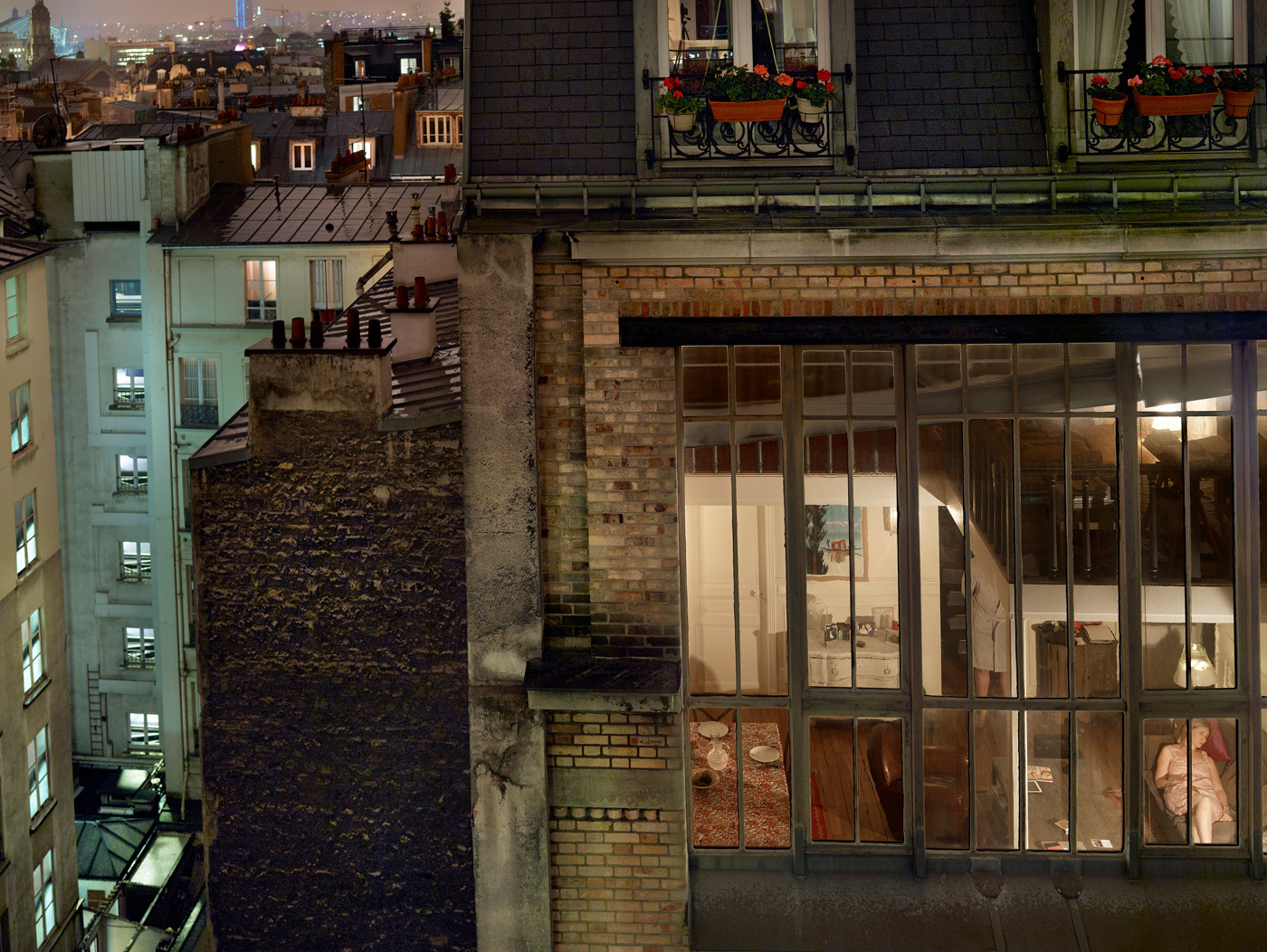
Image Content Callouts
Gail Albert Halaban, Bis rue de Douai, Paris, 9e, le 19 mai, 2013 (from the series Vis-à-Vis). Courtesy the artist
The one on Mistral was bright, with a sunroom that Anna immediately envisaged full of plants, like an indoor garden. The apartment was a little drab. It was one of those seventies buildings, squat and not particularly attractive, which the area is full of, but which to my wife seemed spacious and, as such, appealing.
By contrast, the apartment in Gràcia was on the first and grandest floor. The building was old, with high-quality finishes: a wooden elevator, a modernist main door, and columns and arches inside the apartment, which gave it a certain air of distinction. It was a very stylish apartment, somewhere you could host pleasant dinner parties—a home to be proud of. Unfortunately, it was somewhat gloomy. This was the reason we didn’t choose it right away. In her spare time, Anna did illustrations for children’s books and preferred to have a bright space. I turned the matter over in my mind that weekend and eventually decided on the apartment in Gràcia. Who cared about the lack of sun if we only invited people round in the evenings? Anna drew so infrequently that this hobby of hers shouldn’t restrict us; she could always use one of those artist’s lamps that simulates daylight. I promised her that I personally would take charge of setting it up.
On Monday morning, we called the agency to let them know we had decided on the apartment on Carolines, but the agent told us it was no longer available.
“It’s very much spoken for, I’m afraid. A young couple with two kids has reserved it.”
“We’ve already filled out all the forms,” I argued. “Can’t you just rent it to us?”
But the man said it wasn’t possible. The couple had already paid the deposit, and this would mean going against the agency’s policy.
“If anything changes, I’ll let you know right away,” he promised before hanging up.
That afternoon, Anna went to the agency to pay the deposit for Calle Mistral. But I continued to hope for life in Gràcia: the walks I would take around the neighborhood, the films I would see at the Verdi cinema, the coffees I would drink out on the terraces, the old Teatre Lliure. I was convinced that living near the theater would help me get back to it. It had been more than three years since I’d set foot on a stage. Before the year was up, I imagined, I would be acting again in some play or other. As I thought about my future, the Gràcia apartment became more and more essential in my eyes. On Thursday, however, the agency called to confirm that it had been rented. There was nothing for it but for us to move to the one near Plaza de España.
It was July, and Anna and I focused on sprucing up our new place. We painted the walls and the ceiling, arranged the wardrobes, and planted the indoor garden she had imagined. When we’d finished, we decided to spend a few days away in my parents’ village, and when we came back, the smell of paint had gone. Nonetheless, I had the impression that the place remained uninhabitable. Anna, however, was happy with the results of the changes we’d made, and I said nothing to her.
i’d been working for two years in a ministry for the Generalitat of Catalonia. According to Anna, I should thank heaven for my crappy job and leave acting to my spare time, as she did with her illustrating. But that autumn, I devised a new strategy to get back into it: spending time around the youngsters who still had respect for actors of my generation. I organized various dinners in order to meet directors. Our dinner guests congratulated us on the apartment, but they never offered me any work in their plays, not even as an assistant set designer. Winter was approaching and the situation remained the same.
As time went on, I was overwhelmed by an undefinable sensation, too serene to be called anxiety but unpleasant enough not to go unnoticed. I began to take walks after work to calm myself, roaming the city with no particular route in mind. These walks often culminated in me circling a theater: the Romea, if I was in El Raval, or the Lliure de Montjuïc, closer to home. Most of the time, I didn’t even get close enough to look at the theater bills, but simply waited nearby for people to leave a performance and spill out toward the local bars and restaurants. It was enough for me to breathe in the intensity given off by the audience after a good show, that intensity I had felt so many times myself and that had led me, as a teenager, to believe I was born to act.
One of these walks took me back to Calle Carolines again. Since we’d finished decorating the place on Mistral, I’d thought less about the apartment in Gràcia. It now was part of that endless list of longed-for things that had never come to pass, and to which I believed I had resigned myself. Even so, when I was near the Fontana metro station, I couldn’t stop myself from going to have a look at the building. The street was dark. From the corner, I could make out the lighted windows on the first floor, and as I got closer, I could hear music echoing. I noticed that a floor lamp stood in just the spot where I had planned to put one; I fancied I could see a couple of pot plants too. I stayed there for a few minutes, imagining that the silhouettes in the window were those of my family and me. Not my family with Anna but a different one, a wife and children I did not know, and who inspired a tenderness in me that was both profound and unbearable.
I felt like a stranger had taken over my face.
Back home, Anna had made dinner and was waiting for me in the dining room, reading. I went to wash my hands, and when I looked in the mirror, I felt like a stranger had taken over my face. I thought about the other house for the rest of the night. I couldn’t let go of the idea that it was more suited to my tastes and my way of being, in the same way that the one on Mistral was more appropriate for Anna. As consolation, I told myself that an apartment is like a child in whom the genes of two families are mixed. In this case, my wife’s tastes had triumphed; perhaps next time it would be my turn.
That Friday, I headed once again to the building in Gràcia. It was already dark when I got off the metro at Fontana. This time, no lights were on in the apartment. Almost all the windows were shut. That’s normal, I thought. No one’s home at this time. I decided to go to a shabby, Parisian-esque café across the street, choosing a table near the road and ordering a decaf café con leche. On the wall, there was a poster for the season at Gràcia’s Teatre Lliure, which was putting on Ubu Roi, with Alfred Jarry’s character adapted to Catalan politics. The play was running for the whole winter season. Although I had heard good things, I wasn’t going to see it. Xavi Mestre, a dark, muscular guy who played the lead, had been a classmate of mine at drama school. After graduation, Xavi had traveled to Italy and then Denmark to train with Eugenio Barba. When he returned, the Catalan theater world embraced him like a messiah, giving him roles that no one of our generation had managed to secure. As I sipped my coffee, my gaze moved between the theater listings and the entrance to the building opposite. Two places that had denied me access, except as a spectator.
Then I saw a woman stop in front of the property. She couldn’t have been much older than thirty. She was slim and blond, with an attractive face, and her hair tied up in a casual but elegant style. Beside her was a pram, and a small boy waiting for her to open the door. A few minutes later, the lights went on in the first-floor apartment. The boy’s silhouette appeared in the window and, further in, the woman with a baby in her arms. The warm atmosphere of the place spilled out toward the café on the corner. I watched for a few minutes, then paid for my coffee and went home. Anna had already eaten, so I found her in bed watching TV.
On Monday, we got up at the same time as usual. We left the house, heading in opposite directions. But instead of taking the metro to work, I sat on the green line like a zombie until I got to Fontana. I waited for an hour in the café before I saw the first-floor tenant emerge. Judging by the little boy’s outfit, she was taking him to school. I left a few coins on the table and prepared to follow her.
I called in sick to the office all week and, for five days, trailed the woman through the streets of Gràcia. By Wednesday, I knew her habits and schedule: After dropping the boy off, she would go back home and feed the baby in the living-room armchair until ten. Later, she would take the pram out to Plaza de la Virreina, where she sat and read in a café until it was time for lunch. Then she picked the little boy up from school and went back home. She hardly ever went out in the afternoons.
The rest of my time—the hours not devoted to my espionage—seemed trivial to me; my own life was like a TV advertisement interrupting a thrilling film. There was nothing I could do about this, except put up with it. Anna began making sarcastic comments, saying that I was on another planet.
On Thursday morning, when I left the house to head to the metro station, I was almost run over by a rubbish truck. I told myself that my wife was right: I ought to stop this nonsense and focus on work, but I couldn’t entirely shake my feelings about it, just as I couldn’t entirely shake my feelings about living on a street full of bureaucrats and immigrants, or about the graffiti on the walls of the metro. I couldn’t shake my feelings about the thick Barcelona accent of my colleagues at work, or the way the cortados tasted in the coffee shop on the corner. Our neighborhood wasn’t bad, the building wasn’t bad, and the apartment was fine, but I struggled to see anything that was good. Life seemed unjust in every aspect. As a trained actor, I could feign the conformity my neighbors had embraced, but I couldn’t stop asking myself which year or at which exit I had gotten off the highway that would have led to my destiny, or, conversely, which corner I should have turned to not end up on this avenue to the frustrated suburb of one’s forties. My intuition told me that something good was waiting for me in the apartment we hadn’t rented, something unusual and refreshing, a new start.
As the days went by, my discretion began to feel unbearable. I wanted to talk to the woman, gain her trust, and get her to invite me to her house. And so that Thursday morning, I decided to intercept her at the café on La Virreina.
It was a sunny winter morning, the sort when it’s nice to sit outside on the terrace of a café. She took off her coat, sat a couple of tables away from me, and ordered a coffee. Watching her, I felt the beating of my heart speed up. I blurted out my question bluntly but naturally.
“You were at the Institut del Teatre, weren’t you?”
The woman looked up. Her blue eyes stared hard at me for a few seconds.
“No,” she replied, with a foreign accent I struggled to place. “But my husband was.”
We chatted for a few minutes. She told me she was Danish and had studied set design in Copenhagen until deciding to move to Barcelona to marry an actor. Before she even uttered her husband’s surname, I realized I was talking to Mestre’s wife.
“Don’t tell me you’re married to Xavi,” I said, feigning amazement.
I pretended to show a genuine interest in my ex-classmate’s career; I shared three anecdotes about our paths crossing as students, shamelessly amplifying the significance of our relationship. She seemed charmed and listened attentively for as long as her maternal duties allowed her.
“Xavi’s classmates hardly ever come to his shows. We should get together another day,” she said as she got up to rush to her son’s school. She gave me her card; her name was Josephina, and she used her married surname.
I went home and put the card in a drawer. I didn’t have the slightest intention of calling her, or of following her around any longer.
Three weeks later, Anna rang to tell me that Xavi Mestre had called the house that afternoon.
“He wants us to go for dinner at his place!” she announced incredulously, as if I had been nominated for an Oscar.
“And what did you say?” I asked fearfully.
“I told him Friday would be perfect. And I bet you can’t guess which street they live on!”
“Actually, I can. They were the ones who beat us to the apartment,” I replied, hoping Anna would hate them a little bit with me. But she had always preferred our apartment.
even though we had never been friends, Xavi behaved as if he really were pleased to see me. The dinner was delicious, and the apartment looked even lovelier than it had when the agency showed it to us. I found Mestre to be much changed, grown older and scrawny, more like the king Ubu than the boy I had known twenty years earlier. I wondered if he was ill or if his appearance was the result of the long-running play. Rather than making him pitiful, however, this premature old age just accentuated his air of superiority. Over dinner, he told me that none of his classmates from the Institut del Teatre had wanted anything to do with him since his return to Spain.
“It’s no surprise all those second-rate actors hate you,” I said to indulge him. “They’re bound to be jealous…” I added, earning his sympathy on the spot.
During dinner, I got up twice to go to the toilet, and so was able to inspect the other rooms of the house, all as sumptuously decorated as the living room. Framed photos of Xavi onstage, as well as a commemorative plaque, lined the hallway. All the furniture and other objects seemed familiar, and I felt a sense of belonging that was hard to bear.
When the night was almost over, Mestre asked me why I had stopped acting. I was about to give him my usual line—that I preferred to have a stable, secure life with a nice apartment for the children Anna and I would have—but I didn’t dare. I shrugged my shoulders and, to my surprise, replied that I couldn’t bear the arts scene, so full of rancor, bitchiness, and scandal, and had chosen to step away. He assured me that he understood perfectly.
It was a strange evening. We talked a lot about our studies, the dreams we had had, the path each one of us had chosen. Xavi described the play to me and his relationship with Catalan theater, which wasn’t as good as I had imagined. I was surprised by how honest he was. In his voice I detected a certain bitterness that I couldn’t figure out at the time.
That December was the coldest I can remember. The chill got into our bones.
We talked and drank until the early hours. We promised to stay in touch, and Anna and I said we would have them over for dinner soon. I don’t remember exactly how we got home. When I woke up, my pounding head was a putrid swamp. Anna was staring icily at me. An hour or so later, she accused me of having designs on Mestre’s wife. She asked me not to see Josephina again.
Even so, I rang that evening to thank them for dinner. Josephina answered the phone, explaining that Xavi was ill.
“In general, he’s managing it quite well,” she said. “But today he couldn’t even get out of bed.”
For the next few days, I couldn’t get Josephina out of my head. I couldn’t tell if what attracted me to her was her personality and her looks or if my fascination was because she was married to Xavi Mestre, a man whom I envied everything, including his contentious relationship with Catalan theater.
That December was the coldest I can remember. The chill got into our bones. Anna was still upset. I went back to the apartment on Carolines several times, although without her. I recall those visits to Xavi Mestre as the only interesting thing I did that winter. We would drink orujo and play chess in his study, where the sunlight hardly ever entered. During these games, he would grow distracted, remembering our shared past. I couldn’t believe that, having been so successful, he felt nostalgic for that miserable period.
One afternoon, as we sipped our drinks, he announced that he wasn’t going to finish the run of Ubu. When I asked why, he showed me a letter with the logo of a private clinic on it.
“My doctor insists I need complete rest, so I asked Rigola to postpone the show, but the damn idiot wants to replace me instead. Can you believe it?”
In the next room, the little boy started shouting. When I asked Xavi what he would do, he replied:
“I’ll think of something.”
I came downstairs, surprised at his answer. As ill as he was, the man still brimmed with self-confidence.
As I left the apartment block, I ran into Josephina, who was waiting for me in front of the café where I had spied on her apartment so many times. Her eyes were swollen.
I sat down with her at a table in the back. She spoke in a low voice, as if worried the other customers might hear. She explained the seriousness of the latest results. According to her, Xavi’s illness was the consequence of several years of work without a break. He was stubborn as well as selfish. She also spoke bitterly of the director who wanted to kick him out on the street like a dog. I tried to reassure her: asking Rigola to suspend the run because Xavi was ill was like asking Rigola to commit suicide.
“Besides, think of the other actors. They’d be affected too.”
As I said all this, I took her tenderly by the hand. But neither my words nor my sympathetic gestures managed to soothe her.
From that point on, I visited more often. I went three or four times a week, excluding Saturdays and Sundays. When I left work, I didn’t even go home; instead, I took the number 22 bus, getting off a few stops early to go to the supermarket. (If there is anything I can say in my favor, it is that I always arrived with something to eat.) Every evening, I offered to set the table, change the baby, or play with the little boy. It wasn’t hard to get used to the house, since, as I’ve said, it had always felt familiar to me. When I arrived, I would hang my coat on the rack and leave my briefcase in the hallway, then go to the kitchen to put away the things I had bought. Little by little, I began turning into another member of the family. I knew exactly where each plate went in the kitchen, how to set the table, even how to change the bedsheets if necessary. In the bathroom, where I liked to sit for ages, I would always find my two favorite magazines.
His discipline and concentration would have made anyone feel bad, not just a suckerfish like me.
Just as he had implied he would, Xavi carried on: as soon as he left the play, he started working on a novel. According to Josephina, he was editing a manuscript that had been on the back burner for more than five years, a parody of the Spanish arts scene in Catalonia. I’m sure his discipline and concentration would have made anyone feel bad, not just a suckerfish like me. When it was time for dinner, Josephina would knock a few times on the door of the study to see if he wanted to join us or would rather eat at his desk. When he agreed to eat with us, he always brought a dose of cheer to the table. He would pick a record to put on, light a candle. The children would already be asleep, and the three of us would sit down to enjoy a nice hot soup. Xavi ate less and less as time went on. Sometimes he was so tired he struggled to hold his cutlery. Even so, he managed to finish the novel.
Shortly afterward, Xavi Mestre went into Hospital Sant Pau. Josephina was with him most of the time, and, of course, the chores in the apartment multiplied. I tried to help her as much as I could, answering phone calls and, while I was at it, deleting from their answering machine Anna’s messages, dripping with emotional blackmail; she had by that point acquired the habit of insulting me. But I didn’t have time for her fits of jealousy—I had to take care of bathing the children, making their dinner, and putting them to bed. This was how I began staying there overnight. At first on the sofa, then with the children, who were always scared. And when Josephina stayed over at the hospital, I would sleep in the marital bed too.
Xavi died shortly before the end of winter. We held a funeral for him in Les Corts. It was a sad service, with more journalists than friends in attendance. My wife said she would not come, and I knew better than to insist she did. In the afternoon, Josephina and I both ended up in the café at the funeral home. It was nice in there, although the steamed-up windows obscured the view of the garden. I remember she was wearing a gray cashmere shawl.
When I reached for her hand, I realized I no longer desired her. I’m certain that neither her pain nor the dramatic circumstances had anything to do with it. I asked her about the children, and she told me her mother had taken them to Denmark that morning. She thanked me for having been so close by over the last few days.
“You showed Xavi that not all actors are as obnoxious as he thought.”
I merely smiled modestly.
When we said goodbye, Josephina announced that she was thinking about going back to Copenhagen and asked if I was interested in renting her apartment. I asked her to give me a few days to think about it.
Guadalupe Nettel is the author of Still Born. The Accidentals, a collection of stories, will be published by Bloomsbury in April.
Rosalind Harvey has translated works by Enrique Vila-Matas, Juan Pablo Villalobos, and Guadalupe Nettel.
Featured
What Happened When I Began to Speak Welsh
By learning my family's language, I hoped to join their conversation.
Dan Fox
When Does a Divorce Begin?
Most people think of it as failure. For me it was an achievement.
Anahid Nersessian