a few years ago, I taught the Lebanese American writer and artist Etel Adnan’s short novel, Sitt Marie-Rose (1978), as part of an undergraduate literature class in the Occupied West Bank. Composed in French over a single month (“end to end,” Adnan said) in 1976, Sitt Marie-Rose tells a fictional version of the story of Marie-Rose Boulos, a Syrian Christian woman kidnapped and killed for helping the Palestinians during the first phase of the Lebanese Civil War, which began in 1975. The book was among the class’s favorite texts on the syllabus, and when I asked why they liked it so much, one student raised his hand and replied: “She said what needed to be said.”
Reading During a Genocide
What Etel Adnan's novel taught me
Isabella Hammad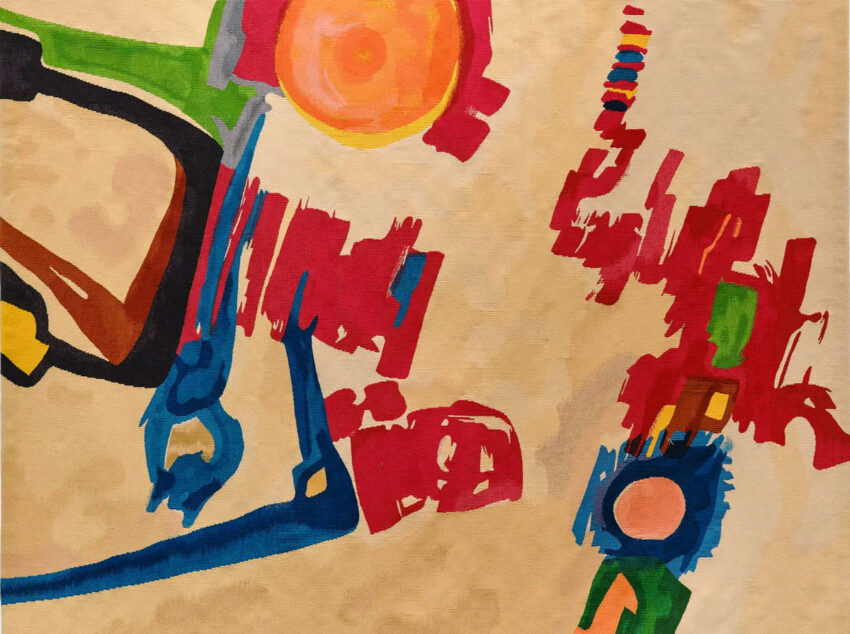
Over the course of the past year, my reading habits have narrowed. As Israel’s genocidal war on the Palestinians in Gaza expanded to Lebanon with the complicity and support of many of the world’s great powers, I found myself passing over books that failed to offer me a route into thinking about the great brutality of the period through which we are living. I returned repeatedly to Ghassan Kanafani and James Baldwin; to Walid Daqqa, Primo Levi, and Natalia Ginzburg; to the poetry and diaries of Palestinians documenting the horrors they are enduring in Gaza, such as those by Atef Abu Saif, Doha Kahlout, Hossam Madhoun, and Mosab Abu Toha; and to accounts of asymmetrical warfare and genocide, such as the essays of Eqbal Ahmad, who participated in the Algerian Revolution, and The Jakarta Method, Vincent Bevins’s narrative of the 1965–66 U.S.-backed genocide in Indonesia. Something similar happened in my relationships: I have struggled with friends who aren’t looking at the live-streamed mass slaughter and calling it by its name—who won’t, in some sense, meet my eye.
Etel Adnan may have lived a life that covered multiple geographies and languages—born in Beirut to Greek and Syrian parents, she spent much of her adulthood in Paris and California—but she retained a visceral and moral connection to the Arab world. Known primarily for her paintings and poetry, she is a writer who can write into the darkness, who sometimes feels like a friend, and who always meets your eye. My student’s comment that “she said what needed to be said” was, I think, a response to the gentle clarity of Adnan’s writing, to her simultaneously cosmic and close vision.
Sitt Marie-Rose opens in Beirut before the war, with a group of young upper-middle-class Christian men who are discussing making a film. An unnamed woman narrates. These young men disdain softness; they would choose driving a powerful Mercedes over sex with a woman, and their speech is full of normalized violence. Cinematically, they prefer Orientalist techniques and references, harking after romantic French imperial images of the Levant and maintaining an aesthetic remove from the suffering they see around them. They consider themselves modern, even European, equipped with sophisticated gear, big cars, and beautiful houses. Mounir, a wealthy ringleader, tries to enlist the narrator—seemingly a cipher for the author—as screenwriter: he suggests a story about a Syrian worker disoriented in Beirut, just as Algerian workers lost in Paris might be struck with admiration for the imperial capital. “They admire us,” Mounir says of the Syrians, in a way heavily inflected by his own class position. This is the peacetime face of the Christian supremacist hatred that erupts a few pages later, when war begins.
The past keeps surging up to obscure the present.
The Lebanese Civil War was precipitated by several factors, including the buildup of Christian nationalist forces in Lebanon and the introduction of a huge number of Palestinian refugees into this situation. In Adnan’s novel, as the night sky fills with explosions, the radio waves with news of kidnappings, and the streets with corpses, this same group of friends becomes a team of Phalangist militants. The Phalangists were a right-wing Maronite Christian party whose paramilitary wings collaborated with the Israelis and fought against the Palestinians and left-wing Lebanese. For Mounir and his friends, “no matter what anyone says, the will of the group rules. We are the Christian Youth and our militia is at war with the Palestinians.” As far as Adnan is concerned, however, their crusade is a war on the poor dressed up as one of religious identity.
We can feel the speed with which Sitt Marie-Rose was written, close to the paroxysm of violence. After the opening prewar section about making the movie, the text tracks war’s fracturing effect on the psyche. “Time is dead” for the unnamed narrator. “Action is fragmented into sections so that no one has an exact image of the whole process.” This exactly describes the shape of the narrative that follows: Marie-Rose is kidnapped, leaving “the world of ordinary speech.” The story breaks into monologues from Marie-Rose and her four assassins—Mounir, once her adolescent paramour; Tony and Fouad, Mounir’s friends; and a priest named Bouna Lias—as well as the deaf children whom Marie-Rose teaches, and who witness her interrogation and killing in a classroom at the school. The killing itself is not narrated linearly. We are told repeatedly that it has happened, and then the text rewinds. The past keeps surging up to obscure the present.
in elena ferrante’s novel The Days of Abandonment, the narrator speaks self-mockingly of “the rules” of writing, according to which “to tell a story you need first of all a measuring stick, a calendar, you have to calculate how much time has passed, how much space has been interposed between you and the facts, the emotions to be narrated. But I felt everything right on top of me, breath against breath.” It is true that writing to any present moment with clarity is a challenge, but the one in which we are now living presents particular difficulties. Given the outpouring of words since October 2023, this is evidently not for lack of trying, yet when writers try, their eyes often stray to the past—for guidance, even escape—or to the future. There has been an alarming recurrence of books and panels and essays titled “After Gaza,” as though the genocide there has ended, as though it is already over, they are all dead.
“I am writing so as not to become brutalized,” the Palestinian writer Muhammad al-Zaqzouq told us in a recent missive from Rafah, “so as not to be consumed by the pitiless machine of war.” Of all the writing being produced, the testimonies of those facing the Israeli onslaught are often clearest. These testimonies have bypassed the gatekeeping and censorship of mainstream Western news outlets and exposed to the world the exterminatory drive of the Zionist project. The assault on Gaza resembles less a war than an explosion of sadistic hatred on a captive population in ways that recall the Israeli invasion of Lebanon in 1982 and the Phalangists’ consequent massacres of Palestinians in the Sabra and Shatila refugee camps, when Israeli forces illuminated the night sky with flares so that the Phalangists could see what they were doing.
In Zaqzouq’s description of the “endless queues and unimaginable humiliation for a few rounds of bread or a gallon of drinking water . . . and the constant struggle to keep up with fast-moving events, which spread dementedly from one part of Gaza to another,” I hear echoes of Adnan’s 1978 novel. Or perhaps it is in Adnan’s words that I hear echoes of Zaqzouq. Amid the daily mortars that “smash like so many rotten melons” and “the hot odor of putrified flesh,” she describes how human beings are deprived of their humanness. Adnan’s first, unnamed narrator tells us her spine has become twisted and stunted like a fallen tree, her eyes “like plants that open during the day and close at night.” Encircled with so much death and meaningless destruction, human life “becomes primitive. The cells remember the solar pulses of their first days, back when they were sleeping, back in the prehuman stage. Everything that has been learned seems to become blurred.” On a Zoom call this summer, the writer Mahmoud al-Shaer, residing then with his family in al-Mawasi’s so-called humanitarian zone, which has been repeatedly bombarded by the Israeli army, said: “They called us human animals, but we are living in conditions worse than those of animals. We live like ants. On the sand, and under it.”
Even the aesthetically detached discussion among the would-be filmmakers in the first part of Sitt Marie-Rose resounds strangely with the 2024 Israeli invasion of Lebanon. A parade of images and videos from Israeli social media accounts included clips of soldiers playing the piano inside a house they had destroyed in South Lebanon, as well as posts admiring the “devastatingly beautiful” natural landscapes there—“What we would give for a world where we could hike the forests of Lebanon,” one Israeli commentator said on X—or the deliciousness of Lebanese olives. (These seem distinct from the more self-evidently sadistic posts of Israeli soldiers in Gaza wearing the underwear of Palestinian women they have killed or displaced.) When fighting between Israel and Hezbollah escalated in September 2024, Prime Minister Benjamin Netanyahu made a speech calling on “Lebanon” to get out of harm’s way and to reject Hezbollah’s actions against Israel—a clear shot at reviving tensions along sectarian lines and appealing to a previous alliance between Israel and the Lebanese Christian right. While much of Lebanese society, like other Arab peoples, identifies strongly with the Palestinian cause, discrimination against Palestinians and Syrians continues to be a live issue in the country. Across the region, turning against the Palestinians and seeking the economic and military benefits of alliance with Western and Israeli powers remains a real possibility, one increasingly acted on: recent normalization deals with Israel have abrogated Arab governmental solidarity with the Palestinian cause, and while the genocide in Gaza put the Saudi normalization deal on hold, for example, the stateless Palestinians still risk becoming pawns in a wider geopolitical game.
I think often of Etel’s suns, bald, unshackled by clouds. Source of life and of disaster.
In Adnan’s rage over the fascism of the Phalangists in the seventies, and in her concern for the role of the dispossessed Palestinian in the Arab mind—whether as a “rat” or the possibility of “a new beginning”—she is engaging in a specifically intra-Arab conversation. To do so in a European language is to walk a fine line. It makes it easier for a Western Orientalist gaze to co-opt the conversation and blame the conflict on the “tribal” nature of the peoples of the East. But Adnan is careful to diagnose the colonial lineage of the Lebanese Christian faction, which remains entangled with the Zionist project’s idea of itself as a bastion of Western civilization fighting against the forces of darkness. Lebanese society’s sectarianism is itself a legacy of French rule, which defined the country’s borders and gave special preference to the Christian population. The Phalangists’ fantasies of purity and modernity were in turn inspired by the industrialized warfare of the developed West, and in their disavowal of the feminine, they embraced a chauvinistic violence that they associated mythically with the Crusaders. The figure of Marie-Rose demonstrates that the antidote to chauvinism is the “love of the Stranger.” And the Stranger, in this case, is the Palestinian.
Samir Kassir has described how, following the 1967 defeat and the steady relocation of the Palestinian resistance to Beirut, hostility toward Palestinians in Lebanon was often disguised in the pejorative word gharīb (plural ghurabāʾ), meaning “stranger” or “intruder.” While the word for foreigner, ajnabi, was and is usually applied to Europeans or Americans, gharīb really signified an Arab from elsewhere. Marie-Rose Boulos was punished with the ultimate silencing for her love of the gharīb—she was in a relationship with a Palestinian doctor and was supporting the Palestinians in the camps—but with this novel, Adnan gives her the chance, albeit imaginary, to say her piece. When Marie-Rose bursts into a lyrical polemic against her attackers, it feels plausible that she is ventriloquizing Adnan’s own rage and shock. (“She said what needed to be said.”) The love she avows is not saccharine but robust: a force like electricity, an energy with real political power. A current running through everything, both destructive and creative, like the sun, which burns not only for other human beings but also for natural things like the sea.
Adnan grew up with Turkish and Greek at home and French at school; her experience of Arabic was more of a visual relationship with the written script than an inhabiting of the tongue. When she started painting at the age of thirty-five after having long been a poet, she said that while she had been writing in French, she would now paint in Arabic. Her bright-hued landscapes, depicted in thick oils applied with a palette knife, often feature a sun over mountains or the sea, invoking Beirut as much as California. Given our unhealthy summer days of unprecedented global heat and increasingly dangerous dryness from Athens to Los Angeles, I think often of Etel’s suns, bald, unshackled by clouds. Source of life and of disaster.
In that classroom in Palestine a few years ago, I asked the student who spoke up to pick a passage he liked best from the novel. He chose a dialogue between Marie-Rose and Mounir, her former-sweetheart-cum-executioner. “And since when does being at home put you above morality?” she asks him. “What morality?” Mounir replies. “I only recognize the power of the State, even when that’s based on nothing but violence. It’s violence that accelerates the progress of a people.” To which Marie-Rose responds:
Morality is violence. An invisible violence at first. Love is a supreme violence, hidden deep in the darkness of our atoms. When a stream flows into a river, it’s love and it’s violence. When a cloud loses itself in the sky, it’s a marriage. When the roots of a tree split open a rock it’s the movement of life. When the sea rises and falls back only to rise again it’s the process of History. When a man and a woman find each other in the silence of the night, it’s the beginning of the end of the tribe’s power, and death itself becomes a challenge to the ascendancy of the group.
In an earlier passage, the nameless narrator recalls looking at an electric wire torn from its socket, the strands of brilliant copper seeming to call to her: “And I wanted to touch them, to reunite them in my hand, to make that current pass through my body, and see what it was like to burn.” She, and we, learn something here about the chauvinist’s thirst for violence, about what it is to desire contact with that mortal energy. And now Marie-Rose has tried to shock Mounir, and us, into reorienting our energy—not into some mild humanism or docile sympathy but into a love that possesses the power of fire, of the sun, of fantastic and terrifying natural movements of the earth.
“The more she spoke to them of love,” Adnan tells us, “the more they are afraid.”
Isabella Hammad is the author of the novels The Parisian and Enter Ghost. Her most recent book, Recognizing the Stranger: On Palestine and Narrative, was published in September 2024.
Featured
What Happened When I Began to Speak Welsh
By learning my family's language, I hoped to join their conversation.
Dan Fox
When Does a Divorce Begin?
Most people think of it as failure. For me it was an achievement.
Anahid Nersessian