this is a pivotal moment for American capitalism. Even though GDP and household incomes have grown steadily in this century, most Americans say they feel dissatisfied with the state of the economy and believe that the country’s economic future will be worse than its past. There is a deep sense of discontent with capitalism, and a conviction that the two paradigms of political economy that have dominated the West since World War II—Keynesian social democracy on the one hand and free-market-centered neoliberalism on the other—no longer work. And while politicians like Bernie Sanders, with his left-wing populism, and Donald Trump, with his right-wing nationalism, have tapped into this discontent, what the new order will ultimately look like remains wholly unclear.
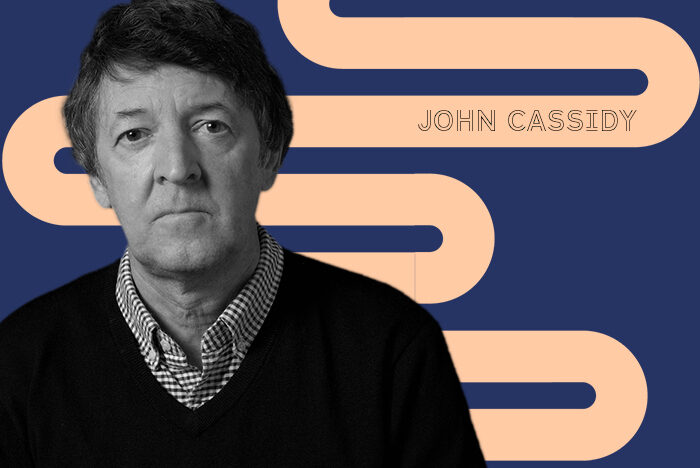
This is, then, a perfect moment for John Cassidy’s new book, Capitalism and Its Critics, which takes, as its title suggests, a wide-ranging look at the history of capitalism through the eyes of some of its foremost critics. Cassidy includes not just the obvious ones—Karl Marx, Friedrich Engels, Thorstein Veblen, and Thomas Piketty, for instance—but also lesser-known yet extraordinarily interesting writers, such as the Irish proto-socialist William Thompson, the French Peruvian feminist socialist Flora Tristan, and the Indian economist J. C. Kumarappa.
Cassidy, a longtime writer on economics for The New Yorker, not only does a masterful job of tracing the history of critiques of capitalism and of attempts to come up with a workable alternative to it, but also illuminates the evolution of the system itself, showcasing its remarkable knack for reinventing itself and adapting to historical circumstances in order to survive—something it may be in the process of doing again right now. He and I spoke over Zoom about his book, and about the past, present, and possible future of capitalism. Our conversation has been edited for style and content.
—james surowiecki, senior editor
JAMES SUROWIECKI I’ll start by asking you the most obvious question: Namely, why did you want to write this book? What was the idea behind it?
JOHN CASSIDY In 2016, when Trump was running for office and Bernie was running, it seemed clear that there was something big happening. The postwar system seemed to have run aground. You could see the rise of populism. There were polls showing that, at least with young people, socialism was as popular as capitalism in the U.S. And I thought, You know what? There must be a book here explaining how we got to this place.
Initially, though, I thought: Oh, no, it’s going to be another history of the rise and fall of neoliberalism, and there are already lots of those, some of them very good.
But a lot of these debates about capitalism, inequality, exploitation, class conflict, they go back to the very beginning of the system, so I thought, Maybe there’s a way to go big and long. And then it just kept getting bigger and bigger. I was originally going to start with Friedrich Engels in Manchester and the arguments over nineteenth-century industrial capitalism. But my editors said: “Why stop there? What was that debate built on?”
While this book is really about industrial capitalism, industrial capitalism emerged from a previous form of capitalism—mercantile capitalism—and colonialism. So I decided to start around 1770 and the rise of the cotton industry, because that was when the first mechanized cotton factory opened, in Derbyshire, while at the same time, there was a huge scandal in Great Britain and London having to do with the East India Company, which was bailed out pretty much like the big banks were bailed out in 2008.
Eventually, what started out as a sort of sideways look at the history of neoliberalism ended up as a history of capitalism told through the eyes of some of its most important and interesting critics.
JS One of the things that’s intriguing about the book, particularly at this moment in time, is that while it’s a history of the criticisms of the capitalist system, it’s also, in a way, a history of the way the system has adapted and evolved and been reformed, often in the direction of becoming more humane (though maybe that stopped in the 1970s). So, two questions: First, what are the factors that are necessary to meaningfully change the system?
JC Well, you have to have a political system that’s responsive to the demands of the people. You didn’t have that in Great Britain for most of the nineteenth century, because it wasn’t a democracy. The vast majority of the population—including, until 1867, most of the industrial middle class—just didn’t have a vote.
But then, on top of that, to get reform on a national level, it feels like you need some crisis, like most obviously the Great Depression. Postwar Keynesianism wouldn’t have emerged without the Depression and World War II. One reason the British welfare state exists is because the British working class had been fighting the war for six years, and nobody could make the argument anymore that they didn’t deserve health care or education for their kids. And I think it was much the same with the G.I. Bill, et cetera, in the U.S.
That then raises the question: Okay, what’s going to be the crisis which produces something similar, and leads to a dramatic reform of the system, in the twenty-first century? And that’s a very good, large question. You would have thought that maybe the financial crisis of 2007 to 2009 would have been that, and would have produced a big shift in political economy to the left. But what we’ve seen instead is that it’s produced more of a shift to the right.
JS I want to follow up on that point. But before that, let me ask a second question about change: How important do you think the critics of capitalism that you write about were in changing the system?
JC To use an economic term, I think they were important on the margin. Big social changes are driven by political movements, and by material conditions, not by academics. But Milton Friedman, of all people, had a great saying, which I’ll paraphrase as: “The role of academics is to keep ideas alive until the world produces the chance to put them into it.” I mean, that was definitely true of him. He was describing his own life there, because for a long time he was an outcast, but eventually his ideas became enormously influential. And, obviously, Keynesianism depended to some extent on Keynes himself and his ideas. So even if I don’t agree with Keynes that ideas are everything, I’m not a 100 percent materialist either. Ideas do matter. If I didn’t think that, there’d have been no point writing the book, right?
Capitalism has these amazing powers of self-regeneration and sustainability and survivability.
JS Right. And, in that sense, the book is very much a book of the moment, because the dominant ideas that have governed the system since World War II—first the Keynesian postwar consensus and then the neoliberal, trust-in-markets vision—seem to have, as you said, run aground. The system is still delivering reasonable economic growth, but voters seem profoundly dissatisfied with the results. And so you’ve seen the emergence of these various alternatives to the older models. How do you make sense of where we are and where we’re going?
JC When I was growing up, many people took it for granted that Keynesian managed capitalism was sustainable, and later, in the Tony Blair / Bill Clinton era, even some people on the center left accepted Margaret Thatcher’s claim that there was no alternative to free-market capitalism. But I think a lot of the big basic questions about the system are coming back again.
I’m not claiming that most people are saying “Let’s get rid of capitalism,” because it still delivers the bacon, to some extent. But I do think that many people are looking for a way to make it work better for everybody, and not just for the few. And that’s basically the main point of the book: that these big questions have never been permanently resolved. Capitalism has these amazing powers of self-regeneration and sustainability and survivability. But it does get reshaped in very fundamental ways over the years. And it seems like this is another moment of transition.
What’s not clear is what the reshaping is going to look like. The last chapter of my book tries to deal with this, and asks: Is there a new paradigm? You could imagine that if AI develops in such a way that we get a massive shift in the distribution of income toward capital, we’ll just have a sort of monopoly tech capitalism, perhaps with a universal basic income to make it more palatable to the masses. But then you have other potential models, such as Chinese state capitalism; Trumpian, right-wing populist, economic nationalism; and then whatever the left candidate is. Intellectually, it’s interesting. Socially and politically, it’s kind of terrifying.
JS What is the left alternative?
JC That’s another huge question. What we want is a new sort of social bargain—in the sense that Keynesianism was built on a social bargain between business, labor, and the government—that can provide an alternative to Trumpian economic nationalism. But this time around, it really has to be on a global scale, which is a huge practical challenge. All these issues—climate change, globalization, labor standards, inequality, capital taxation—you can, to some extent, deal with them on a national level, but to really get a handle on them, you have to have some sort of global approach, at a time when it’s a massive struggle to get anything done globally. So I think, in those terms, we’re building practically from ground zero on the left or center left.
JS And one of the challenges the left faces in trying to build that alternative is that there is no real labor movement, which, as you write about, was very important in shaping Keynesian social democracy.
JC Right. That’s another constraint we’re facing. How do you build a social democracy for the twenty-first century without a strong labor movement of the sort that used to exist? Because in the twentieth century, practically the whole thing was built on the labor movement. Now we have this paradox of so much rhetoric, from Republicans as well as Democrats, around helping the working class at the same time as we are sorely lacking a powerful working-class movement (in the United States, at least).
You do, of course, have the Democratic Party, but it isn’t really a political party in the European sense, with individual membership, and ward meetings, and so on. At the national level, it’s more of a collection of ambitious individual politicians backed by a bunch of different interest groups. That’s a very different idea from a cohesive political movement. When people say to me, “What should we do about the Democratic Party?,” I say, “Well, why don’t we create one?”
JS To shift gears, and to think for a moment about the more radical critics you write about, many of them did not just criticize capitalism but also tried to offer alternative, noncapitalist models of structuring economic life. One of the most interesting alternatives, and one that I think is intuitively appealing to many people, is some variant of what you might call cooperative socialism, where instead of the top-down communist model, economic life is organized in small-scale communities where there’s collective ownership but more freedom of production and exchange. This is an idea that, in different forms, people keep coming up with, but it has never, in the roughly 250 years you cover in this book, been adopted on a meaningful scale in any country. Why do you think that is? Why is top-down, state-controlled communism the only alternative to capitalism that we’ve seen really put into effect?
There just are so many people who feel that, to quote the cliché, they’re not doing better than their parents were.
JC It’s a huge question. And I think now, when we’re asking ourselves if there is an alternative to monopoly tech capitalism (or whatever you want to call it), this question comes back again. You’re seeing people talk about localism and small-scale production versus large-scale production, and asking whether economies can be based on smaller units.
So one of the answers is just the efficiency argument—namely, that large businesses, whatever you think of them, are efficient in an economic sense. There simply are economies of scale in large-scale production. And it’s very hard to overcome that on a local basis.
Now, you could say, “Well, we could keep that for mass production and energy, say, but still organize much of the day-to-day economy on a more communal basis.” If you look at someone like the Indian economist J. C. Kumarappa, whom I write about in the book and who was Gandhi’s economist, his idea was that what used to be called the “commanding heights” of the economy—utilities and big manufacturing plants—would still exist, and would be largely under state control. But below that, things would be run by the private sector, but organized around villages and towns. And he also believed, much like the early cooperative socialists, that these small communities could be largely self-sufficient.
I think the question of why truly radical ideas like that have never really taken off is interesting. And while I don’t really write much in this book about the cultural impact of capitalism, because this is a book about economics, I do think consumerism and individualism are very powerful, and it’s just very hard to sustain communal values on a large scale in a modern capitalist economy. People might like the idea, in principle, of going to live in a small communal community, but would you sign up for it?
JS So do you think the early advocates of these models in particular, like the early Irish socialist William Thompson (whom I’d never heard of before I read your book), did they have a utopian view of human nature, or did they believe that in the society they were living in, with the humans they were writing about, this stuff could really work?
JC I think they did think it could work. To begin with, the individualist, consumerist, materialist mindset wasn’t as strong then as it is now. And the capitalism they were writing about was capitalism in the raw. Capitalism meant factories employing kids and women for very long hours with harsh overseers. They saw it as an inhuman system. And the idea was: We don’t have to push people into cities like Manchester or Leeds. We can set up alternative communities from scratch. They were rejecting the very idea of mass production.
I think it’s hard for us even to conceive of that now. But I also think that Generation Z is more open to radical ideas than the generations above it, perhaps because they grew up after the collapse of the postwar models.
JS One oft-cited reason for that is this sense that the system is not working for ordinary people anymore, which has engendered this quest for a new system, a new way of doing things. But one of the interesting things about the last decade is that, by many measures, working- and middle-class Americans have done reasonably well. Excepting the pandemic, we’ve seen low unemployment, meaningful growth in real wages, and a decline in inequality (not a huge decline, but even so). But none of this seems to have diminished people’s unhappiness, or frustration, with the system. How do you make sense of this?
But this all points to the way that people have given up on the idea that you can just leave everything to the market.
JC It’s true that we’ve seen real wage growth, especially in the bottom half of the income spectrum, since 2015. But if you go back and look at just the wage trends since the early 1970s, for average, nonsupervisory workers, there just has not been much growth, especially compared to the decades before that. And there just are so many people, I think, who feel that, to quote the cliché, they’re not doing better than their parents were. I do think if we’d had more shared wage growth over the last thirty to fifty years, people would feel differently.
And there are other factors too. I think among Generation Z—in places like New York, in particular—the fact that being able to buy an apartment is becoming unattainable is radicalizing, especially when they are seeing older generations living in their million-dollar homes.
The other aspect of this is that social mobility has clearly declined. It used to be the case that the correlation between the incomes of parents and the incomes of their children was a lot lower in the U.S. than it was elsewhere in the developed world. But between the 1970s and the 1980s and 1990s, the correlations started to get closer, meaning that social stratification was becoming more important.
One way of looking at it is that Americans of the last generation have gotten an education in the existence of the class system. When I first came here in the 1980s, people used to seriously say to me, “There is no class system in the U.S.” You don’t hear people saying that anymore. So, I mean, I guess that’s political progress in a way.
JS One of the odder developments of the past few months has been this emergence on the Trumpian right of a kind of anti-consumerist rhetoric, with Trump talking about how it’ll be fine if little girls only have three dolls instead of thirty, or five pencils instead of two hundred and fifty, and Treasury Secretary Scott Bessent talking about the “spiritual degradation of the working class.” Obviously, this is mainly a way of trying to convince Americans not to get upset about tariffs, but it also seems to reflect the growing popularity on the right, as well as the left, of the idea that the system needs to be reined in, or pushed in a different way.
JC I have this term in the book, managed capitalism, which I use to describe postwar Keynesian social democracy. And I think on the left and the right now, you can see people grasping for some sort of managed capitalism.
In terms of Trump specifically, one of the critiques I would make of my own book is that I don’t have enough conservative critics of capitalism in there. But I did write about Thomas Carlyle, who in the nineteenth century was a kind of cultural critic of capitalism, a moral critic, while being on the right. And at the end of the book, I also write about the American Compass people, like Oren Cass, who are critics of unfettered monopoly tech capitalism, and are groping around, again, for some sort of managed capitalism. I don’t think they’ve got the solution, and Trump’s solution is obviously just tariffs.
But this all points to the way that people have given up on the idea that you can just leave everything to the market, and that, as I said, the big basic questions about capitalism, about economic systems generally, are coming back again.
James Surowiecki is a journalist and author of The Wisdom of Crowds. A former columnist for The New Yorker, he is now a senior editor at The Yale Review and a contributing writer for Fast Company and The Atlantic.
Newsletter
Sign up for The Yale Review newsletter to receive our latest articles in your inbox, as well as treasures from the archives, news, events, and more.