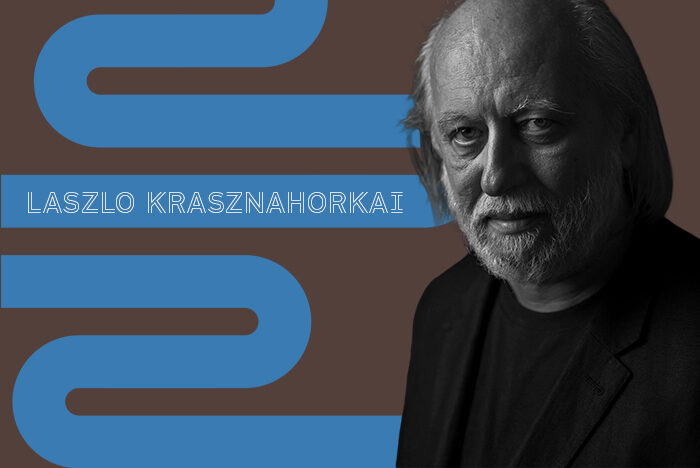
The last time I saw László Krasznahorkai, he declared his love for me. Admittedly, he was making a rhetorical point about his singular prose style, and we were speaking in front of an audience at an art gallery, but it still felt good. Krasznahorkai is the author of an extraordinary body of fiction, which has made him one of Hungary’s most prominent writers and a perennial candidate for the Nobel Prize. His collaborations with the filmmaker Béla Tarr have brought the bleak, existentially freighted atmosphere of his early work to cinema audiences around the world. His narratives consist of single unbroken sentences that seem to have an almost infinite flexibility, swerving from labyrinthine philosophical musings to earthy humor. In his opinion, experiences such as love—particularly love that has taken time and courage to express—cannot be contained in short phrases. The full stop, he has said in the past, “belongs to God,” and the flow of his writing has a profound humanism. It isn’t the fragmented interiority of the old modernist “stream of consciousness,” but a kind of all-encompassing curiosity about the world, which carries the reader along in its current.
Krasznahorkai was born in Hungary in 1954. His early career was marked by his inability to travel (the secret police confiscated his passport), and his novels, such as Satantango and The Melancholy of Resistance, convey an almost unbearable sense of suffocation. After the fall of the Iron Curtain, he found a lightness that expressed itself in work such as Seiobo There Below, which engages profoundly with Asian art and philosophy, particularly Buddhism. His recent novel Herscht 07769 counterpoints Bach with German neo-Nazism. The story he just published in The Yale Review, “An Angel Passed Above Us,” contrasts the muddy trenches of the war in Ukraine with the phantasmagoric promises of technological globalization.
I spoke with Krasznahorkai the week of Trump’s inauguration over email. The conversation has been edited for length and clarity.
—Hari Kunzru
HARI KUNZRU Your story “An Angel Passed Above Us” is set in Ukraine. What does the war in Ukraine mean for you? Your perspective on this conflict—as a European, a Hungarian, someone who has lived for a long time in Germany—would be interesting to hear.
LÁSZLÓ KRASZNAHORKAI That the First World War is essentially repeating itself?! What do I think?!
It fills me with horror. Hungary is a neighboring country of Ukraine, and the Orbán regime is taking an unprecedented stance—almost unparalleled in Hungarian history. This is partly because, until now, we were always the ones being attacked and losing, and partly because I could never have imagined that the Hungarian political leadership would talk about so-called neutrality in this matter!
How can a country be neutral when the Russians invade a neighboring country? And haven’t they been killing Ukrainians for nearly three years? What do you mean “This is an internal Slavic affair”?!—as the Hungarian prime minister puts it?! How can it be an internal matter when people are being killed? And it is the leader of a country saying this—a country that has been constantly invaded throughout history. Among others, by the Russians. And these Russians are the same Russians.
This Hungarian regime is a psychiatric case. There is the inhuman calculation behind it: Maybe they have already killed my daughter, but I would rather accept that so that they don’t harm my mother. But they will harm her. They will kill both. Is it so hard to understand?
HK “An Angel Passed Above Us” follows two dying men in a dugout, one of whom is telling a kind of fairy tale about the wonders of globalization to the other. The contrast between that fairy tale and the reality for the two dying men is very stark. It seems to undercut the techno-optimistic tone of this tale about the accelerating world. Could you say something more about why you have chosen to place these two elements side by side?
LK A dirty, rotten war is unfolding before my eyes. The world is starting to get used to it. I cannot get used to it. I am incapable of accepting that people are killing people. Maybe I’m a psychiatric case. All of this is happening while, in the digital space, there is a vision of the future promising that the terrifyingly rapid advancement of technology will soon bring a beautiful new world. This is complete madness. While a fundamentally twentieth-century war is raging, someone is talking about how we’ll soon be going to Mars. I hope Putin and his sympathizers will be the first passengers.
HK Your storyteller insists that “he was not an analyst of the future but rather of trends, data, facts.” He is uncomfortable with the “cosmic” level and the individual “psychological level.” He prefers the level of the social. Is knowledge of “the future” something more spiritual or metaphysical than this kind of empirical, “data-driven” knowledge?
LK It’s quite an uncomfortable question. After all, in this piece, the events do not unfold in some general context; rather, one wounded man is trying to keep another, mortally wounded, alive in a trench by talking to him about hope—about a beautiful new world where everything will be different, where everything will be wonderful. A basic human instinct drives him to offer comfort to another. They have no other hope, and even the one telling the story of the digital future knows he is merely stalling for time, hoping their comrades might come back for them—even though he knows, as does the other, that in their current situation, this is impossible. So no, this speech does not have a spiritual or metaphysical dimension; it is, in fact, deeply practical: to keep the more severely wounded man alive through the suggestion of futile hope.
Newsletter
Sign up for The Yale Review newsletter to receive our latest articles in your inbox, as well as treasures from the archives, news, events, and more.
HK This setting—the front line of a brutal trench war—is somehow familiar in your writing. I know that Sontag’s description of you as a “master of the apocalypse” follows you around. But if your writing is about the experience of apocalypse, it does not seem to be a sudden event but something slow and grinding. What is our relationship to the future? Are these the end times? Or are we living after some kind of apocalyptic event?
LK The apocalypse is not a single event, as the New Testament’s prophecy of the Last Judgment threatens. The apocalypse is a process that has been going on for a very long time and will continue for a very long time. The apocalypse is now. The apocalypse is an ongoing judgment.
We can only delude ourselves with the future; hope always belongs to the future. And the future never arrives. It is always just about to come. Only what is now exists.
We know nothing about the past because what we think of as the past is merely a story about the past. In reality, the present is also just a story. It contains both the story of the past and the future that will never come. But at least what we live as the present exists. And only that exists. Hell and heaven are both on Earth, and they are here now. We do not have to wait for them. Yet we do, comforting ourselves with the score of hope.
HK You have written a lot, particularly in Seiobo There Below, about art. What is art’s role in the future—in imagining it, bringing it into being? Is there anything salvific or redemptive about art?
LK Art is humanity’s extraordinary response to the sense of lostness that is our fate. Beauty exists. It lies beyond a boundary where we must constantly halt; we cannot go further to grasp or touch beauty—we can only gaze at it from this boundary and acknowledge that, yes, there is truly something out there in the distance. Beauty is a construction, a complex creation of hope and higher order.
HK We have spoken before about the way literary characters come into being as presences manifested through writers into the world. In an interview with The Paris Review, you said that “every character in so-called eternal fiction came through ordinary people. This is a secret process, but I’m entirely sure that it’s true.” Could you expand on this?
LK Only the ordinary person exists. And they are sacred.