In A Closer Look, a writer annotates a piece of art or an archival object.
Kafka's Double Portrait
What a pencil sketch reveals about the writer’s view of his mother
Lynne Tillman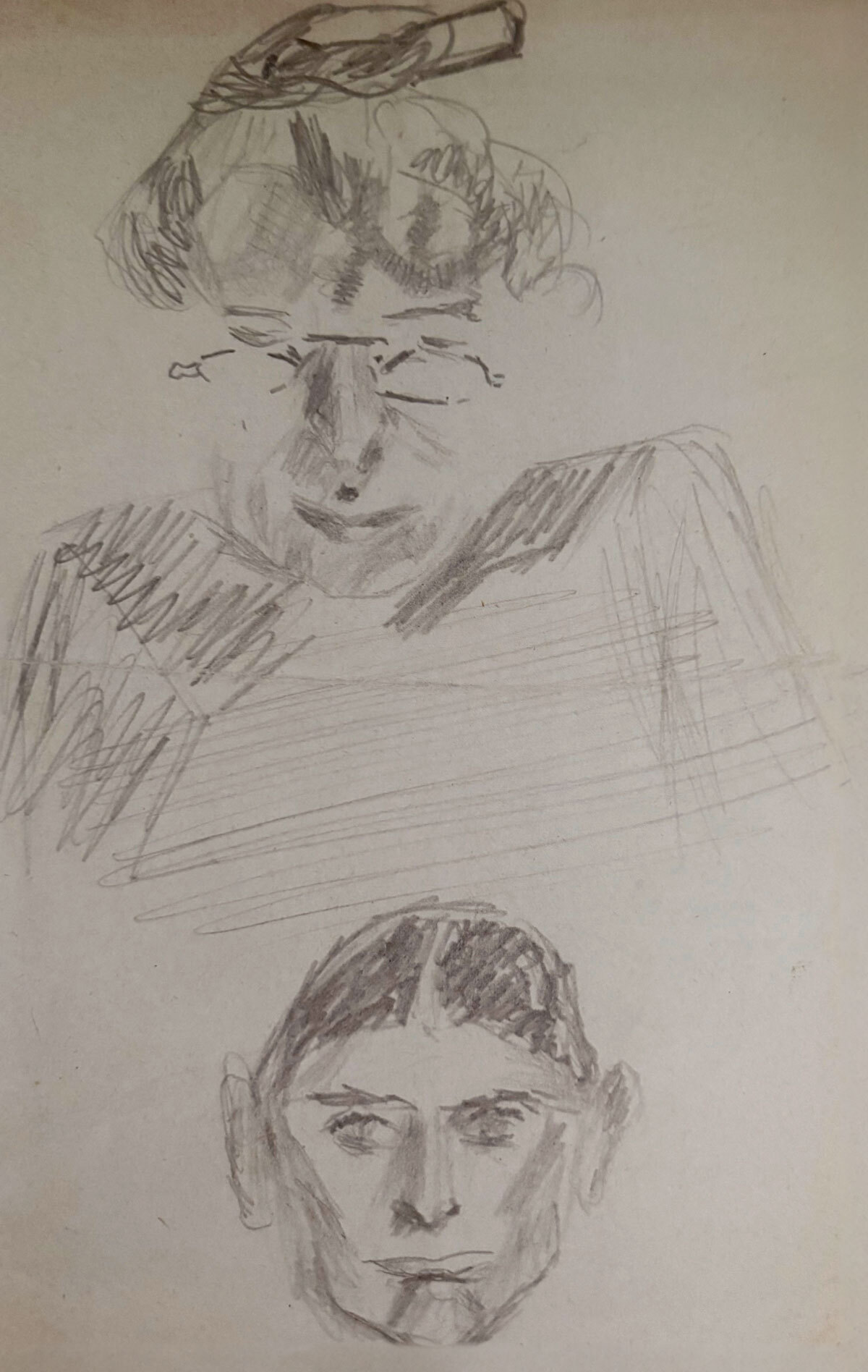
Image Content Callouts
Courtesy the National Library of Israel, Max Brod Archive
two heads drawn in pencil float in a white rectangle. The heads are not touching; there is a lot of space between them. Franz Kafka’s spatial arrangement in this self-portrait and sketch of his mother might be significant, and might not.
Kafka didn’t leave space in his prose. Descriptions, settings, characterizations have an almost suffocating concision—nothing is incidental. Except to say, all of Kafka’s writing is built of incidents.
Space between the heads might suggest reluctance or anxiety about rendering his and his mother’s portraits. In Judaism, believers are forbidden from making graven images. Being forbidden was grave to Kafka, a great source in his writing.
The drawing, which is undated, tells something about Kafka’s attachment to his mother, Julie. Little is written about her. She was meant to be kind and often silent. Mothers are frequently neglected in tales of famous men, fathers emphasized, especially in Kafka’s case, because of the hundred-page handwritten screed he wrote in 1919. It was later published as Letter to the Father in 1953.
It’s said that Kafka gave the letter to his mother for advice; she said, Don’t show it to your father, Hermann, so he didn’t. Or, as his literary executor Max Brod later wrote, Kafka asked his mother to give it to his father, and she didn’t. Similarly, Kafka asked Brod to burn all his work after he died, and Brod didn’t.
Support Our Writers
A sustaining subscription provides vital, ongoing support for The Yale Review and the writers we publish—and includes new holiday merch.
Become a Sustaining Subscriber
kafka’s head rests at the bottom of the paper, the chin nearly touching its edge. The image looks somewhat like his portrait photographs. Fixed eyes stare out at viewers with a kind of defiance and severity. (Contemporaries said his eyes were beautiful.) His hair is parted in the middle, sternly pasted on his head. In Kafka’s day, the style was fashionable and considered bookish. A middle part could also indicate incipient baldness.
The two heads form a double portrait, a relationship. Kafka’s self-portrait is unimaginative, lifeless. Did he feel this about himself or was it poor artistry. How strange claiming that anything Kafka is not special.
His mother isn’t just a head; she has shoulders and neck. The drawing, with abstract elements, is mysterious and subtle. Her unruly bun touches the top of the drawing paper and seems to have been added later; the lines are darker than the other ones. Julie appears to be looking down, her nose lightly shaded, prominent relative to her other features. The rest of her hair, loosely drawn, covers her forehead. That encourages interpretation and association, while in his self-portrait, every line is hard and firm, the face rigid.
Julie wears glasses, most likely with metal frames. Unlike her son’s open eyes, Julie’s are slits, horizontal black lines, and they might be closed. Matthew 6:22: “The eye is the lamp of the body.” Kafka doesn’t show her inner “light,” or whether she is happy or sad. She might even be blind: this is familiar Kafka, metaphorically insinuating his mother cannot see her son or is submissive to his oppressive father. Julie might also be embarrassed.
Kafka began to draw her shoulders, the collar of a blouse or dress. The lines are on a diagonal on the right shoulder, shaded in. On her left shoulder, lazy marks start to render a sleeve. Julie is a sketch, sketchy. A person he couldn’t delineate; an unfinished woman; a woman unable to show herself or look you in the eye.
I wondered: Which head did Kafka draw first? Probably he drew them at different times; I imagine the portrait of his mother first, begun at the top. Then he left all that space and, in it, he drew his portrait. He hadn’t planned a double portrait. His unconscious was acting up or it was a practical matter: Don’t waste the paper.
Kafka was not a realist. His métier, fiction, allowed him freedom to transform “reality” into fairy tales of unfreedom, authoritarianism. He couldn’t draw the absence of freedom, though leaving all that space might have been an unconscious attempt. So, with words, he transformed ordinary anxiety into existential terror.
Lynne Tillman is a novelist, short story writer, and essayist. Her most recent selection of stories, Thrilled to Death, was published by Soft Skull Press.
Originally published:
March 25, 2025
Featured
What Happened When I Began to Speak Welsh
By learning my family's language, I hoped to join their conversation.
Dan Fox
When Does a Divorce Begin?
Most people think of it as failure. For me it was an achievement.
Anahid Nersessian