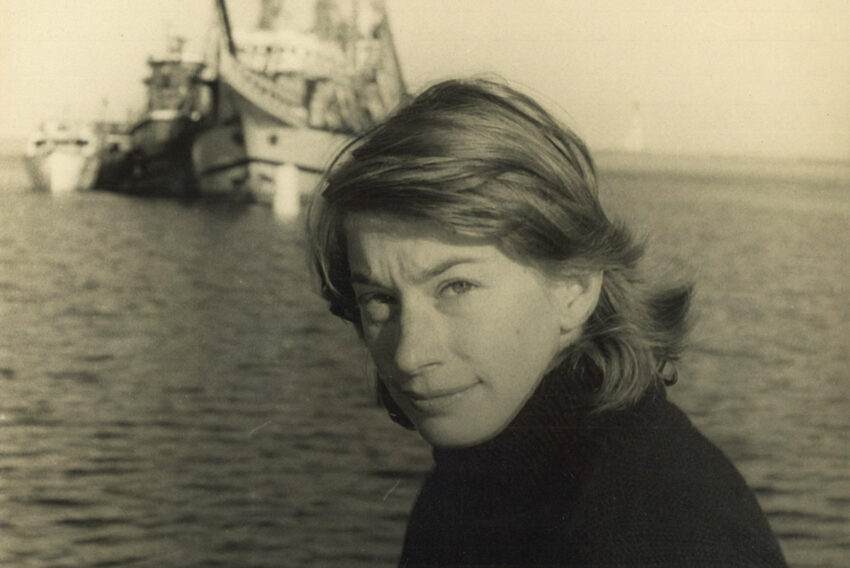
mary oliver was the first poet I read. American Primitive, her Pulitzer Prize–winning fifth collection, was the only book in my childhood home by a living poet. I have a bleary memory of my six-year-old hand pulling the volume’s dark spine down from the hallway shelf, then turning its pages on the floorboards with rapt pleasure. When my parents noticed me reading it, they acquired more of her books: House of Light and New and Selected Poems, which received the National Book Award in 1992.
I was raised on the edge of a forest in central New York State and spent much of my time alone and outdoors. Oliver’s poems, mostly about the animals and plants she encountered on daily morning walks through the wilds of her adopted Cape Cod, must have instantly struck home; I could look up from a stanza about blackberries and go pick some from the prickers behind the house, or glimpse a heron that seemed to have flown directly out of the poem I’d been studying. And her work’s plain, sensical language made it approachable to a person who had only recently learned to read. I remember responding viscerally to the poem “The Black Snake,” about roadkill lying “looped and useless / as an old bicycle tire” on the pavement. I had stepped over the sunbaked remains of countless garter snakes by then, but it had never occurred to me just how rubbery they were, how recently mobile and alive.
Oliver’s poems marked me permanently—to this day, I can’t see a snake without thinking of a bike tire—and yet, if asked in any faintly professional setting about my background as a poet, I have always been careful to omit her from my list of early influences. When I left my rural hometown and arrived at a fancy college in 2009, I quickly learned that Oliver’s reputation was not that of a Serious Writer, even though she had published more than twenty books of poetry and nonfiction, many of them national bestsellers. Where her contemporaries were respected in English departments for their stylistic influence (John Ashbery), political commitment (Amiri Baraka), technical virtuosity (James Merrill), or feminist bona fides (Audre Lorde), the prevailing wisdom among my classmates and professors seemed to be that Oliver was middlebrow, accessible, placatory. Literary critics tended to agree: a review from 1965 complained that her “conventional” work kept “the real poem shut out”; another, from 1991, charged her with “providing many poems with the same, perhaps too-easy solution—politically and aesthetically—merely to rise and float away from a troubling world”; and a pan from 2008 deemed her “the poet laureate of the self-help biz.”
It seemed clear that my disavowal of Oliver was more about my own shame and snobbery than about the merit of the work itself.
Feeling that I had rolled up to undergrad straight from the very wilderness Oliver’s poems describe, I took her name out of my mouth and never put it back. Though I hold both a bachelor’s and a master’s degree in creative writing, I have never taken a poetry class with her work on the syllabus, nor have I ever assigned it. (Oliver herself had no college degree, despite attending Vassar and Ohio State.) When she died in 2019, at eighty-three, I did not add to the torrent of tributes that appeared across social media, where snippets of Oliver’s work have long circulated in the form of feel-good memes. And when asked to write this piece, I was at first too embarrassed to accept the assignment.
But this embarrassment soon began to interest me. It felt out of proportion to the largely inoffensive texts that inspired it, the vestige of an adolescent need to disown a prior version of myself. Oliver belongs to a small class of commercially successful poets—E. E. Cummings, Kahlil Gibran, Rupi Kaur—whose audience consists primarily (necessarily) of people who do not write poems themselves. The poets in the room tend to smirk and lower our eyes when we hear these writers’ greatest hits trotted out at weddings and funerals, listening for stock imagery and moral platitudes as if for bingo numbers. Often, two subsequent feelings arrive to shore up our initial repulsion: first, a sense of righteous protectiveness over the hallowed tradition being milled into schlock, and second, resentment that someone else is enjoying a readership.
A new anthology of Oliver’s poetry and prose, Little Alleluias, published this month, will undoubtedly charm the masses and repel the cognoscenti in equal measure. As I paged through it, I found myself so stuck in the defensive postures I’d picked up as an insecure eighteen-year-old that I had trouble actually taking in the poet’s words. It seemed clear that my disavowal of Oliver was more about my own shame and snobbery than about the merit of the work itself. Could I let those feelings go? And what would I find in her poetry if I did?
the prospect of offering a corrective reading of Oliver’s work suddenly excited me. I imagined her poems blossoming under new scrutiny into complex literary objects, layered with branching ambiguities or sublimated queer desire. (As a child, I hadn’t known that either of us—Oliver or I myself—was gay.) In much the way that reading Oliver’s poems had trained me to notice details in the world around me, my experience as a poet would, I hoped, allow me to find nuance I had previously missed in her poems.
But the first thing I felt when rereading Oliver’s work was frustration. Though almost uniformly straightforward and sincere, her poetry is vastly uneven in quality, demonstrating little thematic or stylistic growth over the long arc of her career. In the dullest poems, her trademark simplicity can seem like the result of lazy writing, bloated with abstractions that hurry the reader toward unearned epiphany. It wasn’t just that these poems didn’t require all my hard-won hermeneutic tools to be understood; it was that they seemed to actively thwart them, resisting my scalpel like polished stones.
Take the end of “A Lesson from James Wright,” from 2009, in which Oliver instructs her reader to sit down
very quietly
in some lovely wild place, and listen
to the silence.
And I say that this, too,
is a poem.
Like so much of Oliver’s work, these lines admonish me to go outside, but they offer me no reason to linger in the ecologies of their own language (and offer little reward if I do). The driving sentiment of such poems—even when I fundamentally agree or identify with it—doesn’t make an enduring impression, because I have not arrived at it through an aesthetic encounter of my own.
Oliver’s didacticism can suggest a moral certainty that forestalls much of the subjective pleasure of reading. Many of her (often gratuitous) explanations about her own poetic project skew pedantic and unironic: “to be dazzled”; “to praise / everything in this world that is / strong and beautiful”; “to look, to listen, // to lose myself / inside this soft world.” And the world Oliver attends to is suspiciously easy to praise. Scrubbed of other humans with their pesky politics and noisy technologies, this world is mostly preindustrial, atavistic. It is not unlike the America I’ve come across in the travelogues of early European settlers: idealized, dubiously unpeopled, and full of wild potential for the white imagination.
As I read on, I began to suspect that I was doomed to remain the same vexed, humiliated fan I had been for years. How many similes involving fire can one book hold? But whenever I was most exasperated in my reading, I would turn the page and discover a poem so disarming and alive that I would feel it in my gut. In “Vultures,” from American Primitive, the flying scavengers
sweep over
the glades looking
for death,
to eat it,
to make it vanish,
to make of it the miracle:
resurrection. No one
knows how many
they are who daily
minister so to the grassy
miles
In these lines, Oliver’s plainspokenness is a strength, animating both the clarity of her vision and the spontaneity of her writing. The diction is unfussy yet precise, with an irregular meter that drifts every so often, as if despite itself, into even cadence. Look how the homely, Germanic monosyllables shift to Latinate abstractions when the narration moves from perception to insight. In this poem, as in her less compelling work, the reader’s attention is still directed away from the words and back toward the world they describe—but the deflection evokes more than passive wonder. Here, the lucidity of Oliver’s language suggests her deeper (and more complex) desire to disappear—to be able, like the food of vultures, to make the rest of the world more real by vanishing into it. I think of her humility in “Praying,” where she instructs herself to “patch // a few words together and don’t try / to make them elaborate”—to conjure “a silence in which / another voice may speak.”
In this silence, Oliver shows the ego dissolving, giving way to “submission and pure wonder.” In the poems I like best, this experience of self-forgetting feels genuine, but in others, it can feel generic and contrived: less like transcendence, more like avoidance. As she writes in “Dogfish”: “You don’t want to hear the story / of my life, and anyway / I don’t want to tell it, I want to listen // to the enormous waterfalls of the sun.” As I watched Oliver repeatedly dodge her reader, it occurred to me that the self-consciousness I felt while reading might be a mirror of the author’s own—and that the embarrassment I’d been struggling to swallow might actually help me find new valences in her poems.
for many poets, I have learned, embarrassment is something to be avoided at all costs. And the scorn of other poets—not so unlike those opportunistic vultures in Oliver’s poem—is often the most daunting source of shame. In the 1970s and ’80s, around the height of Oliver’s career, a coterie of poets formed the Language school in opposition to what they saw as the dominant “lyric” style, which relied on first-person narration, epiphanic imagery, and a putatively bourgeois obsession with interiority. Language poetry, by contrast, was disjunctive and antiexpressive, foregrounding the materiality of words to resist the egotism supposedly embedded in the lyric mode.
Even as the rancor of this particular factionalism has subsided, many of us have retained a queasiness about the narrow scope of first-person poetry. Gillian White brilliantly dissects this “entrenched, common, perhaps inescapable way of reading” in her 2014 book, Lyric Shame, arguing that the conflation of lyric writing with self-absorption and political complacency has made American poets of all stripes variously defensive, self-righteous, paranoid, and abashed. The anticipation of shaming, White persuasively shows, has changed not just how we talk about literature but how we write it: our poems themselves have become embarrassed.
Oliver’s detractors, pro- and anti-lyric alike, show all the classic symptoms of this sort of shame: a discomfort with her work’s digestibility, earnestness, and apparent disinterest in other people—and a fear about what the popularity of such work might say about them. Her commercial success alone seems to imply her complicity in American capitalism; could a true devotee of observation and stillness—someone aspiring to be the “tiniest nail in the house of the universe”—really have churned out such a large and lucrative corpus? And why did she seem not to know about modernism?
It was easy to detect shame in the contempt of Oliver’s critics, but it hadn’t occurred to me to diagnose it in the author herself: such a distinctly social emotion seemed unlikely to have inspired so many poems about the nonhuman world. Yet as I revisited her work, what struck me again and again was the tinge of social difference that suffuses her best poetry. Oliver’s own childhood was intensely lonely, marred by abuse and neglect that she referred to in interviews but treated only obliquely in her poems. It was this early trauma, she said, that first sent her both out of doors and into books. “Oh, I wanted // to be easy / in the peopled kingdoms, / to take my place there, / but there was none // that I could find / shaped like me,” she writes in a poem I love called “Trilliums.” Her more boring poems might pretend to a state of prelapsarian innocence, but the most vivid ones unfold in the fallen world inhabited by this highly self-conscious speaker, who is dogged by feelings of shame and unbelonging. As Oliver writes in “The Moths”: “I was always running around, looking / at this and that. // If I stopped / the pain / was unbearable.” What my favorite Oliver poems seem to dramatize, I realized gradually, is not a successful defection from human society but a deeply moving failure to leave it.
Read through the lens of social alienation, even Oliver’s most well-worn verses can reveal new, more slippery meanings.
Once I began looking for it, I saw the telltale traces of lyric shame all over Oliver’s work. Many poems seem to announce their own shortcomings outright, as if preempting accusations of self-indulgence and sentimentality. “Welcome to the silly, comforting poem,” Oliver’s book-length poem, The Leaf and the Cloud, begins. An ode to beans worries, “I know what you think: this is fool- / ishness.” In another poem, daisies flaunt their yellow centers, “their—if you don’t / mind my saying so—their hearts.” This sort of coy address to a generalized “you” appears in many of Oliver’s poems, and certainly in the ones most often cited by preachers and yoga instructors. (“You do not have to be good,” goes the oft-quoted opening line of “Wild Geese.”) Oliver’s use of the second-person can confer a sense of intimacy or instruction, but can just as easily evoke scrutiny: her human audience, unlike her nonhuman subjects, reads her poetry—and has the power to either befriend or reject her on the basis of it. When I flipped back through Little Alleluias, and then through Oliver’s older books, in search of poems that truly retreat from society—without apostrophizing, defending, seducing, beseeching, or arguing with another person—I was hard-pressed to find a single one.
Read through the lens of social alienation, even Oliver’s most well-worn verses can reveal new, more slippery meanings. You know the final two lines of “The Summer Day” (1990) from social media posts and motivational speeches: “Tell me, what is it you plan to do / with your one wild and precious life?” Taken out of context, Oliver’s question is usually understood as an injunction to optimize your limited time on earth—YOLO, basically. I already suspected some nuance might have been lost in the process of memeification; Oliver’s poetry generally urges her readers to slow down, work less, and “look upon time as no more than an idea.” Considering it anew, though, I found the poem even less Pollyannaish than I’d expected.
“The Summer Day” opens with a cosmic question—“Who made the world?”—before telescoping its attention down to the tiny body of a grasshopper. Near the halfway point (the poem is a crisp nineteen lines long), the speaker settles in between these two extremes of scale to address the personal—what she has “been doing all day”: looking at things, assuming various postures in the grass, walking idly through the fields. It’s this sheepish confession that sets up the poem’s closing lines:
Tell me, what else should I have done?
Doesn’t everything die at last, and too soon?
Tell me, what is it you plan to do
with your one wild and precious life?
This can be read as a return to the poem’s initial interrogative mood, but I also detect a plea here, even a challenge: Tell me. The presumptive addressee is no friendly interlocutor but, rather, a moralizing critic, poised to pass judgment on the speaker’s time—that is, their life. Oliver’s recognition of mortality is both a caution to herself (why pay attention to a grasshopper?) and, potentially, to the reader (why pay attention to a poem?). This is at once self-deprecating and self-defensive; the same logic that strips the poet of the authority to praise the world divests the critic of the right to judge it. The final sentence in the poem is the only one that uses the pronoun “you,” and I am tempted to read it with special emphasis: What is it you plan to do with your life? What gives you the right to censure mine?
This subtle but dramatic change in inflection suggests how easy it is to pass around a flattened, misleading idea of a Mary Oliver poem, whether you love it for its optimism or disdain it for its escapism. Many readers think of Oliver as taking simple delight in ordinary moments, yet here that simplicity is precisely what’s at risk: she cannot exalt in solitary observation without the specter of disapproval encroaching on her reverie, impelling her to speak. After all, Oliver’s most natural world is the world of language, that most irreducibly social of materials, which depends on the presence of another to complete itself.
“there’s nothing more embarrassing than being a poet,” Elizabeth Bishop said in a 1978 interview. But when we’re not apologizing for it, we poets spill a lot of ink trying to justify the materially useless endeavor to which we’ve devoted our lives, all the while fostering complicated prejudices against anyone doing it differently than us. At a recent dinner with my parents, I heard myself explaining that, for many poets, writing unintelligibly “is actually kind of a populist move,” and the silliness of judging poems by their political utility careened back into view. My parents still love Mary Oliver; other than me, she remains the only poet they regularly read.
One reaction to all this insider-y discourse is to try and rise above it. Some Oliver fans within the literary establishment—and they do exist—make a show of admiring her without apology. The critic Ruth Franklin “unashamedly” outs herself as an Oliver-head in a New Yorker review. In a poem about life’s underrated pleasures, Gabrielle Calvocoressi unequivocally insists: “Mary Oliver. I love her. I really do.” I, too, started out with the hope of overcoming my ambivalence. But Oliver is herself highly ambivalent; her most affecting poems are fraught with anxiety about their own impotence and marginality. As she writes in “Stars”: “Here in my head, language / keeps making its tiny noises. // How can I hope to be friends / with the hard white stars // whose flaring and hissing are not speech / but a pure radiance?”
Oliver is bracingly, uncommonly honest about her fear that she might be a loser.
Since I first encountered Oliver, I have discovered many other poets who, had their books found their way into my six-year-old hands, might have tutored me in the arts of noticing and image-making—in “flaring and hissing”—better than Oliver did. But, to my adult mind, what seems truly singular is her alertness to the way feelings of shame and social inadequacy attend even our most seemingly private and ecstatic moments, and her belief in the lyric poem as an arena for exploring that contradiction. Oliver is bracingly, uncommonly honest about her fear that she might be a loser—that she should not “hope to be friends” with those she admires, whose in-group language she will never learn to speak. If this lack of guile drew me to her work as a child, it is even more instructive to me as an adult, after decades of hiding my shameful desire for inclusion under layers of posturing and pretense.
These days, the only poems that really embarrass me are the ones that refuse to wrestle in some way with their own smallness and contingency—to acknowledge that a page of poetry is not the same kind of place as a town hall or a war zone or a protest or a poll site. A page of poetry, in some sense, is no place at all, and it is fitting that we feel a little shame when we attempt to leave society to visit it. I don’t want this shame to reach a pitch that prevents me from writing and reading poems, which are, thanks in part to Mary Oliver, among the greatest joys of my life. But I also don’t want to wish the feeling away or project it onto some other miserable lyricist. Ideally, as in Oliver’s case, shame can be generative rather than debilitating; by facing it head-on, I might find in it an occasion for a poem, or a humbling reminder to take to the streets. That sounds like a decent use of my time, I think. Tell me, what is it you plan to do with your one wild and precious life?
Maggie Millner is a poet and a senior editor at The Yale Review.
Newsletter
Sign up for The Yale Review newsletter to receive our latest articles in your inbox, as well as treasures from the archives, news, events, and more.