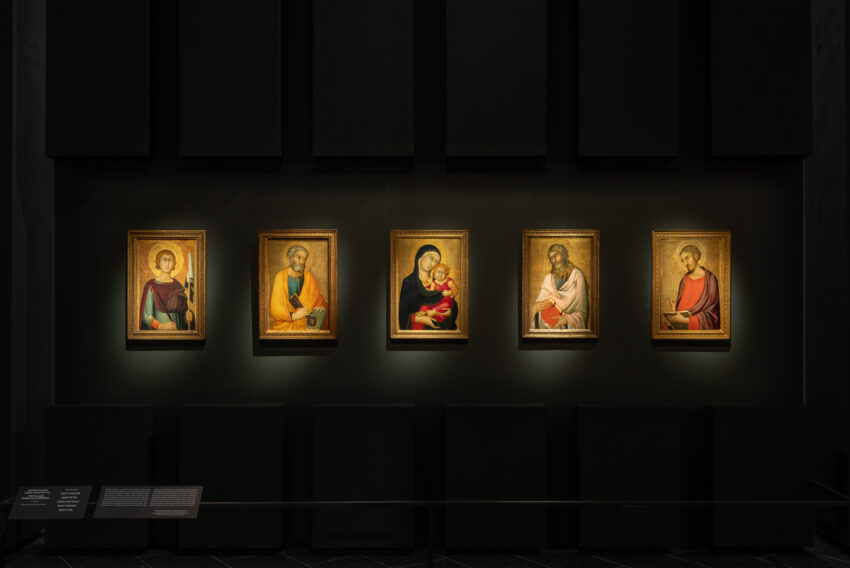
Installation view of Siena: The Rise of Painting, 1300–1350, on view through January 26 at the Metropolitan Museum of Art. Photo by Eileen Travell, courtesy the Met.
A procession, celebrating Jesus’sreturn to Jerusalem, is wending its way through the streets of the medieval city and into the cathedral. We, the townspeople, have closed up our homes and shops, left behind for now our bread-making and baby-raising and money-counting, and gathered to see him, about whom we have heard so much. And now here he comes, riding a humble gray donkey. It is improbable but true that others in our town, who until now have seemed to care only about the stylish turn of their fur-lined collars, have also assembled and, like us, are overwhelmed. The experience of joy and wonder is communal. Now, without our even knowing what we are doing, we are waving palm branches and laying our mantles and Canada Goose parkas on the ground, proclaiming his glory.
Or so it seemed last week when we went to see Siena: The Rise of Painting, 1300–1350 at the Metropolitan Museum of Art, where everyone was peering at flickering tapers of red-and-gold flame that, so the placards claim, are fourteenth-century paintings on panels. Many of the paintings are displayed in cases rather than on the wall, so we saw not just the painted images but also the wood that bears them. Like Jesus on his donkey, the paintings came here riding their own humble supports. At the sight of these works, all of New York was stirred, or at least all of us, New Yorkers and tourists, who had come that Saturday afternoon, and looking back and forth from each other to the image of Jesus or Mary or the shimmering lake surface that is a piece of green fabric woven in the second quarter of the fourteenth century, we exclaimed: “Who is this?” (Matthew 21:10, Quis est hic?) Or, in my girlfriend’s words, “What the fuck even is this?”
Reunions like this are supposed to happen only in Paradise.
This is a golden age. Siena in 1300 was going through a period of good governance: the independent commune was ruled peacefully by a group of nine elected magistrates (the Nove) who roomed together in the Palazzo Pubblico. It was a time of prosperity and cross-cultural exchange. Located on the Via Francigena, an ancient pilgrims’ way connecting Canterbury and the Apulian ports, Siena benefited financially and intellectually from contact with northern Europe, as well as with Rome, Naples, and beyond—Mongol designs appeared in Luccan silks. The result was that painting in Siena caught fire: led triumphantly into the palazzo were the monumental but also intimate tempera paintings, first of Duccio di Buoninsegna, then of Simone Martini and the brothers Pietro and Ambrogio Lorenzetti.
A collaboration between the National Gallery in London and the Metropolitan Museum of Art, Siena is highly unusual for bringing together not only these four central artists (alongside other, less famous painters and sculptors of the period, not to mention the anonymous carpenters, goldsmiths, weavers, and clerical advisers) but also the long-dispersed parts
of artworks, like the panels from the back predella of Duccio’s altarpiece, Maestà, which haven’t seen one another for more than two centuries. Reunions like this are supposed to happen only in Paradise. The show begins with the florescence of these astonishing artists and ends with the arrival of the Black Death, which wiped out half of the city’s population (including, probably, the Lorenzetti brothers). Lights out, Siena.
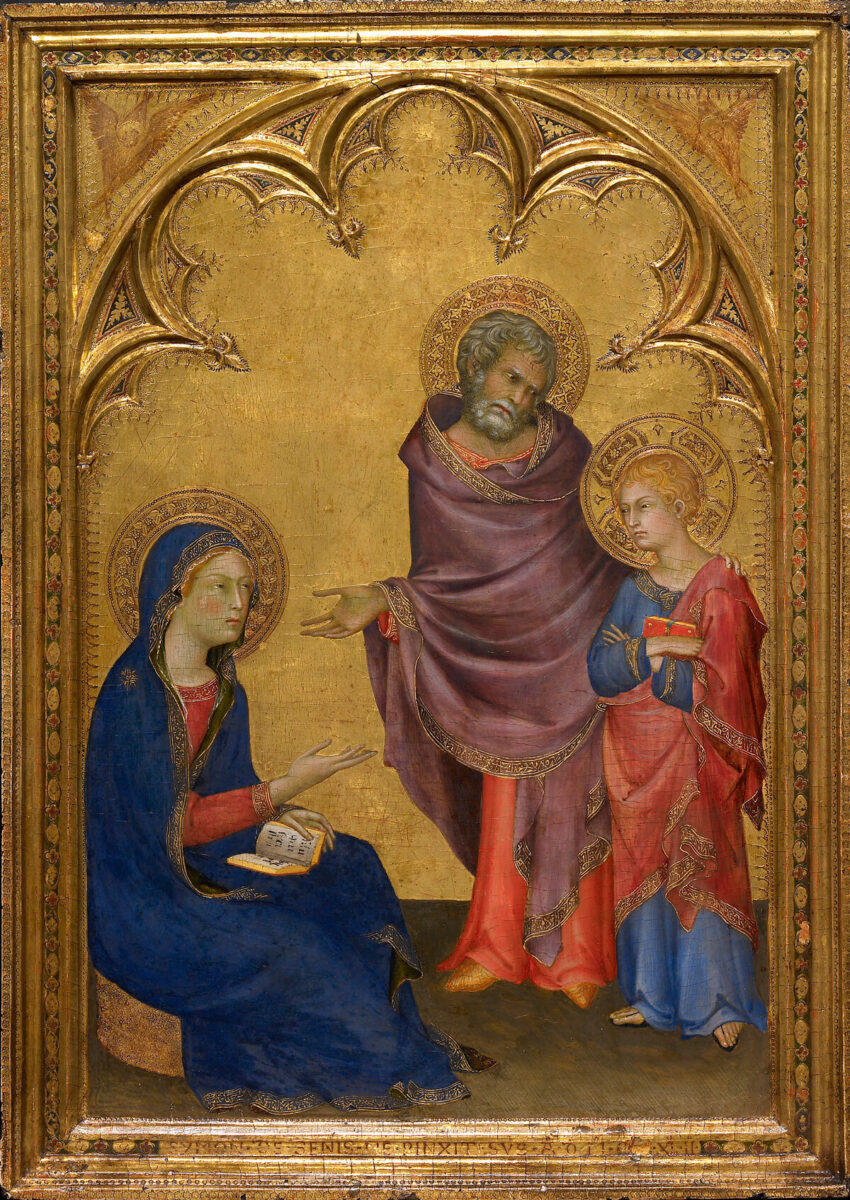
Siena lets us see in relief works that we might have known previously as pictures hanging on walls or, more likely, as illustrations in books. See how the gold surface has been punched; the edge has been burned; the frame is thick. Not two- but three-dimensional are those pieces of wood, which, bent with age and chipped, have faithfully done their duty for seven hundred years: “O good old man,” someone of another age might have praised their loyalty, “how well in thee appears / The constant service of the antique world.” The exhibition space evokes a modern version of the Sienese duomo: deep gray, almost black columns vault the space, rotating it this way and that. The exhibit goes forward, throws up obstructions, turns back on itself, progresses, and reaches various peaks of dramatic intensity, such as the appearance of a painting that travels even less than my eighty-two-year-old mother does (who, to be clear, doesn’t travel): Simone Martini’s wondrous Christ Discovered in the Temple, a tight family drama with an ornery adolescent Christ, which normally keeps to its room in Liverpool’s Walker Art Gallery. The theatrical spotlighting causes the colors to gleam in the dark space, making us feel, as we approach each painting, that it is ready for its close-up.
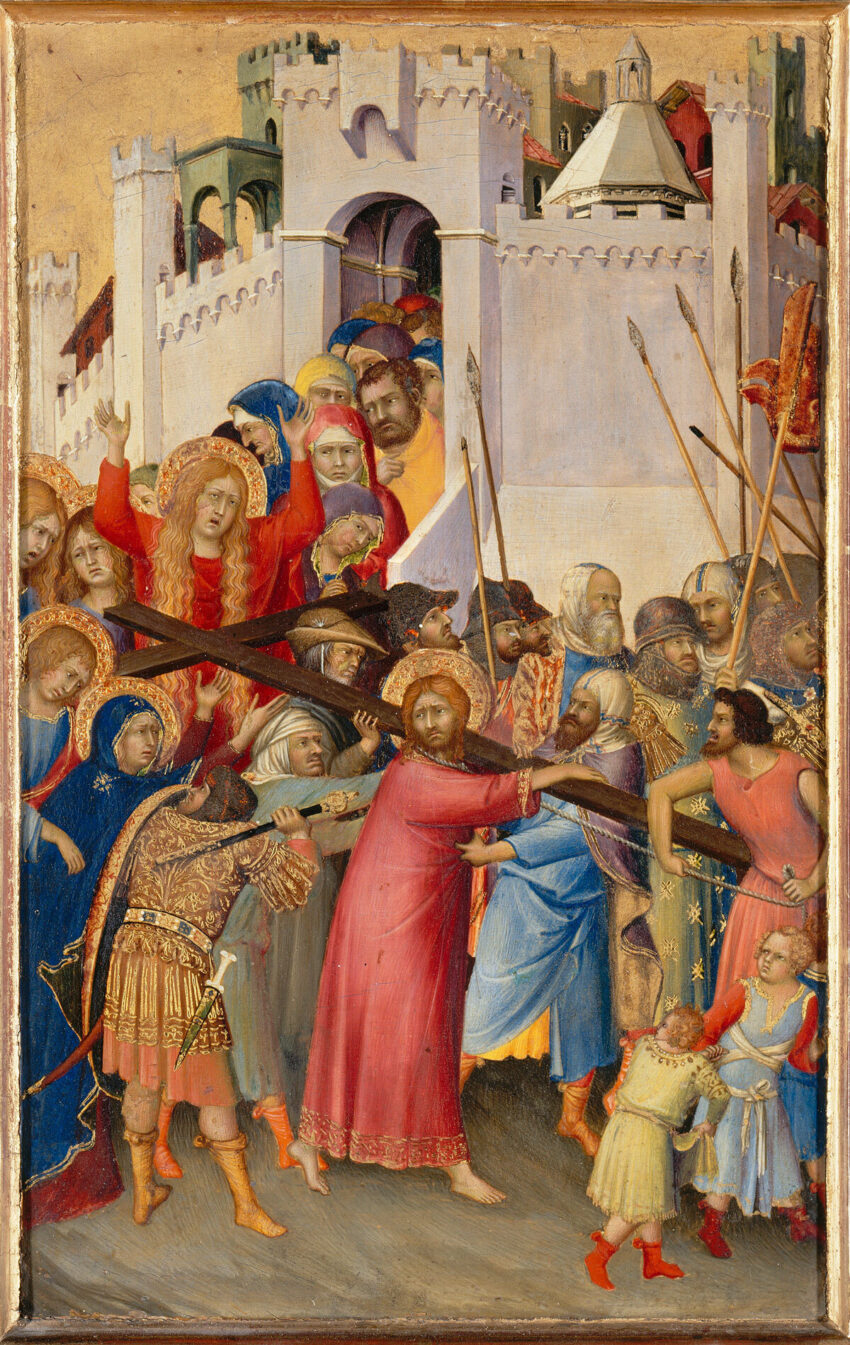
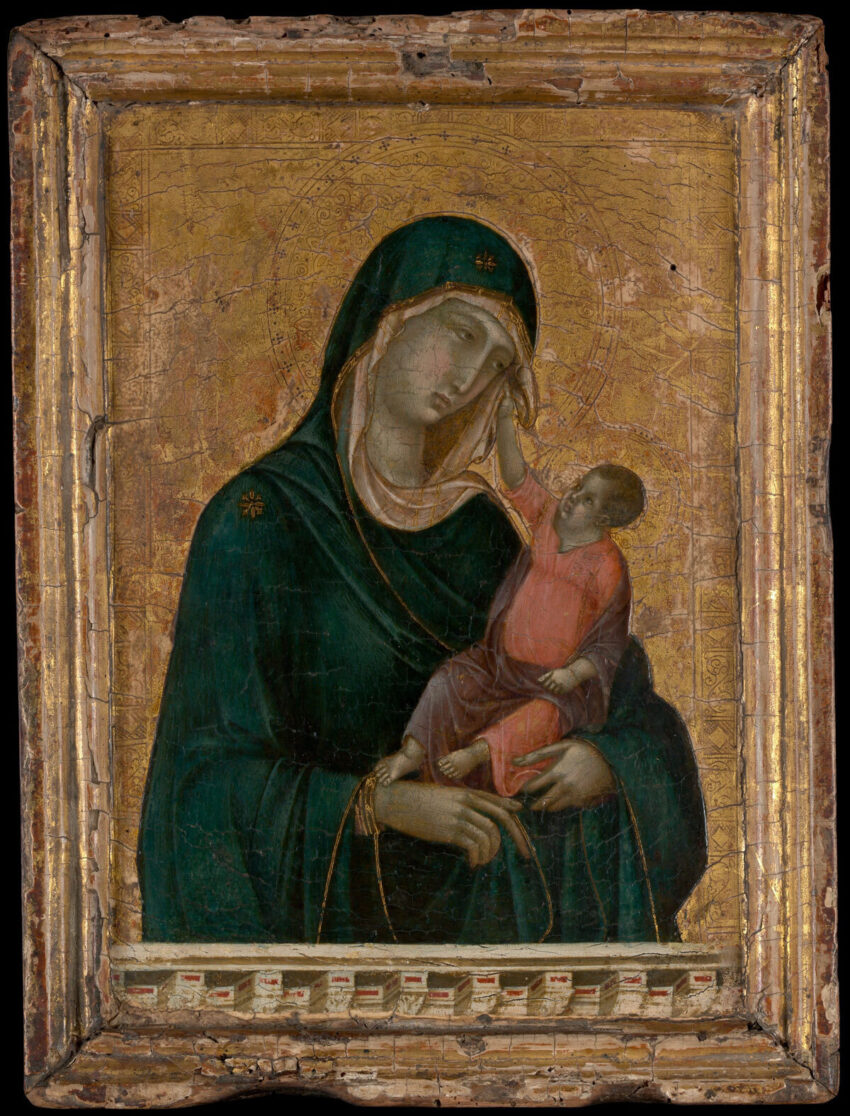
What charges the surfaces of these paintings is not just the deservedly famous color (a result of countless tiny strokes of pure pigment mixed with egg yolk) but also the compositions. Spend some time with Simone’s Orsini Polyptych (my personal favorite narrative sequence in the show) and observe, in The Way to Calvary panel, how the ground plane has been tilted up so that the crowd seems to spill out from the city gates, making a cascade that repeats the right angle of the cross on Christ’s shoulder, as well as the goalposts of Mary Magdalene’s upraised arms. Or look at The Crucifixion panel of this same sequence and observe how Mary’s elbow, as she clings to the base of the cross, is echoed by a gilded shape that, formed by the negative space between her and the crowd to her left, recalls an angle bracket (<). It is as though her desperate grief were reverberating outward in harsh, jagged waves. The emphasis on shape means two ways of reading a picture are being made to play against each other, surface against depth. We may think of such games as belonging to twentieth-century modernist painting, but open your eyes. A painter like Giorgio Morandi, who may appear to be in another world when he makes the edge of his flower vase seem to flow into the curve of a teapot handle behind it, is not the inventor but the interpreter of a long history of abstraction embedded in representational Italian art. To convince yourself, all you have to do is look at Duccio’s Virgin and Child (ca. 1290–1300), which is singed at the bottom edge from candle flames. If you follow the edge of the Virgin’s head, covered with a blue hood, you will find that this line of her silhouette is picked up by the gold edge that runs down the front of her body, and that line is continued, in turn, by the folds of the robe on baby Jesus’s lap, and then this same line continues into the gold edge of the fabric on the Virgin’s left wrist. What recedes from you in depth is returned to you on the surface, and your experience is thereby rendered for a moment whole, manifest, unified.
Duccio di Buoninsegna (active by 1278–died 1318), Virgin and Child, ca. 1290–1300. Courtesy the Metropolitan Museum of Art, Purchase, Rogers Fund, Walter and Leonore Annenberg and the Annenberg Foundation Gift, Lila Acheson Wallace Gift, Annette de la Renta Gift, Harris Brisbane Dick, Fletcher, Louis V. Bell, and Dodge Funds, Joseph Pulitzer Bequest, several members of the Chairman’s Council Gifts, Elaine L. Rosenberg and Stephenson Family Foundation Gifts, 2003 Benefit Fund, and other gifts and funds from various donors, 2004.
The curators—a group including Caroline Campbell, Joanna Cannon, and Stephan Wolohojian—have displayed this painting between two objects, both from a few decades before. To the left is a Byzantine icon of Mary and Jesus. It would be impossible, in looking at such a picture, to ask the place or time of day; this is the no-place of eternity. And to the right is a French ivory in the Gothic style that shows the same trope as a semi-domestic scene—a mother smiling tenderly at her baby, who is playing with her veil. By placing the Duccio here, the curators tell an important story: of how Sienese painting emerged at a crossroads. The trope is kept while being endowed with new intimacy (see how Duccio’s baby reaches to his mother’s veil, perhaps to wipe away her tears). And notice what Duccio has done with space: the gold background retains the nowhere of eternity but comes to a stop when it meets, at the bottom, what appears to be a three-dimensional parapet on which the Virgin is standing. In layering one style on top of another, Duccio anticipated the Renaissance. Later, more naturalistic painters would build on the visual template of religious art established in Siena. If you have the time, wander over to room 614 of the permanent collection. It is no coincidence that the subject of Johannes Vermeer’s Study of a Young Woman (ca. 1665–67), who seems to have just now turned to look when you entered the gallery, meeting your eyes, wears a blue robe—as does the Virgin Mary.
This object serves as a somewhat overdetermined mirror of my mental state: mind blown.
Don’t neglect the sculptures. Here is a head of Jesus, which was split down the middle on January 23, 1944, when an Allied bomb fell on the church of the Osservanza, just outside Siena. A strip down the center of the face was blasted off, laying bare the savior’s mortal body, which, we can now see, is splintery walnut of a rich, milk-chocolatey color. This object serves as a somewhat overdetermined mirror of my mental state: mind blown. To make it even more fascinating, the placard tells us that the blast revealed two pieces of parchment (one in the head, the other in the knee) on which the sculptor, Lando di Pietro, testifies to his authorship and begs for mercy for himself and everyone. These scraps are included in the show; not included is a translation of the bit written in the right margin of the parchment piece found in the head—which tells us that the sculpture is a likeness of the true and living Christ, and that it is he we should venerate “and not this wood” (et non questo legno).
Well, you might say, it’s a bit late for that.
Materiality is a big emphasis of this show, and in truth, it’s odd that objects once intended to help believers overcome the lure of the material have become opportunities to concentrate on just that. Understood in the language of their times, these pictures were made to help viewers recall, with as much emotional intensity as possible, the holy scenes they depict. Such memory work lies at the core of theories of medieval art, as the scholar Mary Carruthers has shown. There is no sense of a bump when, in their travel narratives, pilgrims pivot from describing a ruin to describing Christ’s footprints or, in the words of the so-called Bordeaux pilgrim, “the palm tree from which children took branches and strewed them in Christ’s path.” It doesn’t matter that such pilgrims couldn’t possibly have seen these things—because what they are trying to see as present is always the past divine scene. We are like pilgrims making our way through Jerusalem when we look at these pictures, and the scenes we encounter help us make the leap from what Peter of Celle in the twelfth century called the “here” of human thought to the “there” of God.
But, of course, such things were never just experienced as only material or immaterial, and it is no discovery that the symbolic gold of the heavenly sky gleams because it is also, well, gold. Francesco Petrarca, who was a fan of Simone’s, claimed he painted a portrait of Laura that was so beautiful it “can be imagined only in Heaven, not here among us, where the body is a veil to the soul.” If this tension between the spiritual and material is central to the Christian mystery, to its claim that human redemption occurred through the miraculous contradiction of a god made flesh, it is also true that the devout don’t have a monopoly on such experiences. What this show awakened in me, a secular person, was a peculiar sensation, a joy, as if what I most needed to see in these gloomy days at the beginning of 2025, when the algorithm seems to have reduced us to simulacra within a video-game version of life, is a semi-miraculous resurrection—not of god into flesh, or of flesh into god, but of humans into humans.
Rachel Eisendrath teaches Renaissance poetry and critical theory at Barnard College, Columbia University. She is the author of Gallery of Clouds.
A Literary Gift in Print
Give a year of The Yale Review—four beautifully printed issues featuring new literature and ideas.