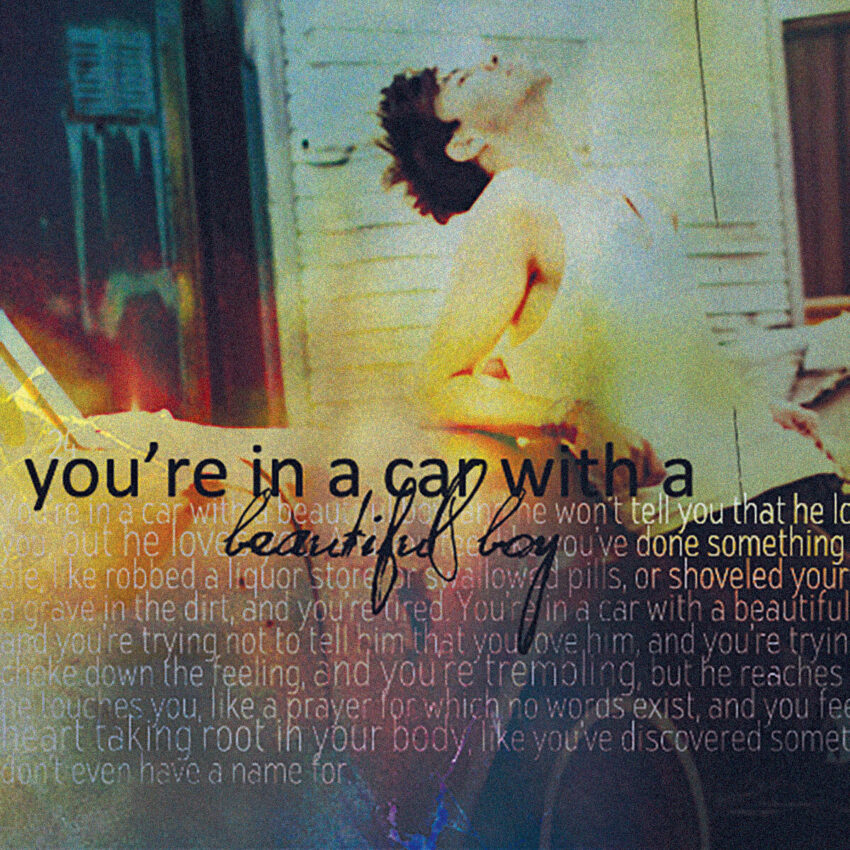
A line from Richard Siken's Crush, repurposed for an image to accompany a fan's mixtape. In the collection's viral afterlife, its poems were stripped of context and remixed into something else entirely. Livejournal
I came up as a poet during one wave of the Richard Siken craze. Crush, Siken’s first collection of poems, selected by Louise Glück as the winner of the Yale Younger Poets Prize in 2004, was reissued this past March for its twentieth anniversary, and we are still, all of us, in the shadow of it, still in the aftermath. Its promise is there in the title: infatuation and pulverization. To read Crush, then as now, is to be consumed by it.
Crush is a book about ruinous love: a boyfriend comes within life-changing proximity of the poet and dies. For those of us raised by teachers from New Formalist and avant-garde movements, for whom the memory of Sylvia Plath was rather dim, the declarations and embodiments, the sweating and screaming of confessional poetry, felt electrifying. “Tell me,” Crush begins, implicating us in its storytelling, its lies, and its evasions. What follows is a sustained unfolding of a self in crisis. The poems—with their insistent advance and withdrawal—don’t read like an MFA portfolio of creative writing exercises. We can sense a human breathing, panting, in between the lines. We can sense what was at stake in a time when gay weddings were illegal. Before social media made every minute of a stranger’s life present and available, Siken was a debut poet offering a seductive glimpse into a life so well crafted that it felt—still feels—real.
I’m struck by how much of the poetry in Crush I’ve internalized, inadvertently absorbed, written myself, and read in the work of my peers and students. In some sense, poetry was remade in its image. Picking out distinct examples feels impossible; Crush is a thrum behind so much millennial poetry—propulsive, propelled by trauma, maybe, but never abandoning poetry’s capacity for beauty and fantasy, never abandoning the friction of metonymy. It’s not merely that melodies of Siken’s have been copied but that poetry is now tuned to his syntactic and emotive key signatures.
Even Glück, whose editorial suggestions helped make Crush the book it is, would complain to me when reading contest and fellowship submissions, “They’re all just Siken imitations.” For poets coming after, Sikenism was enthralling. But it was also a world of danger: we all feared the possibility of getting stuck there. Siken surely must have feared this too. I keep asking myself, in appropriately Sikenian terms: How do we escape? Are we all just living and making poems in a post-Siken world?
the question is complicated by the vibrant (if bizarre) afterlife that Crush found online—the second wave of the Richard Siken craze. Lines from Crush were co-opted into memes, fan fiction, and other artifacts of the internet age. Phrases were ripped from their context; sacred line breaks disappeared. And the terrifying world of Siken’s book—generated in the atmosphere of the AIDS crisis, the murder of Matthew Shepard in Laramie, Wyoming, in 1998, and pre-marriage-equality homophobia—was displaced by images of characters from the faux-terrifying world of blockbuster vampire movies. This violated the book not only as a work of poetry but as a historically rooted gay exploration of trauma and risk.
Crush liberated us by telling stories, by not swallowing what felt true.
The vast response to Crush also flattened its intelligent play with storytelling and confession. A certain online reader was insatiable for details. Did your boyfriend really die?Crush’s complexity comes from the way the book revives confessional poetry with a new terror—a complexity lost on the reader who wants to know whether the dead boyfriend was real. To read autobiographically effaces the poem’s interest in perspective, its artificial (even exuberant) construction of the story itself. When Crush went viral, readers demanded a piece of Siken’s life or a piece of his language.
His second book,War of the Foxes, published ten years after Crush, and ten years ago now, swerved radically away from the eminent debut into the more fabular world of animals and the ekphrastic world of painting. The book had the impossible task of living up to its predecessor. We wanted more Crush! Then, in 2019, Siken had a stroke that nearly wiped out the language and memory for which we readers had been so callously hungry. Miraculously, he survived, and so did his impulse for poetry. Now in his fifties, he has joined his fans online, where he gives dignity and wisdom to their unanswerable questions about love and loss, life and death. It was on X that he announced a new book of poems,I Do Know Some Things, which came out in August. The new book seemed aimed at addressing the very anxieties and disruptions that stemmed from the response to Crush. Can Siken escape? “It is 77 prose poems,” he wrote online, “about what I can remember about my life. It is autobiographical. A backstage pass.”
What we encounter in the new book, though, is not the radical departure that prose poetry and unadorned autobiography seem to promise. I Do Know Some Things is unsettling. Unsettling because the poet’s knowledge has been unsettled. The new poems enact, in some sense, not just the relearning of language—the poet’s command of words—through linguistic acts of association but the relearning of interiority as well. Siken now asks not only How do I tell the story? but also How can I remember the story in order to tell it?And in what words, which have a way of swerving and evading?
crushis a book about telling stories and telling the truth. The collection opens with a perfect poem, “Scheherazade,” that beckons to the reader in a series of asked-for tales:
Tell me about the dream where we pull the bodies out of the lake
and dress them in warm clothes again.
The poem, so characteristic of what we adore in Crush, flips fleetly from the intimacy of address to the surreal world of dream to the mortal world of flesh to a terrible image of tragic death to an act of utter tenderness. We as readers are pulled into the story, pulled into and out of the lake, pulled into dark relation with death and eros, in a single sentence; we are, instantly, storytellers, listeners, dreamers, murderers, and mourners:
Tell me how all this, and love too, will ruin us.
These, our bodies, possessed by light.
Tell me we’ll never get used to it.
“Scheherazade” invokes the deadly costs of storytelling, but everywhere in Crush, Siken is trying to get the telling right. In poem after poem, Crush stages a relationship with its reader-beholder, not confessing interiority but making the act of confessing central to the poem’s framework. “There are so many things I’m not allowed to tell you,” Siken writes in “Dirty Valentine,” both restrained and seductive. Later in the book, perhaps coyly or perhaps earnestly, Siken writes, “I want to tell you this story without having to confess anything.” After revealing new details in yet another poem, the speaker confesses, “I guess I can tell you that now.” How thrilling to be the one being told. The one with the poet’s voice in his ear. The poem’s second-person perspective, designed in part to create distance between the author and the speaker, also collapses the distance between the poem and the reader. This is a strategy Siken uses throughout Crush. On the one hand, it’s engaging; on the other, we sense the poet-speaker struggling through his own narratives, dramatizing what can and can’t be revealed, what private feelings the poem can give clamor to, and what private feelings must ultimately remain private. Like Frank O’Hara (whose urbane “I do this, I do that” poems precede Crush in the gay American poetry canon), Siken builds his poems from a series of actions and statements with simple syntax. He litters the page with flawless details in which a precise image stands for a bright cascade of feeling: the unbearable nostalgia of “the sandwich cut in half on the plate,” or the cinematic terror and dread of “you tramp around a mustard-colored room / in your underwear / drinking Dutch beer from a green bottle,” or the quiet violence of “the disk of the drain / punched through with holes.” But the poems are engined by shifting details within anaphora, so every poem feels both endlessly spinning and rooted in specific places and times:
That means it’s noon, that means / we’re inconsolable (from “Scheherazade”)
so it’s summer, so it’s suicide, / so we’re helpless (from “Little Beast”)
These shifts within anaphora enact discomfort with singular and straightforward narratives. Siken is about to tell a story in poem after poem and then denies us; there are swerves and surprises and trapdoors everywhere. Sometimes the poet deploys opposing or contradictory information within one list; the fictive center is always moving, and the poet is always reaching toward it, then running away. That revelations are yoked to evasions, that confessions are twinned with disavowals—this is the intellectual rhythm beneath the violent, irrational, mesmerizing spell of Crush.
Crush liberated us by telling stories, by not swallowing what felt true. In symphonic sentences, it made suppressed emotions feel propulsive. It gave words to feelings—gorgeous words. Glück called it a book about “panic.” It’s also a book about ecstasy and survival. I still remember reading “You Are Jeff ” in the stale light of the college library:
You’re in a car with a beautiful boy, and you’re trying not to tell him that you love him, and you’re trying to choke down the feeling, and you’re trembling, but he reaches over and he touches you, like a prayer for which no words exist, and you feel your heart taking root in your body, like you’ve discovered something you don’t even have a name for.
Reading the poem, inhabiting the “you” for its stunning duration, I, like hundreds of others, felt close to Siken the poet and to a self, like a word, like a feeling, just coming into existence.
in “cover story,” one of the most surprising and characteristically beautiful pieces in I Do Know Some Things, the poet revises the premise of Crush:
My boyfriend did not die in 1991. I told a lie and it turned into a fact, forever repeated in my official biography.
The poem is a “cover story” because it is so prominently featured in the poet’s life; it’s also about a lie, which becomes a “cover” for the real story. Part chronological narrative, part harrowing elegy, the poem is a confession and an apology. The speaker confesses that after his composer boyfriend died, he broke into his apartment and took things, presumably in order to hide evidence of the relationship from the boyfriend’s family: “He hadn’t told his family and it didn’t seem right to tell them now, to suggest that they didn’t really know him.” In this way, the living lover covers for the dead lover. In this memory, the dead can make no space for him.
The second-person strategies of Crush are abandoned in I Do Know Some Things for a more direct style, but Siken’s signature intensity still throbs between sentences. The new book’s prose poems may contain the autobiographical impulse, but they defy poetic expectation and vacillate—constantly, exhilaratingly—between unstable artifacts of reality. The poems do not bleed as before, but there is blood beneath the surface; you can feel it in the way the sentences grope their way through, crawling down into the deep grave of the page. Take the opening poem, “Real Estate”:
When the man who was not my father divorced my mother, I stopped being related to him. These things are complicated, says the Talmud. When he died, I couldn’t prove it, I couldn’t get a death certificate. These things are complicated, says the Health Department. Their names remain on the deed to the house. It isn’t haunted, it’s owned by ghosts. When I die, I will come in fast and low. I will stick the landing. There will be no confusion. The dead will make room for me.
At the bottom of the grave, we find the fantasy of the poet’s own death, insisting on a proper place. Siken knows, on some level, what his greedy readers might ask. Where is Richard Siken in these poems? And so the poems are everywhere obsessed with finding space—among the dead, inside memory, in the body, in “real estate”—for a life already lived.
“A line break,” as Siken notes, “makes a hitch in the breath, a crack in the thought.” In prose, Siken relies on the friction of sentence on sentence. The energy of the poem comes from the closeness between “the Talmud” and “the Health Department,” from its register sliding from “deed to the house” to “owned by ghosts.” Though the format is repetitive, and the collection numbers about one hundred pages, Siken’s prose is often deft and exciting. As he relearned everything, the prose poem helped him rediscover how to create poetic tension, how to be dynamic without the gravity-defying magic of enjambment. Syntactic variation. Quick, unexpected shifts in register. Artful repetition. These are all refined strategies in the collection. The prose is also a steadying element. It is another way of not losing oneself, of not falling through the cracks.
The poem is a small window. The photo is the poem, which captures us and never really captures us.
Siken includes a section of poems that comments directly on the prose poem itself, interrogating the meaning-making properties and artifices of the line, the sentence, the paragraph—all the while questioning our desire to contain experience and be contained by it: “I wouldn’t break the line. I was afraid to. Too much was already broken.…The sauce breaks. Your heart breaks. The car breaks down by the side of the road and you end up walking home in the dark, exhausted and iambic. I didn’t want to risk it.” In I Do Know Some Things, the risk is not that of desire, as it is in Crush, but that of a different annihilating force: the vanishing of a self. Dissolution isn’t the threat of the new collection, what we, like the poet, feel panicked about; it has already happened.
Some of Siken’s strongest poems are pieces that invoke other people’s histories. “History” is a darkly zany poem made up of brief “biographies” of dead famous people, both historical and fictional, and their possessions:
Stevens had a blackbird. Stein had a rose. Thor had a hammer. He hammered in the morning. Plato had a cave. Noah had a boat. Jonah had a whale. Melville had a whale. Dumbo had a feather. Adam had a rib. Jacob had a ladder. Wittgenstein had a ladder. George Washington founded a nation. We gave him a dollar. Abraham Lincoln freed the slaves. We gave him five dollars. Harriet Tubman had a railroad. It wasn’t an actual railroad. Magritte had a pipe and a painting of a pipe. It wasn’t an actual pipe because it was a painting of a pipe but really it was an actual pipe in its own way. Sherlock Holmes had a pipe and, separately, morphine. Freud had a cigar and other people’s problems.
Not surprisingly, the lyric “I” appears in the poem, amid all the furniture of history: “I got a wheelchair, then a cane, and I used to know some things about an earlier version of you.” In piecing together poems and memories, Siken wants to construct a personal history, for himself and for us, as a record. To do so, he must navigate not just the aftereffects of a stroke but a profound discomfort with selfhood and interiority. These poems embed Crush’s problem of autobiography and its aftermath into their very narratives: “At the bars, I used a fake name. I was as blurry and undefinable as everyone else.” Complicating the central preoccupations of Crush, Siken’s new poems insist on autobiography even as they destabilize it.
While grasping for something true in the skittery sentences of “Field,” we arrive at a sentence that might form the heart of Siken’s poetics: “You learn to be you so you aren’t stuck being everything.” How can we be a self, in the world and on the page? How can we navigate poetry’s artificiality, which is like and not like the lies we tell ourselves and others in order to live? In his pointed poem “Nonfiction,” the speaker protests, “I am not lying. These are not metaphors.” All of this uneasiness about identity and knowledge got me uneasy about the authority of the poet—not as the recounter of lived events but as a maker of statements: “Call it a myth and the truth grows abstract,” Siken writes in “Fauna.” “Call it a lie and the truth is a doubled fact.” If there was anxiety in drafting Crush, in navigating bravura performance and vulnerability, then I Do Know Some Things makes the divided self—the divided story—startlingly literal. “Who you are and who you think you are: They grind against each other, sand in the frosting. I wanted to defend my new self from my old self. I didn’t want to be him anymore. You live on this side now.”
The incessant questions that fans have been asking Siken for years the poet must now ask himself: What is true? What is real? The old self and the new self—this concept comes to dominate the book. In one of the book’s best passages, Siken illustrates this duality through the figure of an old photo:
We tell ourselves the story of a bright day in November. It isn’t accurate but we have to live as if some things are true. Landfill, I have a question for you, about the bones of things. Library, I have questions about the bones. Because everyone will die, die. Everyone will die. We rise into language for only so long before we fall back down into silence. It’s a small window, the span of time in which we get to say what we know. I took a picture of myself by the side of the road. Strange picture. I don’t look like that anymore.
Though the speaker invokes an old photo, I can’t help but think of the old poet and the new. The poet whose debut, in its inaugural gesture, asked readers to “tell me.” I don’t write like that anymore. I don’t think like that anymore. I no longer know what I thought I knew. The questions that terrified me I’m not scared of now. The love I thought would destroy me didn’t. And I think of all my friends, as well as myself as a reader, too, transformed by Siken’s work, shaped by absorbing it and resisting it. Life is a small window. The poem is a small window. The photo is the poem, which captures us and never really captures us. The poems are all libraries and landfills.