Then there’s a blank in my brain. The parade starts in eight minutes.
“The apartment?” my son asks.
Children eat toast in our kitchen. Dog looks at me. Dog loves me. “No.” Or else dog is hungry.
“Your diary?” my son tries.
I gave both children locking diaries after their father left. A place to have feelings.
“No,” I say. I don’t have a diary.
“The car?” my daughter asks.
“Yes! Have you seen the keys to the car?”
“No.”
“No.”
My son wears his Little League uniform. My daughter wears a camo T-shirt that her dad left behind. She hot-glue-gunned fabric flowers to the shirt to march with the Junior Garden Club.
It makes no sense, but I find the car keys in the recycling bin, and we get to the parade just before it steps off. My children march. Son sweats in his polyester raglan. The heat from the black asphalt loosens the bonds of last night’s flower glue, and fake petals fall all around.
The parade, short and small as our town, ends in the cemetery. Everyone assembles. The national anthem is sung by the receptionist at the kids’ school, the school where I teach.
Last week, my students were at PE and the remains of an old grammar lesson were mesmerizing me from the whiteboard when Julia, the singing receptionist, called me down to her office. There was my son.
“What’d he do?” I asked.
“Please take me home, Mama,” he said. “If you make me stay at school any longer, I will kill myself.”
“How?” I asked him to develop the narrative. I am an English teacher.
“I’ll flush myself down the toilet.”
“You’re too big for that.”
“Then I’ll hang myself.”
“How does a child in second grade know about hanging?” I asked Julia. “From the word game? From the ballad?”
“The what?”
“The song.”
“What song?”
“Hangman, hangman, slack your rope awhile?”
“What?” Julia asked.
“Forget it.”
Julia looked back at the bright lights of her computer. “Ma’am,” she called me because she is young, “death is everywhere.”
in the cemetery, people arrange blankets and soccer chairs on top of the graves. Kids and I find an empty spot. I have no sunscreen so position children in the shade cast by the tombstones.
Near me is a humble marker carved with one eternal word. wife, the stone says. I look around. No husband. Maybe wife hates husband because he no longer listens, or because his wilting looks, trained on her decaying body, encourage her to hate herself. Maybe husband left wife because she was so stuffed with language she couldn’t stop thinking, talking, fretting, haunting. He took his headstone and left in search of silence. Or maybe husband went off to fight a war, then came home and couldn’t stop fighting.
I lie down on the grassy green body of wife, who gives me rest.
“Today we memorialize those who sacrificed all.”
Thank you. Thank you. I smile and nod.
“Because,” local businessman’s voice booms over the portable PA. Businessman is beloved. He gives money to our school to purchase books, office supplies, and—twice now—security teams. “Freedom ain’t free.” He has a family member in the military, though he himself never served. Maybe never even served dinner. How much of his wealth (tremendous, pharmaceutical, inherited) is dedicated to charity? And how, percentage-wise, does it compare to my own contributions? No one has yet asked me to deliver a patriotic speech, but if I were to deliver a patriotic speech in my sleep-deprived, overworked, overinformed half-language, I’d say—
“Mama.”
“Yes?”
“I can’t see.”
I shift over. Move child into sun to see wealthy businessman as he repeats his catchphrase. “Freedom ain’t free.”
Sounds like a potentially dangerous frat party. Or Congress.
My offspring braid small strands of grass into precious bracelets. Freedom isn’t free, I’d like to tell him. Ain’t ain’t a word. Also, his statement leaves me wondering: What does freedom cost, and who do we pay? The wealthy businessman? How many lives until we are out of this debt? Couldn’t we just forgive these loans instead? What if we stopped paying or found an alternative payment system? Or perhaps businessman means that freedom isn’t free because it has been captured and requires liberating? In which case, where are our best negotiators? In my speech, freedom—
“Mama.”
“Yeah?”
“I’m bored.”
Just freedom, then, followed by one big blank.
I shouldn’t provide distraction or entertainment for my bored child, because he’ll come to think he needs to immediately look away from boredom anytime it rolls up. Today we remember the fighters who died. Fighting is a terrible business. But not fighting is also very hard. I’ll add this to that patriotic speech no one has ever asked me to deliver. I know not fighting is hard because my children regularly do terrible, annoying things, and each time they do, it would be easy for me to yell at them as their father did, to slap them across their little faces. It would be simple to grab their tiny arm bones with too much force when I am exhausted. Striking back with superior weaponry is not hard. But to not yell? To not strike when provoked? This is so hard it is almost impossible.
I pull a pencil and paper from my tote bag. I sketch seven lines and a scaffold.
My son guesses the letter X. A fun letter, true, a letter of excitement and marking the spot, but a dumb choice in Hangman. I draw a head.
He guesses W.
I draw a spine. “What does every word have?” I ask.
“Straight lines?”
“Ooo. No. I was thinking of vowels. Those five pretty, necessary ladies.” Despite being an elementary school English teacher, I still pass along confusing things from my own childhood, like thinking of vowels as girls. I give my son an alphabet in which there are five girls, twenty dudes, and one nonbinary letter, Y. Sounds like a potentially dangerous frat party. Or Congress.
“Right,” my son says. “Vowels.” He guesses U.
I draw an arm. “Certain letters appear more often than others. Can you think of some of the popular letters?”
“Popular?”
As if some letters have more friends? Some letters will go to Ivy League schools, while others will stay in town, marry, and divorce their high-school sweethearts before finding meaningful work as underpaid, overworked public school educators? E beats U?
“Let’s play tic-tac-toe.”
“What was your word?” my daughter asks.
I fill the blanks with the name of our town—a small, jerkwater place where despite our differences, democracy still sometimes works.
They smile. They know that word.
“Who named our town?” daughter asks.
“Probably some guy’s last name.”
“Why did he get to name it?”
“Good question. It used to have another name.”
“Who made up that one?”
“The people who lived here before that guy.”
“Why did they get to name it?”
“Who do you think should name it?”
She looks around the cemetery. “The dirt.”
“Mama,” son says.
“What?”
“I have to poop.”
There are no toilets at the cemetery. That makes sense. The dead don’t—
“Mama.”
“Help your sister collect her, uh, the things, the, uh…” Another missing word. “Not leaves but—”
“Flowers, Mama.”
“Right, yes.” Artificial petals are everywhere. Many looks of annoyance. “Excuse us.”
We file out of the cemetery while businessman continues meditation on war, the need to fight, and the high price of freedom. Or so he’s heard.
“Pardon us.” See neighbors’ disdain. See neighbors think, There go the freedom haters. There goes the family that wants to poop on freedom. If you can even call them a family, since the husband-slash-father left. One man wears a T-shirt with these colors don’t run beneath an image of the Stars and Stripes.
To be less would be a real blessing.
When I was a girl, the flag reminded me of things I love: parks, porches, skies, rivers, music, my family. I don’t feel that way anymore, but I also don’t want to abandon the symbol or leave it in a dangerous place. For my patriotic talk, I’ll wear a flag T-shirt that says these colors don’t run, except for red every twenty-eight days. Incorporate the biological with the patriotic. The real motherland.
We walk.
Daughter stops on the sidewalk in front of our town’s auto repair shop, its toilets reserved for employees only. Daughter reads sign out front, with its movable black letters. Daughter is a new reader, first grade. She pronounces the text carefully, reading the sign as it is composed, with its unintended white space after the first letter: “Be less our soldiers.” I like that better than “Bless our soldiers,” a construction that has always irked me. In French the word blesser means “to wound.” Wound our soldiers? Haven’t we already?
“Mama,” son says.
“You have to poop.”
We cross the street. To be less would be a real blessing. Less worry, less language, less thought. Down the road, it’s a short walk to the rec park where public facilities await. We find the ladies’ room. We find the men’s. Public restrooms, those beautiful gestures of democracy, care, and tenderness that nonetheless seek to divide us into—
“Mama.”
“Yes?”
Son stands outside both doors, facing a terrible choice.
“I’ve got to go.”
“Yes, you do. You want company?”
“Yes.”
“Then let’s use the ladies’.”
“No way.”
“I’m a grown woman. Plus, it’s cleaner in the ladies’ room.”
“Why?”
“I don’t know why.”
“Please. I can’t use the ladies’. People will think I’m—”
“A lady?”
“A pervert.”
“Where’d you learn that word?”
I’m not against him learning words, just curious where he picked that one up.
Son says nothing. Son farts. Where are the toilets for boys whose fathers show up only once a month or leave them waiting for hours in the foyers of their mothers’ apartment buildings, asking, “Did you hear a car horn? Maybe we missed him.” Where are the toilets for boys whose fathers take cash jobs to dodge child support? I throw open the door to the men’s room. Boys whose fathers—
“Mama?” my daughter asks. Daughter will avoid the men’s room. Okay.
“Stay here. Don’t talk to anyone. Don’t talk and don’t go anywhere.”
“Yes.”
“Promise?”
“Yes. Hurry.”
Son and I enter the men’s room. “Hello?” Two urinals and two stalls. Both empty, one filthy, one less filthy but out of toilet paper. Into the filthy stall I go to grab a handful of paper for wiping down the less filthy toilet, and a handful of paper for son. I avert my eyes from the shocking refuse others have inhumanely left for maintenance staff. Or maybe a mess is humane? I once read an interview with a German man who was a child during World War II. He said that the way his country papered over genocide afterward—by becoming the wealthiest and cleanest nation in Europe—made him forever suspicious of clean people with too much money. What horrors, he wondered, were the wealthy and clean always trying to cover up? Maybe whoever did this had no—
“Mama?”
I prepare the toilet. “Okay.”
Son enters stall. Closes door.
“Don’t touch anything.” I turn to head back out to daughter and fresh air and—
“Mama.”
“Yeah?”
“The lock is broken.”
“Okay.” I hold stall door closed. I call out to daughter. “Let us know if anyone’s coming.”
No answer.
Has she already been abducted?
The outside door swings open. A man in shorts unzips his fly as he enters. He is surprised to find me clinging to the stall door. The man brings no children with him to the toilet.
Words roll out of my brain and appear on my children’s tongues.
“Sorry. One minute.” I hide my face, caught in deviant bathroom behaviors. Mothering is a perversion. Part of my unheard, unheralded, unwanted patriotic speech will include a bit about how each time I was pregnant, I lost a tooth because my babies sucked the calcium out of my bones. More biology. Now, through this same leaching process, I’m losing sleep and language, the ability to finish thoughts. Words roll out of my brain and appear on my children’s tongues. This is not a complaint. I’m glad to give them the calcium, the ideas, the words. I don’t even want words anymore. They are fodder for worries. The best relationship I have is with my dog, and he never, ever says one word. He—
“Mama, who’s there?”
“Some man. Just hurry.”
Man waits against the wall. I steal a glance to make sure he will not murder us. Good-looking man. He smiles as if he doesn’t mind my trespass or understands or had kind parents. Or maybe he likes mother perverts. I smile back, considering best way to show off my solid rack and curvy rear while also holding door for son.
Son flushes, pushes open stall door, and with it, me. I fluff my hair. Son, humiliated to have been caught being a boy who needs help, attempts departure without requisite handwashing.
“Hands,” I remind him.
“Hey, buddy,” man says. “Need to wash those hands.”
“I know!” Son snaps at me, not man. Son joins me at bank of sinks.
Outside, applause soars from the cemetery. Outside, finally, we breathe fresh air, and my daughter continues to exist. “Why didn’t you warn me about the man?”
“You said not to talk to anyone.”
“I didn’t mean me.”
“Aren’t you someone?”
In class, one lesson I cover concerns the difference between what is plural and what is possessive, as if those are our only two modes for being: community or ownership. The possessive is a singular self who possesses things. Then there is the plural. That self is a multiplicity. It doesn’t own but collects grandparents, siblings, children, gut bacteria, neighbors, plant life. That self is a many, and there are no boundaries to be guarded or—
“Mama?”
“Yes?”
“Do we have to go back to the graveyard?”
“No.” Today we are free.
there’s a pool to the right, a playground before us, and ball fields to the left. Our town grills meats to memorialize the war dead. The normally fee-based swimming pool is open to all—for one day. Freedom ain’t free, and neither is the pool. “Let’s eat first.”
“Dad told us not to eat before swimming.”
Their father—so worried for their safety he finds it easy to make rules he won’t be around to enforce.
“There will be lines for food later.” This food is free and cooked by someone other than me. The three of us approach the grill master. “Two burgers, please.” Grill master’s big brown eyes and long lashes look like those of a beautiful, unground cow.
“Nothing for you?” he asks, freckles on his strong, tanned arms. This man’s attention almost makes me feel hungry. But here at the grill is where the Germanic becomes the Romantic, where cow becomes beef. The Romantic hides the animal origins of our food. The Romantic hides our own animal natures—
“Ma’am? Something to eat?”
Thoughts of cow-slash-beef destroy my appetite. Thoughts of: What would I actually do if the attractive grill master asked me out? I mean, not that he would, but…
“Me?” I ask. “No. No, thank you. I’m good.”
We share a picnic table with an older fellow and some teenagers who stare into their smartphones. Older man pounds Diet Cokes in a manner that suggests he once pounded stronger beverages. Older man smiles. Teens don’t look up from their phones. Older man, unsolicited, says, “Real freedom comes in breaking our addictions to drugs, food, sex, screens.”
A twinkle of fear crosses her brow.
Teens look up for one second—the word sex—then back to their phones. “Smartphones have destroyed our independence, our sanity, our souls, our ability to speak.” He looks at my kids and smiles like a grandfather. I would love to have no phone, but at this point, a single mother without a smartphone probably constitutes abuse or—
“Mama. Can you get me ketchup?” son asks.
“No. But you can.”
Grandfather nods his approval at my tough-love parenting.
My son asks his sister instead, because sister still does things she thinks will make him like her. Sister is about to fulfill his lazy request, but I shake my head no. She continues eating, and a twinkle of fear crosses her brow—the retribution her brother could mete out later when I’m not around, the love he will withhold.
“Forget it.” Son forgoes ketchup on his burger if we will not serve him.
“Mama, can we buy some Nerds at the snack bar?” Daughter’s burger is half eaten.
“Later.” Later creates ease for now and the promise of a bright future.
Grandfather takes a swig of Diet Coke, then yowls. He detaches the can from his mouth. A honeybee is latched on to his lip. Grandfather has been stung. Teens again look up from their phones. One of them snaps a photo. “Help!” grandfather says.
“Hold still,” I say.
But grandfather swats at the bee’s body. The bee’s body tears. The stinger, its barb, remains lodged in lip, throbbing venom into grandfather. I take the man’s face, my hand under his chin. I feel the stranger’s stubble. I pinch the bee stinger out of his damp, sugary old-man lip. Fake sugar. Diet sugar. “There, there. You might see if they have any baking soda for a poultice. You’re not allergic, are you?”
“No. Ow!”
“Yes. It hurts.”
My son is horrified by the yelling man. My daughter is indignant. “Well, it hurt the bee way more than it hurt you,” she says. “She had thirty thousand sisters and you killed her.”
“Thirty thousand sisters?” Grandfather’s lip is beginning to swell like a model’s.
“Her hive.”
“No brothers?”
“There’s only twelve boy bees in each colony. Approximately.”
“Twelve? Why?” grandfather asks.
“They’re unnecessary. They don’t work. The boys die each winter.”
“That’s terrible.”
“They do what’s best for the hive’s survival.” My daughter looks at her own brother, whom she loves terribly. Still, she enjoys telling people how easily boy bees die.
“Is that true?” Grandfather wants me to confirm.
“Her science teacher’s a beekeeper,” I explain. “Each kid in the classroom takes on one of the jobs the bees do in the hive, like nurse, guard, heater, cooler, queen.”
“But no boys?” he asks.
“Well, the human boys take on the roles of female bees in her classroom. Then they all try the waggle dance.”
“The waggle dance?”
“That’s how bees talk to each other.”
“Boys and girls?”
“Sure.” I realize I shouldn’t have gone down this path. I don’t want to get my daughter’s teacher in trouble, and I know how old people love to show up for elections and vote to cut school funding if they think boys are being feminized and made to dance like girl insects. I know how old people think: In my day, we never learned about the bees, and it was good enough for us. I don’t want anyone to—
“Mama,” my son interrupts, “can we swim now?”
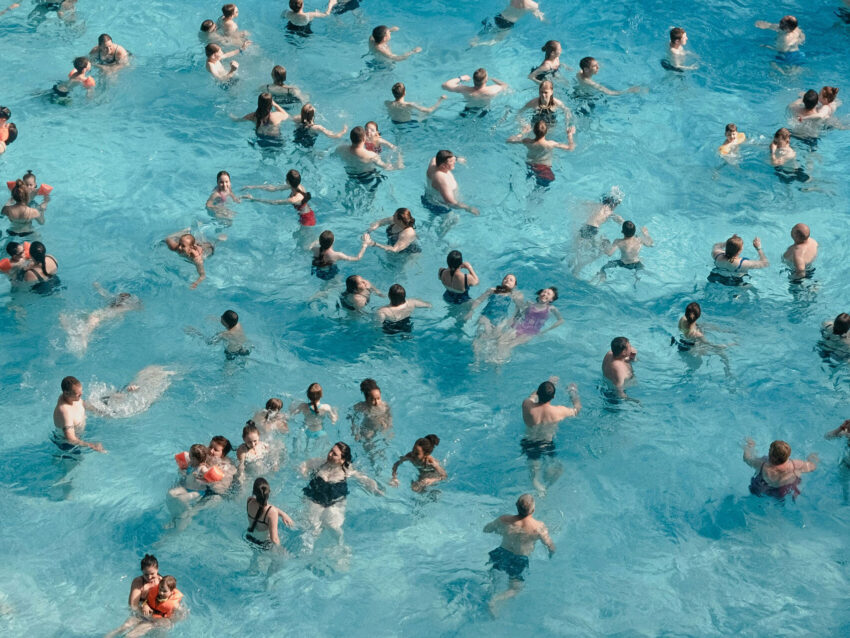
the pool is turquoise and it is still still. Over in the graveyard, the last presenter is droning over the PA, but here it is nothing more than a far-off buzz. Here, celebrants relax on towels and lounge chairs. Some secure babies’ swim diapers. One mother clutches her toddler, bobbing in the shallow end. My son and daughter, friends again, splash past that mother, unaware that anyone outside their universe of two exists.
I sit at the pool edge to dip my feet. The town pays a passel of hormonal, cursorily trained high-school students to serve as lifeguards. Still, my neural pathways, for so long set to high alert, are hard to shut down. I remain at attention, especially around bodies of water, even on national holidays.
The mother titters to her toddler. Her swimsuit, modestly cut, does little to hide her most exuberant feature: arms and thighs patterned everywhere with hash marks, scars from her previous life as a cutter. As with the distant voice over the crackling PA, it’s difficult for me to understand what her scars are saying. It’s impossible to look away. Does she want to discuss the hundreds of tiny white mouths she cut into her copper skin? Probably not. Probably she doesn’t want to talk about—
“Mama, watch!”
I watch a jump off the edge of the pool.
“Mama, watch!”
There’s a tremendous splash.
“Mama, can we join the pool and come here all summer?”
I smile tenderly so as not to say, Ask your dad. To not say—
“Mama, watch!”
I watch. Daughter and son swim to me, grab hold of my wet legs and dangle.
I see my girl see the scarred woman. I feel her deep attention absorbing this strange skin.
“Mama,” daughter says without taking eyes off the woman. I dread the next words from my curious daughter’s mouth. “Mama,” my daughter says slowly, entranced by the scars, without looking away, “your down-there hairs are showing. Mama, I still want Nerds.”
I exhale a tremendous amount of air. “Yes. Candy.”
The other mother smiles.
Two small, wet ducklings, my own fowl, follow me to the snack bar. Snack bar is manned by our school’s new history teacher. She supplements her teaching income to pay off her student loans.
“Hi. How you doing?”
“Don’t ask,” she says. “Don’t ask.”
I buy Nerds and Snickers. Snickers are my nod to nutrition. Snickers have nuts. Nuts are an antidote to the poisonous nonfoodness of Nerds. They are—
“Hello,” a small boy says to my children.
“Hello.”
“Do you want to throw stones at the side of the building?”
“Yes.”
They toss the small, painful-to-bare-feet white stones that landscape the picnic area. Who can land a stone closest to the wall without hitting the wall? The children swiftly develop a system of classification. A fine shot is a “sunset model.” A stone that lands far away is a “rooster.” A stone that hits the wall and glances off is tallied as “lost luggage.” Is it freedom to be able to develop our own words for our own experiences, or must we have some agreement as to what, precisely, we mean when we—
“Mama, can he sleep over?”
What is this strange custom, this desire to lie unconscious in one another’s company? Is this longing akin to our desire to feel plural and not possessive, to slip into the world of dreams together in rooms dotted with abandoned apple juice glasses and plush toys? What is—
“Mama?”
“What’s your friend’s name?”
“What’s your name?”
The boy, young enough that his belly still pops like a toasted bun above his swim trunks, says, “Cal.”
“Hello, Cal.”
“Hello.”
“Can he, Mama?”
More likely, these children will lose consciousness together gathered around a shared, glowing screen, a reenactment of gatherings around ancient fires, the significance of which the history-teacher-slash-snack-bar-server could perhaps elucidate or—
“Mama?”
“Sure,” I say. I am one single mother. I will not wage war. “Let’s ask Cal’s family, okay?”
We return to the pool. Children run ahead and jump in as the crowds, at last, arrive. Done memorializing the dead, neighbors are ready to eat meats, to be received by chlorinated blue waters, to wash themselves clean.
The crowds become people I recognize. Here comes the neighbor who wants to read my tarot cards—and yes, of course I want her to read my tarot cards, but also, no. What if she discovers things? What if cards say that Satan is my lover, or that I will murder somebody someday, or I am a bad mother? Neighbor waves. I wave. Better my neighbor not know those things.
Here comes the neighbor who is recently divorced, three small children, his sister in a cult. This neighbor makes life look easy, has confidence. Maybe this neighbor believes in a kind god? Maybe that’s a good idea? Except, what happened with sister who believed too much?
Here comes the neighbor who gave my children piano lessons until I ran out of money. Unfinished lessons open a crevasse between us. Avoid eye contact.
Here comes the neighbor who social climbs to success. Children attend best colleges, will marry best people, have best children, best pets, best furniture—all by sheer force of neighbor’s fashion sense, bright teeth, scheduling prowess, and ability to make small talk at parties.
The words, the calcium, the air—all return electric.
Here comes the neighbor whose child is ill, who openly carries the pain and fear that live hidden among the rest of us, a burden we try to share with hot dishes of food, but can never really share. This mystery—sick children—makes believing in aforementioned kind god almost impossible without rethinking our fear of death or the deaths of our—
“Mama!” Sugar rush reaches wild peaks, heights of ecstatic giddiness. Limbs writhe and grab, glisten with droplets, rainbows of chemical bonds and engineered sweets. “Mama!” Charged bolts shoot from the children. A prompt, an encouragement. One day it will be winter. One day I will be weak. “Mama!” The words, the calcium, the air—all return electric. I move slowly. My swimsuit could use replacing. The elastic is spent. But even a taut non-rippled-edge suit could not contain all I am, belly bursting, mind spinning. I scale the high dive’s steps. A few feet of height gives me pause, but in the scaffolding of the ladder, small, vigilant spiderwebs catch the light. They are wonderous. They are homemakers. They are killing machines. They—
“Mama! Jump!”
I continue to climb.
Children wriggle like worms below. They perform druidic dances. They are conduits. “Yes!” son screams to his sister. “Jump!”
“Yes!” daughter agrees as I reach the top of the very tall ladder. The big, free high dive is a dizzying springboard into open space. It vibrates. It hangs. From here, I see petals, trees, beasts of each hot dog and hamburger. I see our war dead. Father, did you bring me silver? Father, did you bring me gold? The mothers patterned with cuts say yes. The landlines of Luddites ring to agree. Yes, jump. Rolls of toilet paper unfurl and festoon the public restrooms, bunting to celebrate this messy mingling, the living and the dead. Wives rise well rested from their graves. Overdue child support is paid. Children eat and immediately swim, because the blue waters of the pool mean Yes, jump. Mean no rules can separate us. Because, beloveds, we belong to one another, even if we haven’t yet met. Yes.
Below, children churn with Nerds, with nuts, and I step toward the edge of the board. The blue water sparks. Freedom doesn’t have borders but collective nouns: pools, schools, hives, sleepovers. I memorialize these miniature democracies. Free meals for all, pollen and pollinators, even when they sting and die and drink our sodas. Even when they are maimed by brutality. These waters will not wash us clean. We will never be clean. We will never be rich. We will not paper over violence. We will not punish the perpetrators. Everyone in the pool. All the tattered swimsuits in the world can’t keep us divided. “Watch,” I say as the elastic of my suit gives way even more. We fall apart, open to intrusions, interruptions, disintegrations. I bleed, burst, and surge. Grammars shift and release. Be less and bless. I hail all the words that escape, finally free. I launch my boundless body into the blank blue sky.
Samantha Hunt is the author of four books of fiction, including The Seas and The Dark Dark. She is also the author of The UnwrittenBook, a collection of essays about death and literature. Hunt is the recipient of a Guggenheim Fellowship. Her work has been translated into thirteen languages.
Newsletter
Sign up for The Yale Review newsletter to receive our latest articles in your inbox, as well as treasures from the archives, news, events, and more.