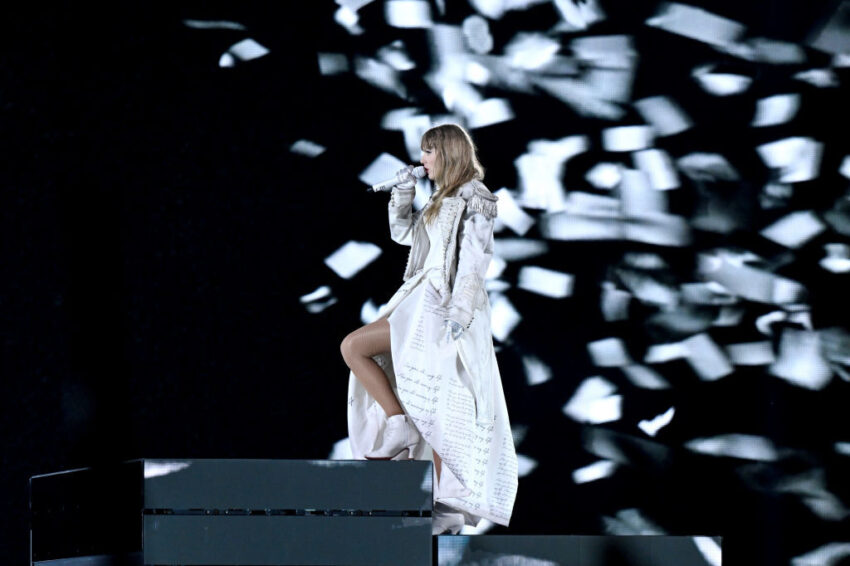
Taylor Swift on stage during the Eras Tour—a spectacle that, like The Life of a Showgirl, turns the act of retrospection into part of the performance. Carlos Alvarez / Getty Images
taylor swift has spent half her career telling us she works to meet impossible standards: she’s a “pathological people pleaser,” a workaholic ex-ingenue, asking “What will become of me / Once I’ve lost my novelty?” and running herself ragged to avoid that fate. So it’s rough justice that critics and fans alike have criticized The Life of a Showgirl, her twelfth album, for its failure to do things that, taken together, not even Swift could do. Many hoped for an album of nonstop bangers, given her choice of producers (Max Martin and Shellback, who crafted her first pop era). Other listeners wanted a literary tapestry, appropriate in light of her upcoming wedding to NFL star Travis Kelce: that’s what Swift implied when she announced, on Instagram, that “your English teacher and your gym teacher are getting married.” Though some reviewers praised it, on the day the album came out, one music writer for The Guardian bemoaned its lack of “genuinely memorable moments.” Most fans I know feel let down too. Some wanted more introspection; others have lamented Swift’s apparent retreat from politics, though I doubt she’d do her best work if she wrote songs about undocumented immigrants. I’ve even heard fans ask whether she’s started settling (as the contemporary term goes), both in her songwriting and in her choice of man.
But we should consider what Swift has achieved with this album: She’s made a work of retrospection. She’s reflecting on her life as musician, friend, former teenager, performer, top-selling brand, thirtysomething woman who dates men, and one of the world’s most observed human beings. It’s eclectic, a mix of styles, with something to tell, and some way to disappoint, everyone. And—on its own terms—it’s a win.
How does her life—and how do her might-have-beens—look now?
What’s a retrospect? It is—if we take examples from outside songwriting—W. B. Yeats’s “The Circus’ Animals Desertion,” reconsidering the poet’s earlier truths and “counter-truths.” It is Stanley Kunitz in his last great poem, “Touch Me,” quoting his own verse from “forty years ago.” It is anything with “Revisited” in the title. And it is, in particular, the kind of thing Seamus Heaney wrote in the last twenty years of his career, after receiving a Nobel Prize. A retrospect might accuse a past self, but it’s more likely to encourage, sum up, smile knowingly, and exhort us to find our own paths. It may also undertake the work of revision, going back to see what was gotten wrong and attempting to right it. The Heaney who wrote Seeing Things (1991) and District and Circle (2006) advised readers to “walk on air against your better judgement.” The mellifluous late quatrains of “Tollund” tell us how, after the 1994 ceasefires, “things had moved on.” We, too, might “make a go of it . . . / Ourselves again, free-willed again, not bad.”
Modern poems are not songs: Swift could not do what Heaney did (or vice versa). Yet The Life of a Showgirl also works as artistic retrospect. Showgirl follows Swift’s earlier, obviously retrospective work of the past few years, rerecording four of her first six albums as Taylor’s Versions; giving the world more songs she wrote back then; undertaking the Eras Tour (which divided her work by, well, eras); and working on a forthcoming documentary about all of it. How does her life—and how do her might-have-beens—look now?
start with the first track, “The Fate of Ophelia.” Swift might have ended, she tells us, like other artsy privileged girls who fall for tortured poets: not literally drowned but submerged in self-involved sorrow. She “lived in fantasy” (like the happy outcome in “Love Story,” her rewrite of Romeo and Juliet). Now, though, she’ll become someone better—with help. Her songs about Kelce let her reimagine earlier stories, particularly her belief that no one will accept her as she is. In the ABBA-esque lightness of the third track, “Opalite,” Taylor says that she has revised her belief about love: “I thought my house was haunted. . . . I was wrong.” Love takes work, like the titular gem, a man-made version of moonstone. “Wood,” a hymn to bad luck breaking at last, is not a love song but a sex song (and a call, one that is still needed, for women to value their sexual pleasure).
Are these songs goofy? Maybe, but they’re retrospective too: because of what Swift’s been through, she cherishes what she has. The dollar signs in the title “Wi$h Li$t” look silly—thankfully, you can’t hear typography—but the song pursues Swift’s real astonishment that a conventional life, “a driveway with a basketball hoop,” might appeal to her now that she has the right man. It’s also a look back at “Midnight Rain,” from Midnights,
where she turned down an offer of marriage: “He wanted a bride, I was making my own name.” Swift now says she doesn’t need more Grammys—they’ve dropped off her list. Sappho’s Fragment 16 makes a similar point: “Some say thronging cavalry, some say foot soldiers, / others call a fleet the most beautiful of / sights the dark earth offers, but I say it’s what- / ever you love best” (κῆν’ ὄτ-τω τις ἔραται). Such claims hit harder if you’ve seen cavalry. Or worldwide applause.
In track five, “Eldest Daughter,” a ballad so ambitious that it takes a few listens to see how it holds together, she promises her lover that the childhood joy she feels with him won’t fade. Again, she understands her present happiness by looking back, first to her self-suppression and then to the days before that. Slow piano chords, G after G, repeat as Swift complains that “everybody’s so punk on the internet,” afraid to show sincerity or warmth. The second verse remembers (looking back to “Seven,” from Folklore) how Swift felt “on the trampoline in somebody’s backyard / I must’ve been about eight or nine.” Since then, she’s become a careful eldest daughter, picking up “cautious discretion.” The song looks back too, to other earlier ones, such as “But Daddy I Love Him” and even “I Knew You Were Trouble,” where “growing up precocious” led her to fall for bad boys. She sang about those bad boys, over and over, to packed football stadiums. Sometimes, as she’s said, repeating those songs made her cry. And now she’s found a good one.
All the best parts of the album look back in some way, but they do not sound like one another: there’s bubblegum pop; 1970s soul; neo-disco; a drumless, indie-guitar diss apparently addressed to Charli xcx, who seems to have sided with Taylor’s tortured-poet ex; that piano ballad; and more. The eclecticism implies that no single style can fit all that experience (all those eras, as it were). It also suggests that her new life will not, artistically, tie her down.
does devoted monogamy foreclose the life of a showgirl? Can a celebrity as shiny as Swift avoid the marital fate of Elizabeth Taylor, who exchanged rings eight times (twice with the same man)? That’s the burden of the album’s second track, “Elizabeth Taylor,” with its retro strings and dubiously angelic backing vocals. The song itself works as a compare-and-contrast: these two stars differ in their approach to men (Taylor, at this point, wants one and just one), but they share a commitment to their work. A BBC host recently asked Swift about Swifties’ theories that she might quit music to raise kids. She called that notion “shockingly offensive.” Taylor and Travis belong together, she said, because “we both, as a living, as a job, as a passion, perform for three and a half hours in NFL stadiums.” The exchange says something about her dating pool, about how few guys could accept her without feeling threatened. Fans who wonder why she won’t denounce the pro-Trump views of other NFLers, or their wives, should remember that Kelce has to work with these people: their distrust would put his life and limb at risk.
A retrospect also looks back to see the future. Swift has sold enough records to do whatever she wants, and what she wants is to stay onstage. That’s the point in the titular track, which has everything to do with retrospection, and turns on its old-timey, feathers-and-sequins image. The showgirl, exhausting herself in costume, must go on: she may look celestial, but she’s also a down-to-earth professional. The showgirl Kitty (apparently named after Taylor’s mother’s Great Dane) encounters a would-be protégé. Kitty warns the newcomer that “you don’t know the life of a showgirl.” But Kitty underestimates her fan, just as we might underestimate the verbal play the song invites, since it doesn’t start till the bridge: “You wanna take a skate on the ice inside my veins?”
Is that Taylor asking? (Probably.) Or is it Kitty? Is she telling us that it’s too late to warn her, or that it was always too late—she was born for this life, and now she’s managed to live it? Our showgirl, not Kitty but Kitty’s apprentice, has hardened and ascended—so much so that the song and the album conclude with applause recorded on the Eras Tour. (The approval keeps coming, commercially if not critically: the album broke records for first-week streaming, and the Showgirl release party film opened in movie theaters around the country.) Moreover, Taylor’s paying it forward: Swift’s own younger protégé, Sabrina Carpenter (whose vocal range resembles Taylor’s), joins her on the song. Yes, Taylor will marry Travis, but like Kitty, like Sabrina, she’s also “married to the hustle.” She won’t repeat herself, but she will look back.
And when she looks back, she sees more than her troubles. The core of the record, emotionally and musically, has to be track five, “Eldest Daughter.” (“All Too Well” on Red, “Dear John” on Speak Now, and “The Archer” on Lover were track fives too.) But the masterpiece, the song that stands among her few most perfectly constructed, has to be “Ruin the Friendship.” It’s a song that looks back not to her tours, or to her internet dramas, or to how she met her man, but to her first three albums, and to her high school years.
Taylor has answered that question, as an artist, with these songs of eclectic retrospect.
In the first verse, she rides in a speeding car with a friend: “It was not convenient, no / But your girlfriend was away / Should’ve kissed you anyway.” (Taylor emphasizes “not” in the line by pausing after: it’s all about what didn’t happen.) They never did kiss, as her bridge, aflutter with second thoughts, explains: “Don’t make it awkward in second period / Might piss your ex off . . . / Staying friends is safe.” After high school, this friend took his own life. The final chorus layers Taylor’s voice over itself so that she speaks both to her dead friend and to us (a vocal strategy last seen in “marjorie,” her threnody for her grandmother). In the final chorus, one version of Taylor repeats: “Should’ve kissed you anyway.” The other concludes: “My advice is to always ruin the friendship / Better that than regret it for all time.” It’s advice you can hum (I can’t help humming it). And it, too, looks back—to “Forever Winter,” a track from the rerecorded Red that surely concerns the same real-life friend, Jeff Lang.
I’ll be listening to Showgirl for a long time. I’ll listen to it the same way I listen to Taylor Swift and Speak Now:
I’ll skip a few tracks and repeat the rest. I’ll think about how I’ve changed—since Red, since Lover—and whether I’ve grown, and how I can make my own satisfactions and settlements into something like art (though I can’t write, much less sing, the way Taylor can). I, too, have what I want for now. And as I listen, in 2026 and 2027 and into the future, I expect to look back on not just Taylor Swift’s growth and eras and catalogues but my own evolution from a casual fan to a Swiftie to a teacher and critic who has now written a book on her songs. That book, sent to press soon after the Eras Tour ended, concludes with Yeats’s poem “What Then?” The poet looks back on “All his twenties crammed with toil” and sees that “All his happier dreams came true,” in his domestic life and in his writing career: “‘The work is done,’ grown old he thought, / ‘According to my boyish plan.’” And yet he cannot stop looking for a next act: he still hears, as he did in youth, now louder than ever, “Plato’s ghost,” singing “What then?”
Taylor has answered that question, as an artist, with these songs of eclectic retrospect. But the album also raises questions. How many can she spend looking back? If there’s another era ahead—motherhood (as “Wi$h Li$t” implies) or otherwise—how will it change her? How will it sound? We can’t know. But we can know that she’s going to write songs about it: that’s the life of a showgirl, babe.