In a 2004 essay, literary critic Hortense Spillers writes about Zora Neale Hurston in multiples. “A Tale of Three Zoras” emphasizes not so much the plurality of Hurston’s literary interventions but the enigmas behind the name: “So much riddle, so many faces.” Raised in the black town of Eatonville, Florida, at the end of the nineteenth century and trained in anthropology at Columbia University in the 1930s, Hurston juggled many forms of prose, from ethnography, autobiography, and folklore to novels, plays, and short stories. Her first novel, Jonah’s Gourd Vine (1934), fictionalizes the life of her black preacher father. “What I wanted to tell was a story about a man, and from what I had read and heard, Negroes were supposed to write about the Race Problem,” Hurston writes, recounting the book’s provenance. “I was and am thoroughly sick of the subject. My interest lies in what makes a man or a woman do such-and-so, regardless of his color.” Unlike many of her contemporaries, Hurston often evaded writing about racial violence, even as she described a society marred by dispossession and trauma. Spillers continues: “Hurston seems to have been equipped with the uncanny ability to create a kind of chaos, to behave outside the parameters of fashion, and to create dimensions of the mythical about her as she modeled versions of self.”
Hurston’s ability to create chaos has been papered over in recent years in favor of neat instrumentalizations. Her 1937 novel, Their Eyes Were Watching God, is a staple of high-school English classes, where it serves as an example of black modernism, black Southern vernacular, and black women’s psychic life. A contemporary syllabus of black cultural theory or black aesthetics might include her 1934 essay “Characteristics of Negro Expression,” which broke down black forms of art on their own terms—“dialect,” “asymmetry,” “the jook,” “culture heroes,” and so on—at a time when black art was denigrated and trivialized. This essay’s organization inspired the schematic focus on twelve characteristics of black dandyism in Superfine: Tailoring Black Style, the Metropolitan Museum of Art Costume Institute’s spring 2025 exhibition and Met Gala theme.
When the sign “Zora Neale Hurston” appears, because of her literary celebrity, we think we know her. We don’t, of course. We can’t possibly. A cursory glance at her oeuvre demonstrates uncontainable heterogeneity. And yet today, Hurston is defined by that impossible desire for knowing: a recuperative mode that obscures more than it reveals, aiming for closure, wholeness, and celebration over indeterminacy, ambivalence, and political probings. The desire to know, to pin down, is reassuring in its possessive finality. But that stable kind of knowledge is impossible; we can only read Hurston in all of her contradictions, an unfinishable and inconclusive task. Hurston has always been puzzling, even to “the most sympathetic researcher,” as Maya Angelou has written.
Zora Neale Hurston’s Rediscovered Novel
A new publication obscures the canonical writer
Tiana Reid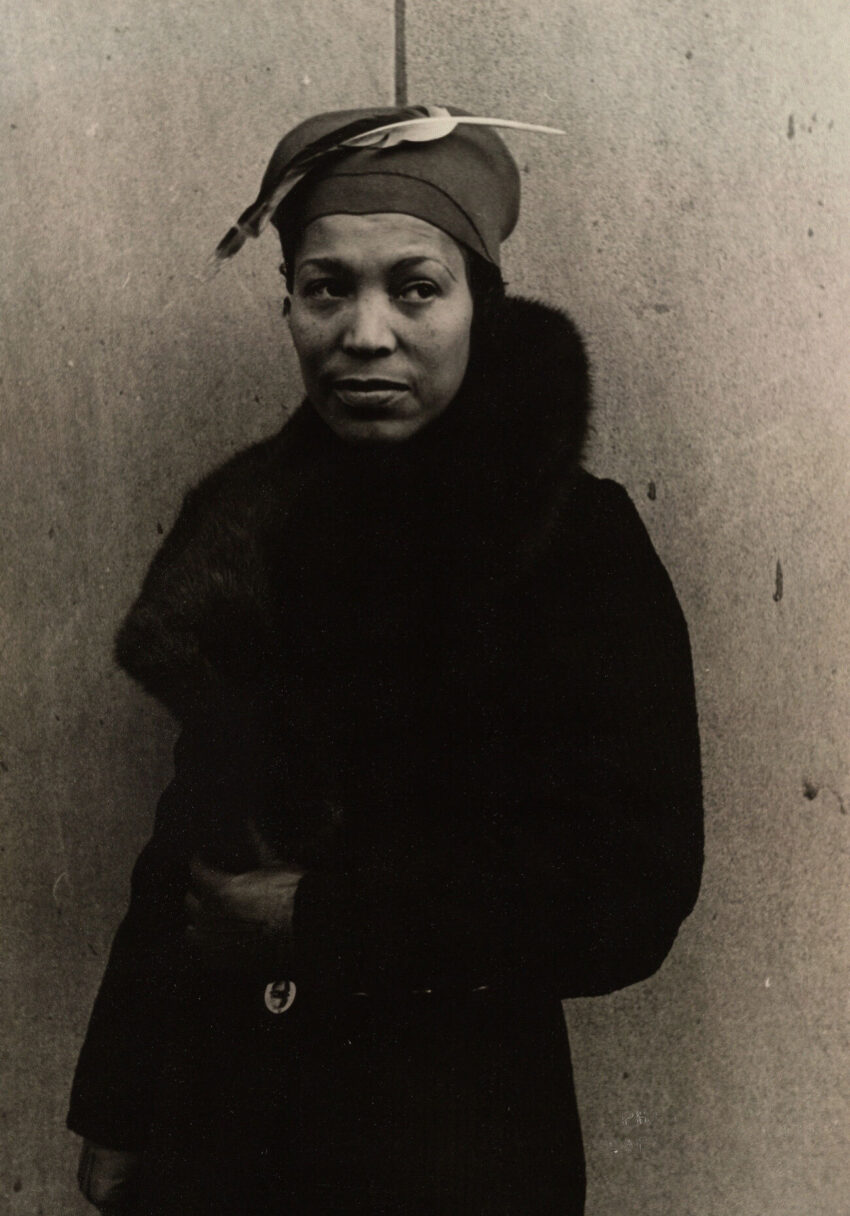
The Hurston we know today constitutes such a “meeting ground” of desire and loss, life and death.
Recuperative readings, foraging for stability, recovery, and health, tend to appeal in times when society is especially sick. I don’t need to explain how sick we all are—literally and metaphorically—and how badly we want a quick fix. The figure of the black woman has been put to work as a vexed cure at various points since her forced arrival in America. In her essay “Mama’s Baby, Papa’s Maybe,” Spillers describes black womanhood as “a locus of confounded identities, a meeting ground of investments and privations in the national treasury of rhetorical wealth. My country needs me, and if I were not here, I would have to be invented.”
The Hurston we know today constitutes such a “meeting ground” of desire and loss, life and death. No doubt, Hurston was a neglected thinker for much of the twentieth century. Self-declared “Queen of the Niggerati,” she was a member of the group of Harlem Renaissance writers and artists, including Langston Hughes and Countee Cullen, who created FIRE!!, a short-lived journal that was more experimental in theme and vernacular than the Talented Tenth deemed proper. In the 1920s and 1930s, she garnered some recognition as a writer and later as an anthropologist and folklorist, but by the end of her life, she struggled to find work. She was briefly a domestic worker in Miami, Florida, before she died at a county welfare home in Fort Pierce. Whatever success she had was gutted. Contemporary efforts to restore her legacy begin with the mourning of this disappearance, so to know her now is to redress past neglect. Alice Walker’s 1975 essay “In Search of Zora Neale Hurston” kick-started a critical reassessment that brought Hurston’s books back into print. In the essay, Walker narrates her search for Hurston’s unmarked grave.
That narrative of concomitant destitution and recovery has endured, even as Hurston’s popularity has grown. Following Walker’s rediscovery, Hurston was converted into what Spillers calls an “enabler,” ushering in a momentous era of black women’s writing and black feminist criticism. As Toni Morrison, Gloria Naylor, Ntozake Shange, and many, many more achieved commercial success and literary prestige, Hurston became prestigious, too, as a legitimating font of black women’s tradition.
In recent years, she has also come to stand for the triumph of joy over tragedy. In “Zora Neale Hurston Is for Everyone,” published by The Atlantic in 2022, anti-racist writer and professor Ibram X. Kendi expresses his unfulfillable wish, via Hurston, for things to be okay amid hardship, amid decay. On the occasion of his adaptation of a Hurston short story into a children’s book, Kendi rewrites a famous line of Hurston’s, “I am not tragically colored,” to say that her lesson for kids is this: “No matter what tragedies befell me and my family and my history and my world, I am not a tragedy. I am not tragically Indigenous”—or, as the list goes on, tragically black, Asian, white, Latina, Muslim, Jewish, trans, disabled, or gay. To say that “Hurston is for everyone” is also to say that Hurston is malleable for every situation, position, time, and identity. We lose not simply the specificity of the black Southern migrant woman’s experience but also a more nuanced yet daring account of one writer’s intellectual life.
Institutionalization in a welfare home, inflamed archives, and an unmarked grave: not how anyone deserves to be remembered.
Readers keep getting chances to read Hurston anew. Her unfinished final novel, The Life of Herod the Great, was published in January by Amistad, a HarperCollins imprint, decades after being recovered from a fire by Patrick Duval, a police officer and friend of Hurston’s. The fire was no accident—it was set during the execution of an order to empty Hurston’s house in Fort Pierce during the days after her funeral. Herod is fragmented not only because Hurston was still writing it when she died in 1960 but also because the manuscript was partially destroyed. Read by a small number of Hurston scholars and biographers, it has been housed at the University of Florida since the 1960s, along with other manuscripts, correspondence, documents, and photographs of Hurston’s.
Institutionalization in a welfare home, inflamed archives, and an unmarked grave: not how anyone deserves to be remembered. Hurston’s great tragedy of being discarded and forgotten—after enduring life as an isolated black woman intellectual whose grandparents were born into slavery—has persisted in the last fifty years, even as she is repeatedly revived from the dead. You can now find Zora—mononymous like Beyoncé and Rihanna—in Hollywood and on theater stages, in children’s literature and comic books, on bestseller lists and syllabi alike, congealing into (to borrow a phrase from Spillers) “an early ‘Oprah Winfrey Show’ all her own.”
Today, black literature has the crossroad blues, as musician Robert Johnson called it. Almost half a decade after the George Floyd uprising spawned anti-racist reading lists, Hurston’s star rises ever higher, and black literature, along with LGBTQIA+ literature, is now high on the lists of books banned by state legislatures and school boards in Republican-led censorship efforts. History is being erased. But that doesn’t mean we should sanctify our predecessors or protect them from critique. We risk it, for Hurston, when we read her complex works through the trope of recuperation, reducing them to a bridge between past and present.
hurston was interested in the Bible as a literary, political, and anthropological resource throughout her life. She became fixated on Herod, a client king of ancient Rome who governed Judea, when her research led her to doubt the historical reliability of some events in the Gospel of Matthew. Hurston spent fourteen years meticulously studying ancient Mediterranean politics and writing her historical fiction on Herod. She dreamed of a Hollywood adaptation, before she’d even gotten the book published.
Though encumbered with a glut of characters, countries, and Roman and Egyptian historical accounts, the plot of Herod is relatively straightforward and chronicles his rise to power, family dramas, and political reign over Judea. Set in the first century bce, Herod transforms the biblical king from his New Testament status as a tyrant who ordered the “massacre of the innocents” in Bethlehem to an esteemed Levantine hero. The novel opens with Antipater appointing his tall, good-looking, confident son Herod as governor of Galilee: “It was perhaps a freak of personality native to the theater where some, a very few, can command applause for doing practically nothing, while very competent actors can scarcely gain notice. Herod had that something.” This kind of glorification continues throughout the book. It may do justice to Hurston’s studied interpretation of history, but it doesn’t do much for the contemporary reader. As a protagonist, Herod is too perfect to be interesting.
Herod has been brought into print thanks to the archival and intellectual labor of Deborah G. Plant, an independent scholar who also edited Hurston’s Barracoon: The Story of the Last “Black Cargo,” which became a bestseller when it was released in 2018. Editing the unfinished works of a deceased writer is an almost Sisyphean task. What did they intend? How much does that matter? What does the contemporary reader need to approach this text with confidence, and how much does that matter? Herod’s additional materials—an editor’s note and commentary by Plant, a preface and an introduction by Hurston, as well as an epilogue constructed from Hurston’s letters—are on the slim side. Plant’s opening note is brief and withholding, making reference to editorial decisions that are not illuminated. We’re told, for example, that “synthesized versions of Hurston’s preface and introduction are included,” but not what those syntheses entailed. The reader is invited to both marvel at and mourn the novel’s unfinished status and the obscurity from which it has been rescued, but no great effort is made to equip us to interpret those gaps—to read the novel as an unfinished one.
What if our black women literary heroines made mistakes?
This is a shame, because the novel is undeniably unfinished: Asterisks denoting missing or fire-damaged text appear especially frequently in the final chapters. The closer the reader gets to the end, the clearer it becomes that there is no end. (The book concludes abruptly, a decade before Herod’s death.) Rather than confront these lacunae, the book’s marketing and production seem devised to downplay them: a press release promises “closure and intimacy with one of the legends of American letters,” and the cover bears a painted portrait of a black Herod, a halo of sun behind him, which the artist Akindele John intended to convey “glory.”
Judging a book by its cover is easy, but judging a book by its drafts is much more complicated. I feel it is almost impossible to evaluate an unfinished book as a book. Publishing unfinished books posthumously has become a widespread practice—recent years have seen marquee recovered novels by David Foster Wallace and Claude McKay—but that has not made it any less fraught.
Plant’s closing words in the commentary to Herod compare the king to the writer: “After hundreds of years, King Herod the Great is coming out of the shadows. After decades, Dr. Zora Neale Hurston can finally tell her untold story. Both Herod and Hurston have ‘come out more than conquer.’” Quoting from Hurston’s autobiography Dust Tracks on a Road (1942), Plant positions the untold story as the fulfillment of fate. The mirrored celebration of Herod and Hurston can be passed over as a platitude—but it also provides cover for a rigid literary politics.
the editing and publication of Hurston’s work has often been contentious. Barracoon evolved from an early anthropological article by Hurston that was marred by charges of plagiarism—charges that Plant downplays in her afterword to the 2018 edition and that hardly made a blip in marketing and book reviews. I have no hunger to relitigate such cases. But I do worry that the ongoing project of cementing Hurston within contemporary culture entails idealizing black women thinkers who seem yet to have earned the right to full complexity. Plant’s anxious effort to protect Hurston from the charges of plagiarism is a way of avoiding a more difficult and honest reckoning with Hurston’s imperfections. The lionization of Hurston, and her conscription as a source of black women’s tradition, forbid us from considering these lapses and challenges. What if our black women literary heroines made mistakes? Perhaps then we would have to rethink our perception of them as heroes, and our very desire for heroism.
The desire for heroism and the salvation of a forebear like Hurston have a spiritual dimension. We want to save her, and we want black women’s history to be saved through her. We want redemption and reparation. Hurston herself had a deep investment in, and curiosity about, religious feeling and tradition, from Christianity and Judaism to hoodoo. It’s important to grapple with Herod not just as a recovery narrative of its titular hero but as theological criticism.
Part of Hurston’s intervention is to ask us to reconsider Herod’s biblical status. He was reviled. Apocrypha abound, but it is probable that Herod, like his contemporaries Marc Antony, Cleopatra, and Augustus Caesar, was embroiled in violent degradations. One such scene in the novel sees Herod and his war party avenge the murder of his father by Malichus, ruler of a neighboring kingdom. After Herod announces himself, “the only reply was an astonished, choking gasp, and as Herod charged with his drawn dagger, a loud and despairing scream. Herod struck while his companions took care of the four guards…, then all joined in the execution of the fallen Malichus.” Moments like this compel us to confront how Herod was a charismatic leader who relied on proto-nationalist loyalty and conquest. Violence is a quotidian part of the maintenance of leadership.
Plant considers Herod a follow-up to Hurston’s other historico-biblical novel, Moses, Man of the Mountain, published in 1939. Opening with scenes of slavery and resistance, Moses rewrites the better-known Judeo-Christian tale of Moses leading the Israelites out of Egypt as a story of black life in the United States. Hurston wasn’t alone in recasting Moses as a black masculine leader escaping bondage. From antebellum spirituals to Martin Luther King, Jr., in the 1960s and Isaac Hayes in the 1970s, the Book of Exodus has been influential for black people and culture. Moses is usually read in this light: the Israelites’ flight corresponds with black people’s long struggle for freedom, from emancipation to the civil rights movement and beyond. Advancing a critique of monotheism, Hurston’s Moses is theocratic, and some of the Israelites are as resistant to his rule as they were to the rule of the pharaoh before him.
But her allegorical interpretation contains multiple meanings and layers. In part because Moses was written and published at the start of World War II, the novel has been read as also critiquing Nazism, with the pharaoh standing in for Hitler. Herod is not so easily read allegorically, but it does provoke in its reader a similar anxiety about leadership. Our word allegory comes, in part, from the Greek agora, which means “assembly.” If we read Herod next to Moses, it becomes clearer that the two books are about political assembly—nation-building, fascisms, upheaval, group power, violence, corruption—in its knottiest forms.
Our task is not to condemn literary and historical figures but to think deeply and imaginatively about them.
By situating black and Jewish people as comparable victims of racism across time in ancient Egypt, Nazi Germany, and the Jim Crow South, Hurston’s biblical retellings also suggest the limits of analogy as a tool against oppression. Considering these novels side by side helps us see them not simply as expressions of Hurston’s noted interest in the Old Testament but, more troublingly, as landmarks in a broader, all too often buried history of black complicity with Zionism. In the 1930s and 1940s, many black writers, Pan-Africanists, and black nationalists explored authoritarian means of achieving supposed race freedom. During the Great Depression, as scholar Mark Christian Thompson argues, Hurston, Marcus Garvey, George Schuyler, Richard Wright, and Claude McKay “turned to fascism to advance their own needs.” Their admiration for fascist ideology amounted to what Thompson calls black fascism. In these same years, Hurston joined Langston Hughes and Paul Robeson in supporting the Emergency Committee to Save the Jewish People of Europe, led by Zionist activist Peter Bergson, and some black nationalists in the United States, such as Garvey, supported the Zionist conquest of Palestine in 1948, which they saw as an extension of their own self-determination.
In Left of Karl Marx (2008), a book about the black radical activist and journalist Claudia Jones, Carole Boyce Davies writes that “one should always use some caution in recuperating historical figures, in order not to make them what they were not.” Hurston, in the preface to Herod, offers a similar admonition: “And Herod the Great, like all other figures of history, can only be understood against the background and customs of his times.” Herod’s day—like ours, to be sure—was overwhelmed by great violence and repression, though of a different sort. But Herod’s own relationship to Judaism is made even more complex by the contemporary publication of Hurston’s novel during a time of genocide in Gaza and Judaization of Jerusalem by the Israeli state.
Citing historian Lynn Hunt, Plant suggests that Hurston penned her account of Herod against presentism—what Plant describes as “the tendency to interpret the past in terms of present- day sensibilities, moralities, and ethics.” At the same time, the present is all we have. Hurston’s work continues to acquire new meanings, and it makes sense to read Herod with an eye on our own era. Our task is not to condemn literary and historical figures but to think deeply and imaginatively about them, wrestling with our complicated relationships to the world. Readers like Kendi who sanctify Hurston tend to smooth over these complications, making it harder to truly reckon with our collective fantasies about liberation. Referencing the COVID-19 pandemic, Kendi writes, “I am not tragically American, despite the tragedy that is the American political economy right now.” To patriotically claim the United States in a way that avoids its production of catastrophe is nothing short of a tragedy.
“there is no agony like bearing an untold story inside you.” The epigraph to Herod, drawn from Dust Tracks on a Road, suggests that the book’s release represents some kind of end to this agony. Googling the sentence, context collapses. In the search results, on our corporatized and often factually incorrect internet, the quote is sometimes attributed to Maya Angelou, suggesting the interchangeability of one late black woman author with almost any other, or with any sign we might seek to invent.
While reading for this essay, I wondered what else Hurston had to say about the pain of harboring untold narratives. I turned back to my copy of Dust Tracks on a Road, to find the full passage:
Perhaps, it is just as well to be rash and foolish for a while. If writers were too wise, perhaps no books would be written at all. It might be better to ask yourself “Why?” afterwards than before. Anyway, the force from somewhere in Space which commands you to write in the first place, gives you no choice. You take up the pen when you are told, and write what is commanded. There is no agony like bearing an untold story inside you.
To ask why is not to undermine black accomplishment. Zora Neale Hurston, who died in financial and medical strife at the St. Lucie County Welfare Home when she was sixty-nine, did not get the chance to ask why. But those of us who are still here and reading, we must.