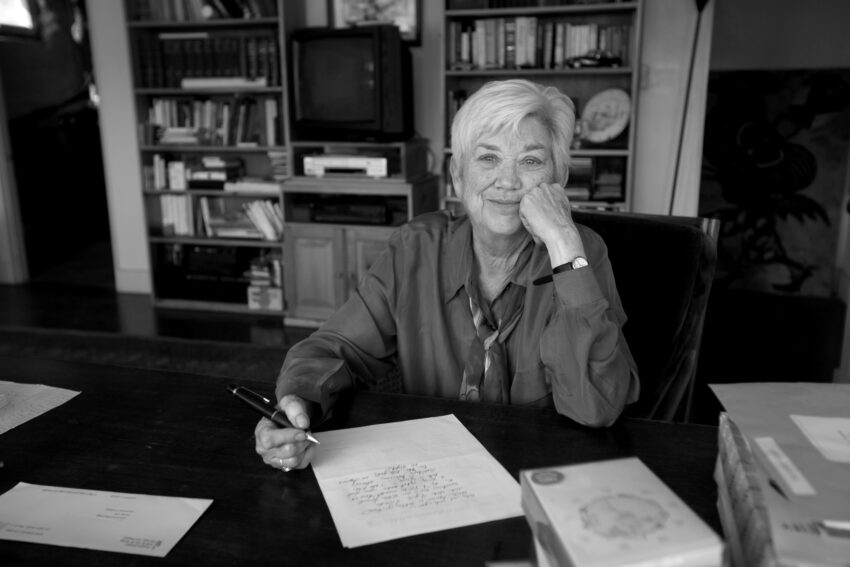
Ellen Bryant Voigt, pictured here in 2015, when she was awarded a MacArthur Fellowship. Credit: John D. and Catherine T. MacArthur Foundation.
ellen bryant voigt, the poet and author of nine collections of poetry, died last week at the age of eighty-two. A finalist for both a National Book Award and a National Book Critics Circle Award, as well as a MacArthur Fellow, Voigt was a central figure in American poetry for more than five decades. Her work combined formal precision with psychological depth, tracing the intricacies of family life, rural experience, and moral attention. She also transformed the teaching of the art: in 1976, she founded the nation’s first low-residency MFA program for writers, at Goddard College, later relocating it to Warren Wilson College, where she mentored generations of writers. Here, her former students and colleagues—including Catherine Barnett, Victoria Chang, Carl Phillips, and TYR’s executive editor, Meghan O’Rourke—reflect on Voigt as poet and teacher.
—the editors
I first encountered Ellen Bryant Voigt—Ellen, as she soon insisted I call her—when she phoned to tell me I’d been accepted to the Warren Wilson MFA Program for Writers. I came home from work—I was then a young editor at The New Yorker—to a voicemail from a woman with a commanding Southern drawl offering me a place in a program I’d heard was both rigorous and flexible: a program in which you visited campus for ten days twice a year and then worked closely with a writer mentor for the rest of the semester. I didn’t want to leave my job, but I did want to finish the book of poems I was working on—I was feeling stuck. I don’t remember the specifics of our call, except that Ellen made me feel chosen.
To arrive at Warren Wilson was to realize, immediately, how much the program bore her stamp. It had grown, I learned, out of an experiment she and Louise Glück had begun at Goddard College—a low-residency model that allowed people who couldn’t leave home a chance to practice their art. There weren’t a lot of these programs back then, but today they are much more common. Ellen had built it into the most influential writing program of its kind.
At my first residency, I arrived late in knee-high stiletto boots—New York habits die hard—only to discover that we’d be walking across icy, unlit paths each night to reach readings and workshops, so my shoes were entirely impractical. Exhausted from flight delays, I was dropped off at my dorm room (in the winters, we stayed in the students’ furnished rooms while they were on break). The room had an abundance—an excess—of teddy bears. They covered the bed, the desk, even the windowsill. A poster of a gray kitten dangling from a rope proclaimed, HANG IN THERE! I felt it was talking to me. I dumped the contents of my suitcase on the floor and wondered what on earth I was doing. The comedy of the situation hadn’t quite hit me, and I felt forlorn contemplating the trappings of an eighteen-year-old’s platitudinous dorm decor and the thin extra-long twin mattress on the bed. Clearly, I was also nervous about what the residency would show me of my own abilities as a poet. Wasn’t working as an editor at The New Yorker education enough?
Brilliant, exemplary, direct—Ellen Bryant Voigt shaped so many of us with her standards, her insight, her care.
By the end of the first full day of lectures, I knew it wasn’t. There was nothing collegiate about Ellen’s graduate program other than the dorm rooms. She spoke to us—and at us—with the authority of someone who had spent a lifetime making language account for itself. She set the tone for everything. When a visiting poet gave a craft talk that wasn’t quite up to par, we’d sit listening, alert to the generalities. And we’d wait. At some point in the Q&A, Ellen would raise her hand. Her question, when it came, was precise and piercing; it revealed what we hadn’t been able to name—the fallacy in the argument, the muddled thinking beneath the eloquence. She didn’t let sloppiness slide. She also had little patience for certain forms of whimsy and experiment—an aesthetic limit I sometimes found myself pushing against. I often thought of Robert Lowell’s line about Elizabeth Hardwick’s voice: loving, rapid, merciless.
Ellen wasn’t merciless with us, but she could be merciless with foolishness. It made the stakes of the work feel real. It also meant that her workshops were among the best I’ve ever been in—and shaped how I went on to teach my own.
Ellen taught us to read not for what was being said but for how the work was being made. Through her, I learned to read like a poet. Not to identify themes, as I’d been trained to do as an undergraduate at Yale, but to attend to effects: how Glück, withholding an “I” until the very end of a poem, could create intimacy precisely through absence; how a poem’s meaning could emerge from its verb patterns. She made us describe poems at a near-absurd level of precision: The poem has nine medium-length lines and two periods. The first sentence is seven lines long; the second, two. The metaphors aren’t anchored to anything concrete. That kind of description, she insisted, would tell you what a poem wanted to be. Her rigor taught me how to read my own work as I’d learned to read others’: closely enough to see what it was resisting.
Ellen gave me tools for thinking about poetry that no one else had. She was passionately interested in the ways poems could be both narrative and lyric, and in how syntax created clues that shaped those “latent narratives,” as she called them, undergirding lyric poems. She was more alert to the implications of syntax—eventually writing a book about it—than anyone I’ve ever met. These obsessions mirrored my own tendencies: I loved close reading and grammatical analysis. But Ellen illuminated something I hadn’t yet worked out in my own writing—a reluctance to make narrative elements clear. She gave me the confidence to see that clarity could deepen a poem, not ruin it. A poem’s preoccupations didn’t have to be a secret that only I knew. I could say what I meant.
Ellen’s teachings on syntax—her attention to how the order of words shapes meaning—resonate in my thinking to this day. Once, in a packet, I’d written a line I thought especially lovely. She flagged it, explained why it was sonically and semantically weak, and wrote: Now that you know, you’ll never do this again. That faith became a kind of command: to keep studying, to be serious, to never, ever coast.
I’ll always remember her astonishingly brilliant structural reading, at a weeklong workshop, of Robert Lowell’s Life Studies. She showed us how the long prose section is essential, how the first and last sections mirror each other, how “Skunk Hour” became possible because of what came before, the autobiography in formal, cloaked verse that Lowell would dramatically drop. To listen to Ellen talk was to learn.
In my last semester, I worked with her on my thesis. I had requested another professor, feeling a little afraid of Ellen—and suspecting that our poetics were different—but she chose me, and so it was. At the time, I had a demanding job running the Culture section at Slate
and writing a weekly column that sometimes made it hard to meet my MFA deadlines. Other professors had been tolerant, understanding. Ellen was not. She told me—respectfully but unequivocally—that I had to choose: to be serious about this work, or not. Her directness startled me. But it was a turning point for me. Her dedication helped me give myself permission to prioritize my own writing for the first time in my life. I’ve invoked that moment many times with students of my own. Her model of leadership made excellence feel like a moral imperative. Yet there were moments when her allegiance to the institution she’d built—to its faculty and its traditions—could come at a cost to students. The semester I had a male professor who failed to return packet responses on time, or at all, I didn’t raise it; I knew they were good friends. I ended that term largely without feedback. I learned from that too—about how authority requires us to push against our own habits of mind.
That was Ellen, the teacher. But it was her poems, above all, that kept me fascinated by her and taught me, with their formal clarity and emotional fearlessness, how to tell what I saw and felt. In “Practice,” she writes:
To weep unbidden, to wake
at night in order to weep, to wait
for the whisker on the face of the clock
to twitch again, moving
the dumb day forward—
is this merely practice?
Two stanzas later, the poem ends in a couplet I love:
until everyone we love
is safe is what you said.
Those lines pierce me every time. Brilliant, exemplary, direct—Ellen Bryant Voigt shaped so many of us with her standards, her insight, her care. I don’t think I have ever lived up to her, or to the moments in the letters she wrote to me, in which she pointed out an awkward syntactical turn and then said, Now that I’ve shown it to you, you’ll never do it again. I remember reading that line and thinking, But I will—because I’m not you.
—meghan o’rourke
“the one who can sing sings to the one who can’t.” That’s the start of the final stanza of Ellen Bryant Voigt’s poem “Song and Story,” whose very title makes clear that story and song aren’t the same thing. In the poem, story is whatever life we each live, along with the various events a life ends up including. Song, for those who can sing, is what we make from within the contexts of our lives, giving pattern, shape, and sound to the parts of a life that all of us can feel—joy, despair, fear—but most of us can’t find a way to talk about. That’s where the singer comes in—the poet—along with the idea of duty: Being able to sing, Ellen suggests, is an instinct but not one without purpose. Being able to sing means singing for those who can’t.
In Ellen’s poem, that includes the daughter who, unconscious, hooked to a heart monitor, can’t hear her mother singing to her, but she responds, her heart does, by finding a safe rhythm. It includes those forced into labor, in the fields and at sea—labor that song, in giving pattern to it, a rhythm, can make more bearable. And it includes the girl whose story of having been raped and having had her tongue cut out is literally unspeakable. But her sister sings to her—song as a record of what happened, song here as connection, reminder that we aren’t alone in our suffering: “one bird, full-throated, calls to another, / little sister, frantic little sparrow under the eaves.”
We have a duty not so much to get it “right” as to offer our best, as much for the art itself as for those who can’t sing.
“Song and Story” is from Ellen’s fourth book, Two Trees, which appeared in 1992, the same year my own first book appeared. Reading the poem back then, I had no idea I’d ever meet Ellen Bryant Voigt (that would happen in 1996), let alone that she’d become a friend and mentor (with the peaks and valleys such relationships invariably include) for the next thirty years. I also had no ideas about poetry, other than that it was something I made for myself, to make sense of things, if only briefly. On the page and in her daily life as a teacher, Ellen showed me an alternative to my own more self-involved and rather relaxed way of thinking about poetry. Just as rigor didn’t have to compromise music, and could instead reinforce it, writing poems for myself didn’t mean I had to think of anyone else who might listen, even as I hoped for listeners. But as with any gift, there’s a choice—we can hoard it, or share it. Instinct—to make art, in this case—could go hand in hand with generosity, which itself doesn’t have to be compromised by duty. Why not make of generosity a duty, and call it devotion, and call all of it love?
Ellen taught me to take myself seriously and especially to take poetry seriously, not just the making of it, but how to think and speak about it. I’d never heard of a “craft talk” until Ellen invited me to join the faculty at Warren Wilson. Serving as faculty meant giving a craft talk at each residency. I don’t remember what I arrived with on paper that first time, but I do recall discussing it with Ellen, who made it clear that she expected more than the random thoughts I was planning to share with students. Was I terrified? Absolutely. At the time, Ellen seemed inflexible in her expectations—imperious, even. But poetry, I think Ellen would argue, not only deserves but requires attention, patient attention, and precision; we have a duty not so much to get it “right” as to offer our best, as much for the art itself as for those who can’t sing, who maybe don’t rely on us to sing for and to them, but they can benefit from it, from the clarity and depth that any art, well made, gives—or can—to a life.
Fierce and ferocious are the words that keep coming up as people remember Ellen. But I’m not sure she’d agree with that. Unless devotion is a form of ferocity, a respect for art and the making of it, an insistence on precision, on not mistaking randomness for intuition, and on remembering that one way to think about art is as intuition coinciding (whether instinctively or as if instinctively) with craft. In which case, yes, she was a fierce poet, a ferocious teacher, and (even at times when I myself swerved a bit, got lost) a swerveless friend.
—carl phillips
when i entered the Warren Wilson program in 2003, I wasn’t sure what I was getting myself into, but I knew I wanted to immerse myself in poetry. To be honest, I was always a bit terrified of Ellen’s presence because she reminded me of my mother—fiercely intelligent, wholly perceptive, and silently demanding. She had the kind of otherworldly sharpness that was entrancingly multifaceted, like a large jewel. The entire time I was in the program, I was always trying to meet or exceed her standards.
And the funny thing is, I don’t think I ever spoke to Ellen while I was in school. I was pretty sure that she had no idea who I was. But, over the years, when I saw her at readings and events, I began to speak to her more and more. Sometimes she would say something like “You are one of our program’s best graduates,” and my heart would swell in the same way it would if my own mother complimented me.
The last time I saw her was at the Bread Loaf Writers’ Conference in 2023. I felt lucky to get to hear her read her poems again. She read “Snakeskin,” “The Hen,” and “Bright Leaf.” The reading reminded me how much Ellen’s poems feel as if each word is in its exact right place; each word knows its role as it rubs against the words around it. Her poems, especially that night, felt full, brimming with language. My favorite book of Ellen’s is Headwaters (2013), in which her poems eschew punctuation so that words collide, as if wrangling for space and air. Only Ellen’s poems can lack punctuation yet still seem as if they’re fighting for the clarity that punctuation can bring.
As I told my poetry reading group the morning after I learned of Ellen’s death, she was one of the few people (besides my mother) who I thought would live forever. I recently completed a craft essay in which I talk about grief and loss. I write that I’ve been struck by how my dead parents feel more present now than ever. Their absence has become a new kind of presence. When I see a hen, a bright leaf, a groundhog, a blue ridge, or a winter field, I’ll think of Ellen’s poems and feel her everywhere.
—victoria chang
i met ellen in a summer workshop she taught at Sarah Lawrence College in 1998, a month before I started my MFA at Warren Wilson. From her, I began to learn a poet’s vocabulary.
In my notebook, I wrote the word gazelle, followed by a question mark, because Ellen had said that a gazelle allows you to work with disparate elements. A small, slender antelope with white underparts was going to help me become a better poet. OK, sure, I’m in, I thought. Ellen had an almost lawyerly way of asking questions, her silvery-blue eyes scanning each of our bewildered faces with an exhilarating impatience.
I was from the city, so I knew a lot about taxis, but parataxis? “It’s chiastic,” she said about a poem of mine, and for a moment I thought she meant orgasmic, which seemed like it might not be a bad thing. She said my “syntax was too passive.” (How did she know?)
It’s galvanizing to look back over the letters Ellen wrote during our two semesters together, and to reexperience the intensity, generosity, and wry humor of her gaze. “Osip Mandelstam said making poems is easy,” she wrote in an early letter.
First you put in everything that the poem needs; then you take out anything the poem doesn’t need. The complication that your drafts prove . . . is that it doesn’t just happen in a nice, clear, step one, then step two. One sort of lurches forward in the one direction, then lurches to catch up in the other.
She encouraged me to invite greater threat onto the page—“controlled disorder,” she sometimes called it. She told me to lay my poems out on an ironing board, but since I didn’t have one, having not ironed in fifteen years, I used a two-by-four. She lived far north of me, but I felt her by my side; she asked me to send her all my drafts, and she went through and circled places where I’d gone off track. She’d say that we’re not after perfection but that, yes, there’s an ideal poem we’re always aiming for: to write something that will let Keats up in heaven look down and say, “Not bad.”
Many years of friendship and correspondence later, Ellen sent me some drafts of poems from Headwaters as they were unspooling. To say I was honored is a profound understatement. The drafts thrilled me. It was as if she were writing while skydiving, which I’ve never done but for which you need to be able to “demonstrate stability and heading control prior to and within five seconds after initiating two intentional disorienting maneuvers, involving a back-to-earth presentation,” according to one manual. Which is surely akin to Ellen’s poetics, along with extreme focus and a wide expanse of sky.
—catherine barnett
Versions of tributes by Catherine Barnett and Meghan O’Rourke will appear in As a Mountain: In Celebration of Ellen Bryant Voigt, edited by Debra Allbery.
Victoria Chang is the author of seven collections of poetry, including With My Back to the World. She is the Bourne Chair in Poetry at Georgia Tech and director of Poetry@Tech.
Meghan O’Rourke is the author of the New York Times bestseller The Invisible Kingdom: Reimagining Chronic Illness and The Long Goodbye, as well as three collections of poetry. The recipient of a Guggenheim Fellowship, a Radcliffe Fellowship, and a Whiting Nonfiction Award, she resides in New Haven, where she teaches at Yale University and is the executive editor of The Yale Review.