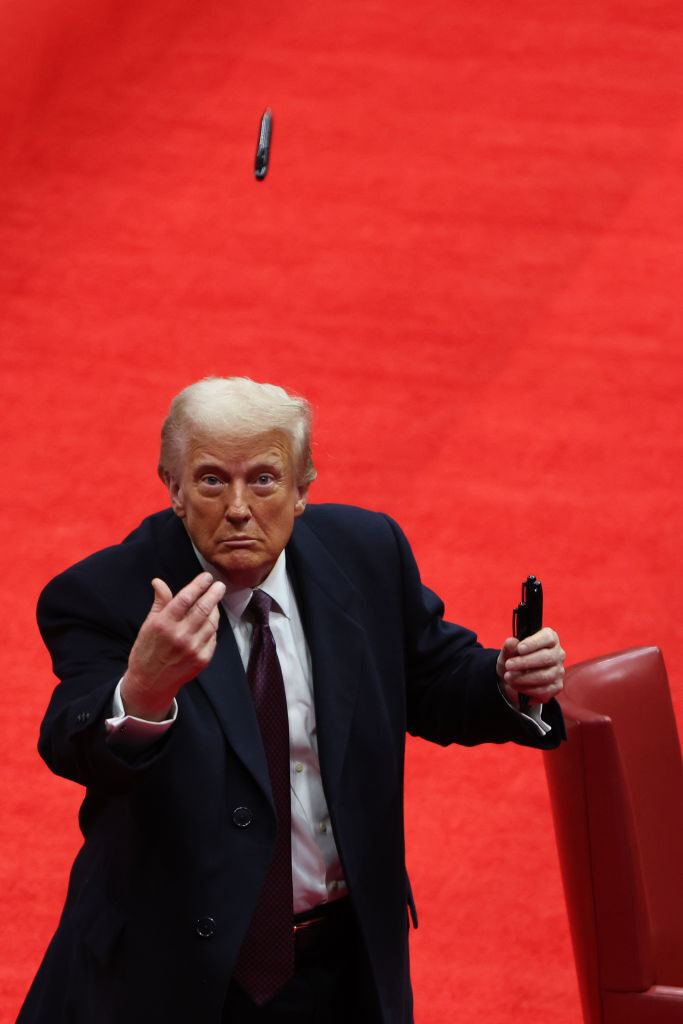
On January 20, after signing executive orders at the Capital One Arena, Trump tossed the used Sharpies to his followers, the way Elvis once tossed his sweat-soaked scarves into the crowds at his shows, writes James Surowiecki. Photo by Justin Sullivan / Getty Images
Wednesday, January 15, 2025 Inauguration Day Minus Five
As I was driving my sons home from school today, they told me that this month in music class they’re studying the work of John Kander, who, along with his songwriting partner, Fred Ebb, wrote the songs for Cabaret and Chicago, as well as “New York, New York.” They had learned a new song that day, they exclaimed, and immediately launched into “Razzle Dazzle,” a tune from Chicago sung by the shyster lawyer Billy Flynn. (You can find Richard Gere, who played Flynn in the movie version of the show, performing it on YouTube.)
“Give ’em the old razzle dazzle, razzle dazzle ’em,” the boys sang. “Give ’em an act with lots of flash in it, and the reaction will be passionate. Give ’em the old hocus-pocus. Bead and feather ’em. How can they see with sequins in their eyes? Razzle dazzle ’em and they’ll never catch wise.”
I clapped and said, “Who does that song remind you of?”
Without hesitation, the six-year-old said, “Donald Trump!”
Correct.
Saturday, January 18, 2025 Inauguration Day Minus Two
Late last night, two days before he once again became the most powerful man in the world, Trump launched a memecoin called, of course, $TRUMP. Like all memecoins—cryptocurrencies that anyone can create—Trump’s coin is not backed by anything. It has no intrinsic value. Its website includes an obligatory disclaimer: the coin is “not intended to be, or to be the subject of, an investment opportunity.” Instead, the site declares, buying the coin should be thought of as “an expression of support for, and engagement with, the ideals and beliefs embodied by the symbol ‘$TRUMP.’”
Whether as an expression of support or out of a desire to get rich, MAGA true believers and speculators alike snapped up the coin. By the end of the day today, its price had roughly quintupled, giving $TRUMP a total value of around $7 billion.
Only 10 percent of the total number of $TRUMP coins were released to the public; 80 percent of them are owned by Trump and his cronies. So Trump had effectively conjured billions of dollars of wealth out of thin air, simply by exploiting his followers’ devotion and crypto traders’ willingness to buy any shitcoin if it looks like the price will go up.
If suckers are willing to shell out billions for $TRUMP, of course he’s going to take their money.
Some Trump supporters expressed surprise that he would sacrifice his reputation in order to make a quick buck—an odd take, given that Trump’s reputation is precisely that he’s a guy who will do anything to make a quick buck. Serious crypto enthusiasts, who have been hoping that Trump will legitimize cryptocurrencies, were dismayed that his scam coin would lend credence to the idea that all of crypto is a giant Ponzi scheme. Ethics experts, meanwhile, fretted over the avenues of corruption that the coin could open and the unseemliness of a president having a multibillion-dollar stake in an industry that his administration would be regulating.
For my part, I hadn’t expected the memecoin gambit, but once it happened, I thought, Of course Trump went there. In fact, more than anything else that happened during inauguration week, the launch of this coin right before he became president was the truest, Trumpiest thing he could do. It showed off his utter indifference to anything resembling norms or rules, and his recognition that most people these days simply don’t care that much about norms and rules. It gave him the chance to make a lot of money without doing any work. And it was the purest expression of the motto by which he has lived his whole life: “Never give a sucker an even break.”
For Trump, the world is divided between those who are in the know and those who aren’t. Worrying about the seemliness, or ethics, of a president-elect making billions from a dubious business venture—that’s for suckers. So is being willing to buy a worthless digital coin just because Trump slapped his name on it. If suckers are willing to shell out billions for $TRUMP, of course he’s going to take their money. What else would we expect him to do?
Sunday, January 19, 2025 Inauguration Day Minus One
The value of $trump soared in the middle of the night to $75 a coin, before plummeting by more than 50 percent. No matter—late this afternoon, they launched the $MELANIA memecoin.
Monday, January 20, 2025 Martin Luther King Jr. Day
Trump’s inaugural address was meaner than most inaugural addresses. But it was not as strange, or as bleak, as his first one. (“That was some weird shit,” George W. Bush supposedly said about the latter.) Some commentators said that the seriousness of the occasion had made Trump grave and restrained. But, really, he was just flat, the way he often is when he reads prepared remarks. Tossing in the occasional sotto voce aside (“Can’t do that” and “It’s all about common sense”) perked him up a bit. But the only thing he seemed excited about was taking the Panama Canal back; apparently, he is not kidding about that.
To see Trump in full flow, you had to watch the impromptu speech he gave later to a host of MAGA supporters who had gathered in Emancipation Hall at the Capitol. One of his trademark rambling monologues, it hit on his familiar themes—the 2020 election was “totally rigged,” he would have won California in 2024 if it hadn’t been stolen from him, blah blah blah. Looser and happier than he had been at the inauguration, he talked about all the things he had wanted to talk about in the Rotunda but that JD Vance and Melania had kept him from bringing up. Among them was the unfair treatment received by the January 6 “hostages,” which is what he calls the people convicted of invading the Capitol and assaulting cops.
Vance stood behind Trump, staring blankly into space; it was hard not to imagine him wondering how many of these speeches he would have to suffer through over the next four years. We also got the revealing digressions that mark all of Trump’s soliloquies: at one point, he told the crowd that Melania calls him “sir” when she’s angry with him, the way a parent might use a kid’s full name when they’ve misbehaved. (Then he said he was kidding, before adding, “I better say I’m only kidding.”)
The most telling moment took place near the end, when, thanking his followers, Trump said, “You’ve been our fans from day one.” And that’s right: The people there were not constituents, or even just supporters. They were fans. Later that day, Trump gave another speech at the Capital One Arena, where he signed a few executive orders onstage and then tossed the used Sharpies to his followers, the way Elvis once tossed his sweat-soaked scarves into the crowds at his shows. It’s mysterious that this flimflam man has managed to win the ardent devotion of so many, but there’s no arguing that he has. Celebrity is a peculiar thing.
But for Trump, every deal has a winner and a loser.
As for those executive orders, Trump issued a barrage of them today. In the afternoon, he sat at his desk in the Oval Office signing orders and answering somewhat random questions from the White House press corps. Online, MAGA supporters extolled the way Trump, unlike Biden, happily took questions from the press. But of course he did. He always wants to be the center of attention. And while many politicians are wary of taking unvetted questions because they are concerned they’re not prepared or might say the wrong thing, Trump doesn’t worry about such matters. In his mind, he’s always prepared. Also, he’s been saying wrong things for eight years, and he’s won the presidency twice.
Among the orders Trump signed was one withdrawing the U.S. from the World Health Organization. When he signed it, he said he was doing it in part because America was being “ripped off” by having to pay a big chunk of the WHO’s budget. “Everybody rips off the United States, and that’s it—it’s not going to happen anymore,” he said.
The statement encapsulated Trump’s worldview: every transaction is zero-sum, with someone winning and someone losing, and the U.S. is always getting the short end of the stick. Economic activity is usually thought of as positive-sum: if you and I make a deal, or if I buy something you’re selling, we both gain from the trade. Otherwise, we wouldn’t do it. But for Trump, every deal has a winner and a loser. That’s why he hates trade deficits and loves tariffs; he thinks that if the U.S. buys more stuff from a country than it sells to that country, we are somehow losing. (By that logic, you lose every time you buy something from Amazon.) It’s a very real-estate view of the world, and coupled with Trump’s desire never to be the sucker, it informs everything he does.
The executive orders themselves were mostly predictable. Trump pardoned almost all the January 6 protesters, including many who had assaulted members of the Capitol Police. (Of course he did; they were acting in his interests.) And he issued a host of proclamations designed to crack down on immigration and get rid of “DEI” programs and jobs inside the government.
Specifics aside, what was most important about the orders was the way they embodied a view of presidential power as essentially unbounded by Congress or, for that matter, the Constitution. Trump issued an order, for instance, declaring that the entry of immigrants through the U.S.’s southern border constitutes an “invasion,” so migrants trying to enter, even at designated crossings, can no longer make asylum claims. That directly contravenes the Immigration and Nationality Act, which establishes the right to do so.
Trump also issued an order purporting to eliminate birthright citizenship, which is explicitly established by the text of the Fourteenth Amendment. And he ordered his attorney general not to enforce the ban on TikTok that became law a few days ago, even though the law includes specific conditions that have to be met before the ban can be suspended. (None of those conditions have been met.) In other words, one of Trump’s first acts as the person who’s supposed to ensure that our country’s laws are “faithfully executed” involved ordering the Department of Justice not to enforce a law passed by Congress and upheld by the Supreme Court.
The TikTok order was notable because Trump had been in favor of banning the app before suddenly deciding he was against it. He’s never really explained why he flipped his position, but then, he doesn’t need to. MAGA supporters who had been vehemently in favor of a TikTok ban have—you guessed it—dutifully changed their positions; they are now celebrating that the app is still alive. If Trump changes his mind again, they will too.
Tuesday, January 21, 2025 The First Full Day of the Second Trump Administration
At a press conference, a reporter brought up the memecoin and asked Trump if he intended to “continue selling products that benefit yourself personally while you’re president.”
“Well, I don’t know if it benefited,” Trump said. “I don’t know much about it other than I launched it. I heard it was very successful. I haven’t checked it. Where is it today?”
“You made a lot of money, sir,” the reporter answered.
James Surowiecki is a journalist and author of The Wisdom of Crowds. A former columnist for The New Yorker, he is now a senior editor at The Yale Review and a contributing writer for Fast Company and The Atlantic.
A Literary Gift in Print
Give a year of The Yale Review—four beautifully printed issues featuring new literature and ideas.