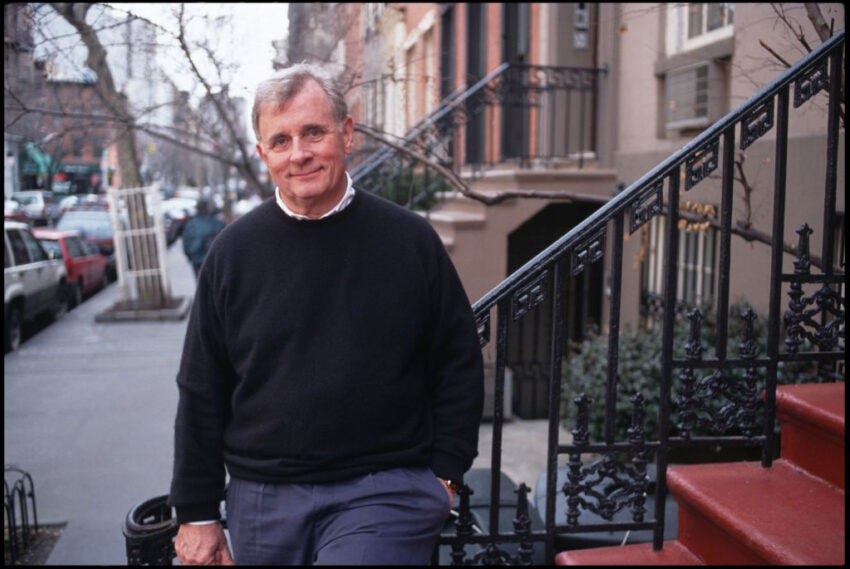
my first conversation with Edmund White, in retrospect, was a perfect example of every conversation we would have when we became friends. It happened in 2016, in his Princeton office, which would later become mine. Soon, he would be retiring and I would be teaching at Princeton, and he often joked that I had been hired as his successor. That alone gave us some pleasure, as the academic and publishing worlds would find little overlapping in our biographies: Edmund, a white American and a major influence on modern gay literature, relished in portraying sex; I’m an immigrant who did not write in English until adulthood, and a reader can take a fine-tooth comb through my work and find nary a reference to carnal activity.
During that first meeting, I told Edmund how I had discovered his work in a public library in Iowa City. I was in my twenties, trying to expand my reading of contemporary literature, and I found that there were many Edmund White books on the shelf. So I read them all, without any prior knowledge of who he was. This amused him, and it amused him even more when I said that I had also discovered A. S. Byatt in the library. Immediately, he perked up and told a story about Dame Antonia that I was able to match with my own story of her. From there we moved on to Iris Murdoch. Then we talked about Elizabeth Bowen and marveled together at the structure of The House in Paris. I was in my Rebecca West phase then and pressed him to read her. Later, in his introduction to The Unpunished Vice: A Life of Reading, he wrote, “Yiyun Li told me to read Rebecca West’s The Fountain Overflows. I’ll always be grateful to her.” By the end of the hour—it was not like a job interview, more like a first date between two readers and kindred spirits—the tone of our friendship was set: we both loved reading, gossiping, and laughing aloud, and we both took pleasure in being irrelevant and irreverent and unflappable.
A year after I met Edmund, my older son, Vincent, died of suicide. The next morning, Edmund texted me: “Come to the city. I’ll hold you all day and we’ll grieve together.” It was at a moment when many people dreaded calling or writing to me, citing their wishes not to intrude, and I was touched by Edmund’s direct and loving note. But when I finally went to the city a few weeks later, our conversation immediately moved elsewhere. When I used his bathroom, I noticed a copy of Secret Memoirs of the Courts of Europe next to the toilet. I told him that I was reading the book, too, precisely the same old edition as his own. He was amazed and asked me why I was reading it—he himself was reading it as research for a novel in progress. I said it was a book given to Elizabeth Bishop by Marianne Moore and they had both read it and sometimes discussed it, though now the memory was vague—I was only certain that I had seen the book mentioned in Moore’s letters to Bishop. Right away, Edmund had a few Bishop stories to tell. (He also offered the forever endearing fact that when he met Bishop, who was older then, he realized Bishop looked exactly like his mother had when she was that age.) Then we talked about Moore, and Edmund related a tale of meeting Moore through a member of the Mafia in Detroit.
When the pandemic started, we met up on Skype at 5:00 p.m., Monday through Friday. The meeting evolved into a five-year-long, two-person book club. I estimate that we read between eighty and one hundred and twenty books together. Some of our favorites included Kipling’s Kim; many Bowen novels; Penelope Fitzgerald’s The Blue Flower and The Beginning of Spring; a wide selection of novels by Elizabeth Taylor, Beryl Bainbridge, and Muriel Spark; and everything by Henry Green. Before Helen Garner’s recent fame, Edmund introduced her work to me (which had been introduced to him by Michael Ondaatje), and we read her together. Edmund also read William Trevor—someone seemingly so far removed from him—because of my love for Trevor’s work. Once in a while, we ventured to less familiar waters. For instance, we read E. F. Benson’s Mapp and Lucia series—six novels set in 1920s England, full of small-town pettiness in the minor warfare of social snobbishness. A few novels in, even we, who could find so much to laugh about, decided that the novels were really too silly and there was no point in going on reading. But we did revisit this abandonment when I read in a biography of Henry James that Benson later bought Lamb House in Rye, England, and the house and the village were the settings of the Mapp and Lucia saga. Should we return to the novels to discover Lamb House and Rye? For a moment, we hesitated—but then decided that, still, the Benson novels were really too silly. Easy laughter was not what we looked for in our reading or in our lives.
Our schedule was forgiving. We read ten to fifteen pages a day, compared notes, and then went on to what we called our giggling session. Edmund shared not only literary anecdotes but also sexual reminiscences from decades of far-flung adventures. Once, when Edmund’s description turned too outlandishly graphic even for him, we stared at each other for a moment and then burst into laughter.
Perhaps I should have prefaced this piece by saying that during our eight years of friendship, I lost two children to suicide. Edmund was no stranger to woe—he had lost many of his friends and beloveds to AIDS, and his nephew, whom he had raised, died of suicide. That life is hard—sometimes bleak, oftentimes brutal—is not to be questioned or dwelled on. Rather, as Moore said, “If nothing charms or sustains us (and we are getting food and fresh air) it is for us to say, ‘If not now, later,’ and not mope.”
Edmund was not a moper, nor am I. Life does not always charm or sustain, but reading and writing offer a provisional haven. So, too, does talking and laughing together. Eight months after the death of my younger son, James, I was with Edmund in his New York apartment. We talked about a friend.
“She’s beautiful,” I said.
“Sometimes,” Edmund agreed.
“Unlike us,” I said.
We looked at each other for a beat and said together, “We’re beautiful all the time,”
then broke into laughter.
The last time I saw Edmund—on May 20, two weeks before his death and a few days before I was set to travel to England and then Spain—he showed me the handwritten pages of his new novel. We were also reading Bowen’s first work of fiction, The Hotel, which we agreed to put on pause until my return. I received the news of his death in Seville, in the middle of the night. Within an hour, I had already discovered something I would have loved to share with him. At the top of his Wikipedia page—which had not yet been updated with word of his death—there were two lines:
For the English cricketer, see Edmund White (cricketer).
Not to be confused with E. B. White.
I wish I could say to Edmund, “Look at that, darling. You’re not to be confused with E. B. White.”
“Never!” he would say, beaming, and we would laugh.
Newsletter
Sign up for The Yale Review newsletter to receive our latest articles in your inbox, as well as treasures from the archives, news, events, and more.