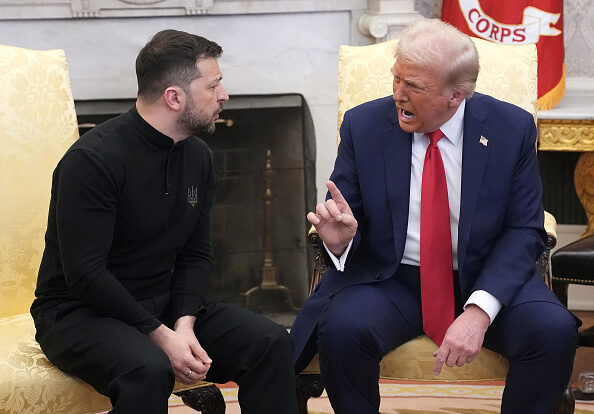
At the end of a disastrous meeting with President Zelensky on Friday, February 28, President Trump said, “This is going to be great television.” Andrew Harnik / Getty Images
If you’re trying to understand what has happened to America over the last ten years, the fact that Donald Trump never planned, or expected, to become president is a good place to start. As the journalist Michael Wolff shows in Fire and Fury(2018),
his book about Trump’s first three hundred days in office, Trump’s 2016 presidential run was something of a lark, less a serious attempt to take the White House than a branding exercise. The campaign was a discombobulated mess. “We’re all losers,” as Trump put it. “All our guys are terrible; nobody knows what they’re doing.” But that was okay, because the goal was not for Trump to win but for him to become, in his own words, “the most famous man in the world.” And on that front, he succeeded wildly. A week before the 2016 election, Wolff writes, Trump told Roger Ailes (the creator of Fox News): “This is bigger than I ever dreamed of. I don’t think about losing because it isn’t losing. We’ve totally won.”
Then, somehow, against all odds, he won for real, landing a job he was essentially uninterested in and utterly unprepared for.
This was, to say the least, unusual. People who become president don’t usually luck into the job. Instead, they dedicate themselves to the task for years. “They prepare themselves to win and govern,” as Wolff puts it. Even those who seem to happen into the presidency—like George W. Bush—have had careers in politics and have surrounded themselves with people with expertise in policy and government. None of these things was true for Trump when he took office in January 2017. Wolff writes:
Almost all the professionals who were now set to join him were coming face to face with the fact that it appeared he knew nothing. There was simply no subject, other than perhaps building construction, that he had substantially mastered. Everything with him was off the cuff. Whatever he knew he seemed to have learned an hour before—and that was mostly half-baked.
Surprisingly for someone with a long business career, Trump was also a terrible manager. He was not interested in delegating authority, or planning, or organizing in general. So the presidency that resulted was, as Wolff writes, “something actually quite comic, if it weren’t so repellent and frightening.”
An enormous amount has happened, both to America and to Trump, in the years since he first took office. But reading the quartet of Trump books Wolff (whom I interviewed last year about Trump’s relationship with Jeffrey Epstein) has written—Fire and Fury, Siege, Landslide, and now All or Nothing, his book on Trump’s bizarre 2024 campaign—one is most struck not by how much Trump has changed but by how much he has stayed the same. His third campaign was better organized than his previous ones because he finally hired a couple of competent political consultants—Chris LaCivita and Susie Wiles (who’s now his chief of staff)—to run it. But Trump himself remains as capricious, inattentive, and ill-prepared as ever. His speeches are, as always, collections of vaguely remembered half-facts, hyperbolic overstatements, and outright lies. He has no interest in policy beyond his pet issues—immigration and tariffs. And even on those topics, he seems to have learned nothing: he continues to repeat the same canards about tariffs that he did in 2017 (foreign governments pay tariffs, and trade deficits are a sign we’re being ripped off).
It is even more striking that Trump’s character has not developed at all over the last decade. Losing an election, presiding over a disastrous response to the COVID-19 pandemic, being convicted of thirty-four felonies, getting successfully sued for defamation and sexual assault, becoming the subject of myriad books detailing the incompetence and chaos of his first presidency—none of it seems to have mattered to him. He is as certain of himself today as he was in 2015, when he rode down the escalator in Trump Tower to announce he was running for president. “There had been in the long narrative no transformational moment,” Wolff writes in Landslide. “People waited for his shame to catch up with him, to bring him to his knees. But this wasn’t Shakespeare. He didn’t learn, he didn’t grow, he didn’t change. He was a simple machine: he got punched, and he punched back. As long as he still stood, he was still punching.”
Reviews of Wolff’s books often focus, understandably, on their tell-all quality, and on the scandalous revelations that Wolff elicits from his many conversations with Trump insiders. But the real importance of his books is the unflinching portrait they paint of a man for whom everything, including governing and policymaking, is a matter of personal caprice. The natural inclination when writing about presidents is to take their politics seriously, and to try to uncover a coherent vision behind their actions. Wolff—a resolutely unsentimental writer—resists that impulse, which allows him to see Trump clearly. The most powerful man in the world today, Wolff’s work reminds us, is not a sinister ideologue. Instead, he’s someone who “did not know enough, did not know what he didn’t know, did not particularly care, and, to boot, [is] confident if not serene in his unquestioned certitudes.”
One obvious reason for this is that Trump has refused to learn. As Wolff puts it, he “didn’t read. He didn’t even really skim.” He hated “anything that smacked of a classroom.” In his first term, at least, he was surrounded by people who knew quite a lot about economics, foreign policy, and management. But in order to have learned from them, Trump would have had to admit that there were things he didn’t understand. And this he would not, or perhaps could not, do. “He almost entirely lacked the ability to listen—sourly looking at anyone who tried to talk to him, before reflexively grabbing back the floor and resuming his own discursive stream of consciousness,” Wolff writes. “He was neither cowed nor impressed by nor appreciative or even comprehending of anyone else’s expertise.”
Unsurprisingly, Trump hates to be contradicted or even argued with. “The most basic Trump White House operating rule,” Wolff writes, “was that nobody could talk back to the president—ever, in any sense.” He lives in a tightly controlled world, “populated only by lackeys, flunkies, and sycophants.” When that world is disrupted, or his will balked at, he becomes enraged, and thus his overheated response after Ukrainian president Volodymyr Zelensky contradicted him and JD Vance last week in the Oval Office (in front of cameras, no less).
Trump can never fail. He can only be failed.
Trump’s public face is that of the nonexpert who nonetheless knows all he needs to know, the man who has no interest in or need for process, the anti-technocrat. And his private self is similarly opposed to what one might call the modern mindset. The conventional decision-maker considers a range of options, weighs outcomes, acknowledges uncertainty, and, if things go wrong, perhaps frets about how the mistake was made. Trump does none of this. It’s not just that he’s all instinct. It’s also that he does not look back or agonize. “No one in a wide circle of acquaintances and colleagues had ever heard him express a regret, doubt, or wish to have acted any differently than the way he had acted,” Wolff writes. If self-consciousness is the curse of modernity, Trump is a thoroughly unmodern man.
This doesn’t mean that he’s indifferent to things going wrong. Indeed, he’s furious when those working for him mess up. This is especially true of his lawyers, with whom he’s perpetually unhappy. (“How come I always get the worst lawyers?” Trump says in Landslide, after learning that a brief filed with the court was full of typos.) A different person might see the shortcomings of their legal team as a reflection of their own bad judgment in picking them, or as a testament to the fact that only certain kinds of professionals will work for someone who has a reputation for stiffing contractors and a penchant for lambasting them. But not Trump. He can never fail. He can only be failed.
While one might expect Trump to be hard-boiled, he is instead sensitive to slights and, perplexingly, appears to be surprised when those slights arrive. He is a narcissist but not a paranoiac. “It was obvious to everyone that if he had a north star, it was just to be liked,” Wolff writes. “He was ever uncomprehending about why everyone did not like him, or why it should be so difficult to get everyone to like him.”
The great mystery of Trump’s political career, of course, is how someone so flawed and so downright odd (as Wolff puts it, Trump is “simply not like anyone else”) has nonetheless managed to be so successful. Some of it has to do with the populist wave, driven by anti-immigration sentiment, sweeping across Western democracies. Wolff simply, and accurately, chalks some of it up to the fact that Trump is among the luckiest men in political history. In 2016, after all, he got to run against Hillary Clinton, one of the least popular presidential candidates in recent memory. And after barely losing to Joe Biden in 2020, Trump ran, in 2024, first against a sundowning incumbent, then against a cautious and vague Kamala Harris, who was never able, or willing, to cut ties with Biden. Had the Democrats run Gretchen Whitmer, Trump believed, he’d have lost “big.”
Trump’s luck extended, even more amazingly, to his various legal troubles. After he lost the 2020 election, he became the first U.S. president in history to try to overturn a democratic election in order to stay in power. The case against him was clear. But Biden’s attorney general, Merrick Garland, dragged out the process of bringing charges against him for so long that by 2024, Trump knew the charges would go away if he won. Meanwhile, an entirely separate criminal case against Trump, this one for his refusal to return classified national defense documents that he had brought to Mar-a-Lago, got assigned to one of his appointed judges, who duly kicked the case down the road before dismissing it. (Last week, the FBI gave the documents back to Trump.) Yet another criminal case against him—for conspiring to overturn the election results in Georgia—was derailed when the district attorney was discovered to have been in a romantic relationship with a man she had hired to help prosecute the president. Luck! And, to top it all off, the justices on the Supreme Court bench (a third of whom Trump had appointed) issued a totally unexpected decision granting him—and all presidents—immunity for any act that could be construed as “official,” no matter how dubious. “Most of us live our lives in a low furrow, if not a rut, of uneven or even miserable luck,” as Wolff puts it. “If your luck breaks for you fifty-fifty, you’ve certainly done well; chances are it will yield far less than that. Donald Trump, for his part, might seem to have among the highest luck percentages ever recorded, fate, good fortune, or the stars rescuing him from so many nadirs.”
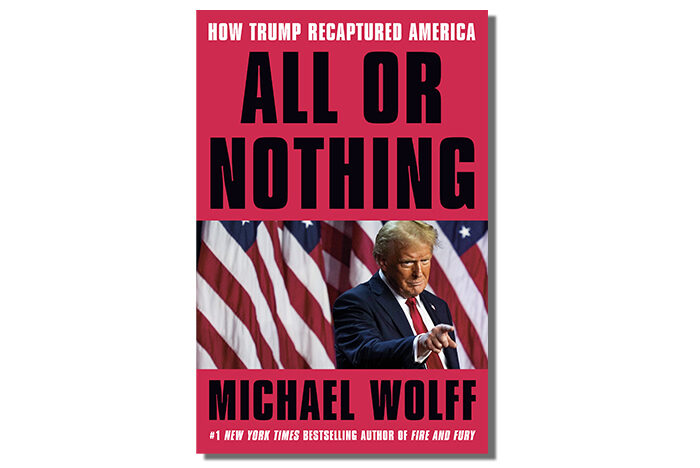
Michael Wolff’s All or Nothing, his fourth book on Donald Trump, charts the president’s 2024 campaign for reelection.
Still, Trump’s success has been due to more than that. He is, as Wolff says, “the most extraordinary showman in the history of American politics,” eclipsing William Jennings Bryan, Joe McCarthy, and George Wallace. If he is indifferent to governing and unaware of his own personal weaknesses, he is keenly alert to questions of performance. After he was nearly assassinated in Butler, Pennsylvania, he had the presence of mind to pump his fist and yell “Fight! Fight! Fight!” before allowing Secret Service agents to rush him off the stage. In the same vein, Wolff reports that in the days before Trump was arrested on criminal charges in New York, he practiced the expression he would use for his mug shot over and over. And when he finally saw the photo, he was “over the moon. He loved the picture. ‘This looks so cool, this is a classic, this is iconic,’ he kept pronouncing.”
For pretty much every presidential candidate before Trump, of course, getting arrested (let alone convicted, as Trump eventually was) would be something to steer clear of. But Trump understands a core part of his appeal to his base: his refusal “to conform to behavior that respectability demands.” He is not a politician with voters but a pop star with fans. And pop stars don’t need to be respectable—part of what makes them stars is that they’re able to get away with things ordinary people can’t. The important thing, as Trump sees it, is to look strong while doing it.
One of the most telling moments in All or Nothing comes when several Trump aides suggest he go to Columbia University in New York City to face off with students protesting Israel’s actions in Gaza so that he can show American voters what he’s running against. Trump immediately rejects the suggestion: “No students! No students!” He doesn’t want to go anyplace where he’ll be heckled. It’s a reminder that Trump almost never appears anywhere but in front of friendly audiences (again, just like a pop star). He’s always trying to project the image of a winner, and winners don’t get heckled. The aide, Wolff writes, berates himself: “Stupid of me, really stupid.”
Ultimately, voters don’t believe Trump cares about the issues. He’s vibes, not policy.
You can see the same dynamic at work in Trump’s insistence on never admitting that he’s done something wrong, which he seems to have imbibed from Roy Cohn, his late longtime lawyer and a former McCarthy aide. When he’s confronted with evidence of his misdeeds, his answer has always been to “deny, deny, deny even the undeniable.” Or, as he is fond of saying, “I never blink.” This is, in an obvious sense, madness. But “certainty has power,” as Wolff writes. “Unwavering certainty. Psychotic certainty, even. . . . And perhaps delusion has power. And the larger the delusion is, the more power it may have.” A Trump adviser tells Wolff: “POTUS really hates ums.” And of course he does: ums are expressions of uncertainty, pauses to consider what one wants to say. In Trump’s world, you do not hesitate, you do not pause, you do not reconsider. The show must go on.
That’s not just a metaphor: for Trump, it’s all a show. (As he wrapped up his disastrous meeting with Zelensky, he said, “This is going to be great television.”) And his supporters—his fans, rather—feel the same way. “He knew nothing about government,” Wolff writes, “and they knew nothing about government, so the context of government itself became beside the point.” That’s why Democrats have struggled to attach Trump to unpopular issues, such as abortion restrictions or Project 2025 or the right-wing plan to dismantle the administrative state. Ultimately, voters don’t believe Trump cares about the issues. He’s vibes, not policy.
It’s not a comforting thought. In the first place, Trump’s vibes were darker in 2024 than ever before, which is saying a lot for a man who is, as Wolff writes, “among the darkest human beings who has ever lived.” In 2016, Trump was an oddly ebullient figure. One could see how people could find him charming, the way one might find a self-enamored five-year-old charming. But in 2024, Trump was all fury, all id, a “petty, spiteful, raging, aggrieved King John—nothing ever going his way.” And it’s hard to dismiss the feeling that this transformation is not just about Trump himself but about a broader shift in American political culture: rage, resentment, and grievance have become dominant political emotions, ones that ultimately helped put Trump back in power.
Beyond that, though, there is a deeper problem: even if Trump doesn’t care about policy, people around him do, and they are jockeying to do the things he has no interest in doing. And in this regard, reading Wolff’s quartet makes one more worried, not less, about what will happen—and is already happening—the second time around. For although there were plenty of bozos in the White House during Trump’s first administration, and although the general atmosphere was chaotic, what one notices today is how many adults there were in the room then: Rex Tillerson, H. R. McMaster, John Kelly, Steve Mnuchin, Jim Mattis, Mick Mulvaney, Nikki Haley. These were serious people with experience and management skills, people who understood how the system worked and were invested in keeping it stable. Now, by contrast, Trump is surrounded by Project 2025 ideologues, such as Office of Management and Budget Director Russell Vought, and by assorted chaos agents, such as RFK, Jr., Kash Patel, and Elon Musk and his Department of Government Efficiency (DOGE) acolytes. And they all seem perfectly happy to tear the system down.
As for Trump himself? Who knows. He’s achieved his main goal already—becoming the most famous man in the world. Other than putting tariffs on imports from every country on the globe and keeping immigrants out, he has no real policy goals, and no real interest in working. Mostly, he likes talking on television, which he’s already done a lot of. But four years is a long time. What will he do with all those days? As Wolff writes of the moment Trump realized he would be president again: “What new fire must he set?”
James Surowiecki is a journalist and author of The Wisdom of Crowds. A former columnist for The New Yorker, he is now a senior editor at The Yale Review and a contributing writer for Fast Company and The Atlantic.
Newsletter
Sign up for The Yale Review newsletter to receive our latest articles in your inbox, as well as treasures from the archives, news, events, and more.