In Objects of Desire, a writer meditates on an everyday item that haunts them.
Salomé
I gave my daughter the name my mother wanted—but who was her namesake?
Colombe Schneck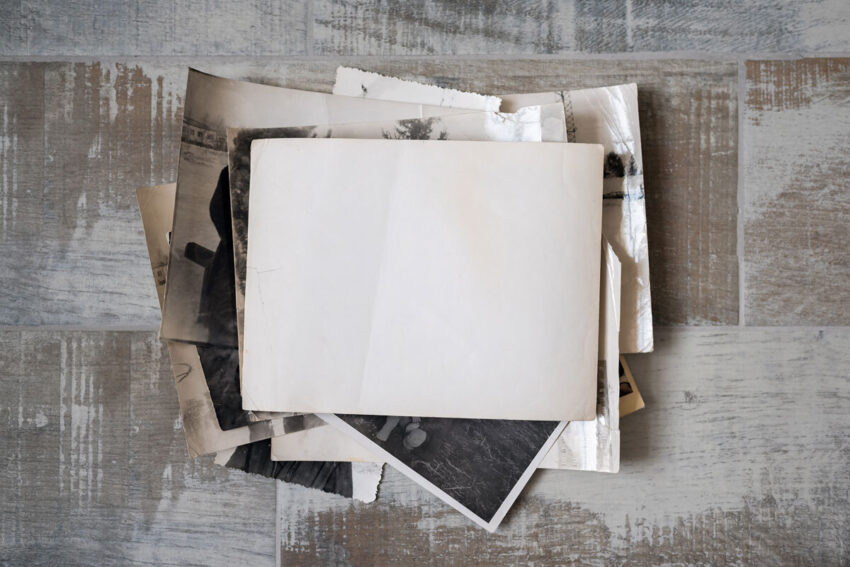
When i was thirty-two and three months pregnant, my mother, Hélène, made a request. She was half concealed behind her bedroom door, and from the hallway I could see a strip of the cream quilted cotton that hung on the wall behind her. With a faint smile and a hint of guilt, she asked: If my baby was a girl, would I give her Salomé as a middle name? She would not ask too much, she said, not a first, just a middle, the one you never use, hidden in your passport. It was the name of her cousin, and “there is nothing left of her.” I laughed, a nervous laugh, and said, “Of course I will.” But I did not dare ask who Salomé was or why there was nothing left of her. In any event, I had a boy.
A year and a half later, my mother was diagnosed with a brain tumor, a glioblastoma. “There is no treatment,” the doctor said. “She is going to die in the next six months. Keep her at home, take care of her.” In the years before her diagnosis, in the dusk before dinner—or, as we say in France, “entre chien et loup”—at the point in the day when there is no longer hope that things will get better, Hélène would call her mother, my grandmother Ginda. Their conversation was not relaxed. It was Hélène’s daily combat, for which she relied on the help of unfiltered Gitanes, the kind of cigarette a worker smoked, then crushed under their shoe before taking their place on the factory line, leaving the dark, tarred butt behind. She lit hers with a cold, sober metal Zippo and put her pink marble ashtray on her chest. Aging mother and adult daughter would speak about the boring chores of the day: a visit to the dentist, tax advice, the organization of a family visit. Facts, nothing else. While speaking, my quiet, pudibund mother would remove strands of tobacco from her tongue one by one and carefully place them in her ashtray. She could not say any of the words she needed to say—not to her mother, not to her children.
When I fell asleep, I saw a monster with a big beard at Salomé’s bedroom window, a knife in his hand.
After the diagnosis, Ginda came to see her dying daughter every day. Hélène forbade her from entering the bedroom, so my kind grandmother stayed in the living room with a cup of tea. I would sit with her, holding her hand as we waited quietly for her daughter to die. I always brought my toddler son when I visited, and as soon as he entered the hall of the Haussmann apartment, he would remove his clothes and climb the bed to lie on top of his grandmother. Two days before she died, she entered a near coma; her last gesture was to grasp her grandson’s arm. I can’t remember her ever touching me, kissing me, or uttering the soft words of love other mothers used with their daughters.
Two years after my mother died, I gave birth to a baby girl, more beautiful than I could have imagined. I had forgotten my mother’s request until two weeks before she was born, when a friend said she thought Salomé was a nice name. Salomé became her first name, despite my mother’s request that we tuck it in the middle.
Once my daughter was in her crib, I had two nightmares. They are still very vivid. In the first, someone said my mother was on the phone. But she can’t be—she’s dead, I thought in my sleep. The person insisted: She would like to speak to you. I woke up before I could tell her that she had a granddaughter named Salomé. When I fell asleep, I saw a monster with a big beard at Salomé’s bedroom window, a knife in his hand. He wanted to steal her. I opened the window and punched him so hard he fell. Then I slammed the window shut and woke up. Why all this drama around my daughter’s crib? What was the story behind her name? I didn’t want to know.
This was in 2009, as President Sarkozy’s administration was questioning whether Muslims were French citizens. I thought: What about me? Am I really French? I knew my grandmother was born in Lithuania, but not much more than that. I went to look at Ginda’s naturalization files in the Archives Nationales and found the questions I needed to ask about my mother, my grandmother, Salomé.
ginda was born in 1905 in Kaunas, Lithuania. She came to France in 1923 and became a French citizen by marriage. This much I knew. Then I found a stamp on her paperwork I wasn’t expecting. It was dated 1942 and made by the Office of Denaturalization, which had been created by the Vichy government in collaboration with the Nazi occupiers. “Is this valid?” someone had written on the file. “Should we remove her French citizenship because she is Jewish?”
I had no choice but to go where I didn’t want to go: Who was Salomé and what had happened to her? What did she have to do with me? I hadn’t previously wanted to know why my mother could utter the name Salomé only from behind a door, or why she never spoke soft words of love to her own children. There was so much I had resisted learning about my kind grandmother and her niece because I feared I would fall with them into a black hole of endless destruction.
I interviewed the women in my family. Every summer of my mother’s childhood, they told me, she and my grandparents would travel by train to Ginda’s hometown in Lithuania, and each time, Ginda would urge her mother and sisters to come to France. “Oh, but it’s paradise here,” they would reply. Kaunas, called Kovno then, was where Ginda’s sister gave birth to a daughter she called Salomé in 1937, five years after my mother was born in Paris. In June 1941, eighteen months after World War II began, Nazi forces occupied Lithuania and deployed Einsatzgruppen, who killed thousands of Jewish Lithuanians; the remaining ones were relocated to ghettos. By the war’s end, Nazi forces had killed more than 95 percent of the Jewish population of Lithuania. I decided to go to Kaunas to visit what was left of the ghetto, the place where the occupiers had moved my family in 1941. I also visited the execution site, now a museum, on the edge of Kaunas. Seventy years later, all I could find was a sign on a concrete wall: near this wall nazis shot and burned people in 1943–1944. Who were those people?
They could say: We won against Hitler.
They were Mara, my great-grandmother. They were Raya, my great-aunt, her husband, and their five-year-old daughter, Salomé, my mother’s cousin. They were Masha, my other great-aunt, her husband, and their baby, Kalman. Three generations of my family lived in the Kaunas ghetto for three years. They witnessed one selection after another: those fit for work sent to the left, the others to the right. Mothers were not separated from their children—they were heading somewhere, but where?
On October 26, 1943, 2,700 people were rounded up. It was the final selection. When Mara, Raya, Masha, Salomé, and Kalman stood before the Nazi officer, my great-grandmother took her grandchildren from the arms of their mothers, offering her own daughters the only way out there was.
Raya, Masha, and their husbands were sent to a mine, where they worked for two years without seeing sunlight. Both husbands died of exhaustion. Raya and Masha survived. They discovered that Mara had been transported with little Salomé and baby Kalman to Auschwitz. After the war, Raya and Masha married again and had children, who had their own children. They could say: We won against Hitler.
Ginda was the only person Raya and Masha were able to confide in about what had happened in the main square of the ghetto. About how their mother had taken Salomé and Kalman. No one spoke to my mother about what happened to her cousins and her grandmother. As a girl, Masha’s daughter, Gila, learned Russian to understand what her parents talked about between themselves. This was how she had learned, at thirteen, of her mother’s child from before the war. It was Gila who eventually told me the story of our great-grandmother, of Mara’s act of faith, of her belief that one day, her daughters would have other children.
After Ginda’s death, I found Salomé’s last name, along with her date and place of birth, on the back of a photo my grandmother kept in her wallet: Salomé Bernstein. May 5, 1934, Kaunas, Lithuania. In the archives, I found the date and place of her death: November 2, 1943, Auschwitz, Poland. Salomé is no longer some strands of tobacco and ashes in an ashtray. She is the cousin of my mother, the ancestor of my daughter, with whom she shares a first name and fair hair.
Colombe Schneck is a writer, journalist, and documentary film director. Swimming in Paris: Three Novellas About My Life, translated from French by Lauren Elkin and Natasha Lehrer, came out in paperback in May.
Featured
What Happened When I Began to Speak Welsh
By learning my family's language, I hoped to join their conversation.
Dan Fox
When Does a Divorce Begin?
Most people think of it as failure. For me it was an achievement.
Anahid Nersessian
You Might Also Like
A Witness to Survival
Hannah Sassoon