In Objects of Desire, a writer meditates on an everyday item that haunts them.
Blue Crabs
Eating them the way God intended
Joseph Earl Thomas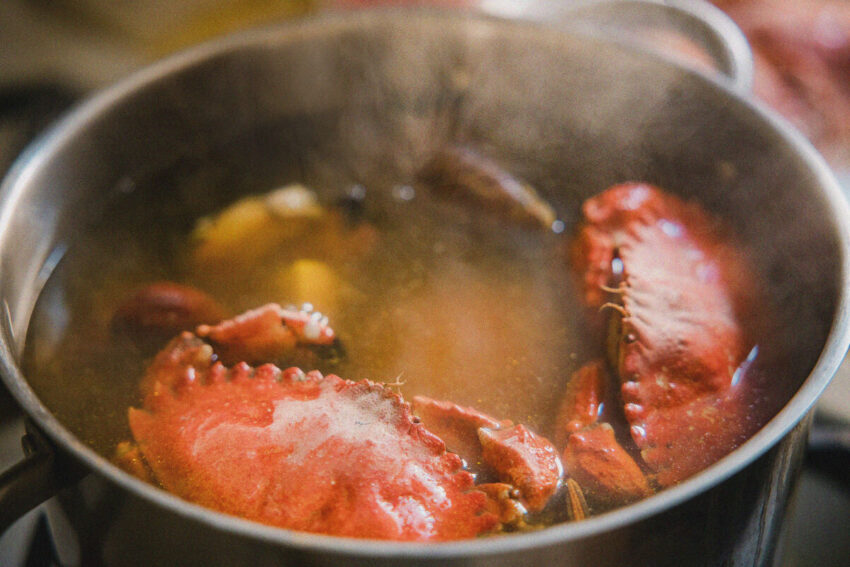
Some philly summers my grandfather boiled up a whole bushel of blue crabs in that one big pot you might also use for dipping braids or cooking collards. In went the hot peppers and Cajun seasoning, the medium-sized bottle of Crystal Hot Sauce, a couple cans of Colt 45, and a few cloves of garlic, and out came a splash of that red water my siblings and I called lava, for sensory reasons. The kitchen of our apartment was small enough that we couldn’t escape the smell, a superheated smog of liquored-up hot sauce tickling that little dangly thing in the back of our throats; it sunk into our clothes and stayed there forever. We kids ferried crustaceans from the ice-cold sink to that silver pot, standing on chairs and staring down our first true glimpse of death. Sometimes we used tongs, but if you were a real one, like my grandfather, you’d use your hands; we, too, could feel the tips of pincers on our flesh.
We loved it, especially my sister and I. We loved setting the newspaper down over old hopscotch markings on the sidewalk or in the middle of the street, stacking bricks on each corner to keep the sheets in place; we loved licking our lips like little fiends as Popop emerged with the pan of crabs doused in Old Bay; we loved biting through the claws and sucking the meat out, discarding empty shells right where we sat; we even loved, as the sun fell hours later, digging through the discard pile with friends and neighbors to make sure we hadn’t missed anything, snacking here and there on leftover little bits. We loved being outside and feeling free, being inside and feeling vital, and the shared labor of preparing, and consequently eating, a meal we actually enjoyed.
And there is still no better texture than the soft crunch of crab leg upon the thrice reconstructed crown of a second molar. I’m talking specifically about Callinectes sapidus, that cheap little cousin of an Atlantic City buffet’s Alaskan snow with butter, brother from another mother to the mid-tier Dungeness you might also find frozen in a ShopRite circular, the ill-begotten progeny of the Red King, whose market price might exceed your PECO bill. Blue crabs were the only kind we killed ourselves. Their supple flesh was our first symbol of fresh food when everything else came from a box or can. This boiled-alive arthropod meat, I would come to understand, ranked low in the gustatory economy and high on the animal cruelty scale. But I still eat it, even when my friends say they’d rather “not do all that work” for such meager portions of food. Though maybe I’m spurred on by some Negro urge—or learned necessity—to make something out of nothing.
We were excited to have our teeth ran through; the dogged overuse and obliteration of the body were also forms of pleasure.
As a child, I’d never considered this a Black thing. Call it a lack of private school or what have you, but everyone I knew was Black, and we did things, some of which I loved and some of which I did not. Yet those early pandemic-era memes about Black people blowing our stimulus checks on crab legs were, to me, quite funny. In America and elsewhere, the Negro influence on seafood (and, well, most everything else) is obvious; it’s what created the culinary cultures of Baltimore, Charleston, Savannah, and New Orleans, all of which were once transatlantic slave ports. Though past that, maybe there is something quintessentially Black about eating crab. The people I grew up with knew punishment all too well, and yet we celebrated disobedience, however minor the disrespect toward formal governance. We were excited to have our teeth ran through; the dogged overuse and obliteration of the body were also forms of pleasure, one tactile instance being the eating of whole crabs without all those silly tools. Use your mouth, I still think before shoving aside the crab mallet and seafood picks, and peeling open a genital flange under a red shell, barehanded. It’s worth noting that I have never been tossed a crab cracker at the Kappa Alpha Psi Chester Alumni Chapter’s annual crab feast, which is one of the many reasons I keep attending every year.
Still, it’s been a long time since I’ve eaten crabs outside like that, “the way God intended,” as my homegirl Nia might say. (Yes, she’s from Baltimore.) I can no longer even imagine a street we could post up on, or how we would spread out a newspaper no one even gets anymore to bask in the merriment of stopped time. Long gone are the cracked-open fire hydrants and bare feet, Clipse and Lumidee playing in the background, our imperatives to grind one another up over nothing and sing, “If you want me to stay, I’ll never leave you.” Sometimes it feels like all we have left is the soft, empty talk of American popular culture, and the growing social, spiritual, and material destitution it both encourages and distracts us from.
I try to nudge my children toward reading serious books and eating serious crab rather than running their mouths about nothing (though sometimes hearing my children run their mouths about nothing also pleases me). As I fail, I recall the development of my own dexterity: those hot little cuts the crabs left along my fingers, which ceased as I grew older and more patient, and which I actually missed when they were gone. When my son asks if a crab can eat your skin off, I offer him a live specimen on the spot to see if he’d like to satisfy this particular curiosity. When, at the movie theater, the giant loot-hoarding crab appears in Moana and my daughter asks, “Daddy, would you eat that?” I explain that our boy Tamatoa looks more like a coconut crab, which I have never eaten; they remind me of raccoons with their expertise in land treading, always hanging out in trees and trash cans. The question makes me hungry, though, and I satiate us both then and there with the seafood boil my mother snuck into the theater in her purse—purchased, most naturally, with a stimulus check.
nothing is what i thought I would feel when my grandfather died, when I smelled him beyond the locked door to his room, not at all outside, not at all in anyone’s pleasure. My mother remembers him primarily for his food and his anger, which seems correct to me; when she’s asked why she never learned to cook, she just says she never had to. And I had never thought of myself as the replacement patriarch, but I understood what the palms extended in my direction meant, the arrangements I’d need to make, the people who needed somewhere to live.
At his funeral, I thought about crabs.
“Remember when he used to make all them damn crabs?” my sister said between bouts of crying.
“Cutty did not play about them crabs,” my brother added.
Years later, fighting against the disappearance of a feeling, I let one clamp down on my finger in the kitchen, that place where my children look up at me like a hero. My son sits on a barstool, beaming with pride. “Daddy, look! I got the whole meat out!” he says. Congratulations are in order. For my part, I just stand there over the pot, letting the heat soothe me into some kind of stillness.
Featured
What Happened When I Began to Speak Welsh
By learning my family's language, I hoped to join their conversation.
Dan Fox
When Does a Divorce Begin?
Most people think of it as failure. For me it was an achievement.
Anahid Nersessian