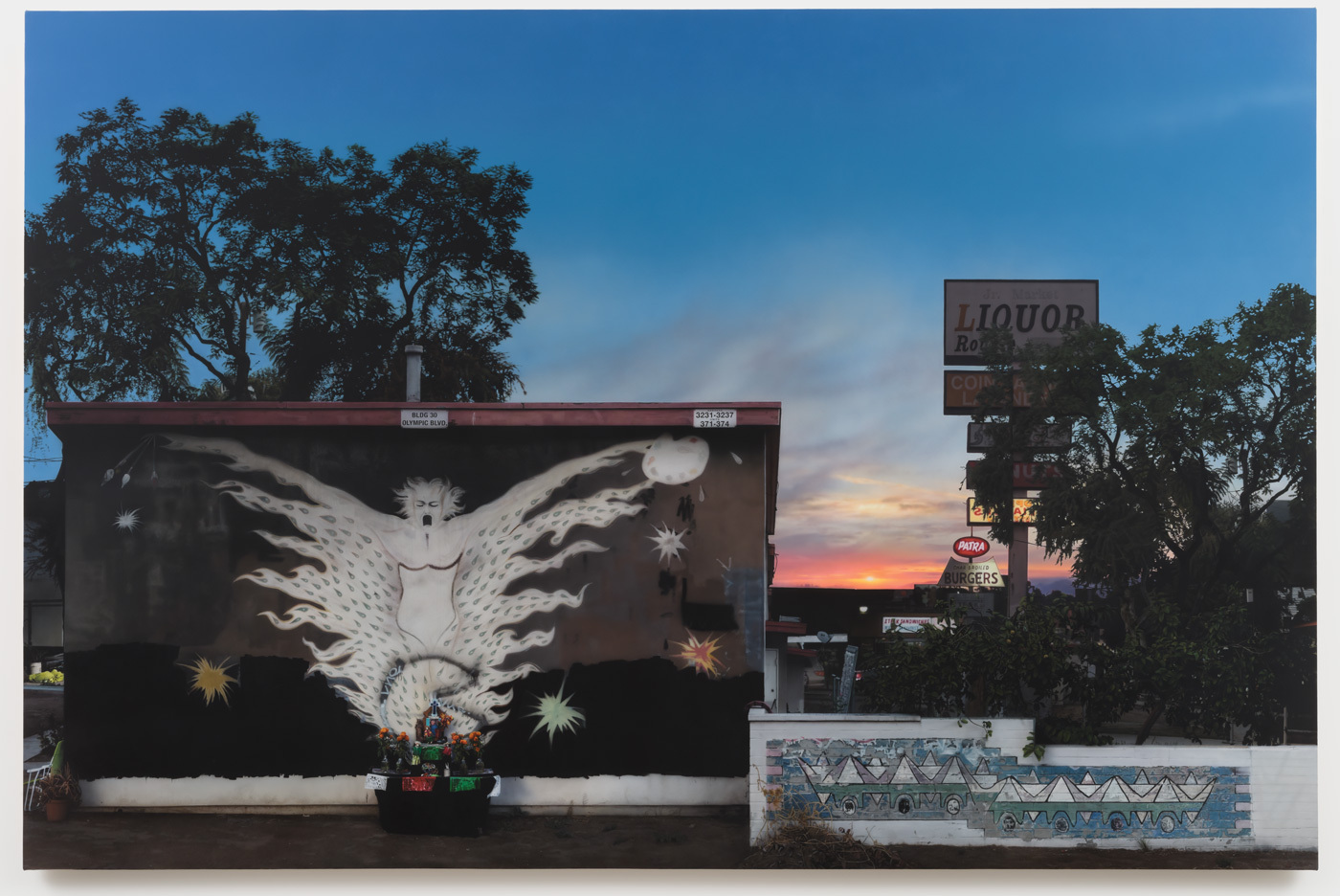
Sayre Gomez, 2 Spirits, 2024. Courtesy the artist, François Ghebaly Gallery, Xavier Hufkens, and Galerie Nagel Draxler.
On bunker hill in downtown Los Angeles, two art museums face off across the street: the Broad and the Museum of Contemporary Art (MOCA). Last November, these museums opened two major new exhibitions within a week of each other, both rooted in ideals shaped by the political and aesthetic revolutions of the late 1960s. Each show proposed contrasting positions for democracy in art and artistry: one populist, the other esoteric; one representational, one spiritual.
At the Broad was Joseph Beuys: In Defense of Nature. The German artist, who died in 1986, is a titanic figure for historians of modern art, best known for the apocryphal story of his transformation into an artist. During World War II, he flew in the Luftwaffe. In 1944, his Stuka crashed in Crimea; Beuys claimed he was rescued by nomadic Tatars who saved his life by rubbing him with animal fat and wrapping him in felt. These substances became talismans in his shamanic performances and sculptures.
Beuys was a charismatic figure, appearing on popular German television shows wearing the fedora and fishing vest that came to be his trademark look. He believed art could be a salve for Germany’s deep postwar traumas, and envisaged a route out of the perceived dead ends of modernist abstract painting and sculpture through a melding of art and life, of mysticism and the everyday. Beuys also believed that all citizens of democratic societies should vote on all matters directly rather than elect professional representatives to act on their behalf, founding a political action group to this end in 1971.
He often returned to the same materials. Among the arcane artifacts displayed at the Broad were a pot of grease with a screwdriver stuck in it (Object to Smear and Turn, 1972) and a yellow light bulb plugged into a lemon (Capri Battery, 1985). One of his best-known performances was How to Explain Pictures to a Dead Hare (1965), which involved Beuys carrying a hare through one of his exhibitions, his own head covered in honey and gold leaf, as he lectured the animal’s corpse about his art.
Beuys is also remembered for his maxim: “Jeder Mensch ist ein Künstler” (Everyone is an artist). By this he meant that anything people make or do has the potential to be thought of as art, a politically expansive and humanistic view of art’s capacity for social change.
At MOCA was Ordinary People: Photorealism and the Work of Art Since 1968, a survey of photorealist painting and sculpture from the United States. The show, organized by the museum’s senior curator, Anna Katz, is a panorama of American life: its storefronts, neon signs, family automobiles, urban detritus, restaurant interiors, and, most importantly, its faces, rendered in high detail. It seems a direct riposte to the obscure symbolism and lofty aspirations of Beuys. Yet for Katz, photorealism is an art form by, for, and of the people. Though laborious, it is a style that anyone can master, given time and practice. Since anyone can do it, everyone is an artist.
The show examines the practice of copying assiduously from photographs so that the artist’s manual gesture almost (but never entirely) disappears. The technique appeared abruptly in the 1960s and was packaged into a movement by two New York dealer-critics who outlined its attributes. The church of photorealism has likely endured because, over the decades, it became pluralistic and diffuse.
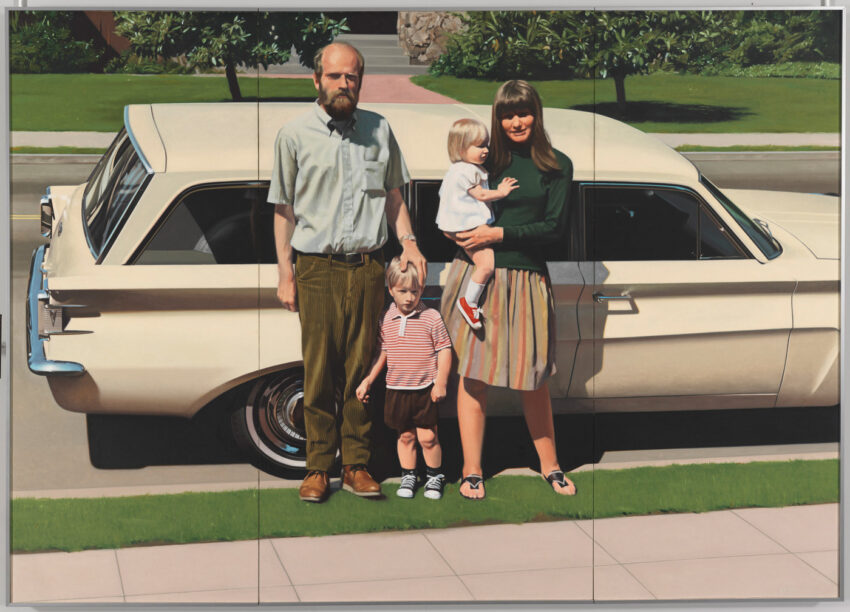
Robert Bechtle, ‘61 Pontiac, 1968–69. Courtesy Gladstone Gallery. Digital image copyright Whitney Museum of American Art. Licensed by Scala / Art Resource, NY.
Katz positions the style as inherently democratic; it emerged as thirty-five-millimeter cameras became more affordable and people began to make their own portraits at home, then broadened with the popularization of disposable cameras in the 1990s and smartphone cameras in the 2010s. By the late 1960s, photography had become increasingly accepted, both critically and commercially, as a valid art form in its own right. The influential 1975 exhibition New Topographics: Photographs of a Man-Altered Landscape introduced the work of Americans Stephen Shore and Robert Adams, and the Germans Bernd and Hilla Becher. Their images of suburban tract housing and water towers are deliberately matter-of-fact; they have none of the compositional dynamism of classic photojournalism. Equally deadpan was the black-and-white documentation of actions by conceptual artists such as Richard Long, who, in a grassy field in 1967, photographed A Line Made by Walking. The kinds of photographs reproduced in early photorealist paintings might have been equally lacking in stylistic flair, but this was part of their value. One of the best-known examples, and a highlight of Ordinary People, is Robert Bechtle’s ’61 Pontiac (1968–69), a large, stately oil painting copied and blown up from a color snapshot in which the artist and his family pose awkwardly in front of their station wagon.
Photorealism, as Katz acknowledges, has always gone down well with museum audiences. But the technical skill involved in producing a painting that looks like a photograph might easily be scorned by critics as simplistic mimesis, an optically impressive but intellectually lightweight trick. In an introductory wall text, Katz contends that people respond not to photorealism’s “dazzling, virtuosic technique” but to its “work ethic.” The style is achieved using a learnable skill “akin to sign painting, commercial illustration, billboard painting, tattoo artistry, and other such labors.” That is not to say it is easy. Typically, it is done by either projecting a slide over the canvas or drawing a grid over the photograph and reproducing the image in paint, square by careful square. There is no mystery to it. Painting in this way is the antithesis of Maurizio Cattelan taping a banana to a wall, even though both are things that, technically, anyone can do. If everyone is an artist, as Beuys said, what kind of art would everyone make? Not, Ordinary People suggests, art that can be made instantaneously by sticking a screwdriver in a pot of grease, but art that requires time, dexterity, and graft.
is it ironic or fitting that photorealism emerged in the 1960s partly as an anti-art gesture? Bechtle argued that “the only way to get away from style and ‘Art’ was to paint things as they really looked.” Why was “art” something that these artists wanted to distance themselves from?
For the avant-garde of the 1960s, the art establishment meant the big beasts of abstract expressionism who had settled into institutional and commercial predominance, such as Robert Motherwell and Mark Rothko. A work of anti-art could be anything that unsettled art’s authoritative status: a found object designated as a sculpture or painting; an artwork that destroyed itself, disappeared, or only existed as a momentary gesture or phrase. Many would argue that Marcel Duchamp’s Fountain (1917), a urinal turned on its side and signed, cryptically, “R. Mutt,” was the original example. In the 1960s, the baton of anti-art was grasped by the Fluxus movement, a loose international network of artists that included Beuys as an early member. Fluxus held that anything could be art and, as Beuys did, that anyone could be an artist.
Painters were influenced by anti-art ideas too. Reacting against abstract expressionism’s emphasis on the artist’s primal subjectivity, they experimented with ways of removing both their hands and minds from the execution of the painting. Some poured or sprayed their paint; some wrote instructions for others to make paintings on their behalf, or declined to use paint at all. In the early 1970s, for example, the Alabaman painter Jack Whitten invented a mechanical device that employed squeegees, rakes, and combs to scrape paint across a canvas laid on the floor. “After several experiments,” he explained, “I built what I called the Developer, an analogy to photography, which was meant to rebuke the notion of touch.”
Photography was seized upon as a source of the touchless, mechanized, instant, and aleatory image. Pop artists copied and appropriated mass-cultural imagery: photographs from newspapers and magazines, logos and graphic design, objects from cosmetics to food. Photorealism overlapped with pop, but it was soon granted its own territory and borders. For one thing, it was aligned with a tradition of realism that reached back to the era of postrevolutionary France, when artists such as Gustave Courbet sought to depict the world around them truthfully. For early realists—including writers and dramatists such as Émile Zola and Henrik Ibsen—this stance was left-wing by virtue of representing working-class subjects doing working-class things.
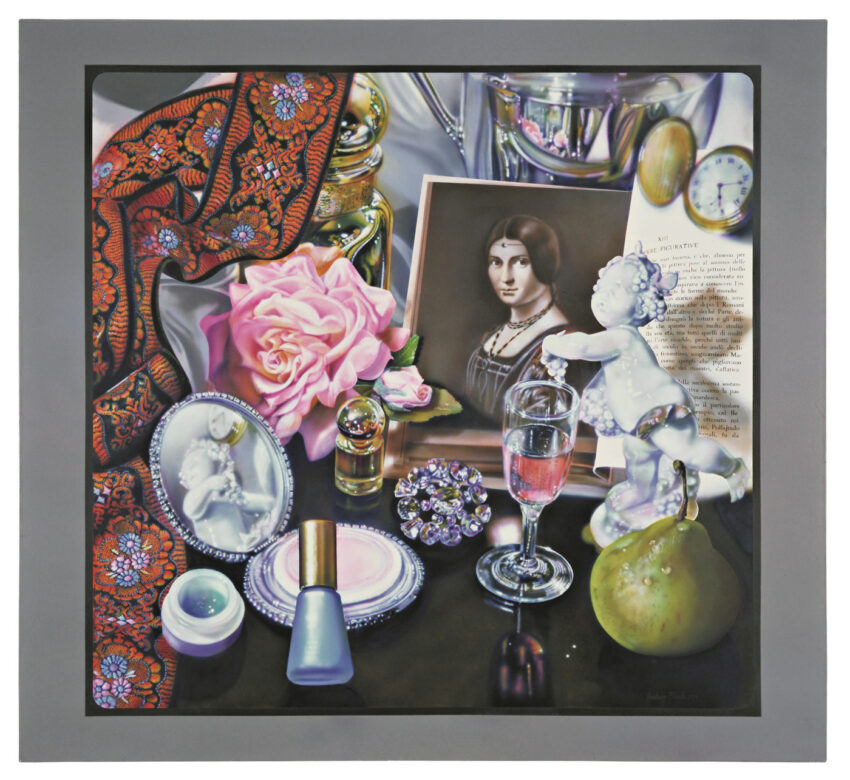
It reproduces tools and signifiers of beauty: a piece of ribbon, nail polish, a champagne flute.
Art historian Linda Nochlin, one of photorealism’s few advocates, wrote in the 1960s that “despite a few minor skirmishes…realism, in the sense of creating an accurate, detailed, and recognizable simulacrum of visual experience, has been relegated to the limbo of philistinism: the propaganda machines of Soviet party hacks or the sentimental platitudes of Saturday Evening Post covers.” That the genre coalesced, in its earliest days, around two Manhattan dealers helped exacerbate snobbery toward it. Louis K. Meisel gave photorealism its name (distinguishing it from competing terms such as hyperrealism and sharp-focus realism), defined its key attributes, and identified thirteen artists as its core members. When he opened a gallery in SoHo, in 1973, he represented many of them too. Ivan Karp wrote and lectured about what he preferred to call “Radical Realism,” and around the corner from Meisel, he ran a gallery called OK Harris, where he showed paintings by conceptual artists John Baldessari and Jack Goldstein, as well as hyper-realist sculptures by Duane Hanson and Marilyn Levine. Most of these artists did not know each other, and by no means did all of them self-identify as photorealists; the impression of a cohesive movement was cooked up for marketing purposes.
Bechtle painted cars; Ralph Goings and John Baeder painted American diners; Richard Estes painted storefronts; John Kacere mainly painted young women’s backsides. Audrey Flack, one of the few female artists among this first wave, depicted mirrors, costume jewelry, cosmetics, porcelain figurines, fabrics, and ersatz-looking roses and fruit in her large-scale airbrush paintings. “I think we have been brainwashed into believing that beauty is a bad word,” Flack observed in 1975. Her work is not conventionally beautiful; rather, it reproduces tools and signifiers of beauty: a piece of ribbon, nail polish, a champagne flute. She employed “bad” taste to upset elitist, male-dominated art discourse.
In 1974, Peter Schjeldahl surveyed photorealism in The New York Times, noting that while the movement had “failed to attract an intellectual following,” it was “evidently doing famously on the market.” Chief among its enthusiastic audience, said Schjeldahl, were “people who know what they like,” and he suggested that “a certain intellectual paucity may, in fact, be part of the point of Photo-Realism, which seems almost determined to eliminate the sorts of ambivalence and ambiguity by which intellectual content enters painting.”
By contrast, the anti-art gestures of Fluxus and conceptualism were, in many instances, literally unsalable. Happenings and performances changed each time. Material artworks and multiples tended toward the ephemeral. Photorealism, on the other hand, offered an expression of the anti-art impulse that could be hung on any wall; one could nod along to the avant-garde while also investing in art made with traditional standards of craftsmanship and prowess.
Audrey Flack, Leonardo’s Lady, 1974. Courtesy the Museum of Modern Art, New York. Purchased with the aid of funds from the National Endowment for the Arts and anonymous donor.
In 2024, the moca show was joined by museum exhibitions of photorealist art in the Netherlands and in Denmark. Ordinary People goes some way to explaining why this art form is thriving once more. The story told in the exhibition is that, following photorealism’s first wave in the late 1960s and early ’70s, the demographics of its practitioners widely diversified. The thirteen artists in Meisel’s original stable were all white and, except for Flack, all men. Ordinary People includes many works by artists of color from the late 1970s and early ’80s, when the vogue was for neo-expressionist figure painting or hard-edged, brightly colored neo-geo abstraction. Artists like the Los Angeles–born muralist and painter John M. Valadez, or John Ahearn and Rigoberto Torres—who cast the bodies of people they encountered on the streets of the South Bronx—were not making art about art but art about people. Their work was humanist and principled, highbrow trends be damned.
These artists were not particularly interested in photography conventions either. Close cropping, shallow depth of field, forced perspective, flash effects, lens flare, and a plastic color palette are all attributes that, even when painted, can signal we are looking at an image first seen by a camera. The idea that the camera captured “things as they really looked,” as Bechtle put it, never really held up; rather, the photographic image became so ubiquitous, in art as in life, that it became a shorthand for reality. Barkley L. Hendricks, whose full-length portraits from the 1970s feature in Ordinary People, referred to the camera as his “mechanical sketchbook”—invaluable but not a subject in itself.
Hendricks’s use of photography anticipated the way most artists now use their smartphones or tablets. InFocus: A Closer Look at Photorealism, an exhibition put on by Utrecht’s Centraal Museum, included paintings by Allison Katz and Issy Wood, whose large-scale works seem drawn from sources as wildly eclectic as any iPhone photo library: selfies, vegetables, cars, ceramics, pictures taken from the internet. Probably neither artist refers to herself as a photorealist. Nor, apparently, does Cynthia Daignault, who contributed a remarkable new commission to Ordinary People. On 486 eight-by-ten-inch panels, she painted every frame of the twenty-six-second-long eight-millimeter Zapruder film, which captured John F. Kennedy’s assassination in 1963. Each painting is carefully, though not realistically, rendered—neither quickly brushed nor painstakingly copied. Daignault thickens time, adding more substance and color and beauty to the recorded instant, even as she smooths out some of its textures and details. “My paintings are impressionistic, not sharp focus,” she writes in the exhibition’s catalog, “and I chafe at the ego in rendering so that a painting might be mistaken for a photograph.”
Photorealism today maintains the same sense of wit that trompe l’oeil painters showed in the seventeenth and eighteenth centuries. Los Angeles–based Sayre Gomez simulates storefront doors and windows at one-to-one scale, precisely mimicking peeling stickers, scratched glass, and even reflections of palm trees. (He is one of the city’s most astute observers.) By spraying fine mists of paint with an airbrush, he achieves a degree of smoothness that eliminates virtually all traces of his hand. To enhance this mechanical style, he has perfected the blurry and pixelated effects of JPEG compression, conflating degraded subjects with degraded imaging techniques, then finally elevating them all through his virtuosic reconstitution of them as paintings on canvas. Gomez’s fellow Angeleno Mario Ayala also uses airbrush to recreate, on shaped canvases, the vinyl-clad rear ends of cars and trucks, which are commonly used in Los Angeles as mobile noticeboards advertising their drivers’ businesses, identities, or aesthetic proclivities.
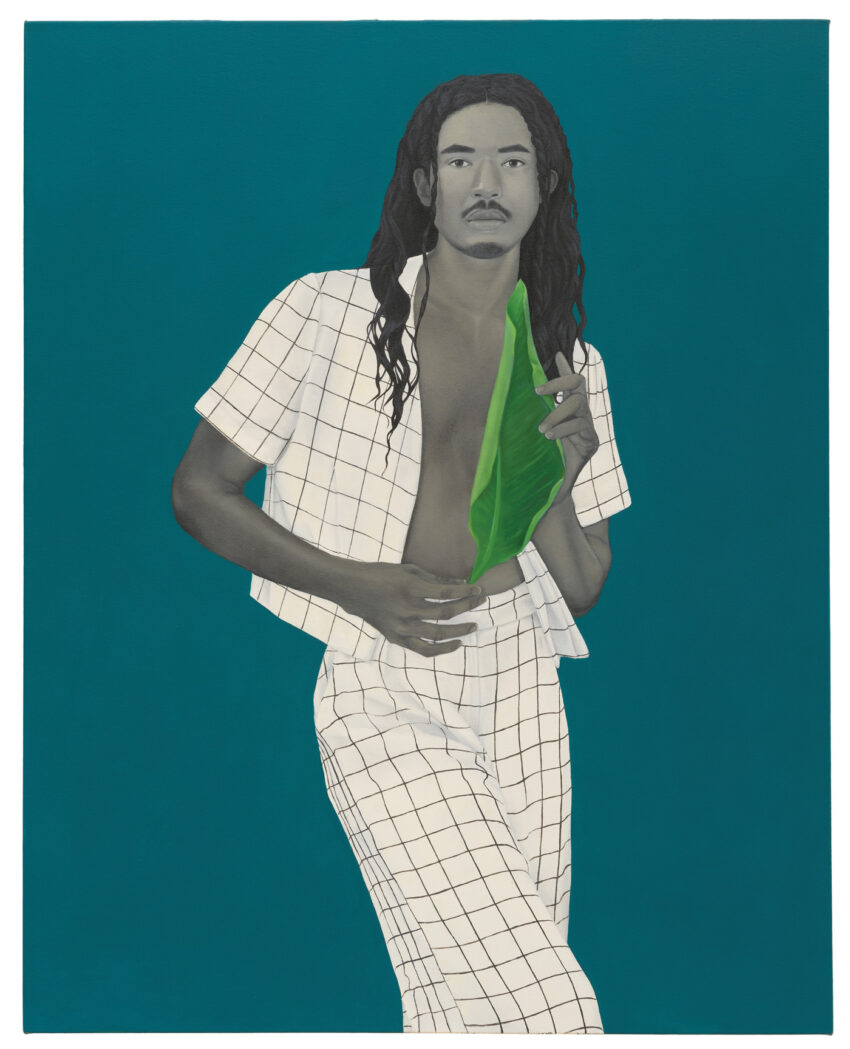
Amy Sherald, The lesson of falling leaves, 2017. Courtesy the Museum of Contemporary Art, Los Angeles. Purchased with funds provided by the Acquisition and Collection Committee.
Over the past decade or so, the most visible expression of photorealism has been in the field of figure painting, specifically depicting people of color and, even more specifically, Black people. Art historians of the future will likely credit artists such as Kehinde Wiley, Amy Sherald, Jordan Casteel, Njideka Akunyili Crosby, and Toyin Ojih Odutola as defining this moment in American art. While not all of these artists are photorealists, all could be said to be realists, and most owe something to photography. Sherald’s painting The lesson of falling leaves (2017), which appears in Ordinary People, depicts a man with grayscale skin holding a bright green leaf, and it would never be mistaken for a photograph. The figure stands still for the painter, not caught by a camera’s shutter. Sherald draws the grid pattern on his suit with a graphic simplicity and sets him against a flat teal background. Most of all, as with nearly every portrait by Sherald, his face and skin seem lightless, despite their minimal shading, and recede in comparison with his bold garments. Sherald has cited as an influence the nineteenth-century daguerreotype, a medium that represented Black people in a dignified manner far earlier and more commonly than oil paintings ever did.
Representation can mean various things. Since postimpressionism and the earliest murmurings of abstract painting and sculpture, the term itself has come to refer to artworks that hew close to visible reality. It is not quite the same as figuration, but it is not antithetical to abstraction either (think Pablo Picasso’s 1907 Les Demoiselles d’Avignon or Willem de Kooning’s paintings of the 1950s). Representation is also distinct from realism, which attempted to capture the social reality of modern life rather than its faithful appearance.
Say “representation” in 2025, however, and most people will think of social representation; in art, that typically means not just the depiction of people but specifically those less often visible in artworks, or in museums and galleries as visitors. “Photorealism constitutes an important chapter in the ongoing effort to populate the museum and world of art with faces and places that have historically been marginalized or erased,” declares Ordinary People’s introductory wall text. The exhibition is alive with faces. The best of these pictures achieve what portraits have long strived to: they capture a person’s uniqueness in a way that makes them feel ineluctably present. But direct representation can also have the opposite effect when it is used to imply that one individual can stand in for a community of others whom they may only superficially resemble. Paintings such as Sherald’s risk becoming used as symbols—especially when corralled into an exhibition that is making a bigger point about what an “ordinary person” looks like. (There is no such thing.)
This problem is compounded by photorealism’s shortcomings as a technique for portraiture. Look, for example, at the paintings of Richard McLean, whose work from the 1970s until his death in 2014 focused on photographs of Western equestrian life. The horses and saddlery lend themselves perfectly to McLean’s rendering; the smiling faces of riders, stablehands, and rodeo pageant contestants, by contrast, look plastic and frozen.
Photographs often fail to capture what people really look like. Alice Neel, one of the finest portraitists of the last century, painted from life. Her version of realism could hardly be further from photorealism: her expressionistic portraits are energetically brushed, irregular in their proportions, and inconsistent in their details. She used color for emphasis and effect, often outlining forms and skin tones in blue or green.
Neel’s paintings succeeded because she incorporated her impression of a subject into her depiction of their appearance. She acknowledged that a representation of a person is also a document of a relationship. Photorealists, however, have historically sought to remove themselves from the equation, even when they, like Neel, have a kinship with the people they are painting. Valadez, who in the 1970s and ’80s had a studio in downtown Los Angeles, mainly took photos of Black and brown people on the street, as well as of his family and friends, then reproduced them, life-size, in pale pastel against white paper. “The idea was to basically dare people to look at a class of people—highly rendered,” he said. “There was no stylization. You’re basically looking at real people.” His portraits, such as Fatima (1984)—a woman clutching a baby blanket and an ice cream cone—feel like specters. Despite their crisp edges and accurate details, a sense of their vitality seems absent. As anyone who has gazed at the face of a loved one knows, a person changes from morning to afternoon, from one mood or thought to the next. The better you know someone, the harder it is to pin down what they really look like.
one of the most beloved and successful photorealist artists is Latvian-born Vija Celmins, who is eighty-six and lives in New York. Celebrated for her sublime graphite drawings that fastidiously reproduce photographs of the night sky or the ocean’s surface, Celmins seldom shows figures in her work. In Ordinary People, she is represented by two 1968 pencil drawings, both made while she lived in Los Angeles. One shows a crumpled picture of the ruined city of Hiroshima; the other, a photograph of the Hindenburg, with swastikas on its tail fins. Celmins shows the reality of those mass-media reproductions but stops short at horror. My favorite work is not included in the exhibition, perhaps because it is not true photorealism but also because it does not make a social point. ToFix the Image in Memory (1977–82) ostensibly consists of a few small stones arrayed on a plinth. After a moment’s examination, you notice that each stone has a double; you have been looking at eleven stones and eleven painted bronze simulacra, scarcely distinguishable from the originals. The sculpture is a koan I never tire of meditating on.
To Fix the Image in Memory is, to my mind, an example of art as close-quarters magic: simultaneously openhanded and utterly bamboozling. Much of the best art does something similar. I think of Paul Cézanne’s apples or Rembrandt’s self-portraits, both of which feel immanently present and substantial despite the obvious dabs and licks of the painters’ brushes. In a sense, Beuys was another magician: an alchemist who transformed everyday objects into mystical talismans before our very eyes.
Celmins’s stones ultimately give themselves away as painted copies, just as a Cézanne still life, up close, is simply color on canvas, or Beuys’s ready-mades are grease and gold leaf. Photorealism, too, always falls short; that’s kind of its point. Of Cézanne, Dave Hickey said, “Pictorial illusion is magic for people who do not believe in magic.” He explained: “Should we discover that the illusions of Ricky Jay or of [Renaissance painter Antonio da] Correggio really are magic, they would merit neither our attention nor our amazement.”
At certain points in its history, one even might have said that photorealism was painting for people who did not believe in painting. What a photorealist work represents is less interesting than why it was made that way. Democracy is baked into its method, with the artist attending equally and unjudgmentally to every part of the image, poring over a wrinkle of clothing or a patch of sidewalk just as carefully as a face. To make such things, which hold our attention in a world of images tailor-made to distract us, is quite a trick.
Jonathan Griffin is based in Los Angeles. He is a regular contributor to frieze, The New York Times, the Financial Times, ArtReview, Apollo, and others.
Support Our Writers
A sustaining subscription provides vital, ongoing support for The Yale Review and the writers we publish—and includes new holiday merch.