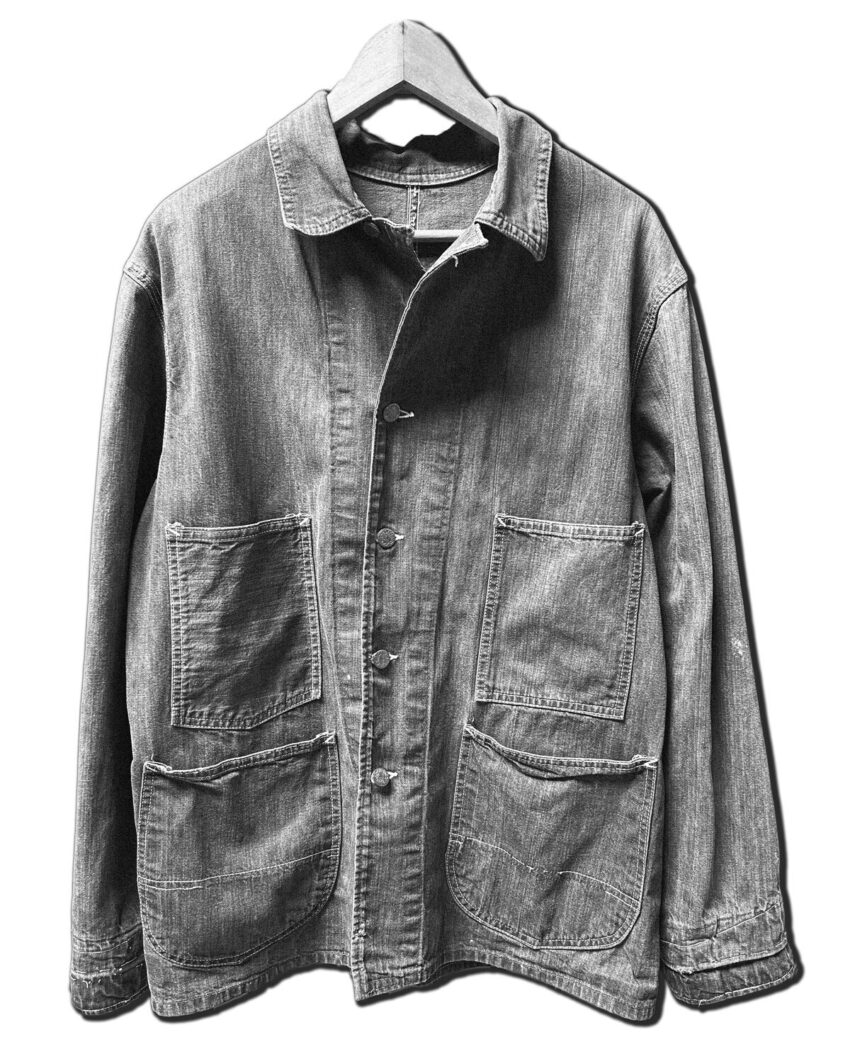
A friend of the author gifted her a blue denim jacket that once belonged to the painter Willem de Kooning, who is pictured wearing it in a photograph a 1998 article in The New York Times Magazine. Courtesy the author
For a long time, beginning in my late teens, Willem de Kooning was my favorite painter. I discovered him in the fall of 1994, when, on a professor’s recommendation, my roommate and I took the train from New Haven to New York City to see the de Kooning retrospective at the Metropolitan Museum of Art. We were sophomores at Yale and knew nothing about the man whose work we were about to encounter. Before then, no one had ever talked to me much about abstract art, let alone abstract expressionism.
The paintings I saw that day loomed full of life, humor, and feeling. They seemed to go on forever, each canvas with its own rhythm. The colors were staggering, and the strokes looked wide and wild enough to have been made with a broom. In Mailbox (1948), chalky shapes, some with sly, toothy smiles or errant eyes, toppled over one another. My favorite was Door to the River (1960), in which amber and lemon splattered and bloomed along two edges of the canvas, and strokes of umber plowed through fields of wet pink. My roommate and I stood in front of the paintings and laughed in wonder. Who knew you could paint like this, as if you were dancing, as if you were mopping the floor? I knew immediately that I wanted to make art that way, with nothing but color and nerve.
Until college, my knowledge of painting had been confined to the trio of Bruegel posters hanging in the hallway of the house my dad built in rural Connecticut. I started taking art classes when I arrived at Yale, alongside a small cohort of other devoted first-years, all of whom went on to share studio space and major or minor in art. Our classes in figure painting were held in a brick building on Wall Street. The room looked like a European salon, with an impossibly high ceiling, ornate moldings, a paint-spattered wood floor, and some elaborate, evolving still-life installation set up amid a gaggle of easels. Everything about it felt exotic to me: the foil tubes of color, the naked models, the classmate who rode her bicycle to the studio with a jar of turpentine in the pocket of her field coat and arrived reeking of spilled solvent.
As my love of painting grew, so did my obsession with de Kooning. I could not let go of the vision of those majestic, reckless canvases ribboned with wild yellows and blues. I read about his childhood poverty; his stowaway travel from Rotterdam to America in his early twenties; his stint as a sign painter with the WPA; his tumultuous marriage to the painter Elaine Fried de Kooning. In 1997, during my senior year, I went to a show of some of his late works, done between 1980 and 1987, at the Museum of Modern Art: giant open canvases that seemed like tiny details of earlier paintings, now blown up to the size of bedsheets. The exhibit, Willem de Kooning: The Late Paintings, was panned by many critics, and there was a lot of talk about the effects of de Kooning’s dementia on his work. (It was positively reviewed, however, by the great art critic Peter Schjeldahl, who wrote in Artforum: “This work henceforth defines the verb to paint. Every painter from now on will learn from it or will know nothing strong.”) To me, the paintings were full of the kind of clarity and air one could only find near the end of life. I loved them.
Who knew you could paint like this, as if you were dancing, as if you were mopping the floor?
Shortly after the show, I decided, after years of wavering, to write de Kooning a letter. I have no idea now what it said, though I imagine it was fawning, written in wobbly cursive script on a legal pad. I dropped it in a mailbox on College Street on a wet day; I recall worrying that the ink on the envelope might run. Later that week, I read in The New York Times that de Kooning had died. The damp letter was too late.
Though I knew he had been ill and not painting for years by that point, his death hit me like nothing I had experienced before. It suddenly seemed impossible that he had been alive during my lifetime at all. The conversation had stopped just when I hoped it was getting started, and I sensed what Kafka described as “diabolical powers…knocking at the door.” I suppose I was losing my first hero, though I had already lost many people much closer to me and more entwined in my actual life. But this was different: an intimation of the death of possibility, a giant hitting the floor.
in the spring of 2022, I met my friend Jay at a French restaurant on Brooklyn’s Atlantic Avenue for one of our ritual dinners. Before the entrées arrived, Jay reached down into a brown paper bag by his feet and pulled out a blue denim jacket. “Here,” he said. “I want you to have this. It belonged to de Kooning.”
Jay is in his seventies—my parents’ age. He has a tall, lumbering frame and wears dark, starched jeans. I got to know him after college, when I lived in New York, making paintings and working at a fancy gallery on the Upper East Side. Both Jay and his partner, Bert, became good friends and enthusiastic supporters of my art; Jay was a lapsed painter, and Bert was a fixture at the gallery where I worked. When Bert died in 2021, I accompanied Jay to inurn the ashes in a mausoleum in California.
Back when he painted, Jay specialized in near-photorealistic renditions of boats and streets: unbelievably detailed, jewellike canvases evincing the skill of an expert draftsman. He had tried to make a go of it as an artist in the seventies and eighties in New York while working as an assistant for Malcolm Morley, who had been his art teacher when he was an undergraduate at Stony Brook University—the same institution where I now teach philosophy. In 1974, Jay now explained to me, he had planned to accompany Morley on a visit to de Kooning’s studio. But de Kooning got sick and canceled at the last minute: a missed opportunity. Later, Morley visited de Kooning with his wife, Fran, in Jay’s stead. They had walked together along the beach in East Hampton, where, when the wind picked up, de Kooning gave his jacket to Fran. She wore it all the way back to the city and later gifted it to Jay as a consolation prize for his not having met the artist himself. Jay told me he had worn it occasionally over the years, though it was tight in the shoulders. It mostly stayed in a drawer.
Reaching back into the bag, Jay handed me an issue of The New York Times Magazine from 1998, featuring a black-and-white photograph of de Kooning in his studio beside the headline “Life Is Short, Art Is Long.” I flipped to the article, and there was my great artistic hero, his back to the photographer, hunched in a chair before a large, partially painted canvas (Summer in Springs, 1963), wearing the very jacket I was holding in my hands. When our meal was over, I hugged Jay goodbye, packed the jacket and magazine back into the bag, and took it with me. I drove home to Connecticut in the rain, worrying that the relic in the passenger’s seat might at any moment evaporate into thin air.
as a student at Yale, I had quickly realized that I didn’t have the space, the money, or the freedom to paint anything like de Kooning. I did not, at the time, think of this as a feminist revelation, though later it would strike me that so much about abstract expressionism’s vaunted place in American art history had to do with a very specific story about gender, race, and scale. As an undergraduate, I was always confined to whatever easel-sized piece of cardboard or wood I had found on the street and dragged home with me. My brushes were tiny. My turpentine only filled an inch or two of the old bean can I kept it in.
One night, desperate for some measure of abandon, I tried to paint without wearing my contact lenses, thinking this might facilitate a completely new approach or tap into some secret well of abstraction within me. But my extreme nearsightedness left me struggling to see the paint on the brush, which I brought close to my face with each daub on the palette, leaving a trail of oil paint over the bridge of my nose.
For years after graduating, I still hoped to acquire the means and the will to make big paintings like de Kooning’s. It wasn’t simple. It would require a studio of my own and enough money to buy supplies. It would entail time and a host of emotional resources I could barely name. In my early twenties, I applied both to academic PhD programs and to MFA programs in painting, ultimately choosing the one that offered me the most funding—a PhD in philosophy in New York. While in graduate school, I started painting cityscapes of New York on five-by-seven-inch pieces of Masonite. After finishing my graduate coursework, I moved back to New Haven to live with my boyfriend and started painting New York from memory: my stacked, abstracted buildings more akin to the flat planes of Richard Diebenkorn than the wild strokes of de Kooning. I rented my first real studio in 2005, a seven-hundred-square-foot third-floor space in an old factory that used to manufacture Erector sets. The still-life painter William Bailey had the studio directly below me; occasionally I would see him walking ahead of me on the stairs. I hoped a bit of his equanimity might waft up through the floorboards. Instead, a lot of water came in through the roof.
Over time, my paintings shifted from cityscapes to gardens, tabletops, and blocks of color. During my first pregnancy, in 2009, I took a break from oil paint—newly attuned to its health hazards—and tried acrylics, only to be frustrated with the way the color seemed to darken and die when it dried. My job at Stony Brook and, in 2013, the arrival of our second child added new time constraints. I began carrying a sketchbook on the train or the ferry to and from work, making notes in black Sharpie for future paintings that seemed fatally deferred. In 2018, a serious concussion forced an extended break from painting, as I struggled to recall basic facts, read, or focus my vision.
Jay, too, had gradually stopped painting over the years. In the late eighties, after meeting Bert and tiring of the art-world hustle, he had given up his painting studio on the Bowery, moved into an apartment in Hell’s Kitchen, and found steady work at a construction company, climbing the ranks until he became the manager. He would take along a small set of watercolors when he and Bert traveled together, but he had neither time nor space to make art at home. As the demands of life and work took over, painting, like youth, had slowly receded from his days. Over time, our shoptalk about oil paint and exhibitions gave way to briefer messages, checking in and urging each other on: Are you painting? Show me!
barely a year after Jay handed me de Kooning’s jacket, I learned that my nearsightedness—the same nearsightedness I had tried to use, back in college, to become an abstract expressionist—was not simply run-of-the-mill myopia. First I noticed a set of gray and black specks in my field of vision; then a shade settled over my eyesight, with a flashing bar at the edge. I was diagnosed with a genetic condition called pigment dispersion syndrome, in which the color of the iris rubs off bit by bit and accumulates in the well of the eye, clogging the drain. Pressure builds, and the optic nerve can become damaged beyond repair. The eye doctor casually explained that this process had been taking place since my birth and that the fluid in both of my eyes was now dark blue. As he spoke, a line from Virginia Woolf’s essay “Pictures and Portraits” appeared in my head like a prophecy or a prayer: “Let us wash the roofs of our eyes in colour; let us dive till the deep seas close above our heads.”
I am unable to even put my hands in the pockets, paralyzed by the thought of de Kooning’s hands having been there.
The irony of being a lapsed painter with pigment dispersion syndrome was not lost on me (dispersion comes from the Latin dispergere, meaning “to scatter widely.”) When I tried, in the glare of that diagnosis, to calculate how many paintings I still had time to make, I came up against the truth: that my painting practice had already come to a halt years before. Initially, I had chalked up not painting to the concussion, then I blamed it on the pandemic, then on a lack of time. But there had been something else too. A hesitation. The last brushes still sit clogged with the remnants of the last painting, suspended in action like bodies in Pompeii.
back in my studio in New Haven, I take out de Kooning’s denim jacket and hold it up by the shoulders, trying to be nonchalant. It has a boxy profile, almost like a blazer, and five brass buttons, each stamped with a tiny lion wrestling (or hugging) a man, below the word smith’s. No tags. Its seams are sewn with white thread, and its collar can be turned up or down. There are two generous, rounded pockets, and above those, two smaller rectangular pockets, one straight and the other slightly curved, making me wonder if the coat was modified or handmade. The stitching across the cuffs is coming undone. A few flecks of white gesso dot the left elbow and bottom hem, with one daub of pale blue on the edge of the right sleeve. De Kooning must not have worn it much while painting.
I drape the jacket on a chair, then move it to a hook. Everywhere I put it seems wrong. I realize Jay might like a photograph of the garment in its new home, so I study the picture in The New York Times Magazine article, slide out a big canvas I painted many years ago, and lean it against my painting racks, as though it is a work in progress. I move the chair in front of it and put on the jacket, which is huge on me, half expecting to be struck dead or find my face melting off like in that fateful scene in Raiders of the Lost Ark when they finally pry open the Ark of the Covenant. My back to the camera, I snap a photo as similar as possible to the one of de Kooning from 1962 and text it to Jay. He likes it; I can picture him smiling. But I cannot leave the jacket on for too long. I am unable to even put my hands in the pockets, paralyzed by the thought of de Kooning’s hands having been there. I place it back on the chair.
It is impossible to reconcile having this jacket, which is, after all, just a jean jacket, with the fact of my life. I know I do not deserve it. I know it does not mean a thing, and yet it seems to mean everything, seems imbued with a history and an aura that sucks all the air out of the room. I cannot stand to touch it, fearing that every second it remains in my possession it loses some of the magic of its former life. Should it be in a museum? Encased in plexiglass? Something about the density of the denim makes the jacket seem like it could stand up on its own and amble out of the studio.
I retrace the jacket’s journey in my mind: passing from de Kooning to Fran on the beach, then riding back to New York over her shoulders, then being handed over to Jay, whose arms were too long for it. After years of being folded and stored out of sight—much like the oil paintings Jay stowed in the basement when he gave up on painting—the jacket reemerged to be shuttled in a paper bag to a restaurant in Brooklyn, where a middle-aged woman with bad eyes would accept it without thinking about the consequences and carry it across the water to yet another shore.
several weeks pass. I receive a text from Jay with an old photograph of him wearing the jacket. He is seated, facing the camera with a serious expression. A tilted mirror hangs on the ochre wall opposite, reflecting his head and shoulders. He has the jacket fully buttoned, with the collar confidently turned all the way up. He looks cool. I have to laugh. We have such different approaches to the same object.
I get a second text from Jay the following day. He tells me that he has started a new painting, his first in more than twenty years. Now that Bert is not there, Jay has made the living room into a makeshift painting studio. He went to the art store and bought pastel oil sticks in a whole range of colors. He is making some attempts. It is terribly hard, he tells me. He can only work in fits and starts, and what he does comes out all wrong. In the middle of the night, he sends me some pictures of the work in progress. “That’s how it goes,” I assure him. His return to painting seems like a sign of his will to live, of sublimation. I stare at the photo of his work on my phone. Has he truly found a way to begin again? It feels miraculous. Maybe lost things do come back.
It is impossible to reconcile having this jacket, which is, after all, just a jean jacket, with the fact of my life. I know I do not deserve it.
I turn that idea over in my mind. Lost things: the letter I sent to de Kooning, vision, Bert, painting, time. All of it cresting out of reach as I shift into a phase where I can see, as if for the first time, all the divergent versions of myself, now dyed in blue. I wanted so badly to be a painter. Then why did I stop? The story was not linear; so many things intervened. But what if painting is more than pigment smeared on a surface? What if it is also thinking, drawing, sewing, singing, loving my daughters, writing these words on this page?
De Kooning’s jacket almost begs me to try it on, as if it were that easy to slip into a different life. Instead, I sit in my studio in New Haven, holding the fabric up to my face and trying to see through it. It is thick enough to blot out everything except the lights in the room, which come through only dimly—an intimation of my future? Things are changing. Time is passing. I look intensely at everything around me, but now in light of the still-dawning fact that I may not be able to see well for much longer, that perhaps things are going dark in some more essential or permanent way. I look hungrily at words on pages and pictures in books. I stare at my children, their pink cheeks, the sky and the sunset and the trees in the wind. I look at my paints. And I look at the jacket and wonder about the weave of life, the weft of vision, the ways that an object can tether times and bodies and places together. I want it to hold me somehow, but when I touch it, it gives. It is only cloth. Only a jacket. Only a painting. Only an eye.
It suddenly occurs to me that I should take the jacket to the beach. Why has that not occurred to me before? To Lighthouse Point, the tip of a peninsula on Long Island Sound, that ambiguous body of water F. Scott Fitzgerald called “the great wet barnyard,” the water I have spent the last eighteen years crossing on a ferry to and from work, the same water that touches Manhattan and New Haven and washes into the Atlantic Ocean near East Hampton, the sites of each member—Jay, me, de Kooning—of our odd trio. The Sound looks and smells like the ocean, though it always seems to me like an impostor. It will have to do for now. The jacket, I feel, needs to be near the water, returned to its native habitat. After all, it is not an artist’s smock but a jacket for driving, for walking, for holding shells, for looking rugged against the pale yellow-and-gray sand. Not that I want to abandon it there—I could not possibly do that, though the thought of it drifting away on the waves seems poetically just. No, I just want to take it for an outing and let it breathe. Let it see the sea.
Megan Craig is an artist, essayist, and associate professor of philosophy at Stony Brook University, where she teaches courses in aesthetics, American philosophy, and twentieth-century phenomenology. She resides in Connecticut with her family.
A Literary Gift in Print
Give a year of The Yale Review—four beautifully printed issues featuring new literature and ideas.