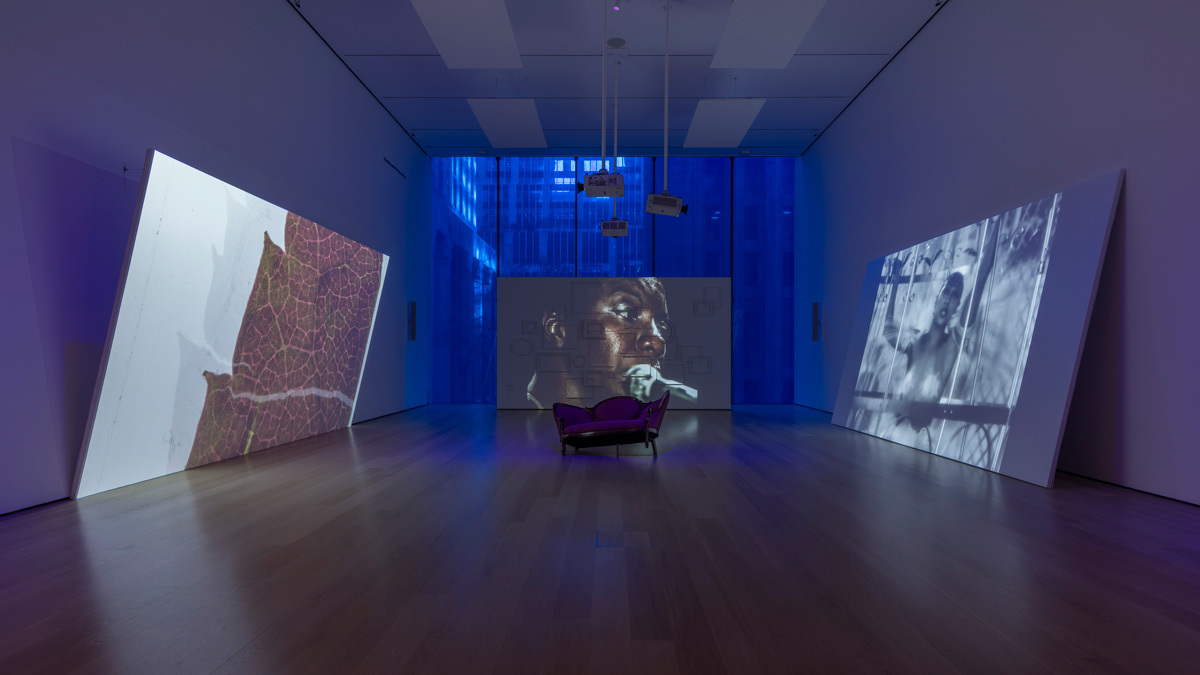
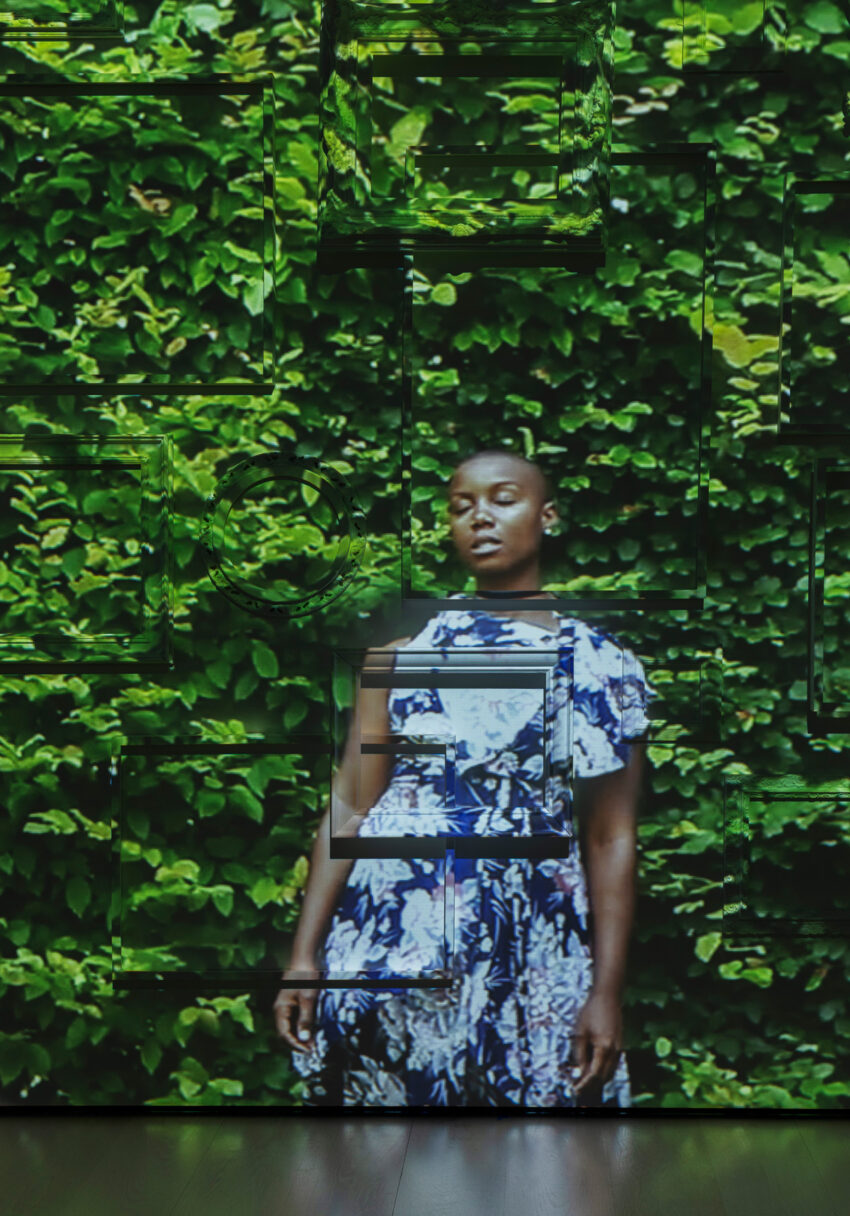
Installation view of Ja’Tovia Gary’s The Giverny Suite in the exhibition Collection 1980s–Present, September 1, 2023–September 22, 2024, Museum of Modern Art, New York. Photographed in November 2023. Digital Images Copyright The Museum of Modern Art. Licensed by SCALA / Art Resource, NY. Photograph: Jonathan Dorado.
Claude monet stood on a path that ran through his gardens in Giverny. He had set his easel up near the edge of the water to be filmed, painting. On his left arm, he held the palette, into which three brushes were inserted, angled out. A fourth brush was in his right hand. The right edge of the painting had lines cascading down it like the tresses of the willow nearby, lines reflected in the shadowy depths of the water. As the camera operator ran his machine, Monet turned right and looked in the direction of the willow. He looked over often, quickly and repetitively, daubed with his brush, then looked again.
It was 1915. His gardens, after more than thirty years of work, were in their glory. The curve of his green-painted Japanese bridge was doubled in the beautifully irregular waters with their lilies; the irises reached up and the willow branches trailed down. He had been painting the gardens, painting in these gardens, for a large part of his long life. Even before Giverny, he had built gardens wherever he and his family could afford to perch. To an interviewer, he would later say, “More than anything, I must have flowers, always, always.”
He would not leave the gardens now. War had come again. When Monet was at work in those years, he would hear the sound of shells from the front and the ambulances at the end of his road. His son Michel and his stepson Jean-Pierre were in the army, and his fear was terrible.
Monet had agreed to be in the film knowing it was part of the war effort: the director, Sacha Guitry, wanted to show the peace and integrity of French artists, performers, and intellectuals amid the war. The film would eventually be called Ceux de chez nous (Those of Our Home, or Those of Our Land, or Those of Ours). In it, Monet would be one of the first painters to be filmed at work. And if he felt somewhat self-conscious performing the act of painting for the camera, there was something to be said for the fact that it would still be his stroke of the brush, his turning to look repeatedly at that hanging curtain of willow. A viewer would see his body, in his gardens, painting.
the impressionist painters are our familiars. We live with reproductions of their bowery gardens and the views from their Paris windows; theirs are the patterns and color combinations that we wrap around our bodies and use to surround our spaces. We have looked back at impressionism so persistently and from so many vantage points that the figure of Monet in Guitry’s film can seem like a relic from an old family reel. Indeed, a few years ago, when I noticed clips from Guitry’s film as part of contemporary artist Ja’Tovia Gary’s short film Giverny I (Négresse Impériale), it did seem almost as if someone’s home footage was sampled alongside powerful scenes of Fred Hampton before his murder in Chicago in 1969 and the recording Diamond Reynolds made to document the killing of her partner, Philando Castile, who was shot by police during a traffic stop in 2016.
Impressionism arrived together with the era we still live in: that of industry, heightened imperialism, the wreckage of modern warfare, and a transforming climate and landscape.
What was Monet doing there? Why Monet, standing on that garden path painting willows, and not any of the other impressionists? One can come at the question two ways: by looking at a generational shift in the understanding of impressionism—which is going on among curators, biographers, art historians, art critics, artists, and viewers—and by delving into Gary’s work and those Giverny gardens in which Monet worked, gardens with a long afterlife of their own.
each new generation of thinkers attends to different aspects of the impressionist world. The past decade has seen a new wave of recognition for the brilliance of certain women artists and the contributions of models, children, and domestic life to the paintings themselves. Recent exhibitions have focused less on youthful revolutions and more on collaboration, as well as on the artists’ later grapplings with age and mortality. In the continual ebb and flow between thinking of painting as object and painting as action, attention presently turns toward action.
The year 2024 has been a signal one in this refiguring. It marks the 150th anniversary of the original exhibition of impressionist paintings that hung as an alternative to the official Paris Salon in 1874, among them the Monet that more or less gave impressionism its name: Impression, Sunrise, a startling orange-red ball suspended in a lavender sky. That first show is the occasion for one of 2024’s larger commemorative exhibitions, which opened as Paris 1874: Inventer l’impressionnisme at the Musée d’Orsay in March, and which I saw in September at the National Gallery in Washington, D.C., with the title Paris 1874: The Impressionist Moment.
Jointly curated by Mary Morton, Kimberly A. Jones, Sylvie Patry, and Anne Robbins, Paris 1874 argues, persuasively, that there was not in fact an easy binary between the radical impressionists and the staid academicians. By hanging works from the two rival shows side by side, the new exhibition demonstrates that each contained many pictures that could have been seen in the other. Everyone’s ideas of landscape, light, time, bodies, and brushwork were changing in many directions. Paris 1874 also restores several women artists to their real influence and position, displaying Eva Gonzalès, Marie Bracquemond, and several gripping canvases that Berthe Morisot exhibited with the new painters. The Morisots are outstanding, and in them you can already see, incipiently, the whirling strokes of paint she would later lift up and liberate entirely, moving with a freedom hers alone.
A third premise of Paris 1874, and a resonant one this year, is to take seriously the effects of the upheavals of 1870 and 1871: the Franco-Prussian War, the siege of Paris, the bloody Commune. Extreme violence and loss marked not only the artists who stayed behind in the besieged city (Morisot, Édouard Manet, Edgar Degas) but also those who fled to other parts of France and abroad, as did Monet, Paul Cézanne, and Camille Pissarro. In the second room of Paris 1874, devoted to paintings, drawings, and etchings of fallen bodies and wartime Paris, the contention is clear: you cannot understand how these painters felt about their physical lives and the world they were painting without this war in your eyes and running through your body.
Impressionism arrived together with the era we still live in: that of industry, heightened imperialism, the wreckage of modern warfare, and a transforming climate and landscape. Several recent books bring out aspects of this understanding. Like the exhibition, Sebastian Smee’s Paris in Ruins: Love, War, and the Birth of Impressionism underscores the role of the Franco-Prussian War in reorienting the nascent painting movement. In considering Monet, I have found particularly illuminating André Dombrowski’s Monet’s Minutes: Impressionism and the Industrialization of Time, which demonstrates the ways that new technological and scientific understandings of time—from the measuring of a body’s reaction time, to the coordination of train schedules, to the awareness of instants of light in a polluted sky—affected Monet’s famous paintings of trains, smoke, and steam, as well as his series of haystacks, cathedrals, and water lilies. Finally, Jackie Wullschläger’s large-scale biography of the painter, Monet: The Restless Vision, brings out the crucial influence of his two wives and his stepdaughter, each of whom created a domestic domain in which he could work. Wullschläger also stresses the restlessness and uncertainty of Monet’s way of working, feelings that tremble within and below the surface.
among these rich curatorial and scholarly reconsiderations, for me, a particularly striking view of Monet, his gardens, and his violent, restless world opened quite differently, at the Museum of Modern Art, in Ja’Tovia Gary’s installation The Giverny Suite. An artist, standing in the place where another artist has stood before them, may catch an atmosphere that otherwise eludes documentation. At MoMA, up on the fifth floor, where some of Monet’s vast late paintings from Giverny are on permanent display, I could sit with quiet crowds, surrounded by the spacious curves of the horizontal water lilies and the tall verticals of agapanthus and irises that Monet began painting during World War I. And, from September 2023 through September 2024, I could then descend three floors to see Gary’s video and sculpture installation, a radical expansion in her Giverny series that remakes the history of visual art, enveloping Monet’s time and ours.
Installation view of Ja’Tovia Gary’s The Giverny Suite in the exhibition Collection 1980s–Present, September 1, 2023–September 22, 2024, Museum of Modern Art, New York. Photographed in November 2023. Digital Images Copyright The Museum of Modern Art. Licensed by SCALA / Art Resource, NY. Photograph: Jonathan Dorado.
In its MoMA incarnation, Gary’s installation consisted of blued
windows, two floral altars, a broken-legged settee in the center of the
gallery, a forty-one-minute loop of three-channel video split across a
triptych of huge screens, and many antique picture frames laid over one
of those screens. The projections played a contrapuntal collage: of
Gary’s footage of the gardens at Giverny and the nearby fields; of Gary
performing in those gardens as a character she calls “la Négresse”; of
Gary as another character, this time in a wig and jacket, standing on a
street in Harlem to interview women and girls about whether they feel
safe in their bodies; and of Gary with her film crew in other parts of
the city. Running through and around—sometimes on one screen, sometimes
on another—were other historic performances: of Josephine Baker swinging
in, and finally leaping out of, a giant birdcage; of Fred Hampton
speaking before he was killed by the police; of Nina Simone performing
“Feelings” at Montreux in 1976; and of Diamond Reynolds narrating the
death she was watching inside her car, with her four-year-old daughter
in the back seat. The fragility and creativity of all these bodies was
further suggested by samples of black-and-white Haitian “travelogue”
films and clips of drone bombings in Syria conducted under the Obama
administration. The oldest footage was from Guitry’s film of Monet
painting in the gardens.
The surround paintings made at Giverny, which now hold their own
space on MoMA’s fifth floor, were, for a year, reunited with the film
Guitry made of Monet working on those paintings. Going up and down the
escalators between Monet’s water lilies and Gary’s The Giverny Suite, I could feel the loop of history—not a line at all but a surround.
ja’tovia gary had not been sure the Terra Foundation would
understand the relationship between her work and that of Claude Monet.
When I had the chance to interview Gary over Zoom, she described
applying for what would turn out to be her first artistic residency: “I
remember thinking, This may be a stretch to these folks. They may or may
not be able to understand, or see, that what I’m doing feels quite
impressionistic as well, in terms of the cutting. The fact that these
are, in my mind, cinematic poems. They’re not following the traditional
structure of cinema, but they are in turn really interested in a kind
of affective possibility and a kind of emotional resonance above
story.” Creating an emotional experience of time with surprising
juxtapositions was, she felt, related to Monet’s work and to what “at
the time was considered revolutionary work in terms of painting.…He was
breaking from the mold.”
Somewhat to her surprise, the Terra Foundation had seen it, and in
the summer of 2016—when Gary was about the same age Monet had been that
spring of the impressionists’ first joint show, and a century after
Guitry filmed Monet at Giverny—she got on a plane. “I brought the camera
because you bring the camera,” she said when I asked her about how it
had unfolded. “But I did not have a concrete idea of what I was going to
film.”
When Gary described arriving in Giverny, her gestures and expression
suggested the difficult world; she was, she said, “destabilized.” For
quite a while, she did not use her camera. She picked “petals…flower
material, plant material.” The manual work, she said, of “adhering” the
petals to “clear film…quiets the mind.” Gary and her fellow residents
were staying near the restored Monet gardens, flooded every day with
tourists and school groups, and she did not enter them. It was a
terrible time; on July 6, Philando Castile was killed by police, and the
cell-phone video that his partner, Diamond Reynolds, had taken to
document his murder circulated online.
The weeping willow, in France as in many places, is a tree associated with grief and mourning.
In anguish and depression, Gary began to film. In the countryside, she was acutely aware of being in a body identified as Black and female. Once, accosted by a sweaty jogger, she put away her camera, folded up her tripod, and held it in front of her: “To signal to him, the subtext is, you know, we will fight if we have to fight.”
One evening, Gary and another resident were able to go into the gardens alone, after hours. “It felt like a stage set,” she told me, remembering what it was like to be there without the crowds. “This place is behind glass,” she recalled thinking. “This place needs a primal scream.” She began to create a narrative for the character she called “la Négresse,” who would walk in the gardens, at first very carefully, then more transgressively; who would take off her clothes, light a cigarette; who would connect embodied life now to embodied life then, and perhaps to bodies and life in the future. Everywhere she went that summer, she seemed to hear the song “La vie en rose”; she found a recording of it by Louis Armstrong, “a connection to the Americas.” The Giverny sections of her film would feature the song, reworked by her longtime collaborator, musician Nelson Bandela, who, like Gary, is Dallas-born. The voice of Armstrong has been “chopped and screwed” Houston-style, somehow making audible the strains of what Armstrong and those he knew had suffered and witnessed, experiences already there in the resonance of his unmanipulated voice, but that you might miss under the surface of his familiar tones.
In the summer of 2016, Ja’Tovia Gary stood in the gardens of Giverny. She herself was the filmmaker. Costumed in a floral dress, her hair cropped, she walked across the green bridge Monet had designed. When she came to the middle of the bridge, she faced out across the water. She lifted her head and her scream pulled her downward, bending her knees, and it pulled her mouth into her hand.
gary’s the giverny suiteshares with the scholars and writers of this moment an important perception of impressionist painters that can be overlooked in the usual focus on their formal and coloristic invention: these artists reconfigured the relationship between bodies and their environments. As Mary Morton notes in one catalog essay for Paris 1874, plein-air painting was not only “about being outdoors but about engaging the artist’s body in the creative process.” It was, Morton writes in another piece with Ann Hoenigswald, “an aesthetic of immersion, of being enfolded in light and air-filled space, and responding in body, mind, and expressive painterly hand.”
If you squint at the painting Impression, Sunrise, which can easily look harmonious to viewers now, you might see the very industrial port of Le Havre and the sun in one of the striking shades it takes on when there is a lot of coal dust in the air. Reading through the Paris 1874 catalog, you can feel some of the physical shocks that people were experiencing in the 1860s and 1870s, shocks bound up with their experiences of time, and ones the original viewers would have had no trouble recognizing in those canvases we do not tire of looking at now.
In Monet’s Minutes, André Dombrowski reproduces a suggestive cartoon from the period that shows gallerygoers on a train rushing past impressionist paintings, which are like the distorted landscapes seen from the machine’s windows. When Monet painted in the Gare Saint-Lazare railway station, France was still running on many different kinds of time—track time, Paris time, Rouen time—which were, Dombrowski writes, “reflected in the layered instants he painted.” The feeling of “time chaos” was inescapable, the sense of conflict ever present, though Monet’s subject matter varied. On one occasion, Monet painted laboring coal carriers, and ideas of regularized labor became part of the repetitive structures and touches of paint in his every canvas, even those where the only body at work was his own. See the work, the painter might be saying, not a square of canvas but a body in motion. See how it is done over and over.
Dombrowski ends his book with a coda that considers Guitry’s 1915 film of Monet. Unlike many other impressionists, Monet did not paint from photographs, but when hung next to each other, the pieces in his long series, of haystacks or the Rouen Cathedral, do, like a film reel, organize broken time back into a knowing fluidity. Monet, Dombrowski writes, was able to take “aspects of time” that were being redefined around him, “folding them back into his confrontations with the landscape.”
When Guitry first showed Those of Our Land, viewers would have known that Monet painted willow branches in a landscape of war. And he went on. Outliving all the other impressionists, Monet, still at work after the Great War, was the only one who had to grapple in his paintings with the recurrence of a landscape of total violence. This is perhaps why those segments of film make such sense reset in Gary’s The Giverny Suite. As Monet folded ideas of time into his paintings, so Gary folded violence into her work’s structure of loops, breakages, static, music, and repetitions; the interplay of tranquilities and emergencies can, in this way, be unmistakable.
as monet had before her, in the gardens, Gary was moving toward a new way of working, toward a much bigger scale. Gary’s Giverny films are themselves a series, worked at and worked out over eight years of different iterations, and in fact The Giverny Suite will be configured again when it is installed at Chicago’s Block Museum in the fall of 2025.
“I always knew that it was going to be something larger and bigger,” Gary explained about the earliest film, which she had titled Giverny I (Négresse Impériale), and which I first saw in Down Time: The Art of Retreat, a 2019 Chicago exhibition focused on respite and Black subjectivity and curated by Leslie Wilson and her students. In that six-minute version, the footage of Gary’s performance in the gardens is intercut with close-ups of flowers, a bee climbing into one, and also with footage of Fred Hampton and the anguished voice of Diamond Reynolds. In different moments, the film is made to stutter and cut out, or is overlaid with hand-drawn images and with the flower material, so as to avoid reproducing the spectacle of Philando Castile’s death. Writing of Gary’s methods in the journal Gulf Coast, Ayanna Dozier calls the distortions “celluloid tears,” which “fractur[e] the frame’s capacity to hold a scene or body together.” There is a resistance to the medium folded into the medium, which Dozier particularly notices in the “scenes in Monet’s famous garden[s] in Giverny,” where Gary’s own body brings a “disjuncture.”
Five years later, watching the videos I made during my repeated visits to The Giverny Suite at MoMA, my sense of the body’s disjuncture is bound up with sound, such a deep physical part of the body’s expression—the voice, the lungs, the diaphragm. About her own voice in The Giverny Suite, Gary observed to me: “In the edit, I snatch the scream from myself, right?”
It is even harder to detach the voice from the body than it is to separate a painting from the body that worked it into being. The voices in Gary’s film installation resound; the music, too, is a triptych. Months later, I hear in my head Shirley Ann Lee’s recording of “How Can I Lose” and experience a rush of emotion from watching Nina Simone’s 1976 performance of “Feelings,” a recording Gary told me she used to watch over and over again; Gary’s footage of Giverny has become inseparable in my mind from Bandela/Armstrong’s distorted “Vie en rose.”
Gary's artistic ambition—to create a healing surround—also helps me see Monet again.
To expand Giverny I, Gary added a huge range of voices. “The moment in the garden is the point of departure,” Gary told me, “so I knew that I wanted to have other conversations with Black women and girls about how they felt,” about what was “happening [to] their bodies on the street in their neighborhoods.…I wanted a chorus.” In the character of a resolute documentarian, a bit like Zora Neale Hurston or Anna Deavere Smith in the mode of performance ethnography, Gary stood on the corner of West 116th and Malcolm X Boulevard in Harlem and asked women and girls of all ages whether they felt safe in their bodies. The reciprocity of these conversations made me, sitting in the dark hall at MoMA, much more aware of the people with whom I was watching. The form Gary created—one between experimental film, documentary, music video, animation, performance, lyric meditation, stage setting, and sculpture—is a form of crossed sight, sound, and time lines: Nina Simone looks across at Ja’Tovia Gary on the bridge screaming; Fred Hampton listens to Diamond Reynolds’s voice; Nina Simone begins “Feelings” after Diamond Reynolds can speak no more; Claude Monet is painting while the bombs fall on Syria; Josephine Baker leaps into waiting arms while the legs and shoes of girls and women who have stopped to talk on the sidewalk cut in and out on the screen nearby.
When Gary mentioned a chorus, I recalled cultural historian Saidiya Hartman’s influential phrase “utterances from the chorus.” Gary and her work are part of overlapping choruses, and as I see it, one of these would include Hartman together with Simone Leigh’s film, sculpture, and staged happenings; the performance work of Lorraine O’Grady; the textured installations of Faith Ringgold; and Deborah Jack’s film installations, which feature found footage and botanical images on multiply reflecting screens.
“Healing is at the root of the work,” Gary is quoted as saying in the wall text for The Giverny Suite. Her artistic ambition—to create a healing surround—also helps me see Monet again, as I found when I took the escalator up from her room to Monet’s.
monet’s lifetime was run through by at least three wars, culminating with the Great War but beginning with the then-ongoing colonial wars in Algeria. In the early 1860s, as a young man, Monet was drafted and served a year in the French Imperial Army in Algeria, where he fell ill and was eventually bought out of the remainder of his service by a relative. In her biography, Wullschläger concludes that Monet “hated army service in Algeria,” and his later accounts of that time are contradictory. It seems that he set out with enthusiasm, fired by Delacroix’s Orientalist paintings, but it also seems that he experienced army life as devastating, and he made a point of destroying a bad painting he had made in Algeria when it resurfaced years later.
Monet, still at work after the Great War, was the only impressionist who had to grapple in his paintings with the recurrence of a landscape of total violence.
Certainly, Monet wanted no more of armies, and he was one of the many artists who fled Paris in 1870 as Prussian-led North German Confederation forces marched into France. So swift was the advance that many did not have time to flee, and German guns pointed at more than 1.5 million Parisians trapped in their encircled city over a four-month siege. No food or people were allowed in or out. Gun bombardment was continuous. An open-air market sold rats to be eaten. After the French surrender to the Germans, furious Parisians declared their own revolutionary and independent government, the Commune, which was then violently suppressed by the French Army, with many days of civilian executions by firing squad. Paris thus experienced two back-to-back sieges totaling six months, the first by the Germans, the second by the French. In the end, more than seventy thousand Parisians were dead from famine or artillery fire. After witnessing the Commune executions, novelist and journalist Émile Zola, a friend of the impressionists, reported that it would take “a great deal of gentleness to heal the million people suffering nightmares, those who have emerged, shivering, from the fire and massacre.”
Among those now called the impressionists, only the much-beloved Frédéric Bazille, whom many thought one of the most talented of the young painters, was killed in battle, in 1870. It was a heavy loss. Bazille had often been by Monet’s side, modeling for many of his figure paintings, sharing rooms and studios. They knew each other in the round, and painters do pay very close attention to bodies. Bazille, in fact, had trained as a doctor, and once, in 1865, while the two were out painting together, Monet hurt his leg, and Bazille made what is referred to by scholars as “a cooling device” to surround Monet’s injured limb.
After the war, what Monet and his fellow painters wanted—when they came back to Paris and when they left it again, in a lifelong reverberation, always going back to that city, which was and wasn’t the city it had been—was something you could immerse yourself in, a painting not durable, not historical, not ruled and clear but ephemeral, vibrant, tactile, something that would surround the bruised senses and restricted body. After the Franco-Prussian War, as Morton notes, there was a movement away from figural painting, and “landscape took on the burden of national healing and reassurance.” The body, the damaged body, was not to be painted in the old way anymore, made into an object of injury, a container of labor. Instead, the viewer would feel the body painting.
in his own time—as Gary sensed when she went into them at night, without the crowds—Monet’s gardens were not behind glass; they were a companionable private domain for him, his large family, and his friends. When the Monets moved to Giverny in 1883, there were ten in the family—the painter and the two sons from his first marriage, his second wife and the six children from hers. The children helped with the garden, pulling buckets up from the well to water it each night. Monet planted so that there would be flowers in bloom in every season, continuous waves of color. He would grow small patches of plants to test their colors before committing to larger areas. His paintings began to sell better, and “everything I have earned has gone into these gardens.”
In 1893, Monet acquired a lot across the road from the flower garden. Along this road ran a branch line of the railroad, which had to be crossed to reach the pond that would become the water gardens. Later that year, Monet applied to the town council for permission to divert the small river Ru and expand the pond into a more continuous and irregular garden. The neighboring farmers were worried that the changes to the water would diminish what was available for their crops and that what they thought of as Monet’s foreign plants might poison their livestock, but, with rage and politicking, Monet prevailed.
He did have foreign plants, many of them: there was a whole grove of bamboo; his wisteria combined strains from China and Japan; the agapanthus he so often painted are native to South Africa; and his regular correspondence with the foremost breeder of water lilies in France brought new international hybrids to float in his pond (Monet liked the crimson ones). Eventually, he employed six gardeners, and he walked through his gardens with the head gardener several times a day. By 1895, the iconic green bridge in the half-moon style had been built. The expansion of the water gardens and the sluices to manage the diversion of the river entailed a large project of real estate and engineering, which went through a second round of community negotiations when Monet acquired still more land in 1901.
One of the generational shifts in our perception of visual art, and of the impressionists’ work in particular, is to see collaboration and influence not only among artists who have become household names but also among the households, communities, and inheritances that were part of their milieus. In this mode, the wall text for Gary’s The Giverny Suite is more like the long credit roll for a film. The new books and exhibitions help to fill out a list for Monet: the children who watered the flowers and modeled for the paintings and went with him to the fields; the gardener in a rowboat, painstakingly washing dust off individual lily pads in the mornings before Monet painted them; the group of gardeners whose ideas for plantings became part of the paintings; the neighbors and the prefect who allowed the waters to be diverted; and the engineers and construction workers who built the bridge and shaped the pond. We might also include Hokusai and Hiroshige and the works of other Japanese woodblock artists, which Monet, Degas, and Mary Cassatt collected in vast quantities, part of the great wave of Japonisme that broke across Paris and is fundamental to understanding impressionism. Monet lined the walls of his house at Giverny with these prints and continually referred to their irises, chrysanthemums, and cascading rain as he made his own works. Could one list the garden itself, too, its botanical generosity and travail? And the water? Monet learned the Nymphéas from the flowers and the water, and it took him thirty years. “A landscape,” he said to a friend, “does not sink into you all at once.”
Flowers float over and at the edges of the depths the artists seek.
Monet loved, very much, the weeping willows he had planted around the long curves of the pond. As curator Simon Kelly has written, when several of these trees were, in Monet’s words, “devastated, their branches stripped away; the most beautiful [one] of them wrecked” after a large 1912 storm, the artist sorrowed. He saw it as a great benevolence when the large willows again draped the water’s edge, including the one he painted in Guitry’s film. The weeping willow, in France as in many places, is a tree associated with grief and mourning, and Monet painted that most liquid of trees over and over in the war, to honor the dead.
in 1915, when monet was filmed painting by the willow tree, he fought against the war in his own way. In the film, Monet turns to look at the camera, at us, and he might also be saying, as he had said to his friends when the war broke out: “As for me, I’ll stay here all the same.” If they “must kill me it will be in the midst of my canvases, in front of my life’s work.” As he was filmed, he could have seen, across the water, a much larger studio under construction in his gardens. He was embarking on a project that some would find incomprehensible but that would matter profoundly to generations of artists after him. He would spend the next eleven years, until his death, creating the immersive, surrounding abstract canvases of the willows, irises, agapanthus, and water lilies that he called the Grandes décorations. There would be nearly two hundred canvases, some as long as nineteen feet, and he had a system of wheeled dollies so that he could move them around and practice different arrangements. He discussed a plan with his old friend Georges Clemenceau—radical statesman, journalist, twice prime minister of France, and one of the most frequent and welcome visitors to Giverny in Monet’s late years—for some of these paintings to be given to the nation of France. Monet conceived of them as spaces for healing after the war, allowing others to be immersed in the landscape as he had been.
After Monet died in 1926, and following the principles the painter had suggested, Clemenceau presided over the installation of the long water lily panels in the oval rooms specially designed for them at the Musée de l’Orangerie in Paris. (In 1928, shortly before his own death, Clemenceau published a still-influential book about the Rouen Cathedral series; ideally, he thought, these paintings, too, should be seen “with one big, circular glance.”) The Grandes décorations became a space for many to sit and observe, to walk around the curved expanses as Monet had paced his own gardens, entering into an unexpected kind of time—not unalloyed peace, though there was quietude, but something that allowed for clash, a flow of tranquility and emergency.
At first, the Orangerie water lilies were derided. Collectors thought them belated and uninteresting impressionism; they preferred the Monet of the nineteenth century: the meadows under dazzling sunshine, the explosions of smoke and steam in the great train station, the monumental haystacks. But, over time, artists began to see the transitions Monet himself had made, moving more deeply into the landscape of his own life at Giverny. Ellsworth Kelly did a green abstraction after a visit to Monet’s gardens. Barnett Newman argued to the director of the Museum of Modern Art that late Monet was “my father” and crucial to the work of abstract expressionism. As the museums learned and began to acquire the Nymphéas, the painters gathered in those elongated spaces. Among them was Joan Mitchell, who had immersed herself in nineteenth-century Monet as a child in Chicago. Mitchell eventually bought a house in Vétheuil next to one Monet had lived in earlier. She gardened herself, looked out her windows at landscapes Monet had seen and cultivated, and painted her own vast, gestural gardens.
Monet might or might not have imagined that the way he moved in his gardens—his joining of painting, landscape, work, and time—would help to make way for artists of the future, who would look for different ideas of corporeal freedom amid the next century’s catastrophes, not only in abstract expressionism but also in minimalist grids, environmental and land art, performance art, and experimental film. Part of what Gary’s installation helps me imagine is all of these artists at work, slowed down and distorted, their movements chopped and screwed, their gestures in color becoming ever closer to the color work of gardeners. Monet’s huge canvases come into view again as the record of his work as a gardener, a kind of private performance made public, like those of the characters Gary invented for her Giverny films.
monet buried his first wife, Camille Monet, née Doncieux, in the graveyard that ran near the house where they had lived in Vétheuil. “You know, she’s my neighbor,” Mitchell would say of the grave of Camille Monet. The ground from which the flowers grew, the ground into which the dead went. We put flowers over bodies at funerals, though Monet requested that there be none at his own; flowers, he felt, were for life. Plants extend their generous roots. I have read that Gary’s studio has huge plants in it, and that she names them. The three screens in The Giverny Suite are framed by complex altars—of shells, sunflowers, fruits, candles, gourds, and hydrangeas—altars that Gary told me have been part of the installation since 2020.
Flowers float over and at the edges of the depths the artists seek. Toward the end of his life, Monet wrote of the Nymphéas that the beautiful flowers are “the accompaniment. The essence of the motif is the mirror of water, whose appearance alters at every moment, thanks to the patches of sky which are reflected in it, and which give it its light and its movement.”
The word surround is an old one, and similar in English and French; it comes from the Latin super and undare (to “flow in waves”). Something that floods, overflows, inundates, which gradually came to mean something that encircles. A liquid word. Paint is a liquid medium that, after time, dries and holds still. Film is a liquid medium made up of stills.
In the space that Monet made, in the space that Gary made, you can sense the waves that ripple from one wall to another. The artists have left traces of themselves on the film stock and on the walls, and as you turn to look around you at the world they’ve made, you can think of their bodies at work.