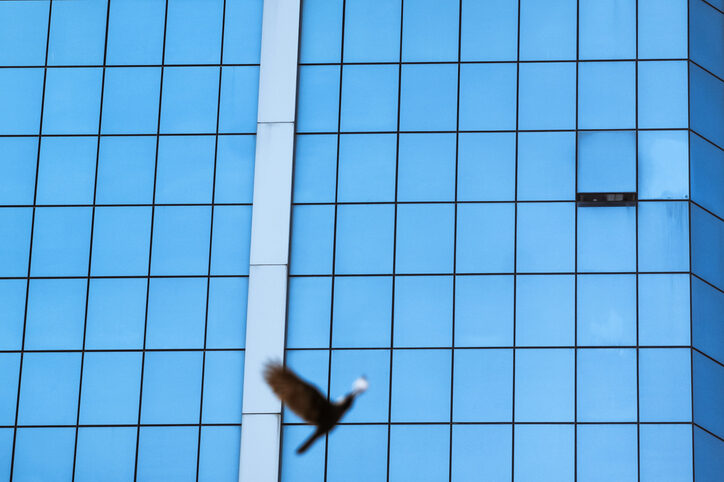
Outside the window, they gathered on the spotty lawn. Black ones, strolling back and forth, tut-tutting and adjusting their wings. They had speckles on their backs and long thin beaks. Djarlika turned back to her magazine. She crossed and then uncrossed her legs.
Three other women in the room, and she was the only one with a view out the window. Four other women if you counted the receptionist. Five other women if you counted the nurse who came into the room and consulted her clipboard, then backed out of the room without speaking. One woman straightened her wig; one looked at her phone and traced her finger across its screen in lazy swoops. The third woman stared up at the television, which was playing a cooking show on mute. Silently, green peppers were being sliced. A pan of sausage was shaken, and the camera zoomed in on the host’s pale, slender hands. Every woman was an ear that blinked in the silence of not hearing her name. The receptionist was new. She was small and still with pleading brown eyes. “Do you have an appointment?” she had whispered when Djarlika stepped up to the plexiglass barrier that separated the receptionist’s air from the air of the waiting room. The receptionist’s fingertips hovered over the keys, trembling slightly. Her brown eyes pled all over Djarlika’s face. “Of course, I do,” Djarlika said. “That’s why I’m here.”
There were fourteen birds on the lawn. Djarlika counted them again; none had flown off or joined the conversation. Some birds thrust their long thin beaks into the grass and then flung their heads back, choking down whatever they had pulled up. The other birds went wild, erupting into the air and then landing and clapping their wings to their sides. Djarlika tapped her finger against the window, at first very gently, like the receptionist’s fingers tapping the letters of her name onto her keys; then harder; then harder, when the birds didn’t react. The new receptionist had failed to address any of the complaints that her predecessor had also elected to ignore. The coffee machine on the long library table across the far wall was still broken, for instance. The air-conditioning was still turned up too high.
Djarlika folded her fingers into a fist and was about to tap again when the nurse came into the room and looked down at her clipboard. Some of the other women looked up. The one watching the cooking show focused exclusively on the TV. She did not even blink. The cooking show hostess tilted the pan again toward the camera. The studio lights made the sheen of fat on the sausage glisten. AUDIENCE: [makes admiring noises], said the teletype scrolling across the bottom of the screen. The nurse looked up expectantly at the faces that were looking expectantly back at her. Eventually, one of the women got up—the one with the phone, which was now tucked into her purse—and joined the nurse at the door, both their heads bent over the clipboard. Tack tack tack, said the receptionist’s keys.
The magazine in Djarlika’s lap was about women’s issues. She moved its pages back and forth. Women’s issues were yogurt and stains on the carpet and degenerative bone diseases and why no one would believe them about the intensity of their pain. Once more, Djarlika congratulated herself for living alone. When she was in pain, she believed herself. A flicker on the television screen caught her eye. The show had gone to commercial break. Now cartoon bears in pastel colors were living together as people do: in a house with specific rooms for specific purposes. A bear kitchen. A bear bathroom. A bear den with their own bear television switched on and playing a commercial about objects bears might need to survive their lives. Outside the window, the birds erupted once more and once more settled down into what looked like the exact configuration in which they had previously been arranged. A loose hemisphere surrounding a central point. An empty center—or empty to Djarlika, who could not see what the birds were clustered around to witness or protect. Worms, maybe? Maybe seeds.
It had been a hearty autumn followed by a long, thin winter. The light was watery and came all the way down to the earth in waves like curtains of water sheeting down a rock face. There was no room between the earth and the light. No place to tuck into and hide away. The woman with the wig closed her eyes. AUDIENCE: [makes anticipatory noises], said the teletype across the bottom of the screen as the cooking host held a glistening plate up under her nose and smelled its empty porcelain face. The sausage was still in the pan. Was this a mistake? A glitch in the editing? She looked at the face of the woman who was watching the television so intently, but she did not react.
Djarlika tossed the magazine onto the low table in front of her and rubbed her fingers against her pants. The woman standing with the nurse patted the face of the clipboard, then squeezed the clipboard in an emphatic way. She and the nurse smiled at each other. Outside, the birds were absorbed in whatever they were absorbed in. It didn’t matter to them that Djarlika was alive, on the other side of the glass, a full body blooming with blood and plasma, digestive juices, cartilage lubricated with synovial fluid, spinal column alight with electricity. Djarlika’s white blood cells were massing for the attack and dying in droves, bodies heaped upon bodies, the thick stench of rot filling all her internal crevasses so that, should she be laid upon a table and lovingly sliced in two, what would spill from her would not be the pink meritocracy usual among organs—each sweet sac whole and gurgling with purpose—but the black leak of infection tainting system after system with its vapid blats and gleaps. Put your money where your mouth is, Djarlika thought, either at the birds or at her own failing organs. The birds didn’t care which one.
Meanwhile, the woman with the phone and the nurse had come to some kind of an agreement. The nurse held the door open for the woman as she passed, not without a look back at those left behind in the waiting room. Part triumph, part regret—the look of a youngest daughter setting sail for further shores. Bon voyage, Djarlika thought, but her thought was drowned out by the clacking of the receptionist’s keys, which had just started up again, though there was no visible stimulus. The receptionist’s head was bent over her keyboard, and Djarlika could see the wide, shiny part bisecting her head. Bonked in the middle of her skull was a faux bun as squat and full as a cinnamon roll. The bobby pins that held it in place caught the light and sent it gleaming back. Then the phone rang, and the receptionist straightened up to snatch it and whisper hello.
It’s not like we’re not all going to the same place eventually, Djarlika considered. She pictured the fleshy examination table, the charts of healthy or diseased parts, the shiny steel mirrors, the musty curtain to pull for privacy, the powerful rope of water jetting into the sink as the doctor washed his hands. It’s not like going wasn’t ultimately the same as staying, both forms of waiting, only in different rooms. At least this room had a television, which even on mute provided some flickering relief from the relentless austerity of ceiling, walls, chairs, floor. At least this room had a coffee machine that could, theoretically, if it were ever again to be restored to working order, dispense a steaming beverage into a thick foam cup. Djarlika eyed the cover of the women’s magazine, which featured a woman who had been very famous in another decade wearing nothing but a stunning red glove. How much money could I fit in my mouth if I really, really tried, Djarlika thought. Suddenly exhausted, she closed her eyes.
Behind her eyelids, Djarlika pictured her house full of the things she had chosen for it and the ways she had left those things. There was her brown, tweed, double-humped sofa with the threadbare arms. There was her plaid throw in rust and cream, glass-eye blue and a kind of acorn yellow. On the table were her breakfast dishes and on the dishes her breakfast crumbs. Everything in her house Djarlika had chosen because she recognized it as something belonging to her. Her couch, throw, dishes. Her bed, rugs, chairs. There were so many things she had been obliged to recognize before she had been able to fill the house with objects she had chosen. Pictures for the walls, sheets for the bed, forks for her mouth, creams for her face and body. Over and over, she had been forced to recognize things and purchase them, but that force—unlike the many other forces in her life—had disguised itself as a pleasure, a convulsive tremor, a swallowing. I have enjoyed my life of recognition, Djarlika tried. I have placed myself inside a museum of my own choosing.
But museum was a horrible word. It evoked stolen treasures; worse: looted recognitions prized from their places of familiarity and propped behind glass to be forever strange. Djarlika remembered going to a large and nationally central museum as a child and seeing there the remains of a Stone Age mother cradling her infant. The skeleton mother’s skull was turned to gaze down upon the skeleton infant’s face, but the skeleton infant’s face was gone—crushed by eons of compressing soil—and so what the mother looked into was a void, an empty bowl, a vacancy where once she had beheld (for how long?) something that froze her in awe and terror. “A Mother’s Love Witnessed Through the Ages” read the saccharine exhibit sign. Djarlika still remembered it because of the way the skeleton mother and the vacant baby and the school chaperone who cooed and then shuddered behind her made her feel as if something had clicked into place for her. Revulsion. She had quaked with it. It had filled her, very young Djarlika far from home on a trip meant to broaden her horizons, with a great and terrible power. I refuse, she thought. I refuse.
What exactly that meant was not something very young Djarlika felt she had to know just then. And she still did not know, but ever after she pushed away what was not hers and recognized what was. She did not compromise. She did not vacillate. Anything could be hers, until very recently. Now there were no choices left. No discernment; that was a part of the diagnosis. Plenty of golden calves to go around in the cancer ward, Djarlika thought. It’s a grab bag. Djarlika imagined fishing around in a rough burlap sack filled with the precious artifacts of lives lived through the millennia and coming up with a devotional coffee mug or an opinionated mousepad or a foul-mouthed paperweight. God Wants You to Hang in There, Asshole! She imagined that object behind the glass of a museum with a pithy informational placard. “Daily Life in the Autoimmune Era,” the placard might read. Or “Social Rituals of the Medical Class.” Djarlika imagined herself being revulsed by it. She imagined herself turning away, only to find behind her, guarding the door, a chaperone with pink lachrymose eyes insisting that she turn back and look.
Djarlika opened her eyes. The receptionist was staring at her but quickly glanced down and began sliding a pencil back and forth underneath her bun as she studied her computer screen. The woman in the wig’s jaw dropped open in her sleep.
“I have enjoyed my life of recognition,” Djarlika tried again, whispering it into the cold pane of window glass against which she rested her cheek. Immediately, the glass began to fog. Djarlika stuck out her tongue and pressed the tip of it against the cloud made by her breath. Tense, her tongue was an arrowpoint, a snake tip; relaxed, her tongue was a wide, soft sandbar parting the flood of something powerful, muscular, unheeding but nevertheless parted. If her life was not a museum of her choosing, then maybe it was a body. Someone else’s body. The wide, soft pad of her tongue pressed against her life’s asshole. Five of her fingertips pinched together into a beak as they pushed past her life’s teeth and down its long, silky, convulsing throat.
Outside the window the birds rose in a clatter of delight. A shadow crossed the patchy yellow lawn. Against the window, Djarlika’s eyelashes fluttered, her breath clouded, her oily cheek compressed. She could feel the receptionist staring again. Go ahead, Djarlika thought. I already know what I look like. The search history on her phone created a stratigraphic profile of the last nine months. Stratum E: Best Short Haircuts for Female Hair Loss. Stratum D: Essential Beauty Tips for Health Warriors. Stratum C: What to Expect When You Are Expecting a Colostomy Bag. Stratum B: The Illusion of Eyelashes. Stratum A: Therapeutic Nihilism: Dos and Don’ts on Your Journey Past Health. Djarlika imagined the artifact that was her reflection in the mirror, stratum by stratum irrevocably unfamiliar, until just this very morning when she had examined her gaunt cheeks; the putty texture of the bags under her eyes; the thick, flaking skin, painfully fissured, that crusted under her nose. She had opened her mouth and inspected the graying enamel of her teeth. She had thrust out her tongue and considered its yellow scales. A Mask with Movable Parts, Artist Unknown, Early 21st Century, Djarlika typed into the label maker of her mind. Go ahead and put that in your museum, she thought. See if I care.
Suddenly a shadow hurtled out of the gray sky and slammed into the middle of the circle of birds. The birds rose, hysterical, dismantling in an instant the symmetry of their previous rapture. They flew in wide spirals, beaks gaping, eyes shiny as buttons. One flew past the window, and Djarlika could see the black needle of its tongue thrust from between the twin black needles of its beak. Three needles to stitch the buttons on. The sky not gray so much as inside out, its stuffing showing. The shadow was a hawk. It had hit the ground with such force that divots were chunked out of the yellow grass where the earth now peeked through. In the center of the extant circle it sat: heavy, dusty, peering around from under its brow. A little bashful now that it was out of the sky. Arrow of death become feather duster of death. Shifting its weight from yellow claw to yellow claw. Hopping forward. Spreading its wings.
One of the black birds was clutched in the hawk’s talons, its back broken by the force of the blow so that its head lolled like a rubber bulb. Once, Djarlika had seen a brace of roasted ducks hung whole in the window of a shop, their skin slick and brown, their bills tucked against their breasts like slippers tucked under the bed, the empty bulbs of their skulls dangling coy as onions. She had recognized them. In she walked and bought one to eat that very night. It had been delicious, but it proved far too much for one, so she had hashed most of the breast into a soup and thrown the neck and head in the trash, where the slipper bill gaped atop a nest made of the previous night’s noodles, the tongue protruding thick from unclasped halves. I should have eaten that part first, Djarlika thought, before I got too full, but she restrained herself from digging the head out of the trash. Though she had wanted to. Though she had recognized it. That was when she still had choices to make, before every day was an exercise in gratitude, a delirium of gratitude, a frenzy of gratitude pressing hot and slick against all her length. Djarlika rubbed her sleeve against the glass to clear her vision. The hawk gripped its prey and launched itself heavily back into the sky.
Djarlika reared back. She sat up straight. She leaned forward, peering. This caught the attention of the other women in the room. “What is it, honey?” whispered the receptionist. She cleared her throat and said again, “Honey,” louder and with a different intonation, as if she were trying something out. The woman who was wearing the wig slowly sat up from her slouch. She pressed her hand to her wig and patted it on either side, as if to reassure it. The woman who was watching the cooking show stiffened in a way that made Djarlika sure all the woman’s senses were attuned not to the glister of pan or sausage or plate or hostess’s teeth but to Djarlika, who had moved strangely and might do anything next. “A hawk, I think,” Djarlika said. “It got a bird.”
She looked over her shoulder at the cooking show woman—this is what I did next, Djarlika thought, I imparted useful information I became the center of group knowledge—but the woman did not budge, and on the screen the AUDIENCE was reported to be [clapping with delight]. So much to be delighted by on that still-white, still-empty plate. Its perfect obedience to its form, for example. Its admirable capacity for eye contact. “Pay attention to me, or I will slap you across the face,” Djarlika was about to say to the woman, now pretending to be watching the cooking show, the only one of the women in the room whose stare was not centered on Djarlika and what she might have seen, when, again out of the un-uniform but gray—such a tediously intricate gray—sky, the hawk plummeted and this time landed on the sill of Djarlika’s own window with the bird still clutched in its claws.
The hawk shifted. It hunched its shoulders and dipped its head down toward the bird’s breast. For a moment, the hawk cocked its head to look at Djarlika on the other side of the glass, entrancing her with its brown eye and stern brow, the bitter yellow curve of its mouth, where it curled beyond the beak. Snip snap, the hawk clashed its beak together like shears. It lowered its head and dug into the bird’s limp throat, after which, clenching a beak full of feathers, it reared back and fixed Djarlika again with its ferocious eye. Ptoo, the feathers flew. The hawk dipped its head and came up with a lengthy gobbet of meat, which it shook, spraying the window with gore, and then convulsively swallowed. It lowered its bloody beak. Again scissored, again shook, again swallowed. Lowered again.
How much in that small bird body could there be to eat? Djarlika looked and looked. She filled her eyes with looking. Where the ribs sprang white from the broken chest. Where the feather’s spine sprang from the dimpled flesh. Where the intestines coiled briefly in the cave of the body before they were unspooled, gooey, into the air. Djarlika looked at the bird’s black eye, now filmed gray, as it bobbed back and forth, the whole head bobbing back and forth, as if the bird still danced, still clapped its wings, still shook in admiration for whatever the fourteen birds had seen together, all while below the neck it was torn apart.
“Oh no!” said the woman with the wig, who had crept behind her.
“What is it? What is it? What do you see?” pled the receptionist, hampered by her plexiglass.
“Got you, you fucker,” whispered someone very close to Djarlika’s ear. When Djarlika turned, the woman who had been pretending to watch a cooking show was right beside her, practically cheek to cheek. Thirteen birds rocketed through the privet hedge that surrounded the spotty lawn. They shrieked. They flung their heads back, shrieking. Four women in different states of disassembly looked out the window together as one more bird, austere in his gluttony, stripped and shook and gulleted the flesh of another—what?—not bird but something Djarlika intimately recognized. Something she wanted in spite of having no place for it in her life. Aftermath, perhaps. Or just meat.
“It just goes to show,” said the woman in the wig.
“Don’t you dare,” said the woman who had been pretending to watch the cooking show but was now pressed against the window with Djarlika, her sour breath gusting the pane. This close, Djarlika could see the edge where the woman’s hearty beige foundation ended and the grayish tone of her skin began: just before her ear, under her jaw, up and around the frazzled line of her hair. A seam that seemed definitive enough that someone—Djarlika, for example—could dig a fingernail under the edge and pull the whole thing right off. Hearty beige mask-face revealing underneath it only the really real skin ravaged by disease or actually the really real bone pocked with decay? Or maybe further: the really real wad of root and dirt, ash and stone, that had replaced, for eons and eons, all human likeness that had once so briefly reposed there? Or nothing at all: only another mask and another below that. Another and another. Movable parts clacking. Blank space where the eye should be waiting to be filled. “Chuck chuck chuck, you darling,” the woman said, presumably to the hawk. Her eye was brown and harsh with veins. She looked briefly at Djarlika and briefly seemed to do something like smile before returning to the window, against which she pressed her hand. “Chuck chuck, pretty bird,” she said. “Eat your fill.”
“What? What? What’s going on?” the receptionist whined, but no one answered her. It was obvious, after all. It was presented so clearly on the other side of the glass.