He was a duke, or an earl—he was some sort of nobility—and not the first of his kind to visit the hotel. Royalty, rock stars, movie stars, rich and famous people from all over the world came to stay there. Some had become familiar faces, returning each time they happened to be in New York. Couples who’d spent their wedding nights at the hotel booked the same room for their anniversaries, and there was a family that got together every Christmas and requested that a tree and decorations for hanging be waiting in their suite when they arrived. As for the English lord, he’d been there once already, a year ago, then as now by himself. It was not uncommon for a guest to sign the register using a false name. Last time, he’d been the Count of Monty Python. This time, he was Lord Sauron.
Gráinne, who was from Ireland, explained that although he might belong to the aristocracy, this did not make the man a royal, as some had assumed. More than half of housekeeping staff were from foreign countries, mostly Ireland, Poland, and the West Indies, and of those born in the United States, many had immigrant parents. And then there was Carmine, whose roots were a mystery. She was an adopted foundling who’d never lived anywhere but the Bronx.
It was not for them to know what had brought the lord to Manhattan, or why he’d booked one of the hotel’s forty-two luxury suites for a month. Nor were they especially curious. (It was only the celebrities, the actors and entertainers of whom they themselves were fans, who excited curiosity.) He was young, still in his twenties, and striking: tall and lean with a long back and a loose, slouching walk, a pouty mouth in a manly jaw, and a rooster shag of black hair with a forelock tickling one eye. The image of the swaggering heartthrob in one of the romance novels the housekeeping supervisor liked to read, he was a match for any of the leading men passing through. He was also a drug addict.
The hotel manager was beside himself: Should he or shouldn’t he contact the police? Since arriving, the lord had been on a binge and had reached the point of not caring who noticed. Other guests could hardly not notice, having been forced to dodge his lurching person in the corridor. Too many had seen him sprawled inert in a bar booth before the bellboys had had a chance to cart him up to his room like a piece of odd-sized baggage. Needless to say, there were complaints. And it was not even the end of his first week.
Already the hotel doctor had been summoned out of fear that the man was not just dead to the world but had suffered an overdose. Any day now he might, in fact, turn up a corpse.
His behavior was not only deplorable it was criminal: Of course the police would like to know. But then the whole sordid business might get into the papers. (An A-list guest list ensured the persistent attention of the press.) And privileged people were powerful people; who could say how such a man might retaliate?
She decided she’d rather clean toilets than wrinkled butts.
The housekeeping supervisor, a no-nonsense woman named Sadie who’d been born in St. Kitts but raised in London, said management had only itself to blame. The man should never have been allowed back into the building—and would he have been were it not for his title? During his last visit, he’d brought in hookers and other disreputable types—past the hour when unregistered guests were permitted in rooms too—and started a fire after passing out and dropping a lit cigarette onto a newspaper. He left emptied capsules and syringes lying about in plain view. His recklessness was baffling. He had been spoken to, he had been warned, and he had apologized. Though he appeared to be, if not genuinely ashamed, genuinely contrite, he seemed to have no fear of being caught, let alone arrested.
In fact, the hotel had a history of tolerating troublesome guests (not to mention hookers). When you’re serving the upper crust, the idolized, and the glitterati, you expect a certain level of bad behavior. Verbal abuse and harassment of staff, wild parties (group sex was the thing then), use of illegal substances, rooms left in appalling filth and, in some cases, deliberately trashed—it could be counted on. Warning guests they’d be billed for any damage they caused was about as effective as wagging a finger at them. Some even seemed to take it as a provocation.
Over the years, Carmine had had her share of unpleasant experiences. More than one guest who chose to remain in their room while it was being cleaned had done so in a state of undress, going about their business as if they were alone, and once, when a couple in bed would not stop smooching and fondling each other, she had fled in tears. Another maid reported a man who’d walked into the bathroom while she was cleaning the tub and sat down to take a dump. What kind of person would do something like that? (The same kind that left used condoms and tampons in the sheets.)
“I am sorry, ladies, but there is nothing we can do about these animals,” Sadie said. “I ask you to maintain your own dignity in the face of it.”
But everyone knew that some were not above taking secret revenge, in ways that might involve a guest’s toothbrush, say.
Speaking of animals, how a live iguana came to be in one of the hotel lobby’s palm planters was a question that never found a good answer.
It surprised Carmine to learn how much theft there was. You’d have thought rich people would be ashamed to steal bathrobes and towels just because they coveted a monogrammed souvenir.
The most elite guests, the sheikhs and kings and presidents who roosted in the penthouse suites, came with their own servants. Others hired one of the hotel butlers for the length of their stay. Every now and then, someone wished to have a say in who cleaned their rooms. A tourist from West Germany hoped there was a German girl to be had. As it happened, there were no Germans in housekeeping, in which case, the woman said she’d like an Asian. She had lived in Japan for a time and had found servants there to be particularly diligent. No Japanese either, ma’am; Reyna, from the Philippines, would have to do.
Years later, when her children heard such stories, they were outraged. You could never get away with racist shit like that today.
Maybe so. But Carmine was pretty sure that today, in that same hotel—though long under different ownership—the same kind of people still got away with a lot.
Her daughter said: “How could you work in that place for ten years?”
But Teresa would never understand. She would never accept her mother’s answer. What she wanted to hear was that Carmine had hated the job and resented the way she had been treated. But that was not in Carmine’s character. Housekeeping was menial labor, often dirty and exhausting, but far better than being stuck day in, day out on an assembly line in some grim factory, or behind a checkout counter, or, God forbid, in a field picking crops. And though she could have easily found a position in the large city nursing home near her apartment, she decided she’d rather clean toilets than wrinkled butts.
Her hands were busy, but her mind was her own.
Not having a boss standing over her every minute was another plus. She liked her bit of freedom—which was why she preferred working alone rather than on a team, as she sometimes had to do. Her hands were busy, but her mind was her own. She could daydream or think about whatever she wished. She could catch part of a talk show or soap opera on TV. And the uniform, from hairnet to rubber-soled shoes, suited her fine. Not having to think every day about what to wear, not having to spend what little money she made on work clothes. (Teresa, on the other hand, never stopped whining about the uniform required by her Catholic school.)
The hotel’s opulence and exclusivity, to which she knew she could never aspire, nevertheless lifted her up. So much she saw every day that was beautiful, from the Oriental rugs to the crystal chandeliers. She could appreciate as much as anyone the elegant furnishings, the pristine linens, the skyline, and the Central Park views. She liked peeking into drawers and closets, marveling at those guests who ignored management’s advice to keep furs and jewelry in one of the hotel’s safes. (And not all of those valuables were insured, as was learned from two separate heists pulled in her day.)
As for the beautiful people, back-of-house staff rarely got glimpses of them. But the constant parade of stars, the crowd of fans and paparazzi outside the hotel’s doors, meant there was always a ripple of anticipation in the air. Though Carmine prided herself on her discretion, she was not above listening to cafeteria gossip, the choicest of which came from the switchboard operator who’d eavesdropped on transatlantic calls between a famous actress and her English mother, about the actress’s breakup with her famous actor husband.
But in the eyes of her children, Teresa and her younger brother, Jules, a very different picture of Carmine’s working life emerged. To them, she had spent the prime of her life as a servant to the rich—first full-time in the hotel, then, after becoming a wife and mother, part-time in private homes—work for which she had been poorly compensated and mostly treated not just as inferior but invisible. The blame for this state of affairs lay on a society that was inherently and incorrigibly unequal. Their mother belonged to a social class that was systematically kept down, from birth deprived of a fair chance.
she had been about a year old when she was found, dehydrated and borderline malnourished, inside a pillowcase, in a tenement stairwell. The press had made much of the fact that a rabbit’s foot had been tucked in with her and what the mother could have been thinking. (“Good luck, baby girl,” one reporter suggested.) And over the years, Carmine would wonder: Whatever happened to that rabbit’s foot?
Once nursed to health, she’d been adopted by a young couple, an electrician and his wife, who’d had no luck conceiving a child of their own. The paperwork was barely finished when the woman discovered she was pregnant. Not long after giving birth to a son, she became pregnant again, this time with twin girls.
Though Carmine would never accuse her parents of neglect, she did not feel truly loved or wanted by them either—at least not in the same way her siblings were. As she grew, the feeling grew with her: her place in the family was really a kind of mistake. Her brother and sisters were so like one another (they were often thought to be triplets), while she was so different: not as good-looking, not as outgoing, not nearly as bright. She was not one of them, and they used this against her, by turns snubbing and bullying her—behavior their parents only mildly admonished. Carmine was the oldest, after all; she should have been able to take care of herself.
But if home life was less than ideal, school was outright misery. It was not that she didn’t try, her teachers said, it was that she was slow. Reading was hard, writing harder, arithmetic impossible. She was assigned to a track with other slow children. Slow as a glacier the years inched by, grade seeped into grade, and Carmine showed little improvement. Her teachers were sorry to report that she was no longer even trying. Somehow, she avoided the humiliation of being left back and graduated from high school with a general diploma.
And wasn’t the world a funny place?
Liberation! Oh, how much better, the working world. And though she continued to live at home, commuting to a job in Manhattan five days a week and earning a paycheck meant that she was a grown-up. The unhappiness of childhood was behind her; it could only recede, never return.
One Fourth of July, at a neighborhood block party, she met a man who had the exact looks that most appealed to her: an androgynous face and a muscleman body. Marco: bare- chested under an unbuttoned shirt. He was five years older than Carmine and worked as a train operator for the MTA. He had been eating watermelon, and his lips were red and dripping…cool and sweet. A summer romance led to their engagement and to marriage a year later.
The subway: as grungy a workplace as hers was sumptuous and, in those days, a notoriously unsafe one. That Marco could be the victim of a violent assault was Carmine’s biggest fear. His was that he’d hit someone who’d jumped or fallen or been pushed onto the tracks. This had happened to another operator (a boy standing too close to the edge of the platform had had a seizure), who was left so unstrung that he’d had to change jobs.
Neither of these fears came to pass. But there was another threat: heat waves, at a time when most trains were not air-conditioned. One steamy ninety-degree day, Marco collapsed and was taken to the hospital. It was the beginning of the heart failure from which he would die three years later.
To Teresa and Jules, their father was another victim of social injustice, forced to work under brutal and dangerous conditions.
a doctor had told Carmine’s parents that her slowness in learning might have been the result of poor infant nutrition. It was also more than possible that her birth mother had been some kind of substance abuser during pregnancy.
Whatever the actual cause of Carmine’s disability, it was not passed down. In school, her children excelled. (Marco had been an average student but had never liked academic subjects and had not even considered going to college.) When they weren’t dumbstruck with pride, the parents would tease each other about their kids having been switched with someone else’s at birth. Brains, love of learning, drive, teachers who saw their promise early and were ambitious for them, full scholarships: They had everything necessary to succeed. Teresa went to Yale, Jules to Stanford—and straight on from there to make their fortunes, she in finance, he in technology.
And wasn’t the world a funny place? Both children did, at one time or another, attend black-tie events in the ballroom of the very hotel where Carmine had worked.
The children knew that their mother had been adopted but not how she had been found, or that her birth parents were unknown. (When, after much nervous hesitation, Carmine had told the full story to Marco, he was so overcome that they’d both ended up sobbing.) Once, at a holiday gathering, Teresa had overheard two of her cousins talking about Aunt Carmine: something about a rabbit’s foot. She couldn’t get any more out of them, but at twelve, she already knew she could search the internet. Good luck, baby girl. After she’d managed to compose herself, she sent the article to Jules.
They lived in two worlds, her babies, and they kept those worlds separate.
Although brother and sister were of the same mind when it came to Carmine’s past, they did not share the same level of anger, which ran hotter in the veins of her daughter, where indeed it boiled. There were times when Carmine felt cowed by Teresa’s fierceness. That she wanted her mother to have had an easier life was understandable. But Teresa’s resentment at the way the world had treated Carmine seemed to shade into resentment against Carmine herself, as though she were in some way at fault, or at least partly responsible, for her life’s deficits.
When her children asked Carmine why she didn’t want people to know she’d been a foundling, she said it was because she was ashamed. When they told her there was nothing to be ashamed of, it rang in her ears like a chiding. She did not argue, she did not say what she thought, which was that her children were speaking nonsense. Of course she was ashamed. And that they were not being honest. Among the people whom Teresa and Jules associated with the most once they’d become adults, none had humble roots. They lived in two worlds, her babies, and they kept those worlds separate. And what other explanation could there be for this except shame?
at first, she was anxiousabout moving to Brooklyn. It was one thing to stop working years before retirement age, another to leave a home filled with memories of her beloved husband and the children growing up. But it didn’t take long for her to get used to the garden apartment Teresa and Jules had bought for her on a safe, tidy street just blocks from Teresa’s brownstone. She enjoyed tending her patch of backyard and, even more so, her new hobby: raising Chihuahuas. But her happiest hours were those she spent with Teresa’s daughter, Celina.
If there was something Carmine could have wished for, it would’ve been more grandkids. But so far, Jules, who had chosen to settle in California after finishing school, was committed to bachelorhood and, in any case, showed no desire to be a father. Teresa, on the other hand, had always wanted to be a mom, and after a series of relationships, each of which had ended badly (she blamed men’s inability to deal with high-achieving women), had decided to have a child on her own.
These days, Carmine saw a lot of Celina, whose relationship with her mother was strained. For one thing, Celina refused to take school as seriously as Teresa expected her to. (In fact, she did not take it seriously at all.) She was furious that she was being forced to attend a private middle school instead of a public one. (“Be grateful it’s not a Catholic one,” Teresa told her.) She disapproved of her mother’s corporate job and criticized her for being “all about money.” She accused Teresa of sometimes being mean to Carmine (for example, mocking her for choosing, of all breeds, the hideous-looking, yappy Chihuahua).
Now he didn’t look so healthy: he was sniffling, and a rash speckled his neck.
If the trouble between her daughter and granddaughter saddened Carmine, she could not regret that it fostered a closer bond between Celina and herself. She was pleased that rather than the aggrieved feelings her past triggered in her children, it was a source of pride for her granddaughter. Against terrible odds, Carmine had fought and survived. She was not a victim, she was a hero. Celina said this so often, and with such ardent conviction, it made Carmine both laugh and cry.
And wasn’t the world a funny place? To Celina, it was her mother’s late-capitalist career and class privilege that were cause for shame. Her grandmother—and her grandfather, too, though he’d died too soon for her to get to know him—were salt of the earth.
“Do you ever miss the hotel?” Celina asked. “I mean, do you ever get nostalgic about those days?”
Unlike Teresa, who’d always discouraged Carmine from reminiscing, Celina was endlessly curious.
“I don’t miss the aching back, that’s for sure.” But, she confessed, she did sometimes miss the turndown chocolates. “I always used to sneak a couple for myself.”
Celina roared. “Oh, Gram, I can buy you the best chocolates, anytime!”
Carmine didn’t try to explain that being stolen gave the chocolates an extra-special taste.
She’d had to wait until Celina was old enough before telling her the story of the English lord.
“He was a duke, or an earl—I never knew, exactly.”
“He was the Duke of Earl!” squealed Celina, an enthusiast of the rock and roll of her grandmother’s generation.
Carmine would never have crossed paths with him if Gráinne hadn’t gotten food poisoning. For a few days, the others had to split her section, which included his suite.
The first day, he was there when Carmine knocked, cordially acknowledging her on his way out. Carmine knew his reputation, and she had to wonder: How could this man be a junkie? Her Bronx neighborhood was full of junkies, and it pained and frightened her whenever she passed the small, derelict park where they hung out, as she did every day on her way to and from work. Most of them were young, like him, but sunken-eyed and gaunt, skeletal even, with pocked skin and scruffy clothes. Some of them looked as if they might die on the spot. But this man—how could he be one of them and yet so spruce and healthy-looking?
As for his suite, it was a mess—litter on every surface, a full ashtray overturned on the floor—though no worse than many others.
The second day, she didn’t see him at all, and the third day, she was vacuuming the carpet in the living area when he returned from wherever he’d been. She would have left and come back if he’d wanted (and as she would’ve preferred). But he only nodded as he brushed past her. She noticed that he was sweating heavily and listing to one side. Moments later, she heard him talking on the bathroom phone, followed by the sound of the shower running.
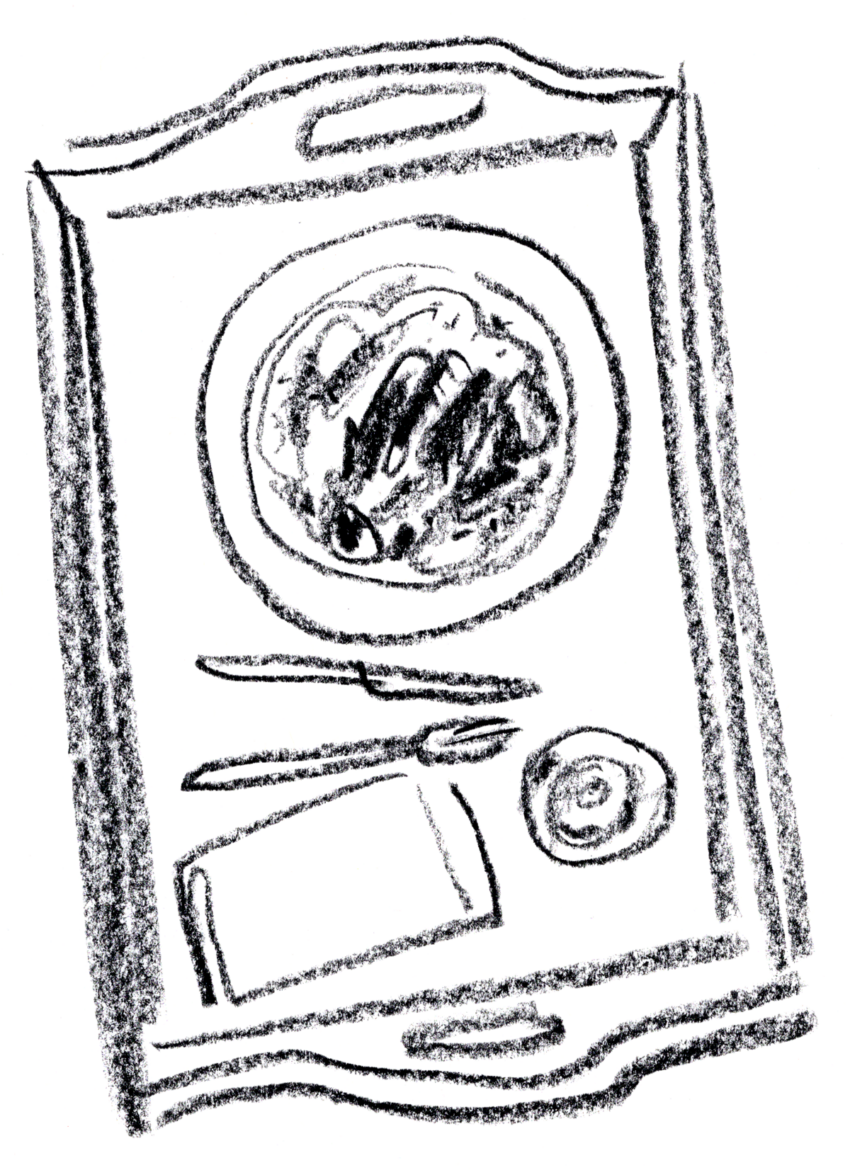
Today, the suite smelled funky. The cart for the lunch he’d ordered had yet to be taken away. Earlier, when she’d lifted the dome, she’d seen he hadn’t eaten much either. Most of a steak lay bleeding into a mound of crusted mashed potatoes. There was a dirty wineglass but no sign of a bottle—until she found two empty ones under the sofa. And one gold cuff link.
When he reappeared, his hair was towel-dried into spikes, and he had changed into a robe—not the hotel’s thick white terry but his own beige cashmere one. Now he didn’t look so healthy: he was sniffling, and a rash speckled his neck. He lay down on the sofa (Carmine hadn’t had time to make the bed yet), yawning and stretching voluptuously before lighting a cigarette.
down in the manager’s office, a man was shouting. His face was red, his fists were balled, he was puffing with rage. The manager knew that this guest, an insurance executive from Nebraska, was staying in the hotel with his wife and two daughters. They were in Manhattan for a weekend visit before dropping the older daughter off uptown for her freshman orientation at Barnard.
According to this man, his younger daughter had gone to have her nails done that morning at the hotel spa, where she’d encountered another guest speaking to the receptionist. Recognizing one of her idols, she’d decided to ask for his autograph. At first, he’d pretended she’d made a mistake (as famous people sometimes do when approached by fans), but when she persisted, he agreed to sign a brochure from the stack on the receptionist’s desk.
What happened next, the father said, as reported by his other daughter (who, despite having promised not to, had taken her sister’s story straight to their parents), was that this man had taken the girl up to his room, where they had engaged in what she described as making out. Confronted, the girl had tried to take back her words: she’d gotten the man’s autograph, she said, but she had never been to his room. She had lied just to make her sister jealous, because she was so jealous of her for getting to go to college in the big city.
“She’s protecting the bastard,” the man said, slapping the autographed brochure down on the manager’s desk. “Everyone knows these guys are depraved. I don’t care who he is, I want him arrested. That little girl is fifteen.”
The manager stared and blinked at the signature.
“Sir,” he said, “Keith Richards is not a guest here.”
when the manager instructed Carmine to leave the room, she hesitated, wondering whether she was supposed to take her vacuum and cleaning supplies with her. After all, as she explained whenever she told this story, she had other rooms to make up.
The lord stood before the manager with his hands in his bathrobe pockets and an amiable smile on his handsome face. “This is about that autograph, isn’t it,” he said. “Yeah, well, all right. I confess.” Then, in response to the manager’s unamused expression: “Oh, please. It’s not like I forged a check. It was just a little joke. Besides, I know Keith, and I know he wouldn’t mind.” And smiling again, amiable again, he turned to Carmine. “There’s no need for you to leave, dear. I’d like you to finish up.”
He glared defiantly at the manager, who glared back and said, “The girl you gave the autograph to has made an accusation against you. Her father has already alerted the police. I need you to come down to my office, where you can explain everything to them.”
“Good God, you’re not serious,” said the lord, drawing himself up and tightening the robe’s belt around his waist. “And I suppose you’ve got a security guard waiting in the corridor, in case I won’t go quietly? Well, I’m not going anywhere. If the police want an explanation, they can come up here and get it. As you can see, I’m not dressed, and I also happen to be poorly.”
His indignation seemed sincere, but immediately, as if he’d just been putting it on, he burst out laughing, a wild cackle that became a hacking cough forceful enough to make him stagger.
“Oh, I know what you’re thinking,” he said after catching his breath. “The man’s mad. He’s completely fucking insane. And you’re right!” Lunging at the cart, he picked up the steak knife, and before Carmine could even think to move away, he yoked her from behind. With his free hand, he flourished the knife, slashing the air like Zorro.
“Yes!” he cried, mimicking the voice of a stage villain. “I am a rapist! I am a murderer! I am the ghost of Jack the Rippaaaaaaah!”
“you must have been so scared,” Celina said. They were sitting in the hotel restaurant, where Celina had talked Carmine into going for afternoon tea. It was the first time she’d been inside the hotel since she had stopped working there. Back in her day, she recalled, the kitchen hadn’t offered afternoon tea.
“The way he was acting, laughing like a hyena the whole time, I didn’t think he could be serious,” Carmine said. “On the other hand, I knew that he was high, and even normal people can do crazy things when they’re high. Then I remember thinking that maybe he wasn’t normal at all, and maybe he wasn’t just high, and what if he really was insane?“
“Anyway, he dropped the knife right away, but he didn’t let go of me. He sort of hugged me and nuzzled my neck, as if to say he never meant any harm. And when he did let go, he started laughing again. I remember that he got so hysterical he fell to his knees.”
“And what did the manager do?”
“Nothing. He just froze. But I remember that his face was like chalk. I never liked that guy, by the way. No matter how stupid or unfair a complaint, he always sided with the guest. And his favorite thing was berating the employee in front of the guest. We all hated him.”
“Then what happened?”
“As soon as I was free, I ran out of there.” Smack into the security guard as she went running down the corridor to find Sadie.
“But what happened to the Duke of Earl?”
“Nothing.”
“Nothing?”
Carmine shrugged. “The girl stuck to her story. He’d gone to the spa to get a massage, and no one there had seen him acting inappropriately with the girl. The elevator operator said he hadn’t taken them upstairs together. Except for the fake autograph, there was no proof of any wrongdoing.”
The Nebraska family had checked out after the weekend, as they’d booked to do. The lord stayed on, but with Gráinne recovered and back at work, Carmine never saw him again. A word to some higher-up had resulted in the canceling of his entire bill and an apology from the manager, which, according to cafeteria talk, had been a sublimely groveling one.
The part of the story that had always rankled Teresa was that no action had been taken against the man for having physically assaulted an employee. The police hadn’t even spoken to Carmine. For her, there had been no apology, or any sort of amends. She might as well have been the steak.
The part of the story Carmine had not told Teresa was the part she would never tell anyone: his mouth on her neck, the heat of his chest, not being able to say whether it was his heart or hers that was pounding. He was naked under the robe, and before he’d let go, when he pulled her more tightly to him, through the thin soft wool she had felt him grow hard. He had made sure that she felt it.
What would people think if they knew how often her thoughts had returned to that scene? How it became, and for a long time remained, the focus of her fantasies. How even now the shame could make her blood rush.
But as the waiter placed the tiered tray of sandwiches, scones, and cakes on the table—far in abundance of what she thought they could possibly eat—she could hear her granddaughter say, “You have nothing to be ashamed of.” Of course she was ashamed. (Not until much later had she understood that it wouldn’t have been as exciting had she not been.)
She thought of the rabbit’s foot. No one could say what had happened to it.
Celina wanted to know if any events from the past had flashed before her grandmother’s eyes, as happened sometimes to people in life-threatening situations. And at once Carmine recalled the image that had fleetingly appeared, and that had always mystified her: the face of a girl she’d never seen before, looking down with a woeful, agitated expression.
“I didn’t know who it was,” she said, “so I decided it must’ve been my guardian angel.”
“Oh, Gram,” Celina said. “I think it was your mother.”
Carmine dropped the scone she had been spreading with jam so abruptly that it rolled onto the floor. Celina neatly toed it under the table.
“It was a flashback, I think,” Celina went on. “From the last time you saw her. She didn’t want to leave you. She loved you, but she couldn’t take care of you. She was saying goodbye.”
“No,” Carmine said, gripping the arms of her chair as if afraid of falling. “It was you! I was seeing into the future! I can picture her now, and she looks just like you!”
“Gram,” Celina said, her voice gently grave, “she was my great-grandmother. Why wouldn’t she look like me?”
At Celina’s insistence, Carmine, who rarely drank, had ordered a glass of champagne. She had drained it too quickly, and now her head was aswim. She tried to remember how old she’d been when she first learned about her beginnings. She thought of the rabbit’s foot. No one could say what had happened to it. Most likely, it had been thrown away. Surely that should not have been allowed. Surely it ought to have been saved so that one day she could have it.
From across the room, a heavenly sound drew their attention. On a small dais, a woman with a mane of silver hair had sat down at a harp and started to play. Carmine had never heard the instrument live before, but she immediately recognized the tear-jerking song. Through a blur she watched Celina, raptly whisper-singing “What a Wonderful World,” and it was as if she were seeing three faces—her granddaughter, her guardian angel, and her young mother—all magically superimposed.
Oh yes. What a funny, wonderful world it was.
At the other tables, people kept talking and eating as if nothing miraculous were taking place, and when the music stopped, only Carmine and Celina applauded. Then they finished their tea: every sandwich, every scone, every piece of cake.
Sigrid Nunez is the author of, most recently, The Vulnerables. It Will Come Back to You, a story collection, will be published in August 2026.
Newsletter
Sign up for The Yale Review newsletter to receive our latest articles in your inbox, as well as treasures from the archives, news, events, and more.