in 2017, i exited academia for entertainment—such was (and is) the state of the job market for humanities Ph.D.s—only to cocreate The Chair, a Netflix show about the world I’d left behind. During our writing process, my cocreator and I talked a lot about professors, about how they can be uptight, self-aggrandizing, depressive, controlling, petty, kind, idealistic, noble, and wise—sometimes all at the same time. We also discussed a kind of material desperation I knew well and to which we thought viewers who weren’t academics might relate.
Pembroke, the fictional campus where our show takes place, is corporatizing. Humanities enrollments are dropping; our professors start freaking out, clawing at each other, retrenching. They—especially the old white guys—make life very hard for the head of the English Department (Sandra Oh), the first woman of color to serve in the role and the one person determined to save their jobs. That, we felt, would be an interesting dramatic situation, especially if our heroine happened to fall in love with a colleague—a sad, white, not-quite-so-old dude who can’t stop kicking the hornet’s nest of campus cancel culture.
When The Chair was released in 2021, I worried that it would strike my friends and former mentors in academia as wildly unflattering: undignified, too truthful about how silly our field can be. But those worries turned out to be unwarranted. In fact, there is only one scene in the show’s three-hourish runtime that I still regret: a small gaggle of students gathers outside the dean’s office to confront the sad dude, who they believe—based on a decontextualized video clip of one of his lectures—is antisemitic. There’s no space in the scene (though we get there later) to feel that the students’ concerns might be valid. They’re ungainly, unreasonable, woke in a kind of made-for-TV, too-online, snowflake-y way. I’ve never taught a single student that annoying.
Unhappily, I was reminded of this scene while watching After the Hunt,
Luca Guadagnino’s latest, which was released this fall. Like my show, the film is about professors and at least purports to be about cancel culture, or about how we should cancel cancel culture, or something like that. It has one such tiny protest scene of its own: near the end of the film, half a dozen students flap their signs at a philosophy professor (Julia Roberts) who they feel should have intervened in a recent campus scandal. So distressing is their chanting that she passes out on the spot and ends up in the hospital.
In The Chair, we had hoped to offer something charming, something realish but gentle—a comedy. After the Hunt—the title nods to a genre of nineteenth-century painting in which a hunter, usually fat, usually rich, surveys a pile of dead animals—doesn’t give itself the same excuse. It’s a big, glossy, often beautifully shot feature film, a satire but also a tragedy. It’s a winter movie, cold and often coldhearted, about who has the privilege of gorging themselves on power, who is predator and who prey. The film’s tagline, “Not everything is supposed to make you comfortable,” is a declaration of intent to provoke. For the most part, critics have taken the bait. So far, After the Hunt has largely been dismissed for its inaccuracy, its muddled arguments, and the stylistic homage to Woody Allen in its opening credits.
These critiques have a point. But watching After the Hunt carefully, and especially at such a perilous moment for higher education, I felt that the film—or its marketing—does itself an odd disservice by framing the narrative as a satire of campus politics or American society or online mobs or the supposed excesses of the #MeToo era. It’s too weird for that, too restless and too dark, too committed to representing its characters’ flaws and manias and melodramas and prejudices. At its most interesting, After the Hunt is a marvelously acted old-fashioned thing about rippingly flawed people and their pain.
It is also—somewhat subtly, even surprisingly—a distorted but damning portrait of how our toniest institutions exacerbate and exploit that pain. The system itself, the film suggests, has been the most powerful hunter since long before cancel culture supposedly redefined the terms of the chase.
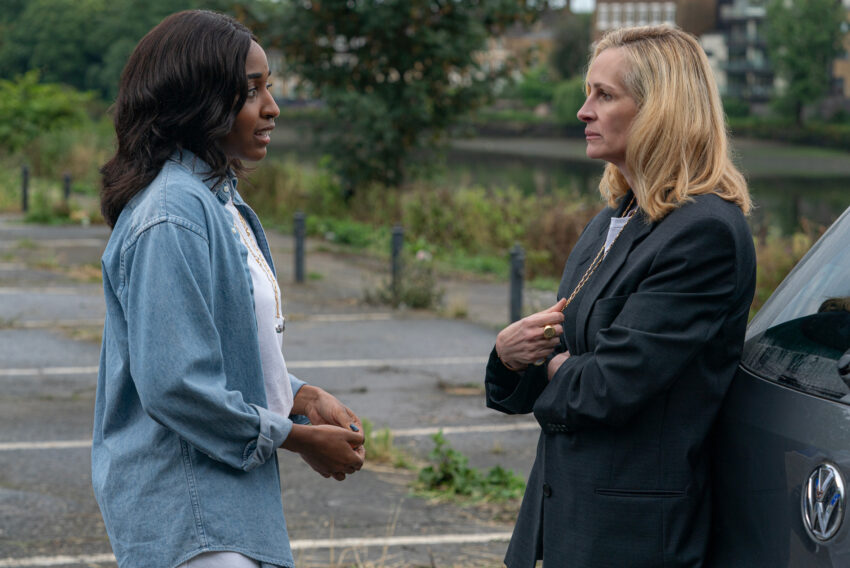
Yale philosophy professor Alma Imhoff (an intently tortured and torturing Roberts) is anxiously awaiting tenure review when her life is upended by a series of accusations: Alma’s friend and colleague Hank (a crass, appetitive, thick-thighed Andrew Garfield) may or may not have sexually assaulted one of their shared graduate students, a rich young Black woman named Maggie (Ayo Edebiri, whingy, wide-eyed, and superb). Hank is brilliant, simmering with class resentment, almost certainly a liar; Maggie may or may not be an entitled idiot who plagiarized her dissertation. This is 2019, #MeToo well underway, the pandemic not yet in sight. After Maggie’s allegation, Hank is summarily fired, which leads to a cascade of explosive fights: between Hank and Alma, between Alma and Maggie, between Alma and her husband, between just about every configuration of classmate and colleague.
There’s some goofy satire, not out of the ordinary for pop-culture portrayals of academia: a supposedly feminist lecture about the role of women in jihad, somehow supported or hosted by the Philosophy Department; a peek at one of Alma’s papers, the title so long I didn’t have time to write it down. At one point, we’re treated to a snippet of Alma’s lecture about the panopticon, because of course under cancel culture we’re all surveilling ourselves (we’ll leave aside that the panopticon is about the individual internalization of state power, not about personal grievance or the fear of social offense).
Maggie eventually gives an interview to Rolling Stone, in which she attacks Alma for refusing to help her press charges against Hank; Alma, racked with stomach ulcers, betrays a psychiatrist friend (a wonderful Chloë Sevigny in preppy-frumpy loafers and wig) by forging a prescription for painkillers. Amid all of this, the fearsome protest of six or so students descends.
The scene is confusing, maybe farcical, and in some ways empty, not least because the ulcers, which cause Alma’s fainting spell, have yet to be disclosed to the audience. It also surprised me and made me feel almost wistful; in the ten rattling months since Trump took office, Guadagnino’s portrait has acquired a kind of unintentional, almost touching innocence. The students who surround Alma go unpunished, at least on-screen. No one is doxxed, deported, or detained.
At the end of the film, we fast-forward five years: In a wood-paneled office, Alma watches the 2025 Los Angeles fire on her computer. She has a hot young male secretary. No one calls to tell her that all the cancer research funding is gone because of that feminist lecture about jihad or those kids with the signs. Nobody gives her a heads-up about the woke right or loyalty oaths, or starts blithering about DEI. There is a belatedness here that the filmmaker couldn’t quite have avoided and that actually ends up serving the movie well; a kind of gentleness enters the narrative.
In the final scene of After the Hunt, Maggie and Alma meet for one last time at an Indian restaurant and discuss their lives as they were and are. Strikingly, both women have been rewarded for precisely the reasons that, by “woke” convention, they should have been condemned. Maggie’s privilege never comes back to bite her. Instead, she becomes an ultramodern member of the Black bourgeoisie—a lesbian with a flashy engagement ring, about to marry a curator at the Whitney. Alma not only receives tenure but becomes a dean.
Instead of punishing Alma and Maggie—who ought to hate each other, who might not even want to talk to each other without lawyers present—the film gives us a different situation entirely. The intensely private things they have learned about each other seem to at last create some sort of peace. Alma knows with certainty that Maggie has suffered at Hank’s hands. For her part, Maggie knows that Alma has a startlingly similar story in her past. And we in the audience know that Alma was abused as a child by an adult she loved, and still believes she is the one to blame. Rather than coming to grips with her own trauma, she has since internalized all the misogyny thrown at her on the way to that comfy dean’s seat.
We are not meant to think Alma is a saint—far from it—but I think we are meant to recognize, as Maggie does, the kind of pain she’s in and also how it enables her misjudgments, her silences, and her rise.
The film doesn’t employ the ungainly therapeutic language I just did, but the point stands. That’s why Alma betrays seemingly everyone. That, the movie suggests, is why she didn’t help Maggie, why she collected grody sycophants like Hank instead of finding or accepting a healthy love or even just keeping her damage to herself, and why her whole life briefly went to pieces—not because Maggie didn’t want to be “uncomfortable” but because Alma, who is also a victim, has refused comfort for most of her life. She can hold simultaneously psychic and physical pain at bay to the point that it nearly kills her. For Alma, the catharsis that might save her will almost certainly never arrive.
This ability—Alma’s superpower and her flaw, to risk a little screenwriting lingo—allows her to thread her way into, and accumulate power in, an abusive, patriarchal world. And that’s where we leave her. It’s not a novel or happy ending, but it’s an honest one.
Certainly, the catchier, clickbaity elements of After the Hunt aren’t as compelling as they want to be; Trump’s assault on higher education has made very obvious what the film’s portrait of university life gets wrong.
But the movie captures something true about academia that endures even now. When I fled this world, I told myself that it was about the money or the job market. Watching After the Hunt and thinking about it carefully—thinking about my own entanglements with grinning male faculty members—I had to acknowledge that it wasn’t just that and never could have been, not considering how much I loved my colleagues, my students, and my work.
Alma and Maggie both know that to be fed by elite institutions is also to be eaten by them. Most women in these environments are aware of this; I am too. In that last scene, Maggie walks away from the restaurant while Alma watches from the window. Alma’s sweater is blue, fluffy, a thought of cloud. She is now the fat man with the pile of dead things. But she’s also stuck within a system that rewards her for swallowing her shit down. She’s trapped by it, perpetually falling prey to it, arch and predatory because something—her own stomach acid—is preying on her too.
Dean Imhoff has won the hunt, but Maggie no longer has to hunt anything. Instead, she wanders off, away from the slaughterhouse and into the snow. She’s the real winner, I thought. Keep going. Get out of there.