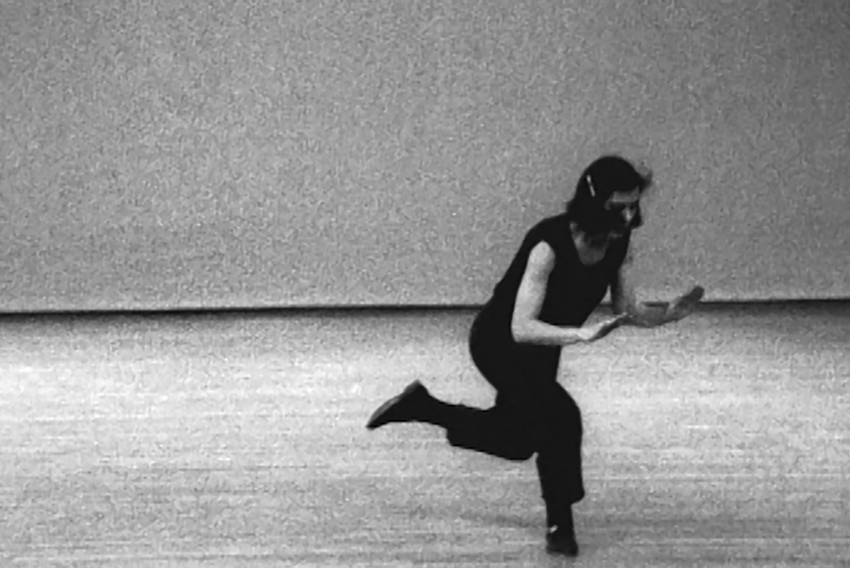
Yvonne Rainer, still from Trio A, 1978. Copyright Yvonne Rainer, courtesy Video Data Bank, the School of the Art Institute of Chicago
The stage is bare except for a woman, the floor below her, the air around her, and for the duration of the dance, as she bends an arm or lifts a leg, her body seems to speak to her, or really it’s speaking to itself, telling itself when to turn or jump, and because the woman is attuned to her body, inhabiting a space completely inside her body, although she’s supposed to be expressionless, and she is expressionless, she seems to be having a good time.
The film of Yvonne Rainer performing Trio A was made in 1978, twelve years after she originally danced it, and roughly forty years before I started imagining what it must have felt like. And feels like. And when I say having a good time I mean the kind of enjoyment that comes when you’re so engaged with performing a task at hand that you forget yourself, leaving behind ideas of who you used to be, or who you think you are. And The Mind Is a Muscle. That’s what Rainer first called her dance, and the problem is stretching that muscle. Actually, the problem is locating the muscle and then, having found it, letting it relax, letting all those ideas inside the muscle dissolve.
I imagine Yvonne Rainer dancing in that short silent film, filling herself with uncertainty as a way to empty her mind of everything she already knew, or wanted. And being empty, she could then be possessed by what might resonate in her, something we call greater than her, but it’s not greater, and it’s not lesser; it’s what she is, or was, and that’s the rub. Who she was is constantly changing. Arriving in New York in 1956, she was full of ambition, ready to make her mark, and because dancing was a way to do that, she studied people she admired, dancers and artists, and even the people she didn’t admire had something to teach. The technique of Martha Graham, for instance, was rooted in a movement style that valorized an emotional life that didn’t align with Yvonne’s emotional life. And in 1965, in reaction against the authority of that style, protesting the constraints it put on her body, she said no. No to spectacle and virtuosity, no to magic and make-believe, no to the heroic and the antiheroic. The point was not to be new or radical. Her so-called “No Manifesto” was meant to clarify what was obvious to her—that dance should be free to be something it wasn’t before.
Sometimes when I’m writing, when I think an idea is about to appear but the words I have don’t quite reveal it, I get impatient. I get critical, judging both ideas and words and inhibiting their inclination to expand into other ideas. And I understand the necessity of constraint, that wanting is one thing and not getting what you want is a fact of life, but still. I want my life to expand into moments that aren’t just reiterations of what I already know. And it ought to be possible. I remember the first time I ever rented a car, standing at a counter, exchanging my driver’s license for a set of keys. I remember the expansion in my chest, a tingling along the front of my spine as I slid into the newish seat of what for me was an undiscovered experience, driving alone in a car, my hands on the wheel, the windows open; the air and car and even the world passing outside the windshield were an intimation of something divine, an experience that, because it doesn’t last forever, I’m looking for moments when it does, when the performance of self evaporates into a performance of what I don’t even know I am.
Yvonne’s so-called “No Manifesto” was meant to clarify what was obvious to her—that dance should be free to be something it wasn’t before.
Yvonne was thirty years old when Trio A burst out of her. Or really, it evolved out, churning and gestating and eventually solidifying into an experience she was able to embody and express in her dance. And fortunately she made the film, evidence of how a body discovers what being can be. Her choreography shows both an experience, and a way to live inside that experience. I say inside because the choreography is a container. And it seems as if it might be possible—by teaching our bodies to inhabit that container, even if for only a few short minutes—to learn the experience.
In the spring of 2017 I decided to take a class. Along with about fourteen dancers and ex-dancers, at a performance space on the Lower East Side of Manhattan, in an airless room with a vinyl floor, I enrolled in an introductory workshop called Learning Trio A. It was a class that would, by teaching us the individual moves of the dance, give substance to the video we’d all seen of Yvonne, dancing. I signed a contract stipulating that I wouldn’t teach or perform Trio A in the future. We were told to wear shoes because Yvonne had danced the dance in shoes, and at the first meeting, along with the other dancers, I put on my sweatpants, tied my shoes, and I wondered about an audition process that would weed out uncoordinated people. But the teacher wanted a range of experiences, including my inexperience. So I sat on the floor, spread my legs, and pretended to stretch like the other dancers. And I did stretch, spreading my legs and reaching out between them, not very far but feeling the front of my spine expanding as the teacher walked between us, reminding us that the sixteen-millimeter film of Yvonne, dancing in her black shirt and pants, was only a recording, made years after the original event, shot from a single angle. Learning the dance by watching a recording of the dance would have been impossible. Imperceptible details connected every movement of the dance, and only certain people knew those details. The teacher was part of a lineage, having learned the dance from Yvonne herself, and for us, a way to become part of that lineage, to inherit, if that’s possible, the physical experience of dancing like Yvonne, was to become Yvonne.
The first step, they say, if you want to change yourself is to know yourself. And although that’s not absolutely true, by learning the steps of Trio A, I was getting to know what my mind was doing, how it wanted some things, rejected other things, and because the mind is a muscle I kept practicing. In French they call it repetition, and the theory is, by repeating an action over and over, knowledge is absorbed by the body. In English we say rehearse, the hearse being a vehicle that carries the dead to the place where the body is buried, planted like a seed, and it also reminds me of hearing. Not so much re-hearing as hearing for the first time, which requires listening, which requires being empty enough to attend to the part of the dance that’s invisible, therefore difficult to think about. Sometimes, when I was practicing the dance, my mind would wander off, following a thought that led in one direction while my body, having other thoughts, was taking me in another direction, and learning the dance means yoking the two together, getting the mind to lodge inside the body, and the body to lodge inside itself, and when I lifted my leg or flexed my foot I felt these movements affecting me. I was learning them by heart as they say, and the heart has its reasons they also say, and muscle memory is just that—the muscles remembering what they’d never done before.
On the first day of the Trio A workshop the teacher told us, forget what you already know. I wasn’t what they called a mover, but I did have my habits of moving, ways I’d trained my body to be, and because those habits would get in the way of learning the dance, I had to begin by letting them go. Beginnings are important; they mark a moment between what has been and what is about to be, a moment when intention coalesces into action. When I stood with the other participants on the black, slightly padded floor, I tried to focus my intention. At the beginning of the dance you’re supposed to just stand there, at a right angle to where the audience would be watching, letting yourself get acclimated to the fact of your body occupying space—and then you move. You bend your legs while simultaneously turning your head to the left, letting your arms swing loosely in their sockets, three times, back and forth across your body, then you pivot on your left foot and step with your right, and with the sole of that foot on the floor, with the left foot perched on its toe behind you, you raise your arms to shoulder level and move them in small, controlled counterclockwise circles. Practicing these moves, and perfecting them, was meant to get us to a place in which, when we bent our legs, the mind wasn’t telling the body what to do, or what it should do. There was to be no volition. At a certain point the legs would just bend, and because there’s no music in Trio A, when we stood on the rubbery floor and practiced the dance, although we weren’t all in unison, we moved more or less together, bending and turning and opening our arms, and every so often the teacher corrected us. At the beginning of the dance, during a moment when I was supposed to turn my head while swinging my arms, apparently I also turned my torso. I was told to stabilize my ribs, keep my sternum facing forward, let the spiral happen in my neck. The teacher’s assistant, a young woman with very good posture, walked up to me, held my chest between her hands, one hand on my breastplate, the other between my shoulder blades, and demonstrated to my body the details that made the dance what it was. Part of any learning is learning to trust the teacher, including an assistant teacher, and although I could feel a resistance in my body, I submitted to the adjustments she made, letting her pull me away from postural habits I didn’t even know I had.
The Judson Memorial Church, an old brick building on Washington
Square, in the early 1960s transformed itself into an incubator, a place
where the people who wanted to try something new could actually try something new. It’s where Yvonne originally presented Trio A,
where the Judson Dance Collective got its name, and certain historical
moments are like that—periods when idealism coalesces and communities
arise. And the performers who danced at the Judson probably didn’t even
realize what was happening. Or maybe they did. Yvonne would later say
about that time, “There was new ground to be broken and we were standing
on it.” Yvonne Rainer and Trisha Brown and Lucinda Childs were part of a
workshop, led by a teacher named Robert Dunn. On July 6, 1962, for the
end-of-the-workshop performance, because Merce Cunningham’s studio
wasn’t big enough and because the 92nd Street Y wasn’t interested, the
First Concert of Dance happened at the Judson Church. First implies
a beginning, a moment when what used to be has changed, or is changing,
and they didn’t have money for sets or fancy costumes, so they used
what they had, their bodies, and their bodies became the tools they used
to obliterate the boundaries between art and life, between performer
and choreographer, and even the audience was invited to participate in a
transformation that, although it was a different time then, might still
be possible.
I thought that by taking this piece of history, Trio A, and
reimagining it, I could reimagine myself. It could have been anything, a
sport, a martial art; even the words I’m writing would do the trick.
Because it’s not a trick. It’s deciding to imagine Yvonne not virtually,
but actually, to see and hear and feel her as she lives and dances her
life, and the trick is, once you’ve chosen a life, to commit. When I
write a word, because the word has meaning in relation to the words
around it, there’s always the question, what word or grouping of words
will lead to the meaning I want. And often, because I don’t know what
meaning I want, I don’t know how to say it. And how can I say anything
about a life that wasn’t mine, and isn’t mine, and can’t be mine because
I’m limited by my own perspective. And feeling those limitations I get
frustrated, stymied. I get lost, like now, not quite believing that my
voice deserves to speak. I remember reading the I Ching when I
was younger, a yellow, clothbound book I kept on a shelf, and I remember
the narrator of the book always talking about “perseverance” or
“persevering,” and what they meant was belief. That an action is
connected to other actions, that one word finds its meaning in relation
to other words, and if you follow those words and believe that something
will come next, although the process is often haphazard, something does come next.
In her instructions for dancing Trio A, Yvonne stipulated that the dancers never acknowledge the audience. In the video of her performing the dance, at no point does she raise her eyes to see the camera watching and recording her. This was partly her attempt to free herself from the judgments of the spectator, to negate the power of anyone that supposedly knows best, or better, and it’s also a way to negate yourself. You say no to the part of yourself that submits to the craving, which is for attention, what Yvonne called “seduction of spectator by the wiles of the performer,” and because she distrusted the desire of the spectator, she also distrusted her own desire to woo them, to win them over, and like Brecht, who distrusted the audience’s easy identification with the performer, Yvonne sought to take her personality out of the equation.
“How marvelous it all does seem, in retrospect.” That’s Susan Sontag talking about the 1960s, about its boldness, its optimism. And it’s easy, looking back, to forget that the people who were part of that optimism were just living their lives. They weren’t necessarily better lives, or happier, but as the Wizard of Oz might have said, they had one thing we haven’t got. A sense that what they were doing mattered. That’s why Yvonne, when she danced Trio A, because she didn’t want to be distracted by what didn’t matter, closed her eyes. What mattered was paying attention, maintaining her balance by attuning her mind-slash-muscle to what was happening, moment by moment, not knowing what that would be but adjusting her responses, noticing her responses, and connecting her shifting intention from what had happened a second ago to what was happening now. That’s one reason I enrolled in the Trio A workshop. To shift in myself what had come to feel stuck, worn out. My desires had become, not like ghosts but they didn’t seem to have a place. They were old, therefore probably corrupt, and whether it’s me or forces acting on me, it was time to be shown, by someone who knew, that I could experience desire undistracted by the influence of other desires. That’s why I listened to the teacher describe a complicated dance that had happened fifty years earlier. It’s why I would sit on the floor at the end of each two-hour session, my legs forming a V, stretching the muscles around my pelvis while the memory of the dance still percolated in my body. I tried to release the entire length of my spine, letting my body connect to my brain and adjust to a new way of being. And because there were people around me, talking, getting dressed, possibly watching me, as I sat on the bones of my pelvis, reaching my fingertips out in front of me, although I wanted to be watched I also wanted to be free of that watching, and so I closed my eyes. I closed my eyes the way babies, because their sense of self is so tenuous, when they close their eyes, believe they disappear.
Failure is a kind of small bomb going off, and after the explosion, if it doesn’t kill you, after you recover, maybe the destruction is necessary.
When we practiced Trio A during the workshop, dancing on the
rubber floor in the basement studio, because everyone followed their
own internal timing, some of the dancers were faster than others. And
being one of the slower ones, I was always trying to catch up. My mind,
instead of trusting my muscles, was thinking about the phrase I was supposed to be doing. And
that’s why Yvonne didn’t want us thinking about phrases. The dance, she
said, was continuous, “no one thing is any more important than any
other,” but because I was trying to figure out what step was supposed to
follow from the step I’d just finished, I wasn’t feeling it. By it I mean the mental state connected to the dance that would connect me to a larger…and I would almost say larger picture but part of the point of the dance was that it wasn’t a
picture, wasn’t something to be viewed and judged but instead
experienced, by the performer who had internalized the movement. Not
that Yvonne performed in empty theaters. People came to watch her, and
she let them watch, and when it was announced, about halfway through the
workshop, that we would perform the dance for each other, I was willing
to try. Willing but underprepared, and my teacher helped me prepare by
giving me a little more attention, by calling out to me what move came
next, not like a mother but it felt like a mother’s concern, and I
wanted her to be proud. Rainer referred to the movements in Trio A as “pedestrian,” but it wasn’t as if anyone walking down the street could perform them. Some were very un-pedestrian,
some very difficult, at least for me, and although I needed my
teacher’s help I didn’t want her seeing me when I was lost or doing the
wrong movement. I wanted her to see me when, now and then, I found
myself doing the right movement, found myself in the groove as
they used to say, inhabiting the dance and letting the parts I’d managed
to memorize change the part of myself that had put them in memory.
Turning my head, for instance, or looking over my left shoulder, letting
the memory of what I was doing move from my head to my body, lodging
itself in my muscles and tendons, and sometimes I imagined I felt the
spirit of Yvonne as it entered me, an experience that would have been
transcendental except the minute those moments appeared, I noticed
them—not just noticed but enjoyed them and admired them and admired
myself for having them—and if anyone was watching, I wanted to show them
what I’d done, wanted to show my so-called stuff, and the teacher told
me that I had a nice verticality, and that Yvonne had that too, and it’s
funny when you get a compliment, and calling me vertical seemed like a
compliment, you begin to play to that compliment.
There were bound to be moments when, in the course of learning the
dance, having practiced a certain section over and over, I felt I was
getting it. But mostly I didn’t. Mostly, in the middle of forgetting
where I was I would look over, although we weren’t supposed to look,
sometimes, looking at my teacher sitting on the plastic chair, the
mirrored wall behind her, I would imagine Yvonne. In my mind, Yvonne was
standing beside the chair or behind it, watching me and either
approving or disapproving. Because Yvonne was the progenitor of the
dance, by performing her dance, for her, how could I
not be performing a version of her? My daughter does the same thing with
me. She imitates me, repeating what I say, or when I do something, she
does it after me, showing me what she’s done, and of course she imitates
me. She imitates everyone. And with Yvonne, I was the child, imitating
her, making mistakes, but like a good enough mother, she let me make
them. That’s how you learn, and because I tend to be careful, meaning
it’s difficult for me to forget my mistakes and move on, every mistake I
made when I danced Trio A made it harder for me to remember
where I was in the dance, to remember the steps and take the steps, and
even with an imaginary Yvonne watching over me, because I felt her
watching over me, my body refused to do what my mind was asking it to
do. It rebelled, saying no to my mind’s authority and no to Yvonne, fending off the authority I’d given her to show me the way, which wasn’t my way, certainly not the only way,
not even a very enjoyable way. But I stubbornly slugged it out,
doggedly repeating gestures I didn’t actually believe would cement in me
the habit I wanted, one that Yvonne had, that was supplanting the one
that came before, and before that, and after a while I got tired. Even
Yvonne got tired. In her autobiography, Feelings Are Facts, she
talks about her relationship with Robert Morris, an older artist she
lived with and probably loved, a successful sculptor and performer who
she knew was having affairs, cheating on her with other women, and she
didn’t want to be cheated on, but she was dependent on him, both of them
dependent on each other for the life they were living, and one of the
unspoken rules of that life was: the one with less dependency wins. And
maybe Yvonne had lovers, too, but the betrayal, what it felt like, must
have devastated her. There was a suicide attempt, an extended foray into
psychotherapy, none of which helped her solve the bigger problem of who
she was and how she fit in the world. And when I say what choice did she have it
isn’t a rhetorical question. One day, under the spell of her
desperation, she walked into an alley, probably infested, reeking of
urine, and she took off her clothes. It was inappropriate, she knew
that, and she did it because it was inappropriate, because she
wanted to be noticed, not praised necessarily but her desperation needed
an outlet, and a policeman took her to Bellevue Hospital, a hospital
for insane people, for people with problems she didn’t want, and when
Morris came back they probably tried to change, probably promised each
other they would change, and maybe she never intended to kill herself but how does a person change?
At some point the Trio A workshop was going to be over. At
some point, having absorbed the lessons in Yvonne’s choreography, I
would break away from her influence. But that point hadn’t yet come. I
was still learning the moves, still struggling with the steps, still
trying to imagine how Yvonne would tell me to dance a dance that’s not
even mine. It’s hers. My dance is another dance, a dance only I can dance like only she could dance Trio A,
a dance from the past, from a moment in time that doesn’t exist, which
makes dancing it now impossible. Sontag says, “Perhaps the most
interesting characteristic of the time now labeled The Sixties was that
there was so little nostalgia,” and maybe that’s what I need, an end to
the constant looking back, the endless struggling with something that’s
already done, the same old thing I always struggle with, unsuccessfully,
and although the failure doesn’t destroy me, it is a kind of
destruction, a kind of small bomb going off, and after the explosion, if
it doesn’t kill you, after you recover, maybe the destruction is
necessary.
And I can’t be myself because every time I try to be what I am, whatever that is, something demands I be something else.
On the last day of the workshop we were going to perform our individual versions of the dance. Over the course of two weeks we’d taken in this information, using it to inform our bodies, and now we sat on the floor, our backs to the mirrored wall, and the teacher, who looked Irish or Celtic, sat in her folding chair. The first volunteers were the dancers who’d studied Yvonne, the ones who knew the steps, and although I wanted to postpone my own performance, I didn’t want to postpone too long. I didn’t want to be the final performer, my ineptitude sticking in people’s minds. So about halfway through the examination I volunteered. It wasn’t an examination, but I stood up, walked to the place on the floor where the dance was supposed to begin. Years before I’d taken a workshop with Lucinda Childs, a Judson dancer who’d worked with Yvonne, and I had a pretty good idea what it meant to begin, to stand on the spot we all started on, stage left, and I took my time getting ready, acclimating myself to the fact that people were watching. Yvonne expected the dance to be seen. But without the dancer corrupted by that seeing. That’s why I closed my eyes. I let my body relax as much as it could, noticing the heels of my feet, the mounds of my toes inside my shoes; the person who’d gone before me had done a pretty good job of imitating Yvonne, but she hadn’t quite abandoned herself. She’d done all the steps, the steps I was about to do, or try, and I was trying not to compare myself with her. The teacher was half kneeling in her chair, one leg curled under her, and that’s when I felt the moment begin. I bent my knees about thirty degrees, turned my head, and because this was the part I’d practiced, this was my chance to give my body the reins, as they say, and like watching a leaf blown by the breeze, I felt my arms swinging in their sockets, the momentum of the swing propelling me forward, my left leg rising and stepping, and all I had to do was keep going, stay out of my way and follow the momentum, letting my mind have its thoughts but not be distracted by those thoughts, taking the next step, and the next, and when I stretched my arms out like an airplane, moving them in circles, I could imagine the air circling around my hands, the trajectory of the circle leading to a turn that led to a difficult move for me, standing on one foot, bending the back of my neck while lifting one leg up, then down, then rounding my back, my whole spine curling in, and although it wasn’t perfect, what was supposed to happen was basically happening. I’d forgotten about the teacher and about the other dancers, my peripheral vision seeing everything but without focus, but with total focus, not thinking about what came next because what came next would come, would call itself into being, acting on me and in me, and at some point I came out of the trance to notice how good it felt. And when I noticed myself noticing, that’s when I tried to get back to the dance, back to the muscles and bones in my body. And that trying is what I had trouble with, the trying that becomes an impediment, that posits a thing you’re trying to achieve or grasp, separate from what you are, and I try to let go of that trying, but of course that’s just another form of trying. But what can you do except try. So I tried to listen. Listen, I thought, to my feet on the floor, and the sound of the air in the studio, the cars outside on Grand Street, or East Broadway, it doesn’t matter which because it wasn’t about what you hear, it’s the state of hearing, of perception becoming just that, perception, and when I turned, landed again on one foot, although I remembered to flex the foot I forgot if I was supposed to look to my left before taking a step, or after the step, and what was the next step? And not knowing what I was doing, but knowing a jump was supposed to happen, at some point, I did a little leap, which was more a stumble, but a moderately graceful stumble, and I was still listening, still hearing the trucks honking outside the windows. And I’m thinking about Hedy Lamarr because, besides being known as one of the most beautiful women in the world, she invented, along with a composer of modernist music, what was known as a frequency-hopping missile guidance system. In World War II, the radio signals that guided American torpedoes were being intercepted, sending them off course, and Lamarr must have known that a different system was needed because she figured out a code, like player-piano music, that directed the torpedoes with a frequency the enemy couldn’t figure out, seemingly random, and if I am going to inhabit my life instead of just performing it, I need to change the frequency of the signals I’m sending myself. Although I could hear the trucks on the street, honking, and the sirens doing what sirens do, my feet on the floor weren’t getting the signal. They were losing the thread of the dance, or I was, and because the thread was invisible, the more I looked for it the more invisible it seemed to be, so invisible that I forgot the thread, forgot the admonitions of the teacher who was watching this half-deflated puppet, which was me, half-heartedly trying to be some thing or do some thing, and because the thing wasn’t me, was outside of me, I stopped. I raised my eyes to the mirror in front of me, and although I believed the old adage about the tough getting going when the going gets tough, I didn’t go anywhere. I stood there, dumb in both senses of the word, and when the teacher clapped, signaling the end of my dance, although everyone joined her, nothing had changed. The clapping didn’t mean anything because I didn’t deserve it.
My attempt to learn Trio A was bound to fail, partly because, having imagined a euphoria that Yvonne must have felt, all I saw was possibility. And possibilities are fine, but I demanded them. And because I did, the desire to incarnate myself as a version of Yvonne was impossible. Because I wasn’t Yvonne. And can’t be Yvonne. And I can’t be myself because every time I try to be what I am, whatever that is, something demands I be something else. That’s not right. It’s me doing the demanding. And failing to satisfy my demands only makes me more adamant. Writing this essay, I know, isn’t going to change the person who’s writing it, but still, I keep trying. And it’s not about failing better; it’s just failing differently. In the dance, even if I managed to move my hand in the way I’d been taught, I never felt the satisfaction that moving my hand that way was supposed to engender. My mind was directing the moving, and because the memory of that moving, instead of residing in my body and liberating my mind, stayed in my mind, I kept repeating the same habits, turning them into stories that acted on me and molded me, and because it was my story I couldn’t get out. Although I would sometimes relax enough to enjoy my ignorance and understand, briefly, the dance Yvonne had danced a lifetime ago, it didn’t happen often. Most of the time I was too busy thinking about Yvonne to be Yvonne, and Yvonne couldn’t save me, and even if she did, or maybe she did, or maybe I have the wrong body.