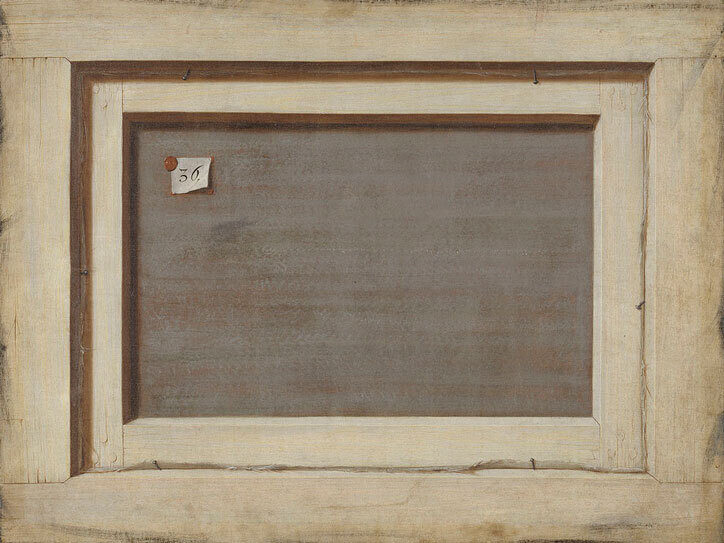
Cornelis Norbertus Gijsbrechts, The Reverse of a Framed Painting, 1670. Public Domain
the musty silence of his childhood bred in Joseph Jaikins a susceptibility to the propaganda of solitude. He had been orphaned horribly and early and reared by a decent elderly aunt. His restlessness was quiet, and his school years resigned him to frustration. At the age of eighteen, he was courteous but shy, and dutiful without ambition.
He was surprised to discover a cautious liking for the first job he took after graduating. He applied to a small but reputable firm manufacturing artist pigments. During his initial interviews and tests, Joseph was found unusually able to discriminate fine gradations of color. He was placed, as an apprentice, in the bright clean room in which two master color mixers worked over small pots of the most intense pigments. In this room Joseph explored his own capacity for sustained pleasure.
He rented an attic room and returned to his aunt’s house only on Sunday afternoons. His quiet childhood had accustomed him to small excitements, and perhaps he was physically inclined to interior intensity with little outward display. Whatever the cause, Joseph’s youthful life took on a staid and contented regularity. He breakfasted on coffee in his room. He ate cheese and fruit at his workbench for lunch. He stopped at the same restaurant every evening during his walk.
Joseph loved the city. He spent every afternoon strolling, hands in pockets, with no other aim than the pleasure he took in the angle of light on the buildings and the multifarious parade of human activity. He would drink coffee in a café or look in on a friend. He seldom returned to his room before dark.
Their understanding of each other had gone beyond friendship or respect through simple habit. It was an almost organic unity.
Only one thing rippled his pleasure. His two masters had worked together in the same room for many years. Their understanding of each other had gone beyond friendship or respect through simple habit. It was an almost organic unity. They rarely needed to speak to communicate. Their language had become so truncated by their specialization that what passed between them could scarcely be recognized as language by an outsider. They were kind men and made efforts to include their shy and apt apprentice, but his sensitivity was too acute to ignore their community of spirit. Sometimes during lunch at the workbench, when the raised eyebrow of one man caused laughter in the other, Joseph could barely restrain the convulsion of self-pity that his exclusion brought him.
On Sunday excursions to his aunt’s house in the suburbs, Joseph helped her with chores and the heavy work of the garden. He would spend an hour or two with a shovel and wheelbarrow, or washing windows, and then join the old lady for a lunch of the same cakes and cookies that she had always baked for him.
One Sunday, he was helping his aunt clean the attic of the house. The space was crowded and stuffy with the furniture of family members who had died or gone off on such journeys as those that never seem to end. Among the trunks and lamps and photograph albums, Joseph found a large canvas, perfectly primed, and stretched on an excellent wood frame. His aunt had no memory of how it had come to be in her attic. She thought it might be a relic of her dead brother’s dead wife, who had been known to harbor bohemian fancies.
His aunt was willing to consign the canvas to the trash, but Joseph disliked the idea of it rotting in the wet and being stained by garbage. He carried it back to his room and set it on the small table next to his window. It conveniently covered several holes in the wallpaper.
Over the next year, Joseph made such progress in his work that his masters occasionally invited him to their homes for supper. The youngest daughter of one took a liking to Joseph. She was a warm and clever girl who made him laugh and play Monopoly every Saturday.
That winter, a new idea crept into Joseph’s thoughts. It troubled him for weeks before he brought several small pots of paint home from the factory and set them on the table in front of the blank canvas. The next day, he brought back a selection of brushes. A week later, he came home from work and began to spread paint on the canvas. For days, he painted every afternoon, putting off his walk until the light failed.
Joseph himself thought it was a strange thing to do. It seemed presumptuous and, in some way he could not quite name, extremely risky. A queer vibration took over his chest, a continuous wave that traveled from his breastbone to his spine and back. Occasionally, he could feel it expanding to fill him from armpit to armpit. The excitement frightened him at first. He imagined it was a sensation that would come to him when he was dying.
When the canvas was covered, Joseph was disgusted by what he had done. His painting was stupid and bad. He stared into the river for hours, wondering why he could not erase his failure by drowning himself. He was silent at work. After several days, he scraped the surface of the canvas and primed it with white. When the primer was dry, he began again. He worked slowly, carefully, but the result horrified him. He primed the canvas before work the next morning.
A light fog lay over his mind. Everything he saw was muted and gray. He abandoned his half-finished painting.
His third approach to the canvas was a deliberate siege. It took weeks to complete. He was unusually quiet during visits to his master’s daughter. He played Monopoly in spurts of attention and laughed nervously when she told him he was bankrupt. Several times he came close to blurting out an account of his preoccupation, but he always stopped himself. He looked at her puzzled smile but was conscious of only the odd quiver that, by then, had established itself permanently in his lungs and throat.
The finished painting was wrong but tantalizing. He stared at it in confusion for two whole afternoons. He decided that there was an area the size of his hand in the upper left quadrant that actually pleased him. He whistled as he scraped and primed the canvas.
He spent two months on the new approach, and when the painting was finished, he found it so depressing that he went to a tavern and drank until they threw him into the street. He walked around the same block for hours, crying softly, wondering about his parents’ deaths and the murky light at the bottom of the river. He was sick for days and turned the canvas to face the wall.
He ignored the canvas for weeks, telling himself he had given it up. He visited his master’s daughter frequently, told cynical jokes at work, and played checkers with anyone at all in the café where he took supper. His chest was heavy and still.
Caught by a spring rain during one of his walks, he took shelter in a bookstore displaying dozens of volumes of color reproductions. He looked through them reluctantly at first and then became absorbed. When the rain stopped, he returned to his room and primed the canvas while deliberately contriving not to look at the previous surface.
He began a hesitant exploration, a series of attempts that, though they always ended in the priming of the surface, gave him enough ground to persuade himself he was learning, however slow and piecemeal the process. He recovered his steadiness of manner. The vibration in his breathing apparatus became a constant. He was at ease with his companions in the factory.
His old aunt died as she had done everything else, discreetly and amiably. He disposed of her possessions methodically, keeping a half-conscious watch for another canvas that might have been forgotten in the clutter of her life, but none appeared.
He had noticed a slight change in the manner of his master’s daughter but did not know how to interpret it. He spent Christmas Day with the master’s family and met, at dinner, a young man who worked in the same office as the daughter. That evening, with the company assembled in front of the lighted tree, the master proudly announced the engagement of his daughter to the young man.
Joseph felt the news rather than heard it. He was struck with the sensation of a balloon being inflated inside him. The chill hollow surprised him. After all, he asked himself, what did you expect? A light fog lay over his mind. Everything he saw was muted and gray. He abandoned his half-finished painting. The layer of sadness in his life surprised him. He had not understood that such a thing could affect him at all.
His melancholy was most acute when he was actually lying on his bed staring at the half-finished canvas. It came to him at last that he had always fantasized a moment when the canvas would be right, when he would be able to affix an image to its surface that was worthy of its perfect proportions and fine quality. What he had always intended to do when that happened was to take the canvas to his master’s house and show it to the girl. He could still do that, he told himself. Why wouldn’t it be the same? Had he actually believed that she would treat this accomplishment with the same reverence he did? That she would recognize the gravity of his effort and judge him worthy of her love? Did he think she would marry him on the basis of one decent picture? His own idiocy astounded him. He went steadily to work at the factory and took long walks that brought him home only after the light was gone.
Spring came, and he went to the wedding. Something about the light beading the bride’s veil and seeping across her cheek pierced him with ecstasy. The little fright of energy swelled until his skull surged with the bang of an incoming tide. He went directly home, hung up his rented dress suit, and primed the canvas.
joseph jaikins, master color mixer, had worked in the same room at the pigment factory for forty-six years on the morning that his landlady found his coffee tray untouched outside his door and looked in to find him dead on his bed.
His apprentices were solemn at the funeral. He had been a kind master and a good teacher. The other master mixer had been hired as an apprentice only a few years after Jaikins himself, and the two had come to understand each other so simply and completely that, in the context of their work, language was almost unnecessary. Jaikins had been a gentle uncle to his partner’s children, and though he bequeathed them his small savings, the family felt a genuine loss at his passing.
Jaikins had always lived simply, occupying the same attic room for many years. His few friends understood that his accommodations were too restricted for entertaining and took it for granted that they should always meet him at a restaurant or in their own homes.
They had no inkling that Jaikins had ever painted.
When the landlady admitted Jaikins’s partner to dispose of the late master’s furnishings, it was the first time he had ever entered his friend’s room. There was little to see. Very few possessions had attracted Jaikins in his lifetime. But there was one strange item. On a small table by the window, a collection of the firm’s best pigments was arranged with a number of scrupulously clean brushes. And, on a crude homemade easel, there rested a large and very curious canvas, its surface turned to the light. It was stretched on fine hardwood in an old-fashioned style, and, seemingly due to many hundreds of coats of paint, its surface was built up evenly until the whole canvas was nearly fifteen inches thick, and enormously heavy. Neither the landlady nor Jaikins’s partner knew what to make of it. They had no inkling that Jaikins had ever painted.
A few old notebooks contained the sparsely kept journal of the dead man. These offered the only clues to the meaning of the strange canvas. Not long before his death, Jaikins had written:
It has so much promise, it contains so infinite a possibility, its nearness to perfect is a constant pull on me. Its proportions and quality lay a profound obligation upon me. Every day I am reminded of the absurd propriety of a single canvas occupying a man’s whole life.
It was obvious that Jaikins’s last act had been devoted to the canvas, for when they found him, dead in his sleep, the coat of white primer that covered the surface of the canvas was still wet.
Katherine Dunn (1945–2016) was an American novelist, poet, and journalist. Her books include Geek Love and Truck. A posthumous collection of short stories, Near Flesh, from which the previously unpublished “Process” is drawn, will be released in October.
Support Our Writers
A sustaining subscription provides vital, ongoing support for The Yale Review and the writers we publish—and includes new holiday merch.