The artist B was married three times, two of them to the same man, though on the latter occasion his right leg was missing. In the years of their separation an accident had occurred that required the leg to be amputated. For social events he used a prosthetic limb that was awkward and uncomfortable to wear. It was at one of these that their second meeting, after fifteen years of absence, had taken place.
In this second marriage they were now approaching middle age. Their bodies bore witness to different histories, most strikingly in the case of the husband’s missing leg. B had known this leg intimately in their first marriage. It was as though they had paid with this leg for the mistakes of the past. It was not generally known why B had left her husband the first time. They were married very young. They were penniless artists full of idealism and vigor. They traveled to the South where they could live cheaply, and they worked there side by side. There was a photograph of them sitting drawing in the sun amid boulders on a shore, wearing identical workmen’s overalls. They were fresh-faced and slender and smiling. Then B’s husband received the offer of a space in a building of artists’ studios and he returned to the city for a while. The studio was cold and filthy, scarcely habitable. When B went to visit him she found that he was living there day and night. He had been working maniacally, works that B instantly identified as being of a new importance. They had already drawn the notice of the other artists in the building. There was no room for B in the studio. She returned to the South and stayed in a hotel with her mother. Her husband wrote to her frequently, asking when she was going to come back. He described the explosion of new art that was taking place in the city, a phenomenon in which his own work was playing an increasingly recognized part. B took longer and longer to answer these letters. In her replies she talked about the interesting friends she had made there in the hotel. They had various plans, she said, that prevented her from coming back to the city just now. Finally she wrote to him and said that she was not going to come back. Eventually she returned with her mother to her native country. Later she married a prosperous businessman who at first liked her being an artist and then didn’t like it.
The house was full of angles and light, and there was a separate studio for each of them next to the water.
In their second marriage B and her husband had more money and ease than the first time. B’s husband had achieved recognition and fame for his work while B had not. They bought some land in the countryside beside a great river and built a house there. The house was full of angles and light, and there was a separate studio for each of them next to the water. During their years apart, B had become interested in the concept of the golden ratio: the mystical proportion, observed in the harmony of nature, that seemed both to encompass and limit the place of human perception in the world. B strove to lay her hand on that limit and find a perception that was more akin to how nature displayed and saw itself. The golden ratio was expressed mathematically as a plus b is to a as a is to b. A visitor to the house by the river once humorously observed that B’s husband’s studio was larger than B’s own by exactly that proportion.
B had understood when she was still quite young that she needed to make her life impersonal but she had not succeeded in doing this. A man’s life was automatically impersonal because of his combination of entitlement and selfishness. A woman had to strain for impersonality through the arduous mechanism of freeing herself from successive forms of oppression, a freedom that was more like a kind of exile.
B and her husband acquired two large dogs who took the place of their unborn—and, in B’s case, unwished-for—children. There had been a dog in their first marriage too, who had had to be given to a neighbor when their small household broke apart. The new dogs were of the same breed as that long-ago dog, for this was now a time in which illusion had to be permitted to play some part in the construction of reality.
Throughout the many years of this second marriage, both B and her husband liked to tell the story of their re-encounter, which had taken place at an art gallery in the city where a party was being held to celebrate the opening of a new show. They told the story not just to friends but to interviewers, to the journalists and art critics and filmmakers who came frequently—though less and less, as the years went by—to the house. In the story they were both among the crowds in the noisy, frenzied atmosphere of the party when their eyes unexpectedly met across the room, which was so packed that for a moment all they could do was stare at each other through the mill of people. Then a great hush fell, as though everyone knew at once that something significant was happening. And suddenly—B’s husband would wave his arms theatrically in his wheelchair to demonstrate—they all stood back to make a path for us to reach one another. It was like the parting of the Red Sea!
In fact, as was revealed by their boxes of correspondence after their respective deaths, both of them had known perfectly well that the other would be there.
we visited the house beside the river. The director was away: it was the assistant director who opened the door. The director had achieved sudden success with other projects, the assistant director explained, and was more or less constantly on tour, honoring the avalanche of media and festival invitations that had come his way. He was never here these days, and was too busy even to respond to requests to visit the house and collection, with the result that very few people now came, the house being open to the public for only a limited number of weeks each year. It required persistence, such as our own, to gain entry.
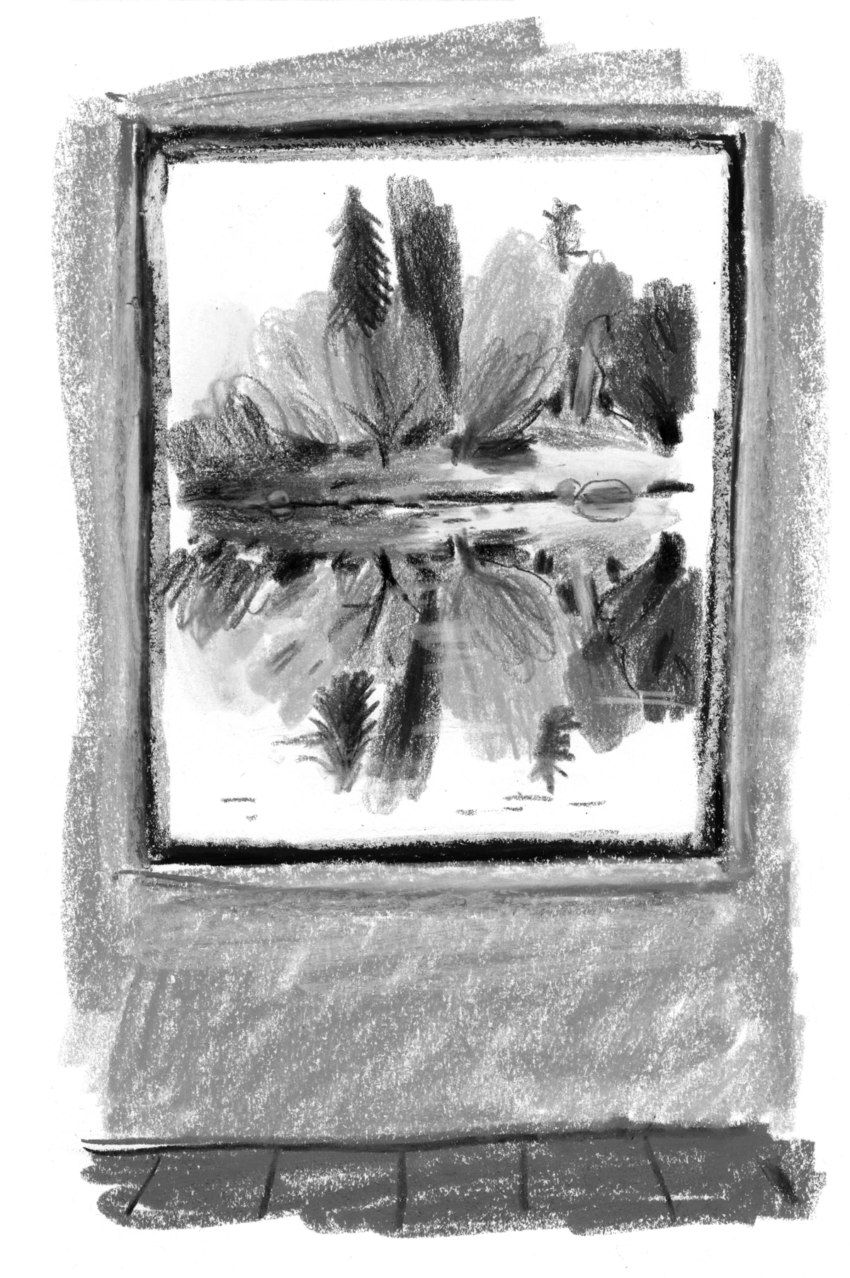
The house stood in a thickly forested river valley that wound for miles in either direction, primevally empty. It had been built on a slope beside the broad river, facing the corresponding bank on the other side of the water. The great green face of the far bank with its clouds of shaggy trees, was perfectly mirrored upside down in the immense, glassy surface. The house had been designed, the assistant director said, so that all its windows looked out at this singular view, whose colors and reflections were always changing. The river was so large that it appeared to stand still, and its capacity to generate light was such that the rooms were always filled with an exceptional radiance. There was something almost inhuman, the assistant director admitted, about the scale and silence of this landscape and its quasi-mystical interaction with itself. Once she had been working here late, alone, and had looked up to see the great eye of the full moon glaring up at her from the motionless water in the darkness. In winter there was snow, and in summer there could be storms of unbelievable drama and grandeur, when the heat built up along the valley until it burst into mad explosions of thunder and lightning. One could watch these spectacles in comfort through the house’s large windows. On the level below, following the incline of the riverbank, there was a large terrace, with steps leading down to the two studios that stood side by side on the water’s edge.
B’s husband had designed the house entirely himself down to the last door handle, the assistant director explained, and had closely supervised its construction. Its interlocking rectangles unfolded and concealed one another: from the top of the riverbank it could barely be seen and one had little idea of the scale of what was there. The director’s theory was that B’s husband had wanted to re-create the seclusion of their early years together, alone in nature. His disability, the assistant said, had obviously presented some practical obstacles to that vision, and you might ask, for instance, why he chose a sloping site rather than somewhere flat and easily accessible to build on. Each day he had to descend the three levels from the living area of the house to his studio and return back afterward the same way, and since he had designed this situation himself he couldn’t really complain about it. I suppose he put aesthetics ahead of practicality, she said. In a way it might have been better if he’d been honest, but I suppose in those days people weren’t honest about themselves.
It seemed to beckon toward some oblivion, stranger and more mysterious than that of the sea.
Inside, the light-filled rooms were silent and still. The great windows along one wall showed the river, emanating radiance. It reached out to all sides on the other side of the glass, vast and vaguely undulating, like a field of light. It seemed to beckon toward some oblivion, stranger and more mysterious than that of the sea. On the far side the densely wooded valley was motionless, hanging upside down in the water. The central room was the living room, which occupied the whole width of the building. Its furniture was modern and spare and had been, the assistant director said, the artists’ own. The living room has remained more or less exactly as it was, she said, except for the artworks, which were sold to raise money for the foundation. Like a lot of artists, the couple had bought work by their friends and contemporaries, whose paintings now hung in museums around the world. The sums realized had been considerable and comfortably allowed the foundation to do its work. But it was a pity in a way, the assistant director said, because without the paintings the room seemed rather cold, even lonely, staring out at the oblivion of the river, whereas in reality B and her husband had been famously lively and social. This room, with its empty armchairs and sofas grouped around a large low table, had been where they entertained. It had its own fully stocked bar, concealed behind sliding doors along the far wall, because B and her husband and their friends were great drinkers, the assistant director said, as people used to be in those days. In their latter years they had an employee living with them here, and it was this employee, now a very elderly woman, who had supplied the director with many details about the artists’ daily lives. She had been devoted to the couple, and though her primary role had been to help them in their studios and with the administrative aspects of their work, she had over time become their companion. And of course, the assistant director said, their witness.
B and her husband had not had children but they’d had two dogs, whose photographs the assistant director had seen. They were enormous animals, she said, shaggy-haired and quite intimidating, like a pair of wolves. They went everywhere with B, including to her studio, and in the evenings, they sat or lay up here, among the guests. For some reason, the assistant director said, I can sense their ghosts in this place much more clearly than I can the ghosts of B and her husband, even though the humans left so much evidence of themselves and the dogs barely any. I sometimes even dream about them, and these dreams are actually quite terrifying, because I always feel that the dogs are about to breach the boundary of the dream and that I will have no further protection from them. I imagine them leaping across this boundary toward me and pinning me down and ripping out my throat.
The assistant director was a fairly young woman, sturdy and open-faced, with small black eyes that gleamed like dark pebbles.
My fear of these dogs, she said, which is ridiculous because they aren’t even alive anymore, must be a fear of something else, but I can’t explain what it might be. It’s as if their ghosts are more real than the animals were, just like the reflection of the trees in the river sometimes seems more real to me than the trees themselves.
shortly after b was born, her mother had put the baby in a basket and boarded a train with it to her native town, never to return. Evidently she had seen the situation for what it was: the man, the house, the baby that would trap her there. When she was older B once went back to that place and visited her father, whom she had never met. He had long since remarried: B called on them at their house. The totality of her mother’s action in removing B from her father was evident in their mutual lack of emotion. Long ago she and this stranger had been violently separated. To B it was unclear why; he did not seem to be a bad man. Her mother’s action stood alone in its violence.
B’s mother left the baby in the basket with her sisters and traveled on alone to another city a long way away to pursue a course of study at a training institute there. She had neither the means nor the time to come back for visits. It was a medical training and thus lengthy. After a period the sisters confided the baby to their brother, who had a wife and children of his own. The basket, which was seen as belonging to B, was placed in her room, where it remained for the several years she stayed with the brother and his wife. They farmed a terrain on the vast blackened plains outside town, not far from the sea. In winter the whole landscape froze for months and darkness fell in the early afternoon. The great boulders along the coast bulged in their straitjacket of snow and ice. At night the thick sheets of ice groaned in the darkness.
The family were cruel to B with the obsessive cruelty of persecution. The presence of an outsider changed the way they saw themselves. They saw the harshness and limitation of their own lives, while also discovering a unique superiority in themselves: their superiority to the outsider. The child was both the center of their focus and the subject of their unkindness and neglect. The mother especially discovered that she could love her own children much better if she hated B. The father’s sullen anger was more evenly distributed. He grudgingly allowed B to accompany him around the farm, which became her means of escaping the mother and children. She rode in front of him on his horse through the desolate winter landscape and for years these slow and silent journeys were her sole experience of intimacy. She looked out at the frozen white boulders, the sculptural masses of ice shaped by winds, the infinite stones that peopled the fields and shoreline with their mute forms. She saw in these forms the soul and story of matter. She saw in their random placement the same universal hand that had placed her here, whether carelessly or with intention. The mother would give her bread to eat whereas the other children were served proper food. They were allowed to treat her as a toy, and pulled her hair so much that for the rest of her life she wore it cropped short like a man’s. When she was ill the door to her room would sometimes open a crack and the mother would look silently in and then go away again. B told these stories later, as an adult. By telling them she squandered her chance of escaping them. She could have pitied these people their sad entrapment in their story of life but instead she remained trapped there with them. In the stories, she idealized her uncle.
She did not appear to know that inside B were frozen boulders and silent heaps of stones and dark wastes of snow and ice.
When B was twelve her mother returned and took her away. She was now qualified to practice a profession and she took B back with her to live in the city. She expected from this point to lead a normal existence with her daughter. She did not appear to know that inside B were frozen boulders and silent heaps of stones and dark wastes of snow and ice. In the city B began to suffer from incapacitating bouts of illness that rendered her bed-bound for days or sometimes weeks. Her body was wracked by pain and vomiting and she would lose weight alarmingly. B’s mother had no choice but to remain continually at B’s bedside, despite the professional pressures that weighed on her. She did not like having to stay at the bedside. She wanted to carry on, to be free. She had worked hard to free herself and her daughter from the future that had been prepared for them. She had expected them now to share that freedom, together.
This situation continued for many years: the future B’s mother had worked for never arrived. It was B’s revenge, this illness that couldn’t be fixed or finished, that spoiled everything, that engendered frustration and inactivity rather than industry and purpose. With a bitter kind of humor, B’s mother came to accept it. She had once hoped that B would follow a medical training like her own, but once the child’s artistic talent had become evident she had immediately abandoned those ambitions and sent B to the city’s best art college. Yet she went unrecognized and unthanked, and this ingratitude puzzled more than disappointed her. It had been so clear to her that the stony path of freedom led in one direction only, away from men and marriage, away from domesticity, up and up to a cold and indispensable autonomy that she had imagined one day handing to her female child intact. There had been no alternative—no alternative whatsoever, other than death—to the exigencies this path had demanded. Yet she was slowly becoming aware that between herself and her daughter lay a dark space of counter-perspective. She had not imagined this breach could lie between a mother and her child. She sensed that something was being embroidered there, in that gap, not only a version of events in which she herself had been cast as the villain, but a secret sort of loyalty to everything she had so painstakingly challenged and surmounted. This horrible notion was worse than unfair—she saw in it the refabrication of injustice itself.
B’s mother did not want B to marry her husband but she married him anyway, not once but twice. She relinquished the violent freedom that had been her mother’s bequest to her. She did not know she was relinquishing it. Rather, she thought she had found it in him—freedom. He did not appear to her as a man any more than she felt herself to be a woman. She believed they were equals. But to B’s mother he was a man—or worse, a boy. To become a man he would have to swallow the body of her daughter. He would have to experience needs and their satisfaction, over and over, until he had doubled in size and she had shrunk. It took B several years to discover this herself, this interminable reality her mother vaguely represented, doggedly extinguishing fantasy. Yet fantasy kept returning, fragile and hopeful, like the first flowers after the crush of winter. For B’s husband, fantasy and reality were indistinguishable: he worked to make them one, sickened and complained when they grew distant from one another. This, in fact, was the difference B had discovered between herself and her husband—not that he was a man and she was a woman but that she couldn’t make her fantasies real. She left him and went back out into the cold of the world.
after the book he wrote about B, the assistant director told us, the director had written another book about another artist. This second book had become an unimagined success—though she suspected, in fact, that the director had imagined it—and was now a worldwide best seller. His biography of B had not sparked the same kind of interest. The director had been very disappointed by the failure of his book about B: every day women artists from the past were being rescued from oblivion and accorded their true worth, like diamonds dug out of the darkness of the earth, and he had hoped for more. He believed that in B he had found the biggest diamond of them all, hidden under the great weight of her husband, where no one else had thought to look. His frustration and disappointment, the assistant director said, were quite funny in a way. It was as if someone had made him walk around in the body of a woman for a while: he couldn’t understand why things weren’t working out the way they usually did. His second book, she said, was about a man, a very well-known man, so he had discovered that the market for gold was as reliable as ever, while the selling of diamonds required more patience.
In fact, he had not been wrong about B: her reputation was growing steadily, as he had predicted it would. The recent retrospective, which was traveling the major capital cities, was proof that B was now receiving significant recognition, a recognition she never got in her lifetime. The director had actually played a crucial role in this ascent—the problem was that he had received no credit for it. In fact, it might almost be said that he increasingly resented this unrecognized labor of his, the work he had done whose result was to make someone else shine. But how, the assistant director said, could it have been otherwise?
She led us out of the living room and down a broad corridor with a closed door at the end. Usually the bedroom is excluded from the tour of the house, she said, because the director himself now sleeps in it. But since he isn’t here, and won’t be here for some time, I think we can take a quick look. I admit, she said, that I sometimes come in here myself, now that he has been away for so long, but at the beginning I wouldn’t have dared. It seemed so strange to me that he would choose to sleep in their bedroom, and not only choose but insist, because it certainly wasn’t what the trustees of the foundation had envisaged. There are other bedrooms on the floor below that he could have used, or he could even have found somewhere to live in town, as I do. It’s a very nice town, she said, with this same river flowing through it, and quite a few interesting people live there, but the director was clear that he needed to live in the house itself. Secretly, I was frightened for him, because as I say, I myself wouldn’t have dared to sleep in their room. I would have worried that I would be cursed in some way, but what I have learned is that people like the director don’t see the world in terms of curses. No, they see a situation in terms of what advantage they can get from it, and the truth is that there is usually no substantial reason to refuse them, as the trustees themselves discovered. I do see, she said, that my fear the director would be cursed was probably a secret desire for him to be cursed and brought to justice, but in fact, the opposite has happened. He has demonstrated, in fact, the power and permanence of injustice, first by the relative failure of his book about B and then by the tremendous success of his other projects. The failure became B’s own failure, not his, which he proved by showing how successful he was without her.
To know something without being able to learn from it is the gift and the curse of people like them.
The furniture in this room, she said, opening the door and standing back to let us pass, is not the original furniture, unlike in the other rooms. The director found the bed too small and so he had it replaced. I did wonder whether even he felt it was going too far to sleep in their bed, but in fact I think that if their bed had been magnificent he would happily have taken it. As it was, it was quite an ordinary bed, admittedly a little on the small side. I think the beds people choose for themselves are quite revealing, she said, and as you can see the director chose a very large bed, close to the floor and almost Japanese in style. The painted screen in the corner, also Japanese, is one of the most valuable objects in the house and should in fact be standing in the living room, where it always used to. You might recognize the sculpted abstract forms on the low plinth beneath the window as B’s, and hanging above the bed is one of her most important and mysterious works, in which she tries to grasp the form of the universe itself. The window here is very large in proportion to the room, and the presence of the river is such that lying in bed you almost feel you are adrift on it. The Japanese elements are actually very fitting, she said, as the scene has an atmosphere you might find in an early Japanese painting. It is so lovely that you can almost forget what a gross misrepresentation it is of the intimate world of B and her husband, whose bodies were so maimed by the violence of their inner and outer lives and whose bed was so humble and unassuming, and who, what’s more, would never have displayed their own work in their bedroom, as though it were merely decoration. It looks like a bedroom in a magazine or in a luxury hotel, something that fills you with envy and desire, and it is this insinuation of falseness, this interference in the relationship between seeming and reality, that in my eyes constitutes a betrayal of these artists and everything they stood for.
Outside, something was stirring on the milk-white expanse of the river. The great surface seemed to tremble. Then it was as though a black wing suddenly swept across it, so large and fast and dark that it had the appearance of some imminent terror rushing up toward the windows of the house. The wind often rushed up the valley in this unexpected way, the assistant director explained, marking the surface of the water with its passage. It’s as though the river has a god, she said, that is continually manifesting itself in the forms of nature, where there is no one to see it. The town has no such god, and nor do most places where people are, but the god has stayed here, perhaps because B and her husband invoked it and made libations to it through the work that they did. They looked, and what they saw was larger than themselves and more mysterious, so their seeing was both a form of humility and of election. I often think of how painful it must be to see in this way, with the truth so continually apparent yet refusing to be learned from. These artists didn’t learn from it, she said, they didn’t improve their personalities or their bodies by what they knew. To know something without being able to learn from it is the gift and the curse of people like them.
The painting of the universe is the one I look at most often, she said, even though its position above the bed makes it difficult to see it clearly. It is somehow diminished by hanging above the head of the person lying there, as though it were merely the background for someone else’s view of the world. When I first came here, I didn’t know anything about the painting or what it was meant to show. The big oval shape could have been a face with no features or a giant pebble or a strange cloud floating against the dark background, but its bright-gold color is more like the sun. Apparently B learned the technique of gold leafing during the war, she said, when she was living in a building crowded with many other people back in her native city. One of these people was an old gentleman who had been an expert restorer of religious paintings, and he taught her how to do it. I like the thought of this skill surviving all that darkness and suffering. The gold shape reminds me in fact of a container, a bowl or a basket that the rich material has elevated into something eternal. When I found out more about B’s life and especially her childhood, I noticed the detail of the basket that had transported her as a baby and that had remained in her bedroom after her mother had abandoned her. I wondered if this basket was in fact the image behind the form of the universe. I mentioned my idea to the director, and he was rather dismissive of it, but he went on to use it in his book when he wrote about the universe painting.
B’s work is ultimately impersonal, she said, it is lofty and almost cold, but its basis is transcendence, and so the self is still visible there, even as it is being left behind. Her paintings are more mysterious even than abstraction, because they belong to this world and contain all its grandeur and indifference. They contain the existence of the self and the death of the self. Their foundation is in looking, yet they show things that would be hard to see. Her last works, for example, are a series of enormous canvases the size of walls that show different views of a mountain. This mountain is completely geometric, like a vast mathematical shape. It is monolithic and unnatural, without texture or light, except for an eerie white ray that sometimes falls on it. Otherwise it is composed of darkness, a darkness of rocklike solidity rearing up against a deep-blue background. Even if this mountain existed, she said, one would have to be standing high up in its foothills to see it in this way. Yet we know it, she said, we recognize it, as though the end point of matter is also the end point of our minds, as though the reality of ourselves is philosophically bound to its reality, so that we are humbled by matter at the same instant that we are elevated by it.
There are no mountains here, she said, looking out of the window. There is just the river and the valley. I sometimes wonder whether that mountain actually exists, she said, and whether I should leave here and go look for it myself.
after the warB married the businessman, which satisfied her mother at last. He was adept at making money, even in the ruin that was the world. They lived in a large bourgeois apartment in a provincial town. Her desire to paint was an irritant in this life of comfort, continually threatening disorder. In the end he asked her to stop, which revealed the absence in her of any desire to have a child, which in turn revealed their mutual dislike. She often traveled alone to the far North, to the landscape of her childhood. She stayed in a hut and lived in total solitude for several weeks at a time. In these periods she studied the pale rounded forms of the coastal stones that were infinitely multiplied all along the shoreline. She studied the horizon and its governing of the masses of land and sea. She studied the mineral content of the earth and the extremes of darkness and light that moved across it. The slow, silent journeys on horseback with her uncle returned to her across the cluttered perspective of years, and she began to understand that this was her inheritance. The return of her physical body to this place after all its sufferings was a strange homecoming. Around this time, she learned what had happened to her first husband, the loss of his leg and the pain he had endured. She knew how frightened he had always been of pain.
When it became possible, she took a passenger boat farther north still, up to the very top of the landmass. It was a trip of several days, uncomfortable and cold, trapping her among bizarre tourists, but she saw things of great terror and beauty, there at the end of the world, things that resolved certain mysteries for her, so that her vision began to function as a total system. She wrote to her first husband about this system and the insights she was gathering. She wrote to him about the mathematical basis of composition and perception that she believed her work would now issue from. He was living in the city again, at the heart of the new painting that was rising from the ashes of war. He asked her to come there and be a part of it; he implored her to come to the heart, the center, after all her years of lonely exile. She understood that the resumption of their relationship was for him part of this vision. She took her time to come. She spent some months in another country, visiting friends. But finally she was there, at the party in the gallery, where he stood waiting on his artificial leg on the far side of the room.
The paintings were full of black, black thrusts, like the death thrusts of a bullfighter or the synchronized flight of dark birds.
Her husband was now at the peak of his importance and she lived in his reflected glory. They had a large house in the city. Her husband’s studio occupied the whole top floor. He was always receiving visitors there, painters and critics and collectors from everywhere. His work was full of violent anger and frenetic motion, as though he were scribbling on the face of the world. The paintings were full of black, black thrusts, like the death thrusts of a bullfighter or the synchronized flight of dark birds. They emanated a tension that was held at breaking point yet did not break. They were exhausting and beautiful, and there were so many of them, so many angry ejaculations. All day and every day he worked. What would become of the countless products of his inexhaustible yet impotent rage?
They built the house by the river and finally she had a space entirely to herself. The dogs followed her down there each morning and arranged themselves at her feet. Sometimes they would suddenly prick up their ears and leap up, pacing rapidly and silently to the large windows. Often she could not see what it was they had seen: it was as if they had sensed an invisible presence outside. She herself believed in and corresponded with this presence, which represented the immaterial portion of her own life, unexpressed and virtually unknown to her. She worked steadily to redress this imbalance. She was two distinct beings: one living and conscious, the other without identity, bypassing consciousness in its search for material substance. The first being was the fruit of experience, some of it voluntary but much of it imposed—by history and geography, by time, most of all by other people. It was increasingly discarded by the second being in its search for the form of the world. Yet she had to continue her occupation of the first being—to speak in its voice, to enact its character, and carry around its memories and take care of its responsibilities. It was like a sack of rubble she had to shoulder each morning on waking and which she set down at the door to her studio.
At lunchtime she and her husband drove the short distance to the town, where there was an excellent restaurant. Her husband liked to sit out on the terrace of this restaurant, where he was often recognized and greeted. They were happy sitting together in the sun. They talked about their work and the work of other artists, about philosophy and literature, about the people they knew. This second marriage, which had started in their late forties, lasted the thirty years until their deaths. The present and future had met and mingled like two great rivers, creating a static body of water. At a certain point a companion was introduced into this static mass. Her role was to assist them with practical things—the management of the house and studio, of materials and exhibitions and archives—but more essentially to bear the brunt of their natures and to spare B the little femininity that remained to her. The companion was like an additional wife to B’s husband in the years of his slowly declining importance: she absorbed his bitterness and rage, the injustice of his disability, his torment at the younger artists growing up vigorously around him. Without necessarily meaning to, B’s husband would have devoured B’s inner world with these complaints. Insatiably and thoughtlessly he would have consumed her, since she lacked the barrier of ego to stop him. The companion did not mind being devoured: she simply regenerated herself overnight. She believed wholeheartedly in his genius, as it was her job to do.
Freedom came coldly and belatedly to B. She was two selves, the one attached to the other like a deadweight. The first self was suddenly exhausted by all it had experienced and suffered. It was this self, summed up in the body, that had been capable of being placed in its entirety in a basket and handed over to strangers. How could she bear her body and her own continuing imprisonment in it? She remembered vomiting one evening in disgust at the food she had been made to eat at her uncle’s house and being made to eat it again. She remembered her years of sickness, in boardinghouses with her mother. Her history of illness had left her with many ailments she tended to privately. No one knew or could imagine the exact nature of her intimate life with her husband. Her professional failure did not seem to be regarded as a failure but as a matter of course. Her mother died and seemed to pass out into the substance of the world, to be diffused everywhere. Her life, the life of the first self, was as though breaking up, becoming inchoate and intermittent.
One day, she saw that all along her husband had had a goal, which had required a force of domination to attain. Or perhaps domination itself was indistinguishable from that goal, the gaining and maintaining of power being a characteristic also of his approach to a created work. This need for power did not preclude erudition, a love of beauty, a defense of the larger cultural sphere; it was not even menaced by other artists of his generation, so long as they didn’t attack his principles, nor by those younger ones who respected and looked up to him. In fact, a cohort was essential to the manifestation of power: to be alone would have made him an outsider. There were certain artists whom he praised extravagantly, many of them safely dead, some of them alive and sharing his territory. She noticed that he was never neutral about other artists, he declared them either friend or foe, and increasingly she came to see something primitive in these behaviors that might have characterized those of the first human societies, where men fought or befriended one another in accordance with their interests. This force of domination was what permitted men to survive on the earth, and its penetration of the expressive arts ought not to have surprised her. Yet it did surprise her, because she had made the mistake of assuming that an artist was neither male nor female, was not a primitive being with a flint in hand but rather someone elected by the soul of the world as its spokesman.
Diminutive and kindly and disabled as her husband was, his instinctive desire for power and centrality had held her in its wake. She could not rid herself of the tension of this situation other than by getting rid of the first and visible self. From then on she was locked in a battle: to trample on and free herself from her body and at the same time to survive ghostlike in its ruins as the pure operation of her expressive will.
the assistant director took us down to the terrace, a paved rectangle empty of ornament with a broad view of the river. Down below it a steep path could be seen, leading to the two studios that stood side by side next to the water. B did not paint this view, the assistant director said, or make any representation in the twenty years she lived here—not even the smallest sketch—of the river or the forest or the wider landscape of this region. I used to feel quite critical of her for that, she said, because in my head an artist’s first relationship is with reality. An artist should always be looking, noticing what is in front of them. But B’s paintings were of things that only she could see and only she could remember. It almost annoyed me, that a woman would choose this subjective route rather than fight for her share of reality. Then, a little while ago, I went on holiday for a few days with my friends to a Greek island. We arrived in the dark, she said, and so in the morning I went out to look at where we were. It was quite early, and the sun had just come up. I walked down a path toward the sea, and at a certain moment the view appeared in front of me, a startling wide view of the ocean, motionless and milky-colored in the morning light, with the mounded shapes of other islands or landmasses standing one behind the other in the distance until they vanished into the mist. In the middle of this view, seeming to be much closer to me, a great rocky shape rose out of the water. It was a long horizontal shape and strikingly sculptural, almost like a primitive figure lying on its side. The pink light fell on its contours and on its sharp facades and crevices, making geometric shapes that were somehow human in their brutality. Looking at this giant faceless figure sleeping on the water, she said, I suddenly understood B’s vision, and in fact the sight itself was like nothing more than one of B’s paintings. Later of course I found out that this enormous rock is a famous landmark and even has a name—the Sleeping Lady or something like that—but rather than disappoint me this fact seemed to confirm something prophetic and grand about B. I came to see during those days on the island that in fact it was the male painters who were subjective, with their obsessive depicting of everything they saw and felt—the women they slept with, the people they knew, the places they went, and the things they noticed there. Many artists had probably visited this island and painted this rock among the other things they painted, but what I understood that day was that B seemed to have known the rock was there without ever seeing it.
Nature has become more significant to me since I’ve been working here, she said. Spending all my days in this landscape, she said, the seasons have become more and more real to me, when in the life I lived before I barely noticed them. I have lived in places where there are no seasons to speak of because nature has been more or less extinguished and the landscape is entirely human, and I know it is perfectly possible to live and be happy in a human landscape. But here I have come to find the seasons more wrenching and giving, more powerful, than I could have imagined, so it has gradually become apparent to me that they—not we—are the central characters of life. Sometimes it occurs to me that I could have been a tree all along and known more than I do now, she said, but I have also discovered that it is difficult to sustain illusions about oneself while living in nature. The director, for instance, became increasingly unhappy here, because he could find nothing here that reflected his own importance. And in a different way I wonder whether B was exposed by living in this place to the essential violence of her origins, which she had tried her whole life to evade or else transform into something abstract and universal. Most of her important work was done in that studio, she said, leading us down some stone steps to join the path that led to the two white buildings beside the water, yet at the same time her living self deteriorated there in the most alarming ways.
The studio was a tall bright-white cube with large, high windows that looked not at the river but at the bank behind it. It is so still and luminous here, the assistant director said as we followed her in, so empty, almost like a chapel. There are many photographs of B in this place, she said, and so we know that even when it was in daily use, it was as clean and bright as it is now. There was none of the mess and disorder we associate with artists’ studios and with creativity itself, which we imagine cleanliness and order as seeking somehow to annihilate, as though it were the artist’s job to create order out of chaos and not the other way around. It was apparently B’s choice, she said, to face away from the river, perhaps for the northern light these windows give access to, but perhaps also so that she could see what she wanted to see. The great mountain that appeared in her last works, for example, could certainly not have been seen from anywhere else. Despite the fact that her work was generated by the forms of nature, at that point I believe she needed to surmount nature in order to grasp its philosophical truth, which lies in its inhumanity.
It turned out that it was easier for him to defend a fragrant martyr than a depressed and marginalized drunk.
You will have noticed that her studio was built very close to her husband’s, she said, right next door. This evidence of their mutual dependency can be seen as quite touching, she said, unless you consider that perhaps he wanted her there to be at his beck and call, or that she on her side may have hoped that some of the collectors and gallerists who came to his studio would call in at hers on the way. If they did, which is uncertain, the contrast could not have failed to overwhelm and indeed disturb them. I myself rarely go into his studio, she said, for reasons that will perhaps be immediately obvious to you. Even the director, she said, was frightened of coming here, though he tried very hard to hide it. Nonetheless he insisted that everything be left exactly as it was when the artist was alive, which in a way illustrates his combination of integrity and cunning, because the more the director was able to bring B into the light, the more this studio incriminated itself and told its indispensable part of the story.
She opened the door to the second studio and stood back to let us through, leaving the door open behind her. It was a high rectangular space, a third or so larger than B’s own, whose walls were so violently splattered from floor to ceiling with paint as to resemble a scene of recent carnage. The different colors exploded everywhere in senseless patterns and mingled in long dripping trails down the walls whose dark viscous centers had the appearance of blood. In certain places the paint had achieved a horrifying form and density, like that of giant bruises or wounds. In the center of the cavernous room stood a heavy metal wheelchair surrounded by a number of large scuffed metal canisters attached to rubber tubes. On the floor lay a broom-like contraption with several wide brushes attached to its head. B’s husband invented this system himself, the assistant director said, which fed paint under pressure from the canisters to the brushes, so that he could reach the canvases from his wheelchair. The pressure was such, however, that the paint hit not just the canvas but also sprayed the surrounding walls and floor and even the ceiling. Only the fact that the windows were protected with plastic sheeting stopped them from being covered too. It is like the den of a murderer, she said, or a madman, and though the sight of the wheelchair ought to inspire our sympathy, I find that contraption almost the worst thing of all, for the role it played in enabling this display of impotence. The many paintings B’s husband made here were in fact of a surprising terror and accuracy. I don’t deny his right to have made them, she said doubtfully, but when you see what they have left behind, it raises certain questions. I have visited the studios of many male artists, she said, and they are nearly always on one level or another the careful celebrations of masculine lusts and freedoms. They are statements of an ultimate entitlement, and what I see in this studio is the horrible inversion of that statement, where the violence and power and privilege of the male body is turned inside out and splattered all over the walls. There is an atmosphere of evil here, she said, which as I say even the director himself finds uncomfortable, and which B’s husband was perhaps not actually conscious of. When the director comes in here I sense he recognizes something about himself and his male nature that his conscious mind does everything to reject, because he wants his lusts and his appetites to remain in the positive framework of art, where they are most intensely celebrated. It is not even that this place reminds him of death, she said. What exists here is the proof of something rotten in the contract of life itself, which the art of men has always profited from and always concealed.
At a certain point in his research about B, the assistant director said, the director discovered some details about her personal conduct during the final decades of her life, most of them supplied by the couple’s companion, who had witnessed these behaviors personally. It was revealed that B had a chronic and profound addiction to alcohol, as well as to a number of drugs that she took in addition to the many medications she had been prescribed for her lifelong health difficulties. The director was very disappointed by these revelations, which contradicted the image he was constructing of B, as a valiant truth seeker struggling against the injustice of her female condition. The idea that she was consuming whole bottles of spirits in secret, that she was often found collapsed and unconscious in various hiding places, that in the end she had to be vigilantly watched for fear that she might wander into the river and drown, was deeply unacceptable to him. He had always vaunted B’s Nordic vigor and purity, her slenderness, her good taste and her self-control, her long-suffering patience, especially with the demands of her disabled husband that came at the end of all her other trials. He had been indignant on her behalf about the female injustice she had endured even in her marriage to a great artist, but it turned out that it was easier for him to defend a fragrant martyr than a depressed and marginalized drunk.
In the foundation’s archives were years’ worth of receipts from the restaurant in town where B and her husband had lunch nearly every day, and the director went back to scrutinize these receipts, which indeed testified to a generous daily consumption of alcohol. He had always assumed the consumer of these drinks was B’s husband, and his complacency had been not the least bit disturbed by this idea, since heavy drinking is part of the male artist’s legend. The freedom of the male artist includes his freedom to destroy himself, but this was not part of the director’s bargain with B. He was disappointed in her, as I say, and the biography suffered as a result, because he somehow had to get to the end of her life while managing these disclosures in one way or another. In the end he skimmed over them with euphemisms about the pain of her early life returning to devour her, and when he did mention her addictions it was only to marvel at how her slight form had withstood this chemical and toxic barrage at all. But his distaste and his eagerness to conclude his research were evident.
She didn’t need to abuse anything in order to create, though she herself had been so badly abused.
The assistant director led us out of the studio and carefully locked the door behind her, and we climbed back up to the terrace where the pale expanse of the river could be seen shimmering in the afternoon light. She looked stubbornly at this vista, her arms folded in front of her. B did collapse and die from alcohol consumption, she said, leaving her husband to live on for several years without her. The mountain paintings were more or less the last things she did, and it is evident in those paintings that she was walking toward death, deliberately and calmly. She did no real harm to anybody by choosing to die in this way: she had no children, and her husband was old by then and well cared for by the companion. But still I find this destruction of herself very sad, she said, not in the patronizing way of the director, but because in this forsaking of life, life itself comes out very badly. It mistreated her, though she was one of its most gifted spokesmen, and this mistreatment—which in fact is evident in all the arts, where people suffer more or less exactly the same discrimination as they do ordinarily—has made me question the value of art itself. What can its truth possibly be worth, if it is marred by the same injustices as the world it seeks to transcend? Yet the thing that keeps returning to me, she said, is the size of B’s canvases, which got bigger and bigger, until they were as big as the walls they hung on. There are photographs of her in front of these canvases, a woman dwarfed by her own creations. In his biography the director didn’t have much to say on this point, but for me it has become increasingly important, the physical scale of what she left behind her. It is in a sense the opposite of the splattered walls in her husband’s studio, she said, where the whole environment must be defaced in order for the painting to exist. That, in a sense, is a metaphor for our human existences, she said, that they are founded on a basis of abuse that lies outside the perceptual frame of our individual lives. B’s paintings did not proceed from that basis, she didn’t need to abuse anything in order to create, though she herself had been so badly abused. Her paintings are in a sense walls against abuse—they receive the abuse and hold it and transform it into cleanness and sanity. I do not see her as having abused herself, she said, simply as slowly extinguishing and transferring herself and her history into her paintings.
The building was due to close shortly, the assistant director said, looking at her watch. She needed to do the rounds and make sure all the doors were locked and the lights switched off. The director was very particular about the alarms, though there was nobody around to actually hear them if they went off. She pointed to the path at the side of the building that led up to where the car was parked. That’s the quickest way, she said. She hoped her tour had been helpful for us—in fact, she said, this is the first time I have conducted a tour. Usually, the director does them. She waved at us as we walked up the path, and then she disappeared from view.
A version of “Into the Light” by Rachel Cusk was delivered in February 2025 as the Finzi-Contini Lecture at Yale University’s Whitney Humanities Center. The Finzi-Contini Lectureship was endowed in 1990 by the Honorable Guido Calabresi, Judge, U.S. Court of Appeals for the Second Circuit and former dean of the Yale Law School, and Dr. Paul Calabresi, in memory of their mother, Bianca Maria Finzi-Contini Calabresi.