It all started with our history and geography teacher. I remember her name was Madame Bontemps. She was French. We didn’t pay much attention in her class; I might even say we were barely listening. For history, she mostly talked about France: the kings, the good ones who had enlarged the country by a province or two; the presidents, who had added a few more colonies. No one dared point out that Africa, too, had its kings. As Rwandans, we knew old folks who had memorized a whole list of them, the ones who had conquered provinces like Bugesera and Gisaka. Even Burundi had kings, though obviously fewer than Rwanda. For geography, Mme Bontemps hung on the board a large map of the African states, each with its own color to keep them separate. It was dispiriting for us to see Burundi and Rwanda: they appeared so small. We wondered whether she had displayed this map just to humiliate us. Rwandan girls like us had always thought of our country as vast, because in our exile in Burundi, the possibility of returning home was all anyone talked about.
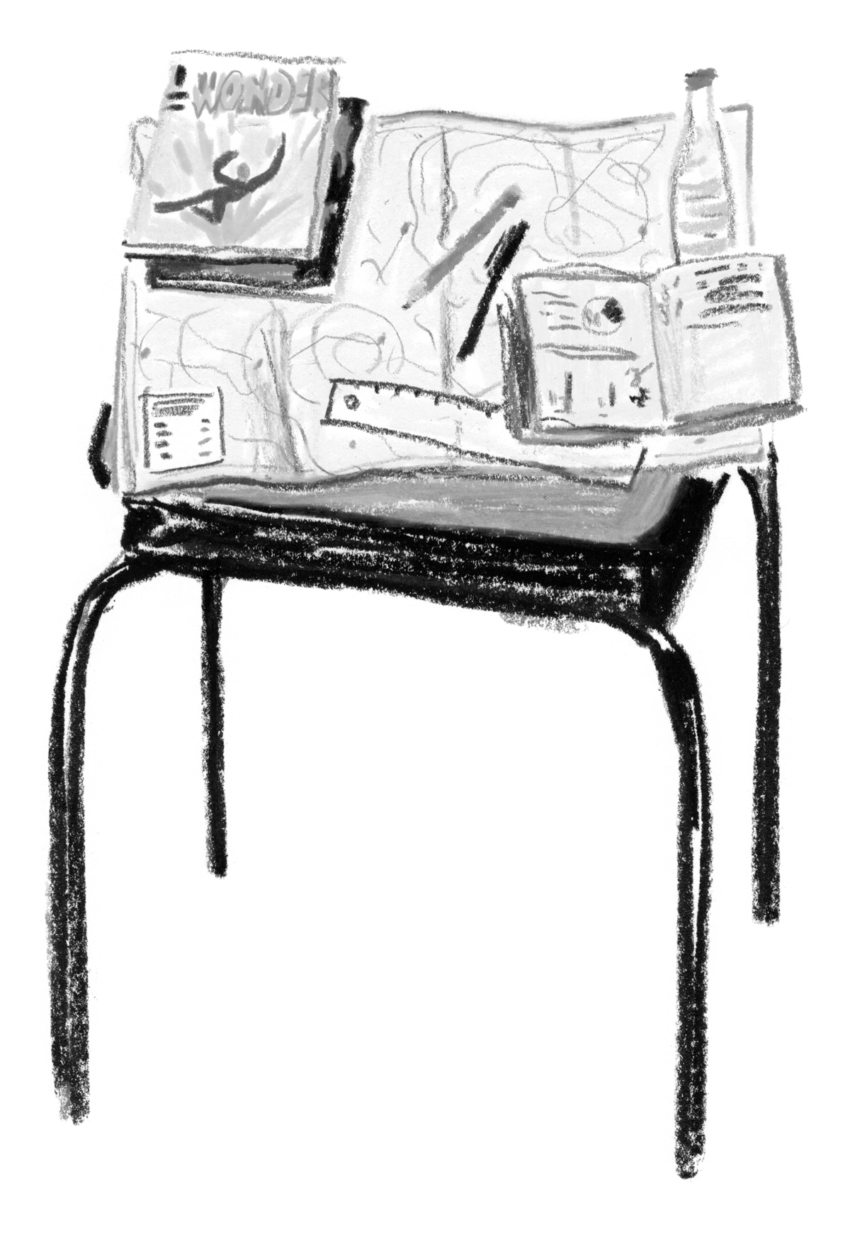
But one day, Mme Bontemps put up a kind of map we’d never seen before. “Physics and geology,” she announced. It was still Africa, but not with its discrete states in different colors, its capitals in big bold letters, its borders marked by dotted lines—none of that. It might have been Africa before Adam and Eve. But the most remarkable part was that Africa appeared to be split by a giant fissure, a crevasse that made our continent look like a cracked jug about to break apart. Mme Bontemps’s ruler, tracing the crack, underscored her words. She started at the upper right, where Africa formed a kind of elbow. “Djibouti,” she said. Then the ruler gradually descended toward where we were, following a string of lakes down to the ones we were familiar with, like Kivu and Tanganyika, and continuing on to other lakes lower still. Then, with an air of triumphant cruelty, she declared: “You see, ladies, Africa is breaking in half. That fissure you see on the map is widening. It’s called the Rift. One day, Burundi will be at the edge of the sea, and Bujumbura will be swallowed by the ocean.” We could hardly keep from laughing, and when school got out, we all said Mme Bontemps had come down with one of those dangerous mental disturbances, perhaps due to malaria, that often afflicted Europeans who stayed in Africa too long.
The next day, in the yard, Joséphine brought the subject up again: “I am not,” she said to us, “like you frivolous girls who think only about straightening your hair or finding some miracle cream to lighten your black skin. I listen in class. What Mme Bontemps said is serious. It kept me awake all night. If the huge ocean waves pour into that rift, like in the movies, it will submerge everything, and Bujumbura will be swept away and drowned, even way up there, at the top of the hill, where the boys’ school is. The one reassuring thing is that Mme Bontemps didn’t say when the cataclysm would happen. But one thing for certain is that it will happen someday, and I wonder if the governments and presidents are taking steps to save people. My fear is that they aren’t. I’m going to think about it some more and find a way to escape the flood and rescue you all, even those of you who make fun of me.”
We didn’t give much credence to Joséphine’s rantings. We were used to them: she was a Little Miss Know-It-All. We asked her with a laugh if she was going to present her rescue plan to the president or if, like Noah, she would build a great ark and invite all her friends aboard. We refrained from answering the curses that the poor misunderstood prophetess hurled back at us.
joséphine! in our little group—all of us final-year students at Stella Matutina, the chic girls’ school in Bujumbura; all of us held together by the impending end of our adolescence and the sorrows of exile—she was definitely what I’d call an outsider. For one thing, unlike us, she didn’t live in the city’s poorer quarters, like Bwiza or Kamenge. Her entire family, and there were many of them, resided in the OCAF neighborhood, Ngagara, the “little Rwanda” reserved for émigrés of distinguished parentage who had fled Rwanda during the first Tutsi massacres in 1959. Many of them had been hired to work in the short-staffed Burundian administration, and the rest had prospered in business. While Joséphine’s father was supposedly a pastor of vaguely Adventist persuasion, word was that he’d made his fortune in import-export. Joséphine was especially proud of her paternal grandfather, who, she claimed, was more than a hundred years old. He was a wise man who knew all the secrets of the ancient days and had advised the kings of Rwanda; even now, she said, in Burundi, ministers, and the president himself, came to consult her grandfather.
His memory was still intact, and he often spoke of how Kigwa, the first of the Tutsi, had come down from the sky. Joséphine had no doubt that her family and she herself were direct descendants of those celestial ancestors, the Abamanuka. This sort of bragging didn’t impress us. Sadly, it was all too common among the exiles, rich or poor, who consoled themselves by exaggerating or inventing lost riches and powers and by adding name upon illustrious name to their lists of ancestors.
Like all students, whether Burundian or Rwandan, we were models of docility. There was only one class in which we allowed ourselves a small measure of unruliness. It was taught by Mrs. Smith, our English teacher. Poor Mrs. Smith labored in vain to make us repeat in chorus the obviously contemptible vocabulary of a language that, like Swahili, was spoken only by Indian or Pakistani shopkeepers or, worse still, by the Protestant pastors dispatched by the devil himself to drag dupes straight to hell. So why did Joséphine copy down with such fervent application all the English words Mrs. Smith wrote on the blackboard, then strain to pronounce them, twisting her mouth and sticking out her tongue in imitation of the teacher?
No two ways about it: Joséphine always had to be different.
Even Naomie and Blandine, who called themselves her best friends, claimed not to know what lay behind Joséphine’s passionate interest in the language of a certain Shakespeare, but we suspected they were really just protecting their friend’s secret, whatever it might be. To get to the bottom of it, we decided to investigate. Immaculata and Spéciosa volunteered. It didn’t take them long to unravel the mystery, and they took unalloyed pleasure in sharing their discoveries with us.
Joséphine, like most of the girls in our clique, had a boyfriend. Our two detectives had dug up all sorts of information about him: he was an American, a volunteer in that organization called the Peace Corps. He was working on a reforestation project, though he wasn’t actually planting eucalyptus trees on the hilltops. Instead, he spent his time in the organization’s offices or, more often, parading through the streets of Bujumbura at the wheel of a huge jeep. Yes, he was young, tall, athletic, but Immaculata and Spéciosa had saved the best for last: Joséphine’s boyfriend was black! Blacker than I am, said Immaculata, who prided herself on having skin as light as the gazelle they call inzobe.
That revelation caused a huge stir in our little group. What could have possessed Joséphine to find herself a black from America for a boyfriend? Of course, there was nothing more prestigious than having an American suitor. It was better than having a Frenchman, and much better than a Belgian. For one thing, there weren’t many Americans in Bujumbura, and what we knew about their country came from films we’d seen at the French Cultural Center. A country rich beyond all imagining! With enormous cars and buildings so tall they scraped the sky, and whose people always rode horses through the sagebrush, wearing huge hats and dispatching their enemies with single gunshots, especially the whooping, painted savages in feathered headdresses who persisted in attacking with bows and arrows, as if asking to get themselves killed. All these real Americans were white, mostly blond, always rugged. So what was Joséphine doing with a black man who was probably a descendant of slaves, as Mme Bontemps had explained to us, and surely not as rich as the white Americans, maybe even their servant? No two ways about it: Joséphine always had to be different.
we solemnly swore to say nothing to Joséphine about her black boyfriend, since she never talked about him—though we couldn’t prevent a few spiteful tongues from making insidious allusions within earshot. Joséphine pretended not to hear, shrugging and taking on that superior air we found so irritating.
We soon forgot Mme Bontemps’s doomsday geology lesson and the terrifying prophecies that it had triggered in Joséphine. What was there to worry about? The world stayed in place, every day was like the one before, and the one after would be identical too. At dawn, the hawkers displayed their bunches of bananas, baskets of beans, and assorted vegetables in the main market; an hour later, at exactly seven o’clock, all the students in the primary and high schools and all the functionaries in their offices sang the national anthem as the flag was raised. The day plodded on until evening in the thud of steam drills, the hubbub of transistor radios, laughter, arguments, and children crying, until the neighborhoods shone with the wavering lights from the cabarets, where all those worthy of being called men gathered around the beer jug.
Two events allowed Mme Bontemps to return to her theory of the great fissure that threatened to break Africa in two. First, there was an earthquake: for several seconds (some insisted it was minutes), the earth shook beneath our feet, the bottles of Primus beer clanked together in their cases, the transistor radios stuttered, and a poorly attached tin roof nearly decapitated a woman fleeing her hut with her baby. At evening Mass that night, the priests and pastors lost no time in preaching that God had sent the inveterate sinners among us a serious warning. Our city of Bujumbura was so full of these sinners that it was more sinful than Babylon itself, and they, the good pastors, were tired of handing out absolutions without seeing even the slightest sign of repentance. If the sinners didn’t mend their ways, Divine Fury would soon come raining down on Burundi’s capital, which would suffer the same punishment that the Almighty had meted out to Sodom and Gomorrah, which hadn’t committed half the abominations now rampant throughout Bujumbura.
The day after the earthquake, Mme Bontemps again hung her geological map over the blackboard and triumphantly declared: “So, ladies, you all felt the tremor. Not a very strong one, but proof that what I’m teaching you is the truth, the scientific truth. The fault is widening by one centimeter a year, according to the experts. But it may be accelerating. I am certain that we’ll soon feel other quakes, much stronger ones.”
The second event bore out Mme Bontemps’s cataclysmic predictions. On January 10, 1977, the radio announced that the volcano Nyiragongo was erupting. Burundi’s state-owned radio station didn’t take the news too seriously, placing the item well after an account of the tireless endeavors of the president. On the other hand, the eruptions were the top story on the French station that Joséphine listened to assiduously. Morning after morning, before the raising of the flag, she gave us a rundown of what she had heard, embellished and augmented with her own commentary. We were interested, of course. Even though Nyiragongo was over the border in Zaire, we Rwandans also had our volcanoes. We knew their names by heart and recited them with pride: Mounts Sabyinyo, Bisoke, Muhabura, and even the largest one, Karisimbi, were Rwandan! On the flanks of these volcanoes lived great apes, apparently the biggest in the world, and the Americans in Bujumbura spoke of a woman, also an American, who lived with them and cared for them and protected them from poachers.
It was like the mouth of hell, vomiting a torrent of lava all the way to the edge of the lake.
Naturally, Mme Bontemps did not waste an opportunity to teach a series of lessons on volcanoes. She even partnered with a few other Europeans and journalists to hire one of those little planes from the Bujumbura flying club to glide over the roaring crater of Nyiragongo. In class, she showed us the slides she’d taken of the volcano: it was like the mouth of hell, vomiting a torrent of lava all the way to the edge of the lake, swallowing an entire neighborhood of Goma. The class that day sounded like one of the apocalyptic sermons that Joséphine’s father no doubt preached on the Sabbath, when his business interests left him time to remember that he was also an Adventist pastor.
No one dared interrupt Mme Bontemps’s endless flood of disastrous prophecies. According to her, the eruption of Nyiragongo was merely the start of what would soon befall us. Nyiragongo would awaken its neighbors, which we’d been told were extinct or long dormant. They, too, would begin to spew fire from the bowels of the earth, hurling searing boulders unimaginably high before they came crashing down on big cities like Bukavu, Nairobi, or Kampala. And, naturally, the first hit would be Bujumbura. Added to this would be the cloud of ash that blotted out the sun for years, the glacial night that would fall over all of Africa.
But Mme Bontemps had saved the worst for last. This would be when the flow of incandescent lava reached the waters of Lake Kivu. “Don’t you know, little Rwandan misses, ignorant as you are,” our teacher railed, as if intoxicated by a peculiar vengeance, “that your beautiful lake harbors a toxic gas? And when it explodes, it will be stronger than all the atomic bombs of the Americans and Russians put together? All it will take is a single ember from the lava flow to sink into the depths of the lake, and everything will blow up. I believe that at least half the planet will feel the effects. The great fissure called the Rift will crack wide open, and you shall no longer see in front of you the mountains of Zaire. The sea will rush into the breach, and a gigantic wave will unfurl, taller and more powerful than any tidal wave ever recorded, submerging everything in its path!”
As if drained by her cataclysmic vaticinations, Mme Bontemps collapsed onto her chair, mopped her brow, and caught her breath. “The lesson is over,” she stated, well before the bell rang. “Pray that all this will spare your generation. But know that it will happen—maybe next week, or next year, or in a thousand years, or in ten thousand years. But it will happen.”
We students left the classroom murmuring that Mme Bontemps had surely cracked. Some felt we should alert Mother Superior or the chaplain so that she’d stop terrorizing impressionable young girls with her tales of earthquakes and floods. Naomie said Mme Bontemps’s classes gave her such horrible nightmares that she would scream in the middle of the night and wake up her younger brothers and sisters. But a few pointed out that it wasn’t so different from what the good Fathers taught us in Catechism about the Last Judgment. Then we moved on to other topics that seemed more relevant, like the upcoming humanities exam and the effects of a new skin-bleaching cream made in U.S.A. that Espérance’s cousin had brought back from the Congolese neighborhood of Matongé in Brussels. Joséphine, for once, did not join in the debate.
The next day, Joséphine didn’t show up to class. After a week, we began to worry about her absence. We delegated Naomie, Blandine, and Mathilda, who were supposedly her best friends, to go to her house in Ngagara. The little servant girl who answered the door told them that Joséphine did not wish to see anyone. Naomie asked for more information:
“Is Joséphine ill?”
“I don’t think so,” the girl said. “All I know is that last week, when she came home from school, she shut herself in her room. Her father let her have a room all to herself because of her studies. She refuses to come out. I bring her food. I knock, she opens the door just a crack. She takes the bowl, but when I come back for it, I see it’s still almost full. All she wants is orange Fanta. Her mother is sick with worry and doesn’t want people going around saying her daughter is crazy and her papa is away in Nairobi for the month. The only one she lets in is Dédé, her little brother. He told me that she looks at maps spread out on her desk, writing on them. And he said she had a stack of comic books. He asked to borrow one, but she told him they weren’t for little kids who are still in elementary school, and besides, he wouldn’t understand them because they were in English. Apparently, she said: ‘Don’t worry, Dédé, I’m going away, but when the time comes, I’ll come back for you, you and the whole family.’”
Naomie, Mathilda, and Blandine’s report plunged us all into the deepest perplexity. Of course, Joséphine had always had attitudes and reactions we found strange, but this was beyond the pale. It was utterly incomprehensible.
Two weeks went by before Joséphine returned to school. After class, she refused to answer our questions.
“On Sunday, I’ll explain everything. Let’s meet at Prince Rwagasore’s monument at noon, after Mass.”
The mausoleum of Prince Louis Rwagasore, a martyr of the independence movement who was mysteriously assassinated mere weeks after he was elected prime minister, stands on a hillside overlooking Bujumbura. Its facade bears the national motto: in Kirundi on the side facing the lake and the city (ubumwe ibikorwa amajambere) and in French on the side facing the hills (unité travail progrès). Each of its three arches is painted in one of the colors of the flag: red, white, and green. There is a splendid view of all of Bujumbura, Lake Tanganyika, and, on the opposite shore, the mountains of Zaire.
Joséphine was waiting for us under the middle arch, the white one. Our small group of Rwandan girls gathered in full, and she launched into a long speech that some later dubbed, in jest, her “sermon on the mount.”
The two of them made real love, not like those little teases who merely let themselves get pawed by impotent old white men.
She began with lengthy imprecations against those—especially the ones claiming to be her best friends—who bad-mouthed her boyfriend because he was black. She was perfectly aware of what we had said behind her back; she had not told us about her suitor because she knew all too well what evil tongues would make up. Yes, her boyfriend was black, and she was proud of it. He was American too. And she wasn’t ashamed to say it: the two of them made real love, not like those little teases who merely let themselves get pawed by impotent old white men. Was she going to marry him? And go with him to America? That wasn’t the point, and anyway, he should be the one to follow her where she felt like taking him. But it wasn’t to talk about wedding plans that she’d summoned us to the prince’s monument. Thanks to Jimmy, she had discovered things that American blacks hid from their ignorant African cousins, secrets they didn’t wish to share with the Africans who had sold their ancestors into slavery. Jimmy had stacks of magazines and comic books, the kind that book dealers sold in the marketplace, the ones they bought off servant boys, who stole them from their bosses and especially their bosses’ children. Joséphine read them when she was at his house. Jimmy’s comics, as he called them, weren’t your everyday Tintins but wild tales, with terrifying artwork, about a mysterious country, one the whites didn’t know about and could never find, because it was reserved for blacks only. It was hidden somewhere between Ethiopia, Kenya, and Uganda. She told us the name of this country: Wakanda. It was governed by a queen they called the Black Panther. “Panthers are sort of like our leopards,” Joséphine added. She had asked Jimmy if this country for blacks really existed. It had made him laugh, and he’d said: “I doubt it! Still, I hope they’ll discover it someday—a country just for black people!” She pressed him for more information, but he didn’t elaborate. He merely told her a strange story, like a folktale, that his grandfather used to ramble on about, claiming to have heard it from his grandfather, who’d gotten it from his grandfather, who was enslaved by the whites of America. According to that great-great-great-etcetera-grandfather, the blacks who had been kidnapped and made into slaves had wanted to return home but found it impossible—except for a few who refused the poor rations their masters fed them and ended up becoming so emaciated that they flew away. Those flying Africans were able to cross the great ocean in the opposite direction, but nothing more was ever heard from them. “Maybe they all met up in Wakanda,” Jimmy had said, “or somewhere like it.” Joséphine had thought long and hard about all of this. She became convinced that Jimmy believed Wakanda truly existed. So she, Joséphine, had decided to find the country that was visible only to blacks. As soon as she discovered it, she’d come back for anyone who wanted to follow her: first her family, then we friends who had come to hear her out, and we’d take refuge in Wakanda, the only country that had nothing to fear from the disasters announced by Mme Bontemps.
Joséphine paused in her long sermon to catch her breath, and no doubt to gauge her audience’s reactions. Most of the girls were stifling their giggles, and a few poked fun at her.
“So, Joséphine, you think you’re Noah? You want to save the rest of humanity, but you forgot about the poor animals!”
“No, she’s more like a new Moses, bringing us to the Promised Land for Africans. Can our boyfriends come too? I’d hate to go without mine.”
Still, there were a few who wanted to know more.
“But…how do you plan to go to Uganda or Kenya to find this country of yours?”
“Next June, like the rest of you, I’ll graduate,” Joséphine answered. “Since I can speak English, I’ve convinced my parents to let me register at Makerere University in Uganda. I have aunts and uncles in Entebbe and Kampala. They can get me signed up, and my father will pay whatever it costs. On holidays, I’ll explore the areas where Uganda and Kenya share borders with Sudan and Ethiopia. Since I’m black, Wakanda won’t be forbidden to me. If you wish to enter it with me, you have to believe—that’s the only passport required.”
“Well, bon voyage,” some of the other girls said with a laugh, “and don’t forget to send us a postcard from your Wakanda when you find it. We’re going home. We’ve got people waiting for us.”
Naomie, Blandine, and Mathilda stayed behind. “You know, Joséphine,” they said, “we can’t let you go there by yourself; it’s too dangerous for a girl on her own. We’ve decided we want to go too. Besides, you’ll need witnesses to testify that Wakanda exists. The only thing we don’t know is who’ll pay for our trip.”
“We’ll find a way,” said Joséphine. “You just have to believe.”
the three remaining months of the school year went as expected. The whole class passed the final exam, and as happened every year, the solemn graduation ceremony celebrated the students’ brilliant success and the excellence of the institution. Joséphine, since her “sermon on the mount,” had been shunned by most of the Rwandan exiles. We scoffed at her lamentations, her airs as a misunderstood prophet of woe. Even her last disciples distanced themselves when she expounded a new theory: she claimed, from what her Jimmy had told her or given her to read, that Wakanda might not exist on Earth but was instead circling our planet like the satellites that the Americans and Russians had launched above our heads. Except it was even higher than those contraptions, and much larger, an actual city, like that celestial Jerusalem whose imminent arrival her father announced in his sermons when he donned his pastoral surplice. In Africa itself—presumably somewhere around the borders of Uganda, Ethiopia, or Sudan—there was only the base from which those who had been elected citizens of Wakanda would lift off. Hearing this, even Mathilda and Blandine started expressing some doubts about Joséphine’s doctrine.
“For,” Joséphine had declared to them in a voice tremulous with emotion, “haven’t you understood that it’s we, the Tutsi, who are the ones that the queen of Wakanda, the Black Panther, wants to save from the coming disaster? You have all heard your grandfathers tell the story of Kigwa, the first Tutsi to set foot on Rwandan soil. I know I’m right in saying that he did not come from Ethiopia or Egypt, as the whites have lied to us, but instead, as our grandfathers’ stories tell us, from gihugu cyo hejuru, ‘the land up above,’ and that’s why he’s called Kigwa, ‘fallen from the heavens,’ and we, his descendants, are the Abamanuka, ‘they who have descended.’ My father told me that the Bible also speaks of this when it describes the Nephilim, meaning ‘the fallen ones,’ like the Abamanuka. Obviously, the Tutsi came from Wakanda, and it’s high time we returned. Besides, think of the story of Kibogo. Our ancestors say he rose to heaven. You see how possible it is. I shall go alert them, Kibogo and the Panther Queen, so that they’ll entrust me with the mission of leading us to Wakanda.”
Joséphine was a shrewd one, no two ways about it.
The three disciples didn’t dare contradict Joséphine for fear of incurring her displeasure, but as soon as they’d gone some distance, Blandine and Mathilda lost no time in repudiating her—the whole thing had gotten too far-fetched for them. Only Naomie’s faith remained unshaken.
On one point, at least, Joséphine hadn’t lied. In the month of September, she climbed into an airplane headed for Entebbe. Her relatives in Burundi and Uganda had managed to procure the necessary papers for her journey and her matriculation at Makerere University. Joséphine’s departure was celebrated at the airport by the most prestigious figures of the Tutsi diaspora in Bujumbura. Her father blessed his daughter and predicted a most brilliant future for her; the Adventist pastor who seconded him in his religious duties stated unequivocally that God and His Providence would guide the student’s steps and preserve her from the temptations of the devil, who unfortunately ran wild in our perverted world; her mother and sisters broke down in tears and wailed out long laments; a teacher from Stella Matutina, a fellow Rwandan, stressed the exceptional intelligence of his former pupil.
We parted company at the final boarding call, under the applause of the small crowd of well-wishers. The customs officer, visibly impressed, cast only a cursory glance at the papers Joséphine held out to him and, with unexpected deference, wished her a pleasant journey. We watched from the observation deck as the plane took off and disappeared behind the peaks of Kibira.
we small band of Rwandan girls in exile, dispersed after final exams, were hardly surprised not to receive news of Joséphine. We knew all too well our former comrade’s blatant arrogance: Now that she was pursuing her advanced studies at a major university, how could she have time for those who would have to content themselves with more modest career paths?
We could wait until her return over the holidays to ask if she’d discovered Wakanda, or at least the launchpad that led to it. Her pastor-businessman father assured everyone within earshot at beer time in the cabaret, where all the notables of the Rwandan diaspora assembled, that his daughter had impressed even her most eminent professors with her intelligence; he didn’t hesitate to compare her to Christ among the Doctors. Her mother, more circumspect, merely answered the friends who asked after her daughter that Joséphine was doing fine and eating well.
Still, we were bewildered when Joséphine didn’t come back to her parents’ house for the holidays. When we asked her father about it, he answered (with much hesitation, spiteful gossips said) that she had been invited by one of her professors to an assembly of scholars called a colloquium. It was being held in Nairobi. As the evening wore on and more Primuses were drunk, the location of the colloquium changed, and Nairobi became only a way station en route to the general meeting being held in England—in Cambridge, or perhaps Oxford. Those sharing the evening Primus warmly congratulated the proud papa, but many thought privately that this somewhat unexpected success might be explained by Joséphine’s having become the mistress of her professor, probably an Englishman, who had enticed her back to his country by promising her the moon and the stars and, not least, marriage.
There, at last, they would find everything that refugees could wish for.
The alumnae of Stella Matutina readily accepted that explanation too. Joséphine was a shrewd one, no two ways about it. She had invented all those stories about Wakanda to impress her girlfriends, and once she’d arrived in Uganda, with the practical English she’d learned in Jimmy’s bed—Jimmy who, for his part, had gone back to America, where black people were even less respected than the Batwa here—she had thrown herself into the arms of the first white man she saw (rumored to be one of her professors), whom we imagined to be of relatively advanced years, amazed and titillated to have someone so young make such brazen advances. At the end of this apocryphal chain of events, no doubt, he had succumbed to his student’s venomous charms and abandoned his legitimate wife and offspring.
But this penny novelette didn’t convince everyone. For some, it was more likely that the white man in question was a pastor whom Joséphine had converted to her end-of-days theology. It was Naomie, her faithful disciple, who provided most of the details in this version of the Joséphine saga. Naomie swore she was still in communication with Joséphine via telepathic or oneiric means, having first checked the definitions of those words in the dictionary. She had seen in a vision, as if in a movie, Joséphine, wearing a long white robe and brandishing a golden wand, walking at the head of a column made up mainly of women and children. A voice informed her that those pilgrims were heading to Kilimanjaro, whose snowy crater would be their shelter in the imminent flood. That was where the flying saucers would collect them and take them to Wakanda. There, at last, they would find everything that refugees could wish for. Nonetheless, Naomie was still unsure where the saucers were to land: sometimes the voice-over mentioned Lake Turkana instead. But she was certain she would join them, whether in the snows of Kilimanjaro or on the banks of the lake. And she hoped there would also be room in the celestial shuttle for Blandine.
We eventually forgot about Joséphine. Even Naomie, after joining a Pentecostal sect, publicly confessed to having been misled by the devil that had clearly possessed Joséphine. Thanks to the pastor, she now understood that the Nephilim, whom Joséphine had likened to the Ibimanuka, were, according to a holy exegesis, fallen angels banished from heaven—in other words, demons from hell.
many years later, some former students of Stella Matutina who had followed the path of exile as far as France or England thought they recognized Joséphine in a photograph that made the front pages of the daily papers. The articles accompanying it concerned the massacre of an apocalyptic sect in Uganda (whether by collective suicide or murder by the group’s leaders: the investigation was ongoing). The journalists blamed the predictions of a prophetess who had called on her followers to prepare for a “great event” that would happen via UFOs piloted by angels. Experts in extremist religious movements reckoned that some members of the sect had died from an overdose of a drug that, according to tracts published by the cult, would adapt the human body to extraterrestrial conditions and enable men and women to copulate with angels and engender a new superhuman race. But the medical examiners also noted that many of the corpses bore wounds typical of weapons like machetes.
The lethal guru’s body had not been found. All traces of her had vanished, despite the concerted efforts of the Ugandan, Tanzanian, and Kenyan police. The press soon revealed the prophetess’s identity: her name was Rosalia Muswi, and she came from Kigezi, a region in southwestern Uganda. While working as a waitress—or, a few mean-spirited witnesses said, as a prostitute—at a bar in Entebbe, she claimed to have received a letter fallen from the skies, one that only she was able to decipher, though she was illiterate. The heavenly missive announced the coming of extraterrestrials who were attracted by the beauty of the Africans and wanted to mate with them, spawning a new race of giants who would live for a thousand years. The letter had given her the recipe for a pill that would enable young girls—virgins, it specified—to couple with those cosmonauts.
The alumnae of Stella Matutina understood that Rosalia’s biography was a poor match for Joséphine’s, even if the false prophetess’s ravings sounded just like hers. But Naomie confessed that, misled by the devil, she’d believed it was Joséphine in the photo and even tried to renew telepathic contact with her. Communication had proved impossible, the signal having no doubt been jammed by her own guardian angel. Naomie begged the evangelical community to pray for her so that she might ward off the repeated blandishments of the alluring demon who, in her dreams, offered to let her join her former friend, whose whereabouts he’d reveal if she gave in to his advances. Although she’d managed more than once to resist temptation, she felt too weak to hold out much longer.
Scholastique Mukasonga was born in Rwanda and is a survivor of the Tutsi genocide. She is the author of eleven books that have been translated into more than twenty languages.
Mark Polizzotti has translated more than sixty books from French. He lives in New York.
Newsletter
Sign up for The Yale Review newsletter to receive our latest articles in your inbox, as well as treasures from the archives, news, events, and more.