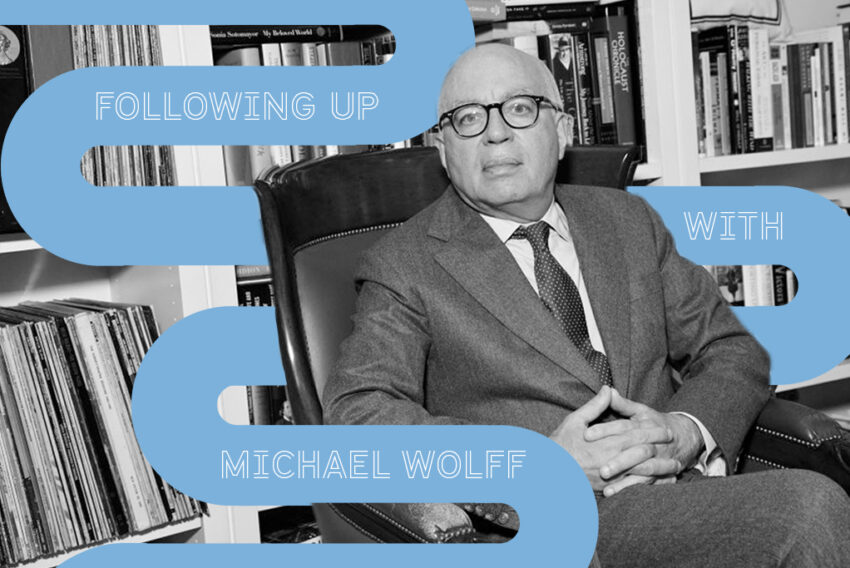
Photo by Jared Siskin / Patrick McMullan via Getty Images.
For Donald Trump, Jeffrey Epstein, the disgraced financier and sex offender who killed himself in jail in 2019 after being arrested on charges of sex trafficking, has suddenly become the ghost he cannot shake. Trump and Epstein were friends for many years before they fell out after Trump won a 2004 bidding war for a Palm Beach house. But even though Epstein has long been a figure of dark fascination for many in the MAGA movement, Trump’s relationship with Epstein evaded most scrutiny, not just from MAGA members but from the media at large. Even when the journalist Michael Wolff revealed, days before the 2024 election, that he had around a hundred hours of taped conversations with Epstein, including one in which Epstein said he was Trump’s “closest friend for ten years,” Trump’s supporters seemed oddly indifferent. (A few weeks after the election, I interviewed Wolff about Epstein and Trump, and about why the mainstream media seemed so leery of covering their relationship.)
Of late, though, things have gotten more complicated for Trump. MAGA voters had been sure that once Trump took office, he would release the so-called Epstein files—the hundreds of gigabytes of information seized by the FBI from Epstein’s residences, along with the results of the extensive FBI investigation into his life and crimes. But after releasing a small collection of files in February, the Department of Justice and the FBI announced earlier this month that they would not be releasing any more files, adding that the much sought-after Epstein “client list” did not exist. That announcement has led, for perhaps the first time, to meaningful cracks in the MAGA movement.
Trump himself, meanwhile, seems a bit at sea. He’s dismissed the Epstein files as “boring” old news, called them a hoax conjured up by Democrats, and said that “only bad people” are interested in Epstein conspiracy theories. But the calls to release the files have not quieted, and the story shows no sign of going away: on Wednesday, TheWall Street Journal reported that back in May, Attorney General Pam Bondi alerted Trump that his name appears in the Epstein files, and a House subcommittee voted to subpoena the Department of Justice for the Epstein records. I spoke with Wolff about why people are finally paying more attention to Trump’s relationship with Epstein, how Trump is trying to manage the situation, and what Trump’s history with Epstein tells us about his peculiar place in American politics. The conversation has been edited for length and clarity.
—james surowiecki, senior editor
james surowieckiThe last time we talked was in the wake of Donald Trump’s election, and one of the things we talked about was the fact that when you went public with your recordings of your conversations with Jeffrey Epstein—including a recording where he said that he was Trump’s closest friend for ten years—it seemed to have made no impact at all on Trump voters. Now we’re in this environment where it feels like Epstein, and the so-called Epstein files, have become a flashpoint for at least part of the MAGA movement, and are raising uncomfortable questions for Trump that they previously didn’t. What changed?
michael wolffMAGA seems to have been tangled in their own obsessions, and to have not seen clearly that this [obsession with Epstein] would impact most directly on Trump. I think the foundation of this story for MAGA has, for a long time, been Bill Clinton—that somehow this was going to get Clinton. The avatars of this have been MAGA voices, at least the MAGA voices invested in conspiracy, invested in this idea of the “pedo elites,” invested in Clinton being the anti–Donald Trump or, in some convoluted way, that whatever one might say about Donald Trump, Bill Clinton is worse.
But Clinton and Epstein were maybe friends for less than two years, while Trump and Epstein were friends for more than a decade. So I don’t know how they missed this, though I think partly they missed it because Trump has been always so bold in his denials, and it is a Trump thing that some people actually believe him, which is weird.
JS So why has it gotten tougher for him in the last two months? Because while I would never say that this—or anything—is going to sink Donald Trump, it does, at this point, feel like things have gotten tougher for him in a way that is a little surprising.
MW Well, this time you have his own people, his own supporters, saying it and forcing him into a corner on this, causing him to respond in a way that makes him seem guilty. I mean, it’s not that he hasn’t seemed guilty before, but he seems guilty and slightly vulnerable, which he does not often seem.
JS He also, at least to me, seems a little baffled. While it’s plausible that he’s concerned about what the files might reveal about his friendship with Epstein, it also feels as if he can’t quite get his mind around why his voters are so invested in this story. It’s as if he’s saying: Why do you people care about this? This is an old story—who cares?
MW I think that’s right. Remember, Trump is very capable of living in this reality bubble of his own. And I’m sure that—whatever happened between him and Epstein, does he feel guilty about it? Does he feel like he was doing something he shouldn’t have been doing? No. I think his attitude is That was living. That’s what we did.
JS And for most of his political career, he’s been able to avoid, or at least dodge, questions about Epstein.
MW I know something about that. In 2021, I went to see Trump at Mar-a-Lago when I was writing my book Landslide [Wolff’s book about the 2020 election and its aftermath], and we had dinner together. We sat in the Mar-a-Lago lobby and talked forever. Well, he talked. But beforehand, his aides asked me what the rough topics were that I wanted to talk about. And I gave them half a dozen topics, among them Epstein. And they said that everything else was fine—January 6, whatever, whatever. But they said, very specifically, that if I brought Epstein up, he would cut short the interview. They didn’t say not to bring him up, but they recommended I not do that, because he would cut it short.
Yes, and they can hang Vance for the flip-flop.
JS Interesting. But now he can’t avoid it.
MW Well, I think that there’s another thing that’s happening, which is that at some point in a president’s second term, the lame-duck years start. And I think this is a step toward that, toward the fact that there are a lot of people on the MAGA side who are looking ahead to when Trump exits, and are making their own calculations about their careers, and are looking at JD Vance and asking: How do we damage Vance? Because right now Vance has the thing—Trump’s support—that they have to triangulate their way around.
MW Yes, and they can hang Vance for the flip-flop. He was saying that back in October because he was the MAGA guy—that was one part of his portfolio, to say to MAGA “I’m your guy here.” And then suddenly he can’t do that anymore. And that flip-flop is enormously helpful to people like Tucker Carlson and Steve Bannon.
JS Bannon is a fascinating figure in all this. As you’ve witnessed and written about, Bannon himself spent a lot of time with Epstein, but now he’s saying that the files should be released and everything should come out. What’s his strategy here?
MW Well, Bannon is, of course, a bald-faced opportunist. And I think he knows that the stuff in those files will never come out. So even if it’s preposterous for him to do so, Epstein is the mega-opportunity of the moment, and Bannon is seizing it. I assume that he knows that this will pass and there is something else that will come on and replace this, so he’s putting money into the MAGA bank: he’ll get credit for calling for the release of the files, and will never be held accountable.
JS So does that mean you’re convinced the files—whatever they are—will never be released?
MW I would say so. They’ll make offerings on this, as they have with their request to have the grand-jury transcripts released (which could not matter less), but never the full open kimono.
JS So if Trump wants the story to go away, why do you think he sued TheWall Street Journal over that supposed birthday letter to Epstein, given that the lawsuit feels like it runs the risk of keeping the story front and center?
MW I think he may be suing now because, of late, suing has been so lucrative for him. You know, the CBS settlement and the ABC settlement—that money goes directly to him (or his “library”). It doesn’t go to the United States Treasury. It’s quite a racket. You know, I’m going to use the power of the presidency to force you to settle. It’s nice work if you can get it.
Newsletter
Sign up for The Yale Review newsletter to receive our latest articles in your inbox, as well as treasures from the archives, news, events, and more.
And I think there are other reasons. First, it gives him the headline: this is so untrue that i’m going to sue. Now, Rupert Murdoch can handle a lawsuit. He’s really good at it. He is not going to capitulate on this, and this suit, like most Trump suits against the media, will go nowhere. But it’s a threat to everybody else—a very, very useful threat, as I myself am now discovering. I’ve been talking to a variety of publishing houses for months about an Epstein book, and it’s clear that there’s much gnashing of teeth about whether you should do something that’s going to invite a lawsuit by the president of the United States.
JS But Trump is not concerned about what happens if it goes down the path where he might have to give a deposition?
MW Is he going to sit for a deposition? Never in a million years. The suit will be dismissed before that. But he’ll get credit for having filed it, and he can blame the courts and the media and say they’re against him. It all works.
I think the one potential downside for Trump is that this may well make Murdoch more tenacious, and make TheJournal
look further into the story.
JS We’re starting to see other mainstream news outlets start to do that—CNN’s KFile published photos of Epstein at Trump’s 1993 wedding to Marla Maples, and video footage of them together at a Victoria’s Secret event from 1999. This feels like a shift—as you’ve said before, it feels like for the past decade, the mainstream media has, with some exceptions, been really leery of digging into the story of Trump and Epstein’s friendship. Why do you think that is?
MW Yes, the mainstream media has largely ignored the story. I think the general feeling has been: Why is this important, and why do we have to sully ourselves talking about it? I had a publisher tell me that it was “icky.” Literally: “This is icky.” Which, in some sense, it is. But I don’t think the respectable media knows how to talk about this. That’s partly because it’s become very difficult to talk about sex, and about Trump and sex. It feels almost like the 1960s in that way. And then Epstein, as a witness, clearly has no credibility, because he’s been utterly demonized.
JS So why is it important? Setting aside the story of how Trump has, at least until now, managed to get a total pass on the subject of Epstein, why does the story of their friendship—which ended more than twenty years ago—matter?
MW If you look at their friendship, this was more than a decade of being joined at the hip, of doing whatever with regard to women in a lifestyle that was certainly outside of any relationship to middle-class norms that we would previously have said were the baseline of being a high-ranking elected official, or of even maintaining the pretense of following those norms.
JSAs you put it last time we talked, Trump and Epstein connected in part because “their interests were aligned: how to make money, how to get rich quick, and women, women, women, women, women. I think that was a constant thing. They [were] playboys in that old-fashioned kind of sense.” And his friendship with Epstein shows that “Trump comes from a kind of demimonde. His experience has nothing to do with politics, has nothing to do with respectability, has nothing to do with the political logic of public life.”
MW Right. So when you’re asking the questions Who is this man? How did he become president of the United States?, here is a window, Jeffrey Epstein, in which you can see who Donald Trump was, in a formative sense. And you have to parse the great irony—or maybe it’s a different word—that you have these two guys who start in a similar place, and one person ends up with a bedsheet around his neck in the darkest jail in America, and the other person ends up in the White House.
One of the things I continue to believe is that Trump is sui generis: when he departs this vale of tears, it’s done.
And this helps illuminate the whole nature of the anomalousness of Trump becoming the president of the United States. I mean, here we have a person who almost consciously behaved in ways that would preclude him from whole precincts of respectability, but most of all would seem to preclude him from the White House. And then, somehow, he was able to nonetheless become president of the United States. How did this happen? You can’t even make sense of it—this is out of the Cartesian universe.
JS And making it even stranger is that he’s become the standard-bearer for working- and lower-middle-class voters, many of them evangelical Christians, even though he has no actual connection to conventional middle-class norms and has lived his life, in a sense, in a way that’s indifferent to them.
MW Yes, that’s endlessly perplexing. And I think, at some level, because it so obviously doesn’t make sense, we have to say that there’s something else here, and that’s a contempt on the part of MAGA voters for the rules and the propriety of the “elite.” And since Trump is defying that, he’s forgiven for other things. That’s the only logical conclusion here, because otherwise it makes no sense whatsoever. Although there is the other thing that his regard for women, his attitude toward women, falls back, you know, fifty years. So whatever the resentments MAGA voters have about feminism and women, which are myriad and probably deep, he kind of aligns with that.
JS So what happens? Do you think the story will just kind of fade away?
MW I don’t know. Trump counts on this stuff to fade away. But I tend to think this doesn’t. I don’t mean that it gets him, per se, but I think it is potentially one of those things that stalks him. And, also, it has the potential for there to be other things, a succession of shoes to drop.
JS What about the future of the GOP, and of MAGA, specifically? You’re already talking about the lame-duck issue. How do you see all this playing out?
MW I would anticipate that whoever is the Republican nominee, Trump will fatally undermine because he can’t tolerate someone else taking over the Republican Party. And in his plan, he will go back to Mar-a-Lago as the king of the Republican Party and continue as the alternative president, situated in Palm Beach. The idea that he would be anything but Donald Trump is impossible to imagine for him, and in order to be Donald Trump, he has to be the once and future president.
But beyond that, one of the things I continue to believe is that Trump is sui generis: when he departs this vale of tears, it’s done. No one will replace him. And it’s connected to what we’re talking about: Who would have the audacity to think you could have lived this life that he led, and lived it pretty publicly, and yet go on and be the president of the United States? This is defying reality in a way that, as I say, we will try to unravel for years and years to come.
James Surowiecki is a journalist and author of The Wisdom of Crowds. A former columnist for The New Yorker, he is now a senior editor at The Yale Review and a contributing writer for Fast Company and The Atlantic.
A Literary Gift in Print
Give a year of The Yale Review—four beautifully printed issues featuring new literature and ideas.