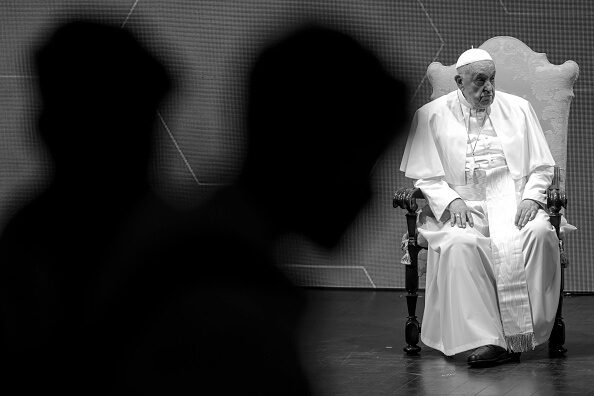
To conservatives, Pope Francis went too far; to liberals, not far enough. Alessandra Benedetti—Corbis / Corbis via Getty Images
The reign of Pope Francis, who died last week at the age of eighty-eight, was marked by a constant debate about the impact his particular kind of leadership will have on the Catholic Church and beyond. Throughout his twelve-year pontificate, conservatives stormed and raged at his progressivism, while liberals lamented that he was not as liberal as anyone had hoped or feared. But the hallmark of his papacy was not simply his capacity to garner attention, pick fights, or confound expectations. Above all else, Francis presented himself as a servant, especially of the poor and the marginalized. The vigorous and occasionally perplexing manner in which he pursued that service was a renewal of the possibility of a Catholic vision defined by its challenge to power.
Francis, born Jorge Mario Bergoglio in Buenos Aires, was the first Latin American to ascend to the chair of Peter, and the first non-European in over a millennium (though his parents were Italian immigrants). In the age of the internet, it is easy to forget that geography matters: the ascension of Francis was understood as another step toward a global church, a goal announced with renewed vitality by the Second Vatican Council. It was only one of the many revolutions attributed to his papacy before he even took the throne, and yet he didn’t exactly try to avoid such speculation. Attuned to his own visibility—an awareness he honed as archbishop of Buenos Aires, where he was seen walking, unguarded, to and from appointments, or else on public transit—Francis began his papacy with some conspicuous gestures, which were widely received as, if not a rebuke to his predecessors, then an unmistakable course correction.
On the day he was announced, he received the congratulations of the cardinals who elected him neither seated in the papal throne nor wrapped in crimson-and-gold brocade but standing, robed in a simple white cassock. In his inaugural homily as bishop of Rome, he insisted on papal authority being inextricably tied to service to “the whole of humanity, especially the poorest, the weakest, the least important,” and asked the congregation of two hundred thousand to pray for him. Later, he returned to the guesthouse where he had stayed during conclave to collect his things and, despite some resistance on the part of the staff, pay his bill. As he lay in state at St. Peter’s Basilica last week, mourners noticed his black orthopedic shoes, tightly knotted and scuffed on the toes.
The message here is stronger than compassion and mercy, which risk appearing to affirm society’s verdict, even while suspending the sentence.
His predecessors, John Paul II (1978–2005) and Benedict XVI (2005–2013), had been seen as largely traditional, even reactionary, each aiming, albeit in very different ways, to restrain the “modernizing” forces unleashed by the Second Vatican Council (in which they had both been, as young priests, energetic participants). John Paul II was a globe-trotting media star and a fierce proponent of conservative morality. He made campaigns against abortion, contraception, and LGBTQIA+ inclusion central to Catholic activism. He was also a fervent anticommunist, which he took so far as to neglect clergy and lay Catholics fighting violent repression in Western-backed autocracies, notably Archbishop Óscar Romero in El Salvador. Benedict XVI was a gifted theologian with a mind for the speculative, a flair for history and beauty, and an impatience with the more mundane task of governing the Church. When he finally confronted the sexual abuse crisis after it had raged for decades under official cover, he buckled, stepping down from the throne of Peter and taking on the unprecedented title of “pope emeritus.”
However much he deviated from his predecessors, Francis inherited the same issues, especially around matters of sexual ethics, and he did not always break from them as decisively as his supporters had hoped. He did not attend to the sexual abuse crisis in earnest until five years into his papacy, and though he made significant improvements, it’s hard not to lament the wasted time. He seemed open to reconsidering priestly celibacy but ultimately reaffirmed it. He kept the prohibition of the ordination of women, visibly dragging his feet on even the compromise that they be welcomed into the diaconate, a decision he left unmade. He continually referred to abortion as murder, and he maintained the Church’s stance against contraception.
To make sense of these apparent contradictions, we should examine them in the context of Francis’s commitment to universal charity and his effort to find a new way of expressing it in our time. The primary ethical teaching of the Gospels, which puzzles and enrages the religious authorities Jesus encounters, is his willingness to spend time with the most despised and marginalized of his day, not to change them but simply to love without reserve.
But the message here is stronger than compassion and mercy, which risk appearing to affirm society’s verdict, even while suspending the sentence; it is worth remembering that Jesus does, in fact, threaten profound punishment for the rich and the powerful. At the heart of Christian charity, then, is the recognition that power and wealth, and the social order that they uphold, are at odds with the love Christians are called to practice.
It is impossible to say what will happen next.
This creates as many problems for progressives as it does for traditionalists. The early Christians may have been radically egalitarian in their social lives, practicing something like anarcho-communism, but they were also utterly apocalyptic, convinced of the imminence of the Second Coming. At various times, the institutional Church has been just another locus of political power, and yet, just as often, it has been at the center of resistance to that power. The stories of people who played a role in the ebbs and flows of this grand history are very often strained, with superficial limitations obscuring deep change, visible only from a great distance, and often without clear implication.
It is telling that many of Francis’s most vociferous opponents have been staunch advocates of the Tridentine Mass, an elaborate Latinate rite that was instituted and standardized in 1570 but phased out after Vatican II, and one that has been a lightning rod for ecclesial politics ever since. (Benedict XVI, baroque-minded as ever, allowed its renewed proliferation, while Francis redoubled its suppression, drawing accusations of tyranny and iconoclasm.) As someone raised in the dark days of liturgical experimentation—I have vivid memories of electric guitars and drum sets beside conspicuously bare altars—I admit to feeling a certain nostalgia for the world I never knew, where the focus was on mystery and splendor, and there are very good theological arguments that some of its elements are more liturgically sound than newer and older alternatives. And yet, for all its beauty and reverence, the Latin Mass is a relic not of the full tradition of Catholic practice but of the moment when the Church was standardized against the threat, political as much as theological, of the Protestant Reformation.
It is impossible to say what will happen next. The Vatican is a famously labyrinthine bureaucracy, and though Francis personally appointed most of the cardinals who will elect his successor (the conclave to elect the next pope is set to begin on May 7), this is no guarantee of ideological agreement. There is a strong appetite for the kind of pastoral care Francis demonstrated, but the Church must contend with the rise of a global reactionary movement that seems to grow more powerful by the day. Its record in similar moments leaves much to be desired, whatever the courage and accomplishment of individuals and groups of Catholics devoted to the ongoing fight against fascism.
The continual decline of European Christendom over the last century was a major cause of concern for both John Paul II and Benedict XVI, who bent much of the Church’s effort toward reestablishing its prestige. John Paul did so by geopolitical intervention; Benedict, by aesthetic achievement. Francis, by contrast, offered a renewal of the tension that characterizes Catholic history and rests in the question of how to practice the love that asks too much and is always revolutionary.
A flawed and in some ways limited man, Francis did not provide a complete answer to this perennial dilemma, nor could he awaken everyone to its pressing call. (It was, however, at the heart of his greatest encyclical, Fratelli tutti, as well as his teachings on climate, his challenge to global capitalism, and his ministry to Gaza.) But he did enough—more than enough—to once again raise the question.
*Correction, May 1, 2025: An earlier version of this piece misstated the year that Tridentine Mass was instituted and standardized. It was in 1570, not 1547.
Jack Hanson is an associate editor at The Yale Review and a lecturer in English at Yale University. His writing has appeared in The New York Times Book Review, The New York Review of Books, The Drift, and elsewhere.
Support Our Writers
A sustaining subscription provides vital, ongoing support for The Yale Review and the writers we publish—and includes new holiday merch.