who does a death belong to? They will say: To whom, to whom does a death belong. To be corrected so early, my words wrong, my understanding wrong, my telling of the past—well. Let me tell you something. It is not me (not I) who needs forgiveness, and moreover I grant none of it. I forgive nobody. On the disputed issues of fact that may or must arise: for what limited, if indeed any, relevance it may have, I favor my own position. To whom does a death belong? There is more than one way to ask this question, more than one way to answer it. For example: Who saw them die? Who caught the blood? Who’ll make the shroud? Who’ll dig the grave? Who bear the pall? Who say the Kaddish? Oh, they will say, so it’s that kind of story, is it? Or perhaps: Why begin with this insistence on owning, this business of having a thing for oneself? Why call the specter forth? We can see even now the nice people rubbing their hands in anticipation. For one knows, doesn’t one, that the blame lies in the story itself, in the telling of it, rather than in its interpretation. In any case, the people I am sure will have their opinions, for the people like their displays of suffering and they like them to be specific, don’t they. Don’t they.
To begin with, some definitions, for the nice people who write far di dailies, into whose word-stock the terms will be assimilated without hesitation: shanda n (1) a scandal, a shame; (2) misbehavior by an individual or group that leads to embarrassment among the broader community. Example sentences: (1) Such a shanda it was that you did not win the award, that you never married, that you forgot the words to the bracha, that you ate treyf, that you did not visit your father more often, that you dropped out of medical school, that you hardened your heart; (2) The ultimate shanda far di goyim is Bernie Madoff, is publishing a novel about a fight over an inheritance, is being a landlord or a banker or a property developer, is picking up a lucky penny, is buying something we call safety at the cost of a life, of life. Now, there is an interesting turn in the space between senses one and two, emphasizing perhaps some small misgiving already seeded in the idea of scandal, of shame: to wit, where one is standing when one levels the accusation. And what, moreover, is the nature of the individual’s misbehavior when she generates embarrassment among the broader community? To whom does the shame belong? The categories are not stable. To clarify things, one might add a third possibility: A shanda is a person, frequently but not always a daughter.
Which brings us to: jino n a slur from one of us to another when one airs thoughts such as these. Example sentences: Dear [redacted], I am writing as a longtime patron of [redacted] to express my anger and frustration about the upcoming event with [redacted] given her recent public statements on [redacted] and [redacted] which are reflective of nothing so much as her willful disregard, her abdication of responsibility, her abandonment of the principles and teachings of [redacted], her appropriate vast stupidity, her apparent ignorance of her own history. (Her bubby, aleha ha-shalom, may her memory be a blessing, whom I knew personally, is rolling in her grave.) Why the [redacted] would host such a self-hating [redacted], such a useful idiot being used by our [redacted] for nefarious and clearly political ends, is beyond me and even perhaps beyond my generous [redacted] over the years. She may well consider herself a [redacted] but those of us who are [redacted] know she is nothing more than a jino who has sworn us off the better to be liked by the [redacted]. I am, suffice it to say, disgusted. Yours sincerely, [redacted].
Definition gives shape, and it also defers meaning, and while it does not do to enter into their logic I have never been able to help myself. You see, one detects a problem, and the problem is one of long standing. On the one hand, one is too much of a thing; on the other, not enough of it, a situation whose parameters ought to have been more obvious, would have been obvious, to someone quicker off the mark, for who else could have played, who else could they possibly have cast, in the high-school musical about the Warsaw Ghetto Uprising, other than the pale-eyed, fair-haired girl who could sneak into the gentile world and weasel her way in. This girl poses a problem: Will she return? And if she does return, choosing not to get lost in the streets of the city, if she does make her way back by force or luck or accident, those weapons she brings with her, the artillery and the information, the hearsay and the silence, who are they for? Against whom might they be used? It is the problem of suspicion, of the question of one’s allegiance: To them or to us? One does not need to arrive a day late, a dollar short, a whiter white, missing one’s [redacted]’s last [redacted], one indeed does not need to attend one’s [redacted]’s shiva at which an argument breaks out between oneself and one’s uncle or aunt or the mayor of the borough to remind others and be reminded oneself of what a disappointment one has been, a success by some metric if not theirs, a failure by all others, failing to stay, failing to come, at all or at the right time, failing to fall in line or lend support, failing to be the person, frequently but not always the daughter, that they wanted, who would have understood such things, what to say, when to call, whose dividedness would be experienced by everyone including, finally, herself, as unforgivable. Oh, this self-pity! It is just this coming home, on the occasion of the shiva, the neighborhood deli owner providing a spread, the barber bursting into tears, the way they all speak, and the sense that all this has been lost now, it can no longer be returned to, one made one’s choices along the line, one took a stance, and now one’s last connection, one’s claim to all this has been revoked at last for good and all. A shanda. A god damn terrible shame. This is where one finds oneself, gripped between oneself and the rest of the world, between where we have put ourselves and where they have put us. (On the other hand, coming home makes one remember things, names and faces long forgotten rise to the surface, along with a feeling from long ago as one watched the leaves toss in the Maytime sky, the longing for something to come, the longing that was the thing itself, the wanting and wanting without end, the feeling that meant one was alive and alive and alive, until one day, the something-always-to-come arrived—there it was, life happened, had happened, and suddenly one was too far down the path, the horizon of possibility diminished, and from then on it was only at particular moments, walking in the city in the springtime, at the end of the lengthening day, when the world unfurled again, when one dropped into one’s body and felt—awake.)
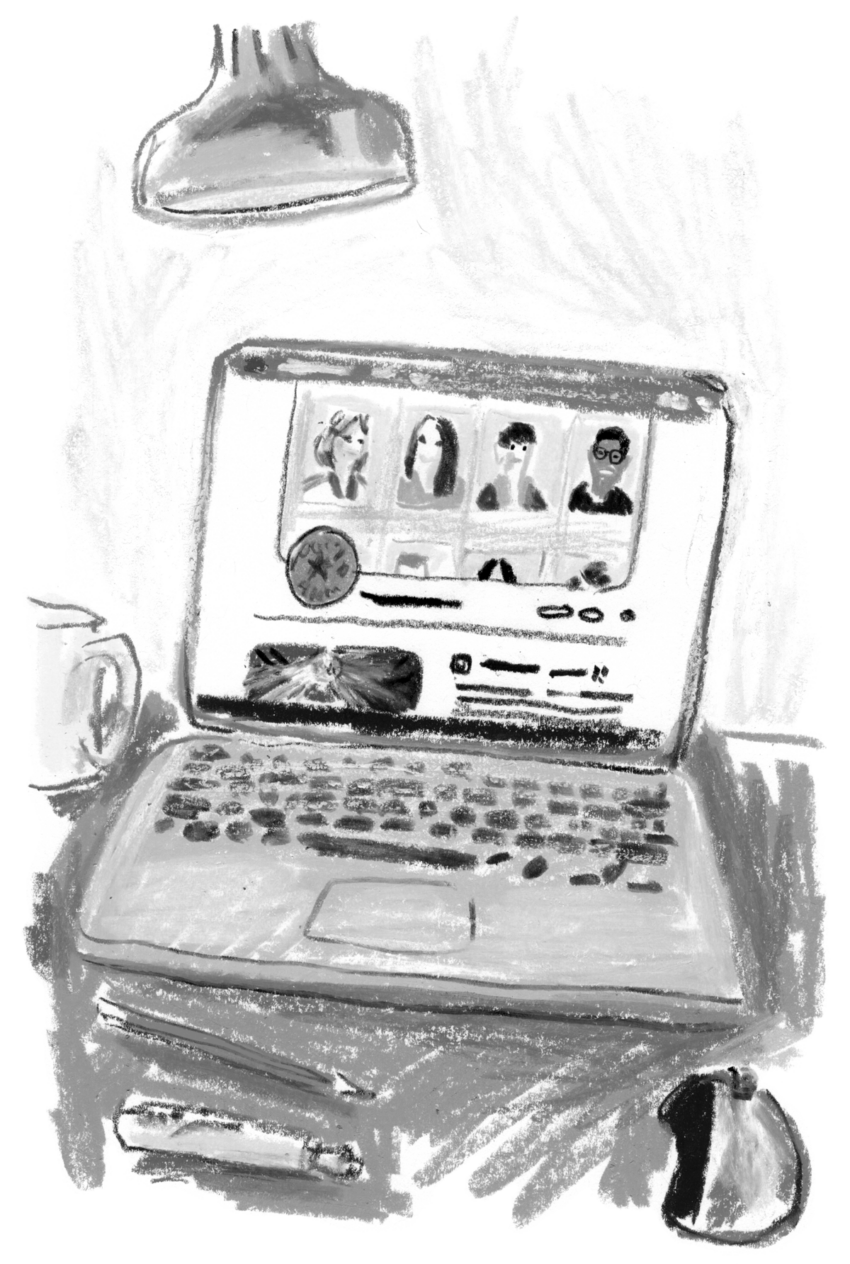
And so it is that I might find myself that very same week, for the past and the present tend to collide in this way, no pain unmixed with more of the same, logging on of an evening, back in the apartment where I grew up, on the occasion of my twentieth high-school reunion (an event I did not attend, my ability to hold a grudge ought truly to have made me the prodigal daughter, to bait fish withal, to bait fish), to look up my former classmates and determine how many of them had become predatory capitalists—but of course one is not supposed to say that out loud, because one will bring shame on one’s own people, the goyim always running with it too gleefully, one has seen it before, how at the first available opportunity they will say, I simply cannot see any beauty in it, and one finds oneself trying to prove the existence of this beauty to friends, trying to wrench oneself beyond their suspicion, the suspicion that feels new and surprising each time, though it is old, age-old, as old as home, heimish, a feeling of home we never had, and so, yes, one finds oneself running, ashamed, through one’s mental Rolodex of cultural artifacts whose beauty might be understood by people not really trying to understand, the candles burning in the holders each Friday night, the smell of the air in the blue evening when one opened the door to Elijah (here I am, translating again, for whom, Eliahu), watching the leaves rustle in the glow of the streetlamp from the threshold of the house I grew up in, the house my father grew up in, the house my grandparents eventually came to from the old country and where they survived, unlike their parents, unlike their siblings, for a time anyway, and where they died, my grandmother in her bed, and later my father in his, in fact the link one ends up sending to one’s friend is of an American cantor singing El Malei Rachamim, the same prayer the cantor sang at my father’s grave on a cold day in early December, the ground too frozen to break, or I can’t quite remember, it’s as though I have been asleep since then and am only now years later starting to awaken to the world, to the times, to all I have done and not done.
Yes, a villain can grieve, same as anybody else. (The last time I saw him, the last time I was home, it was warm for October and the ladybugs swarmed the back alleys in the sunshine, they flew in clouds over the fire escapes, the municipal parks, over the bagel shops and empty storefronts, the shtibls and the Greek Orthodox churches, over the lunch counters and the tourist gangs on self-balancing motorized scooters, over the rush hour traffic and the crumbling city infrastructure, over all of us sitting on the café terraces or walking down the avenues in utter bewilderment in the heat of the October afternoon, one’s propensity for counterfactual thinking adding to the problem of seeing things clearly, he wasn’t really dying, he would get better, the ladybugs were only symbolic, although if symbolic, so laden with possible meaning that the work of interpretation would be hopeless, and in spite of all this, in visiting all the old places, one could remember feeling, inside of oneself, long ago, the hope of something, of happiness, of pleasure, one’s skin tingling on the way to the bus stop on Park Avenue, the buses that were perennially late or perennially early, the smells of other people on the way downtown, on the way uptown, through the snow, through the seasons, the sense of being a person among other people, adding to this redolence.)
In fact, I discover, logging on again the next day, at the reunion it was determined that the most common profession entered into by the members of our graduating class, the most work by a significant margin, so that 60 or so percent, or about 72 of the 120 alumni, had taken it up, was accountancy. A generation of bean counters from a people who have been counting beans since time immemorial, counting our grievances, the historical and ongoing wrongs undertaken against us, such grievances as continue to be used as alibis for undertaking historical and ongoing wrongs against others whom over time we have fashioned into the enemy in order to allow ourselves the luxury of not seeing, not seeing them or ourselves, how we have become what we hated, what has killed us. For this time, we have done it to ourselves. Here we might observe the nice goyim smiling and nodding, nodding their heads, a people who have made the world for themselves, and who remain in spite of this eternally innocent, a people who can speak on anything, who claim everything for themselves, who created for the rest of us an economy of pain, pain the currency to be used for entrance into their nice, smiling world. One learns by rote, and the weight of it all, of all that depleted language, presses down on one, exacting its demands, its rules for living.
For example, things one may or must claim ownership over, in part or in whole, in minority or majority shares, and/or not at all: grief, beauty, permission, meaning, common sense, innocence, land, pain. The problem with history is that it is ongoing, that we feel and live it in the body, sometimes we give in to it, cease to seek, let ourselves get swallowed by the mouth of all that history, ramming us down the gullet so that, peeping in, what we find is ourselves looking back at us, out of time, out of throat, into belly, from thence caressed wetly through the small and large intestines, or perhaps (indeed) the stoma, down and down into the deep dark, and we can’t see outside, we cannot see beyond our own lives. Oh, these appeals to everlasting innocence. And oh, and oh, this proprietary pain. After all the time that has passed, the accidental and purposeful forgettings, the sneaking out and the weaseling in, as I click through the photos of the cheerful accountants at the reunion, as I lie on a pullout futon in a room that used to be mine, the scarf torn by the undertaker’s son hanging around my neck, I find myself humming the tune of one of the songs in the play, the last song we sang in the very last act, all of us teenagers standing in a row, two performances a day for a month, singing our hearts out, the final words of that final song. The set went dark, and the only thing still visible was the English translation of the Yiddish words that ran in time across a screen hanging over our heads, heads that even then were filled with a kind of knowledge, the words beginning to fade to black as the last note faltered, as silence descended on the theater: accompany us into the abyss of the world.