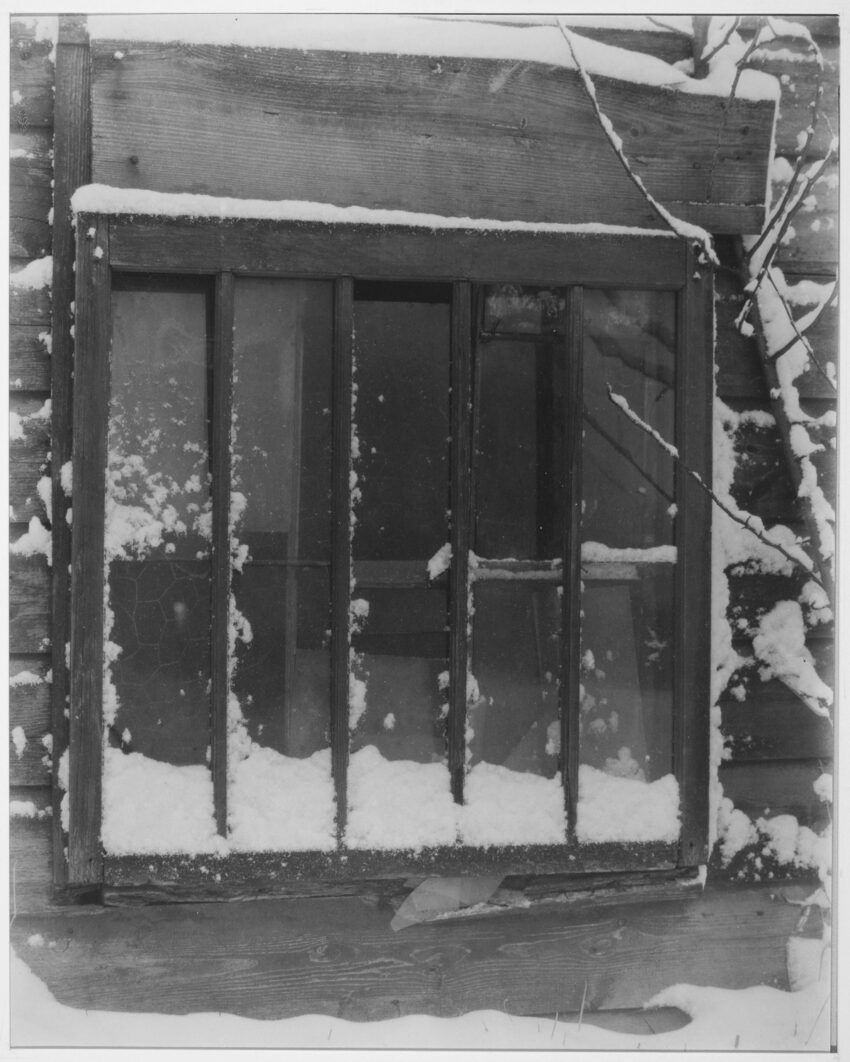
Alfred Stieglitz, Window: Wood, Glass, Snow, 1923. Alfred Stieglitz Collection, Chicago Art Institute, CC0 Public Domain
There was a list of things Alex swore he’d tend to before the baby arrived. The poplar shingles, the nursery door, the staircase to the cellar that was missing a step. Desperate as he was to get it all done, Alex was stuck in a funk from which he couldn’t pry himself free. He knew his wife had every right to be frustrated with him and wished he could tell her so. But communicating with Shannon was yet another thing Alex lately couldn’t do.
He was thawing himself out after a morning plowing snow—one of the side gigs that helped steady the farm’s wobbly income—when Shannon reminded him her due date was only a week away.
“A snow day, hon,” she said, addressing him in her calm, escalation-avoidant tone. “Why not use it to tick some things off the list? Or”—and here she pressed a palm to her back and poured him a coffee—“we could hire someone to knock it all out? It wouldn’t cost much.”
“I’ve got it covered,” Alex said, and watched her shoulders drop.
So he drained his mug, bundled up, and took Nettles the dog into the woods to dig out the poplars he’d felled and abandoned earlier that fall. By late afternoon, he’d stripped the trunks of their branches, grappled them with the skidder, and, despite the thickening snow, managed to haul them over to the barn. It was while trudging back to fetch his chainsaw that the beauty of the storm-battered trees stopped him dead. He was again overcome with the deep, deep sadness that he’d sworn to Shannon he could control. Above him soared his prized black ash, the second tallest in the state. Alex stared at the canopy’s upswept branches, tipped with their hard black buds, like tiny deer hooves in a giant rangale running toward the sky. All that life. All that hope. But Alex couldn’t keep his eyes off a clump of papery seeds still huddled together, hanging limp and exhausted from the tree’s gray winter crown.
Alex stood beneath it and cried until the sound of Shannon’s cross-country skis startled him sober. For a second, he thought about making a run for it. Though he knew, even full term, Shannon was faster and steadier on skis than he was off.
“I heard the chainsaw and the skidder and then nothing for way too long,” she said, breathless. “I thought you were crushed under a tree—that I’d find a giant bloody snow cone with you as the cherry on top.”
Alex laughed, despite himself. “You really thought that one through.”
Shannon cradled an imaginary child, her ski poles dangling from her wrists. “I was picturing raising the baby on my own.”
“And how did that look?”
“We did great, me and Junior. But at night we were haunted by the sound of Tyvek HomeWrap whipping in the wind—because the baby’s poor father died before shingling the back of the house.”
Alex wanted to laugh at that too, but all that came out was a humiliating sob.
Shannon’s face softened. “Oh, baby, I’m sorry about your trees.”
She maneuvered closer to allow for a hug, holding on to her husband until Alex, unable to stop himself, blurted out, “I just—what kind of world is this to be born into? What decent futures are even left?”
“Jesus!” Shannon pushed at Alex’s chest with both hands, sliding back on her skis. “You are not okay, Alex! It’s time to fix yourself, for real. If you don’t want pills, then don’t take pills. But you need to get yourself back in therapy. You can’t lose your mind over a bunch of trees.”
“The trees aren’t the problem. It’s the beetles coming to kill them. They’re here now, Shan. Feasting on my ash. Don’t I get to react to that? It’s only been a day.”
“A day since you found them, yes. And a full fucking decade of you waiting for them to arrive. So they’re here—exactly as expected. But guess what else we’re expecting? Our son, who needs a father that can smile at him without weeping,” Shannon said, ready to weep herself. “You had a great therapist. One you quit the minute I turned pregnant. Who does that?” She took an exasperated breath. “You promised me, if you got like this again, you’d ask Dr. Stokes to fit you in.”
This was indeed the promise he’d made when he left therapy. Back then, he’d told Shannon he couldn’t justify the expense with a kid on the way and things already so tight. To spend that kind of money on a single hour, an hour wasted solely on him, was too much.
What he’d never told her was how disastrous his last session was.
Now Alex avoided his wife’s gaze, squinting at the sky. “I should plow again. If it keeps dumping this hard and I don’t run my route, tomorrow will be a nightmare.”
He whistled for Nettles, who came bounding through the woods. The beauty of that creature racing toward them filled Alex with unceasing love. And if he could feel this for a dog, what would having a baby be like?
When he turned to share the moment with Shannon, she drove her poles into the snow and kicked off with more force than he knew was in her. She cut a clean, graceful retreat, leaving Alex at the wood’s edge, watching the distance between them widen.
back at the house, climbing the porch steps, Alex spotted Shannon through the front window. The sun was setting, and she moved around the room, turning on lamps. She stopped and looked out, and Alex couldn’t tell if she frowned at the sight of him or at her own reflection. Either way, he loaded Nettles into the truck and left without saying goodbye.
Alex knew every turn, every rise and fall to those roads. He felt fully in control, driving faster than visibility recommended and steering lazily into the skids, the dog already snoring at his side. What he’d lost control of was pretty much everything else. His ability to properly care for his wife and unborn child. His purchase on reality. The basic strength to keep his world-ending terrors at bay. What are we doing? Alex thought, driving on. What have we done?
Years ago, before he and Shannon were a thing, he’d work the local farmers’ market on Saturday mornings, then race to the Tiny Brook Public Library to make the last weekend hour. An ex–city kid, Alex had traded one singular way of living for another. His New York family said he was crazy. And maybe he was. All he knew was that he had a lifetime of catching up to do.
When the beetles first popped up in Concord, just across the state line, Alex knew it was only a matter of time.
Shannon, junior staff back then, noticed this young man who never so much as glanced at a novel or magazine, who hurried in every week to take out volume after volume about things like soil fertility and environmental impact, aquaculture and input costs. She and Alex had barely spoken a word before the day she scanned his books and said, “How about you check me out instead?”
That first date had never ended—the only thing in Alex’s life that hadn’t. And from the start, Shannon made it clear that all his agriscience tidbits were right up her alley. Anything he wanted to share with passion, she wanted to hear.
Then, two years into their relationship, the emerald ash borers entered his consciousness. They’d hitched a ride on a ship to America and drilled right into Alex’s already-obsessive brain. He tracked their progression from Michigan to Ohio to Pennsylvania to New York as they tunneled under the ash bark, squiggling madly through the trunks and cutting off the roots from the sugar in the leaves, starving tree after tree.
When the beetles first popped up in Concord, just across the state line, Alex knew it was only a matter of time. Of course, he’d already understood what was happening to the environment; he’d started his farm to tend the land responsibly, to push back against the massive agricultural conglomerates with their forever-poison-laced fields, their leaking industrial-shit lagoons, and their processed Frankenfood output. Here, in the perfect, beautiful place he lived, it had felt different for a while. Felt hopeful. Until the beetles reached New Hampshire and Alex was sucked right back into the same helplessness he’d moved there to escape. Even in the Live Free or Die state, he was defenseless when it came to protecting what was his.
Alex had every right to be upset, Shannon wanted him to know. But, given the size of his reaction, the depth of his despair, might there be other, more personal issues at play?
“There are tools,” Shannon told him one night as they settled into bed. “It’s too much upset over a beetle. You don’t need to suffer like this.”
“Better than not feeling anything at all. Or stumbling around permanently happy with a stupid grin on my face.”
Even in the seriousness of the moment, Shannon couldn’t help but laugh. “You think you’re at risk of chronic joy?”
It was an earlier time in their marriage, and Shannon covered his chest in kisses. “If you can find a pill like that, grab one for me too,” she said, rolling onto her back. “You understand the medicines don’t work like that? That you’ll always be you—just maybe a version that doesn’t always feel so fucking bad?”
That was when she brought up the doctor. She knew him from the library, where he chatted with Shannon on Saturday mornings while his children read quietly in the book nook. Years ago, Dr. Stokes and his family had bought a house on the edge of one of the big lakes. They became established second-home types, the kind of rich folk who show up from Boston on Memorial Day and spend the season acting hearty and rural, kayaking around with their paddle blades facing the wrong way.
Give your therapist a little shake, then wait nervously while the answers to your deepest questions slowly surface in the doctor’s mouth.
Interlopers though they were, they weren’t the off-putting kind. The wife, who was quietest, looked Shannon in the eye like she actually saw her and never failed to put cans in the bin when the food drive was on. The kids were, in Shannon’s opinion, independent and lovely. Even at the very height of sandy, melty-ice-cream summer, they returned their books on time and in good condition.
One fall, the family just stayed, moving to New Hampshire full-time. They signed the kids up for school, the wife worked in Boston half the week, and the doctor built an office off the side of the house for seeing patients.
Alex was so anxious about his first session, Shannon had to come along and wait in the truck. He’d imagined that going to therapy was like consulting a Magic 8 Ball. Give your therapist a little shake, then wait nervously while the answers to your deepest questions slowly surface in the doctor’s mouth: “Yes,” “My sources say no,” “Reply hazy, try again.”
What Stokes had actually done was sit in his swivel chair and listen. A man in a uniform of white shirt and blue blazer, his hands resting serenely against his thighs. If he wanted to show sharper concern, he’d slide those hands forward and cup his knees; otherwise, he communicated through the subtly shifting muscles of his face—expressions of care, expressions of interest.
Behind him towered shelves of books, and on one, staring at Alex over the doctor’s shoulder, was a large gilt-framed photograph: the doctor with his wife and two children.
Alex was new to all of this, but he wondered why the picture was angled toward the couch and not propped on the desk in the corner, for the doctor to gaze at as he recorded his secret session notes. But maybe it was there as a kind of model. To let Stokes’s patients know that behind the oak door separating the office from the house was a world where happiness and harmony reigned. Who among the doctor’s stable of worriers wouldn’t want to work toward the same?
In Alex’s case, harmony had not been achieved. The sound of the beetles marching in his head couldn’t be silenced, nor was he able to admire the vast woods surrounding him without acknowledging the broader, empty-aquifered, microplastic-filled world. Somehow Stokes remained unruffled by Alex’s tortured outlook. Those agonizing thoughts weren’t going to turn off, he explained. So why not treat them like a river running through Alex’s mind? He could let the worries hold his attention, or he could simply let them drift by. This, for a while, Alex tried to do.
pausing at the foot of Walter Bird’s driveway, Alex closed his eyes. He breathed in and out, counting breaths, attempting to muster a kind of mini-Stokes, a little parrot shrink who’d perch beside his ear, bobbing his therapeutic head and reminding Alex of all the coping mechanisms they’d come up with over time.
After a final four-count exhale, Alex gave up and opened his eyes. “Good boy,” he said to Nettles for no reason, and gave the dog a pat. Then he lowered the plow blade, turned on his high beams, and pushed ahead.
When Alex was halfway up the drive, the porch light went on. And as he neared the top, the front door opened and out came Walt, gloveless, coatless, not even a hat on his big bald head. It was calming to see him. Walt, the only one who’d taken Alex seriously when he decided to try his hand at farming, who apprenticed him for a full year and taught him everything he knew.
Alex rolled down the driver’s-side window, and Walt looked in on Nettles, busy making a run for it in his dreams.
“Your wife called. She says you’re acting crazy.”
“I’m fine,” Alex told him.
Walt snorted at that. “Whose word would you take if you were me?”
“I found one,” Alex said. “Yesterday.”
“One what?”
“A beetle. An emerald ash borer. Actually, I found two.”
Alex watched Walt’s chest fill with air.
“They’re here, Walt. On my farm—probably yours too. They were flattened dead in some ash set aside for sugar wood.”
“Goddammit,” Walt said.
He turned toward the handsome stand of ash behind him and went silent. Alex could tell his friend wasn’t seeing the ash but picturing their absence, the trees already ghosts, the space wide open. Then, with the kind of peace Alex forever failed to manage, Walt exhaled a giant billowing breath, as if the anger in him was a puff of steam one could choose to release.
When he spoke, it was to grasp at a safe, familiar subject.
“You boiling sap with hardwood now? That’s not how I taught you, that’s for sure.”
“Soft, mainly,” Alex said. “But I mix it up some to slow down the fire. The ash has a nice burn. I like what it does to the syrup.”
“‘Ash wet or ash dry, a king shall warm his slippers by.’”
Alex tried to find something in that line, wisdom or guidance.
“I’m scared,” he ventured. “The bad things coming in faster than the good.”
But Walt only nodded and glanced back toward his trees. He gave the door of the truck a solid slap, then walked inside.
during that last session with Stokes, Alex and the doctor had slipped into their rhythm of asking and receiving, covering well-worn territory. Feeling the opportunity disappearing, Alex shared his news in a rush of desperation. Shannon was pregnant! They were pregnant! He was happy, but because it was therapy, Alex confessed to something more.
“As good as it feels,” he said, “as thankful as I am, there’s also this intense worry…”
“About the pregnancy?”
“No. I feel excited about that. Like, ready.”
“About the baby’s health?” Stokes asked, his hands slipping forward and clasping at his knees.
“No, not that either. Sometimes I get panicked, but Jesus, I run a farm. I fetch the eggs in the morning. Birth the lambs in the spring. Life, death—they usually take care of themselves.”
“Okay. So, what is it, then?”
Alex sensed an unfamiliar impatience in Stokes’s voice. He wondered if Stokes was judging him for making too big a deal of it. After all, every single person on earth was someone successfully born.
“It’s why I came to you in the first place. Because I’m worried about the world. What we’re doing to it.”
“Because of the beetles?” Stokes said.
“It’s not like I’m asking you to tell me everything will be all right—only that it might be.”
“Because of everything. The trees. The winters. Who knows when Squam Lake will dry up? What if the kid wants to play baseball and there aren’t wooden bats? It’s not the same crack off aluminum—a home run that sounds like a car backing into a pole.” Stokes raised an eyebrow, signaling Alex to get to the point. And then Alex said what he’d been finding it impossible to say. “What if Shannon and I did something selfish? What if we can’t protect our kid?”
Stokes leaned back. “Welcome to parenthood.”
Alex wasn’t sure if this was meant to be dismissive or sympathetic or both. He tried to smile, but his face betrayed him.
“That’s not what you wanted to hear?” Stokes said.
“It just sounds—” Alex stalled. Why was it so miserably hard to share what he felt? And not just in this office. Even with Shannon and Walt. The safest people he had.
“How does it sound?” Stokes prompted him.
“Flippant,” Alex said, feeling his heart rate rise. “It sounds mean. It’s not like I’m asking you to tell me everything will be all right—only that it might be. That we haven’t doomed a baby not yet born.”
“You want me to tell you that?” Stokes looked bewildered. “That’s not what I do.”
“But I’ve been working so hard in here. What does it even cost on your end?” Alex said, pleading with his whole self. “What’s so horrible about indulging?”
It was supposed to have been a celebratory session—about Shannon’s pregnancy, about Alex finally doing a natural thing in a natural way.
“If I can’t promise those things to my own kids,” Stokes said, stern, “how can I do it for yours?”
For the first time in all their sessions, Alex was up on his feet. Did he take a step forward? Did he stand over his therapist? Lean threateningly in?
What he remembered exactly was his final demand.
“Why not?” Alex said to Stokes. “Why not tell me everything will be all right?”
driving on from walt’s and rolling carefully down Tiny Brook Road, Alex simply couldn’t reconnect with that former self—the one doing so much better, who sought only confirmation that it wasn’t completely insane to see what he saw and not go mad.
But if he was off his rocker, how was it he could maintain his commitment to the farm with limitless energy and without complaint, even when it came to the thankless tasks that kept it afloat—like the one he was grinding out now? Why was the contrast so stark when it came to doing things for the person he loved? It had taken him near a year to cut some poplars and drag them to the barn, and he still had to split the shakes and shingle that wall. And it probably wasn’t even ten minutes’ work to plane down the swollen edge of the bathroom door and make his wife happy. But the overwhelm. It was crippling.
“Fuck!” Alex said aloud.
He tried Shannon’s cell to tell her the run was taking longer than expected, but he couldn’t get a signal, not a single bar. No surprise: he always lost service in bad weather. Shannon wouldn’t worry yet. Alex tucked the phone into his pocket and drove on.
One extra turn at the end of the route was all it would take to get to Stokes’s private drive. He’d long wondered who plowed it, and had once offered to do it himself as a kind of barter, a bit of road clearing for a bit of head clearing. But Stokes preferred to keep that sort of thing separate; even at the farmers’ market, his family bought their produce from other stands.
Something in his face had tightened, or maybe gone frail.
Alex’s nerves went jangly at the turnoff, so he reached under the seat for the emergency cigarettes hidden there. The first drag was such a pleasure he moaned. As Alex smoked, he tried to picture Stokes sitting down to dinner with his family, the truck’s headlights illuminating the scene as their house swung into view. Did it need to be awkward? Couldn’t his popping by be the most natural thing in the world? Alex was one of the few neighbors who could get around in these conditions, so here he was, checking up on them in a storm. By the time he lit the second cigarette off the end of the first, the idea of stopping in for some chitchat and a bit of advice left him almost giddy.
At the foot of Stokes’s drive, Alex’s heart sank. The snow was piled high, untouched. The doctor and his family were obviously away. Alex hesitated, then lowered the plow blade anyway.
Their private road was gnarly even in good weather, winding and far too steep, especially over the last rise. Alex had resisted telling Stokes to get the whole thing regraded, knowing it would earn nothing more than a silent nod. Alex felt almost proud as he expertly took the sharp curve to the final downhill, the feeling of being in command swelling again.
If there were such a thing as a bespoke forest, this property had it. The dense oaks and sugar maples, the white pines and spruces, the beeches and balsam firs—all of them now opened onto a vista of Stokes’s house, nestled on its own private promontory with unparalleled rich-person views of the lake beyond. To Alex’s surprise, the house was seemingly wide awake. Light bled out from the windows of the main floor. A lamp burned in the office behind the curtain that was always drawn. The family car sat in its usual spot in front of the garage, snowed under. How many times had Alex parked next to the Stokeses’ Outback, as he did now?
Those afternoons felt distant as Alex wavered between the house’s front door and the office’s side door, unsure which one should be used by a patient who’d ended things on bad terms and was arriving uninvited. He was halfway out of his truck, ready to change his mind, when Nettles decided for him, jumping out into the snow to run loose.
Alex went with the office, permitting himself a second ring of the doorbell only after he’d counted to one hundred. A few more seconds went by, and then the door opened.
It was barely eight o’clock, but Stokes was in pajamas and a pair of corduroy slippers.
“Alex?”
“It’s me. And my dog!” Alex looked over his shoulder. “Somewhere.”
“You brought a dog?”
When the doctor spoke, Alex glimpsed a void at the back of his mouth. A tooth gone missing.
It unnerved Alex. How old was Stokes? Twenty years older than him? Thirty? The doctor had always had an ageless look. Strong chin, trim waist, a kind of eternal vibrancy. Now something in his face had tightened, or maybe gone frail.
Alex cleared his throat. “I was out plowing. And I wanted to make sure your drive was passable, I’m not sure why. But then—it wasn’t!”
Stokes gave a faint, stiff nod. He made no move to continue the conversation.
“Biggest storm of the season, they’re saying,” Alex said.
They stood. They stared. Then Stokes shuffled back and cracked the door just enough to let Alex pass through with Nettles, who’d appeared at his heels.
“You’re probably wondering what I’m doing here.”
“Well, I wasn’t expecting you,” Stokes answered flatly, and gestured toward the couch. “Why don’t you give me a moment to change.”
From where Alex sat, he could see the familiar family photo on its shelf. A fresh-faced Stokes and his fresh-faced wife posing at the lake that was currently frozen over outside. Two genderless children in matching shorts and T-shirts and haircuts stood in front of them, eating ice cream cones as big as their heads.
The doctor reappeared in his uniform: the blazer, the slacks, the standard white dress shirt, wrinkled but clean. Alex was struck by how much he’d missed looking at the man. He felt himself blush.
“So what brings you?” Stokes asked, as if this were their first session.
“Well,” Alex said, suddenly uncertain, “I’ve been chipping away at the house. Doing busywork. You know how winter is for farming. And with the baby—”
Stokes clapped his hands together, startling Alex. “Are you a dad now?” he asked, sounding sincerely happy.
“No, no! Anytime now. I mean, not any minute. Shannon’s due in a week.”
Alex watched Stokes tamp down his delight, the doctor’s hands sliding back to their default position on his thighs.
“I wouldn’t have come if it weren’t serious,” Alex said. “The emerald ash borers. They’re here.”
Stokes’s face shifted through its catalogue of listening expressions, but he didn’t speak.
“They’re probably in your trees too,” Alex went on, hoping to draw the doctor out.
“Which is it?” Stokes said. “Are you here about the beetles or the baby?”
Alex thought back to all the milestones this man had coached him through: getting married, trying for a kid. Yes, he knew why he’d shown up at the doctor’s door.
“The baby,” Alex said, and his voice cracked. “I came to talk about what happens after he comes.”
“Can’t you talk to Shannon about that? Or your pal Walt—I assume he’s still in your life. I know you aren’t alone.”
“It felt like something for here. Something I could only figure out with you.”
The doctor pressed his lips together. Warmly, Alex hoped. Then Stokes nodded and stood, crossing to his desk. Stokes rummaged through it and came back with a business card.
“If you’re really ready to try again, that’s the contact for an excellent therapist. I think she’d be a truly fine fit. And please use my name.”
Alex was hit with a wave of dizziness. The doctor walked to the foyer and pulled the door open.
“I wish you well, Alex,” Stokes said. “Truly, I do.”
outside, nettles went wild barking at the scattering light and the blue shadows and the thumbprint smudge of a moon. When Alex looked back at the office, the lamp behind the curtain was already off. The darkness filled him with shame—the whole visit had. He wished he were already home with Shannon on the couch, apologizing his way to mercy. He could fix the bathroom door tonight, repair the basement steps, show her they were over the worst of it. That he was ready. For the baby. For whatever came next.
Alex got Nettles into the truck and ground his way up the hill. Almost instantly, the tires failed to grab. The pickup started to slide a yard or two shy of the peak, nothing underneath it but solid, glassy ice. Alex threw his arm over the passenger seat and, squinting out the back, steered as best he could. He rode it out, the truck coming to a halt practically where they’d begun.
The second try went no better than the first. As soon as he reached that same spot, it was like they were skating in reverse. Alex put the truck in park and got out of the cab with his flashlight, inspecting the route until he spotted a gravelly ridge he could aim for sticking up through the icy patch at the road’s edge.
Support Our Writers
A sustaining subscription provides vital, ongoing support for The Yale Review and the writers we publish—and includes new holiday merch.
On the third attempt, when he reached that gritty stretch, Alex fed the engine some gas. He finally got over the hill and was steering into the curve when the truck went left, though the road went right. His fender caught a tree stump, and he felt the front tires jump and the truck begin to roll. Then it stopped. And that was that. Nettles whimpered, as if aware of what they’d only narrowly avoided.
Alex reached for the cigarettes under the seat, but the pack had ended up who knows where. He cut the engine and left the keys where they were: good luck to anyone who thought they could steal it. Hopping out with Nettles, Alex shone his flashlight under the chassis to admire his bent axle before hiking down to the house.
He went straight to the front door this time. One ring, two rings. Three.
“You’re back,” Stokes said, already in his pajamas again.
“Never left. Got myself stuck.”
“Stuck?”
“I jammed the truck up pretty good.”
“I don’t understand,” the doctor said. “Do you need chains? A tow?”
“I am the tow,” Alex said. “I’m the tow guy. The plow guy. I’m all the winter rescue things.”
The way Stokes stared at him, his face tired and strangely vague, it was like the doctor had forgotten Alex had just been there. If Alex didn’t know better, he would have guessed that he’d woken him from a deep sleep.
“Are you going to let me in?”
Stokes took an unsteady step backward. “Come around to the other entrance,” he said, then disappeared into his house.
Back in Stokes’s office for the second time that night, Alex took his seat on the couch while Nettles reclaimed his spot on the floor.
“What are you going to do?” Stokes asked, sounding helpless. “How will you get home?”
“Sorry to say, I think I have to stay here for the night.”
The panic on the doctor’s face was clear.
“That can’t be true,” Stokes said.
“I think it is.”
“Could you use my car?” he asked. “Drop it by whenever. Keys in the mailbox. No hurry.”
Alex shook his head.
“Should we call a taxi or an Uber?”
Alex didn’t even bother to respond.
The doctor, unable to look at Alex, turned his gaze to the dog. “If you’re stuck, you’re stuck,” he said. “I’ll set you up on the couch.”
“You want me to sleep in your office?”
The doctor scratched at his chest, figuring. Stray hairs poked out from a gap between the buttons of his pajama shirt.
“It’s got a great view of sunrise over the lake.”
“I need to call Shannon and tell her I’m alive,” Alex said. “I’ve got no service.” He held his phone out to the doctor, as if Stokes might not believe him.
Stokes looked confused. “I got rid of the landline. There’s no phone in the office anymore.”
“But there’s a house phone, right?”
Stokes’s hands fluttered around nervously, as if he could no longer manage them on his own.
“Shannon will think I’m flipped over in a ditch,” Alex said.
“I could call her for you,” Stokes offered.
Did Alex seem so ill? Did Stokes think he’d contaminate the rest of the house with his worries? Whatever was back there was clearly too personal, too private and wonderful, for Alex to see.
“It’ll take me two seconds,” Alex said, now full of offense. “I promise not to act crazy. You can hide your family.”
Stokes glanced at the heavy oak door and slumped forward in defeat.
the dining room was a mess. An overflowing ashtray, dirty dishes left on the table, clothes draped over the backs of chairs. Alex’s first instinct was to freeze, but his body did the opposite. His eyes stayed on the bright-yellow phone mounted to the kitchen wall.
Alex dialed home and was flooded with relief when he heard Shannon say hello in her unfamiliar-number voice.
“It’s me,” he said, his own voice gone high. “It’s Alex.”
“Where are you?”
Alex lifted a foot from the Spanish tile, sticky against the bottoms of his socks. He looked around at the cluttered counters, at a bowl by the sink with a single fuzzy lemon sitting atop a bunch of bananas rotted black. Next to it was an empty bottle, and then another, and another. Bourbon and vodka and gin. Had Stokes thrown back a drink or two while Alex tried and failed to get up the hill? Was that the sleep Alex had seen in his eyes?
“Babe, you’re freaking me out,” Shannon said. “What’s going on?”
The simple answer was that he was in his former therapist’s family kitchen. Alex scanned the room again, as if he might come across the missing family that went along with it.
“There’s a bit of a complication,” Alex said. “I messed up the truck on my way back.”
“You what? Are you okay?” He could hear the breathlessness of her pregnancy. “Are you at the hospital? Tell me where you are!”
Alex looked to Stokes, who’d carried some dishes into the kitchen and was now wiping out an ashtray over the bin, as if a little tidying up was all the place needed.
“I’m at Dr. Stokes’s. I went off the edge of the drive at his place. But me and Nettles are completely fine.” Alex said it evenly, a surprising sense of calm taking over.
“You saw Stokes?” He could hear a flash of happiness in her voice. “Wait, he met you at night, in a blizzard?”
“I’ll tell you later. What matters is I’m here and I’m stuck.”
“At your old shrink’s house?”
“Yes. And I’m sleeping over, Shannon. Sleeping here.”
At first it sounded like Shannon was choking, and then Alex realized that what he was hearing was laughter. His beautiful, beloved wife was laughing her heart out.
“You’re not hurt?” she finally said. “Just stuck?”
“I’m not hurt,” he repeated.
“Just make sure he’s not charging you by the hour!”
Across the room, Stokes had lit a cigarette.
“The doc is making me dinner, Shan. I should probably help.”
“All right, all right,” she said. “I don’t care how big they are—you tell those kids Librarian Shannon says hi.”
“Of course,” Alex said. “And please don’t have the baby while I’m gone.”
“I won’t. We’ll both be right where you left us.”
the doctor nuked two frozen dinners in the microwave, then led Alex to a dimly lit room with a big-screen TV and a pair of retired therapy chairs, the leather cracked, the headrests worn shiny and smooth.
“This room’s cleanest,” Stokes said, taking a seat and pointing the remote at the TV.
For the next hour, they picked at their plastic trays and watched television in silence. Two and a Half Men. The Big Bang Theory. An episode of Jeopardy! that the doctor had saved.
Then Stokes lit another cigarette and scrolled through the guide. “How about Columbo?”
“I used to watch that with my grandfather,” Alex said.
“It’s as good as you remember. Maybe better.” The doctor moved the remains of his dinner to the floor and whistled for Nettles, as if the dog were his own. “Can I fix you a drink?” he offered.
Everything about the night so far had been bizarre, beginning with Alex’s decision to plow the doctor’s road. But drinking with his old therapist was a whole other level. Man, though, did a stiff one sound good.
“Whatever you’re having is fine,” Alex said.
“I’m having a double. The question is rocks or not.”
“Rocks, please,” he said. “Thank you, Doctor.”
“If we’re about to partake, you’d better call me Paul.”
Stokes went off, and Alex listened to the sounds of him in the kitchen, washing and clinking. A door opened, and a blast of cold air rushed through the house. When Stokes reappeared, he carried two tall glasses, poured high.
Alex had taken everything this man told him as gospel for so long.
“I used a bit of snow. We’re all out of ice. That is, I’m out of ice.”
Alex studied his overflowing drink, which was, for all intents and purposes, a bourbon slushy. They clinked glasses, and Alex took a fiery and frozen sip. He couldn’t believe the doctor wasn’t going to say a word about the state of his house—of his life.
“Do you mind if I ask?” Alex started in. “Is everything all right?”
“You can see it’s not.” Stokes paused, and Alex wondered if he was contemplating sharing a secret or gauging levels of trust. “I want you to know, if seeing me like this undermines any of the good work we did together, I’m sorry.”
Alex took another swig from his glass and felt his nostrils flare.
“But all those years, you looking so happy. And your kids looking so nice—”
“My kids are nice.”
“I just mean—you and your family. It always made me think my version of your version was out there.”
“And now?”
Alex looked up at the screen, where the detective poked around the scene of a crime.
“It makes it harder for me to believe,” Alex said. “It makes me less hopeful that things can turn out all right.”
Stokes used the arms of the chair to pull himself upright.
“Why can’t this be all right?” he asked, giving the room a once-over. “Why does change have to be the worst thing in the world?”
“Are you really asking me that?” Alex said. “I’m going insane with the fear that everything good has to end.”
“Your marriage too?”
Alex nodded.
“You remember I’ve known Shannon longer than I’ve known you, right? I’ve heard how she talks about you when you’re not there. Heard how much she loves you,” Stokes said. “Now, I’m not saying she’ll love you no matter what. It’s possible to drive even the most loving partner away. But you’ve got something good there, Alex. Something great.” Stokes’s eyes drifted off. “The best things are like that. Rock-solid and fragile in equal measure.”
Was that true? Alex had taken everything this man told him as gospel for so long. What he’d said had sounded beautiful. And it also sounded a lot like bunk.
Alex got up and lifted the remote from Stokes’s lap. He turned off the TV.
“Paul,” he said, “I think we’re all out of time for today.”
The doctor led Alex upstairs, pausing, winded, at the top landing, Nettles pushing past to explore.
“Which room do you want?” Stokes asked him.
Through two open doors, Alex peered into pristine bedrooms, preserved like dioramas in a museum and lit warmly from the hall. To the left was the daughter’s room. Alex could tell from a trophy topped with a golden woman, frozen as she kicked a golden ball. To the right was the son’s room, all dark wood and books, like Stokes’s office, but with a neat single bed.
Alex chose the boy’s room, falling into that bed and slipping under the covers fully dressed, kicking his socks off under the duvet. Following him in, the doctor switched the bedside lamp on and sat down on the mattress’s edge. For a moment, Stokes put his face in his hands, and Alex worried the doctor might cry.
“I googled them after one of our sessions,” the doctor said, straightening up. “The species of trees you told me about. And some you didn’t. You know what I found?” Alex propped himself up on an elbow, listening as he had in his own single bed when he was a kid. “The Franklin tree. The Delaware hawthorn. They’re extinct, right? But guess what? They’re only extinct in the wild. They’re still alive. Cared for in private gardens. Saved by regular people with green thumbs, people like you. And the American chestnut—completely wiped out. Four billion gone. But now, only a hundred years later, millions have returned. Did you know that, Alex?”
Alex knew all these things and more. He knew that what Stokes was saying meant nothing. What did the doctor understand about deforestation and monocultural planting, about climate disruption and temperature extremes? Alex was well aware of those millions of chestnuts. They were sprouts, and they would die before they became anything like trees, killed by the same fungus that killed the ones before them.
“Your face,” Stokes said. “What’s wrong?”
“Nothing,” Alex told him. “That sounds good. Hopeful! A comfort.”
Stokes rubbed hard at the corners of his eyes.
“See you at breakfast, then,” he said and smiled.
Alex switched off the lamp as Stokes left. Lying in his borrowed bed, he heard the doctor down the hall, talking loudly and lovingly to Nettles, like an old pal. Alex thought of Shannon home alone in their bed and wished more than anything that he was there beside her. If he were, he’d press an ear to her stomach and just listen. And when he wasn’t listening, he would talk to the baby. Singing songs. Telling jokes. No way to know what might make it through.