Joan Mitchell, Edrita Fried, 1981. Courtesy the Joan Mitchell Foundation Archives, New York
Joan mitchell painted at night. There would be dinner and drinking with whoever was staying with her—at her old stone house called the Tower, in Vétheuil, France—the others would go to bed, and she would go to her studio. She would put on records at high volume, blasting Maria Callas or Hector Berlioz’s Requiem, and she would paint all night. Many of her large works were made up of more than one panel, each of which might be six feet wide and as tall as nine feet, and she would move them around, trying different orders, painting across from one to the next. It was athletic work. She was now in her sixties and had suffered acute losses over the years, but she was both strong and fearless, up high on ladders until five or six in the morning. Her dogs kept her company. She did not like to live alone, and she did not like to say goodbye. When the light started to come, she would scrawl a note to one of the younger artists staying with her—asking them to find out about a possible train strike, telling them how the dogs had fought in the night, suggesting melon for lunch, noting how she had painted “with my eyes closing,” exhorting them to work more intensely. She was a person at full stretch. After she had slept, she would come back to look by daylight at the work she had done in the night. In this way, the lag and cycle of the day and the dark were built into the layers of her paintings.
In March 2025, when I first spoke with the scholar Sarah Roberts, senior director of curatorial affairs at the Joan Mitchell Foundation, about my interest in Mitchell’s letters, she mentioned what she and other researchers think of as “the breakfast notes,” these rapidly written messages that relayed the night’s work into the day. My main pursuit at that time was understanding what get called, prosaically, “the multi-panel paintings.” This makes them sound like kitchen cabinet doors, but you have to imagine vast canvases, diptychs, and quadriptychs that take the walls at spans of fifteen or twenty feet, painted with immense freedom and control in ferocious and delicate color combinations, with splatters, drips, calligraphic swoops, and arm’s-length strokes, that cross and are split by the canvases’ divisions and seams. The multi-panels, I hoped, would answer my questions about Mitchell’s sense of time.
It was the painter’s centenary this year—she was born in February 1925—and museums across the country and around the globe have been paying a little extra attention to their Mitchells. I first fell for her paintings at the Whitney Museum of American Art’s Mitchell retrospective in New York in 2002, and it seemed natural to return to her twenty years on, as I have been writing a book about how artists work with time: time slipping away, time divided by technology, rejoining the flow of time. Mitchell’s adjoined panels, I thought, compress a series of canvases into one work and evoke a sense of passage, as a Claude Monet series showing the same haystacks in different light gives the hours, or as a sequence of Japanese woodblock prints—cherry blossoms, kite festivals, autumn leaves—gives the seasons of the year. I was eager to see those panels Mitchell had carted around her studio.
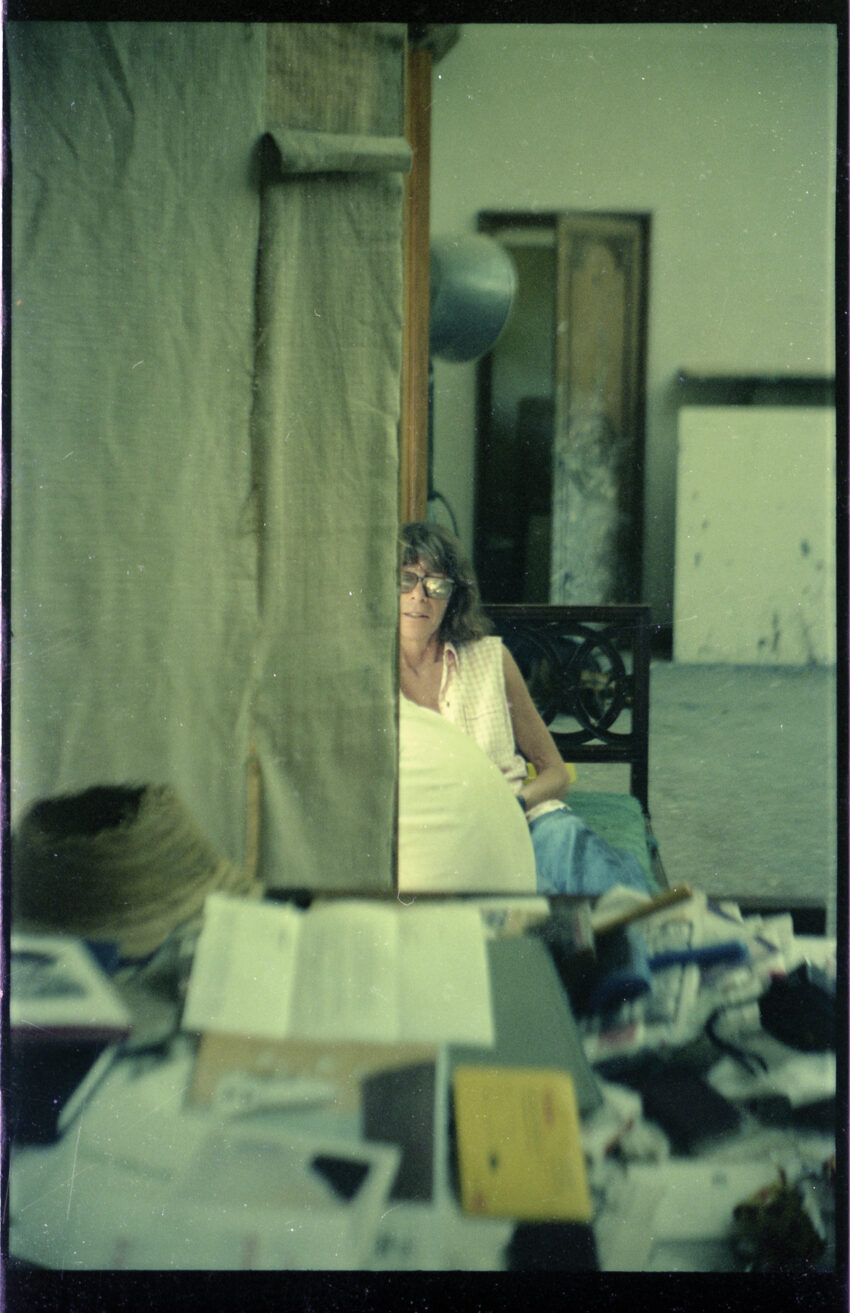
Joan Mitchell in her studio in Vétheuil, France, ca. 1976. Photographer unknown, courtesy the Joan Mitchell Foundation Archives, New York
Mitchell established a foundation in her will, to help shepherd her legacy and manage part of her estate, and to support artists early in their careers. Throughout 2025, the Joan Mitchell Foundation has given a number of grants to different museums to further the conservation and display of Mitchell paintings. The foundation’s website offers an interactive map of the nearly one hundred works of Mitchell’s displayed this year by more than seventy museums on three continents. Studying the map, I found that several of the polyptychs were within easy reach of my home in Chicago. Mitchell grew up in Chicago, but it has only a few of her paintings, and no multi-panels in its public collections. In St. Louis, though, I could see the large diptych Ici (1992), from the year she died; in Michigan, another two-panel painting, Preface for Chris, made in 1973, when she was hard at work in France; in Cleveland, the triptych Some More (1980), which came out of a dark period in the artist’s life.
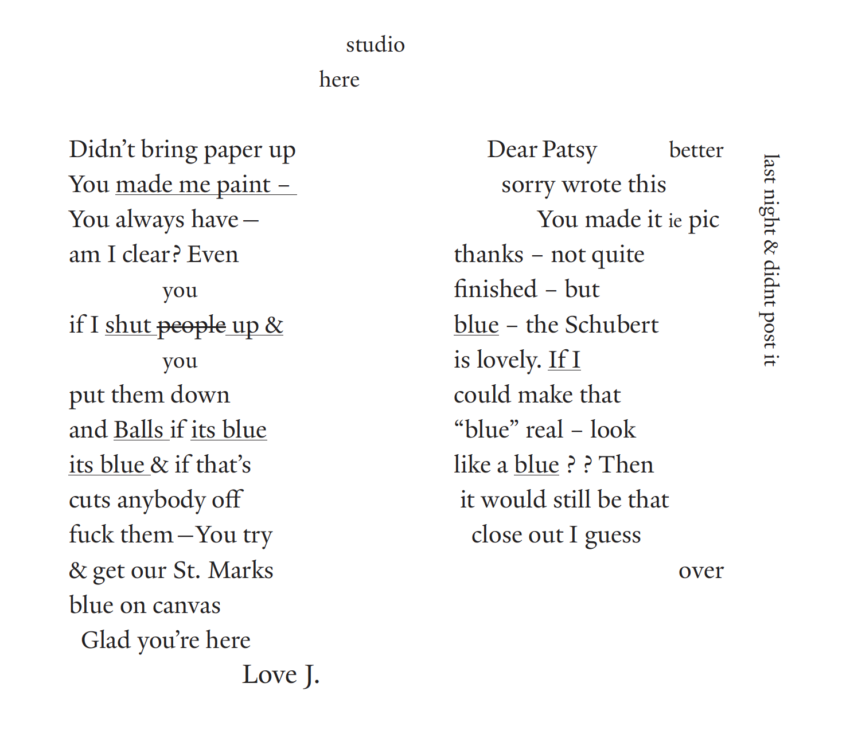
I had begun a correspondence with the foundation’s archivist, Laura Morris, and in the spring of 2025, I went to the archive to read letters for two days. At first, I didn’t see much relevance, but gradually I realized that the look of the letters was, in fact, very much like Mitchell’s brushstrokes. As I turned the pages, I was struck by the sprawl of writing across the paper, her thoughts connected with long dashes, how she interrupted herself to swear or exclaim, and made significant words larger for emphasis. In one blue ballpoint note to Patricia Molloy, a psychiatric social worker and close friend, she underlined the word blue so that it spattered across two pages like blue paint: on the left, “if its blue its blue”; on the right, another “blue”; and lower down, “blue ? ?”
Mitchell was a good letter writer too—forceful, veering, incisive. I knew of the artist’s long association with writers: her mother, Marion Strobel, was a poet; Mitchell had many poet friends, and she’d had an affair with Samuel Beckett (they used to walk around Paris talking about color). I knew she had been close to New York school poets, particularly Frank O’Hara and Joe LeSueur, and had named paintings with O’Hara’s poems in mind. But now it occurred to me that her witty, personal titles were like lines from New York school poems: George Went Swimming at Barnes Hole, but It Got Too Cold; The Good-Bye Door; No Rain; They Never Appeared with the White.
In the archive’s folders, there were many letters to, or about, the composer Gisèle Barreau, Mitchell’s housemate and close friend of many years; others mentioned Edrita Fried, usually just called Fried, who was Mitchell’s psychoanalyst and an important presence in her life for nearly thirty years. Laura Morris confirmed the significance of these two women for Mitchell, and she told me that if I came back at summer’s end, the foundation could arrange to bring out of storage the vast four-panel Edrita Fried, painted in 1981, at the time of the analyst’s final illness.
In my mind, this was all going to form a quadriptych—four experiences of paneled works, spread across the country, the last an immersive day with Edrita Fried, which Morris said was a special Mitchell even among Mitchells. The five years in which I did psychoanalysis had a deep effect on my understanding of time—of repetition and memory—so perhaps I would be able to recognize something of this in Edrita Fried. “Painting,” Mitchell had said in 1957, “is a still thing. It doesn’t move in time like music or a novel, and the images of memory which are so important to me find their expression in my painting.”
i. ici, 1992, diptych, saint louis art museum, st. louis, missouri
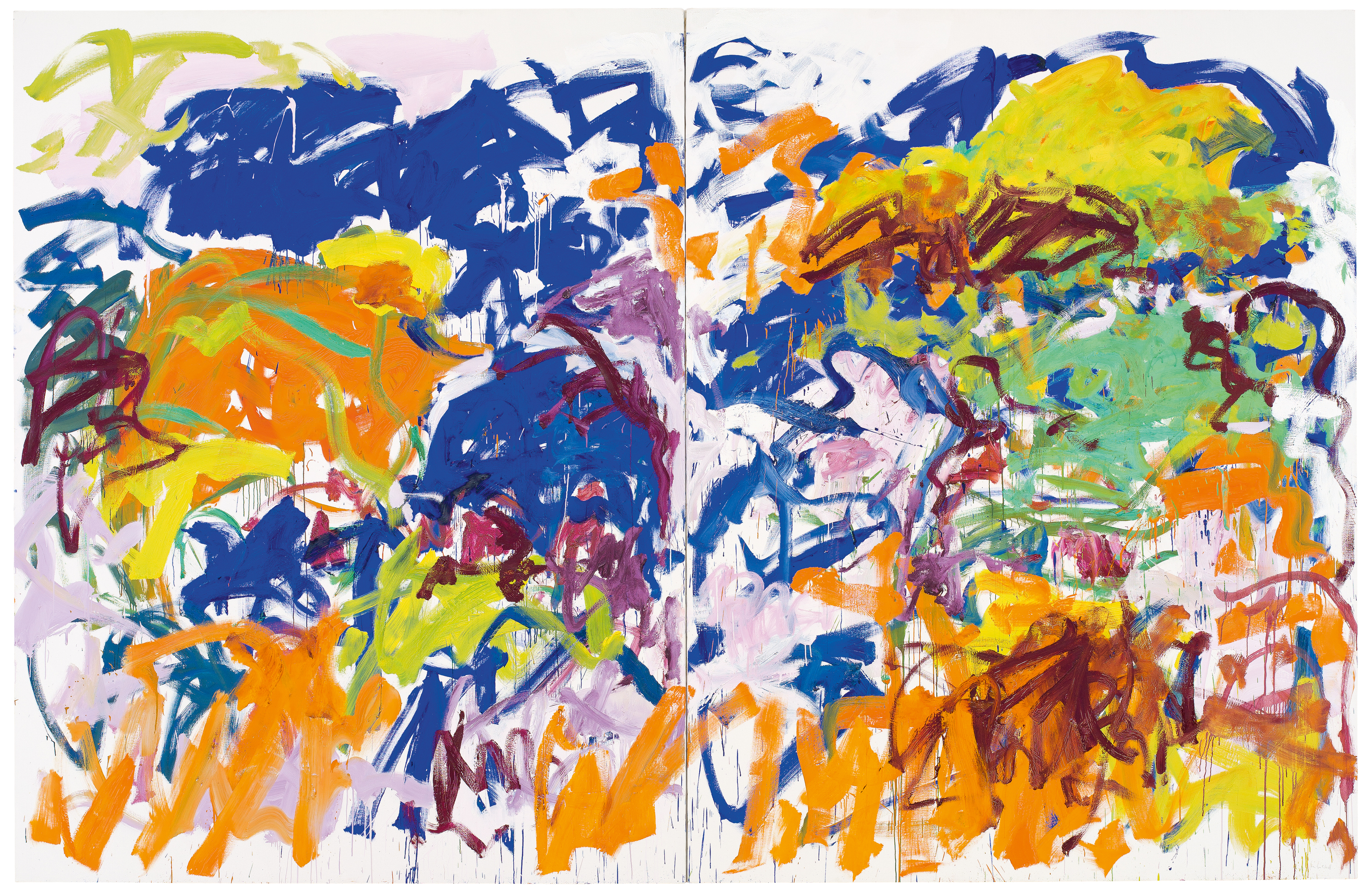
in reproduction, Ici, which is a large diptych (eight and a half feet high and more than thirteen feet wide), had looked garish and flat, with bright oranges, reds, and greens, ill-assorted, and large bright-blue areas—a sketch in housepaint. But when I caught sight of it at the end of the long room, the first word I thought was embrace. It appeared glad to see me and shared what turned out to be surprisingly harmonious colors with a touching, hopeful quality. I had been listening to the compositions of Mitchell’s friend Barreau, who had been staying with her in Vétheuil on and off for twelve years at the time Ici was painted. In an essay on Mitchell, Barreau wrote, “She painted works that can be heard—radiant, lyrical, a perfect vibration. I paint in sounds, framing the music—gestures, energy, a color field expressed in a musical score that can be seen: music for the soul.”
Looking at Ici (which means “here” in French), I could think of arrangements of sound being built up by the waves of paint. I stood near and far, sat down on the floor, photographed, sketched, and returned later in the day with Simon Kelly (curator and head of the Department of Modern and Contemporary Art at the Saint Louis Art Museum) and the conservator Melissa Gardner. The three of us examined the border where the two canvases abut. Mitchell, Gardner said, must have moved them both apart and together as she worked—you could tell from the varying splatter of colors and strokes. The paint along the interrupting seam, then, was a record of passing time. We all saw landscape in Ici: Kelly pointed out an orange-yellow flower on a stalk of green (Mitchell painted many sunflowers, thinking of Vincent van Gogh), while I saw a blue river. Calligraphic reds seemed to extend messages from the far edges, and the join between panels had been sealed by Mitchell with an orange arc.
When Mitchell painted Ici, she had fought off cancer of the jaw, but metastatic lung cancer would be the cause of her death a few months later. The tremendous physical exertion required to make large free-flowing strokes on ladders must have been a gritted effort. I sensed in the painting immense determination—to have no self-pity, to be vital. As plain as its day of orange and green and blue, the painting didn’t want to leave, and didn’t want to be left.
mitchell’s first diptych had been made thirty-six years earlier. It’s called The Bridge, two panels whose main color is white, with strokes of greens and blues, as well as a few touches of red. In the left panel, there is a knot of lines in dark blues and greens. In the right panel, a long, thick horizontal curves downward at its right end—an image of an actual bridge. The left end of the bridge runs at, maybe even disappears into, the seam between the two canvases.
When Mitchell began The Bridge, she was in France. It was late 1956, a few months after Jackson Pollock had been killed in a car accident. Mitchell was not close to Pollock—her own interlocutors were the painters Franz Kline and Willem de Kooning—but she had been involved with abstract expressionism from the first and was looking for her own way across to the work she wanted to do next. Mitchell had been one of the few women who hung out with the original Artists’ Club (whose members met at an Eighth Street loft in Manhattan and drank together at the Cedar Tavern), and she had exhibited a huge painting in the famous Ninth Street Art Exhibition of Paintings and Sculpture of 1951, the moment abstract expressionism inflected from a group into a movement. She was part of that outpouring in New York, but she was already marked by France, where she had lived for two years in 1948 and 1949 on a fellowship from her alma mater, the School of the Art Institute of Chicago. In France, she had married Barney Rosset, an early love with whom she had gone to high school. Although both were also involved with other people, they stayed married until 1952, and Mitchell helped Rosset in the early years of what would be his life’s calling: building the avant-garde publishing house Grove Press.
Psychoanalysis, like a multi-panel painting, is an exercise in getting relationships to develop across boundaries and in time.
New York compelled and repelled her. In 1955, the year before she began The Bridge, Mitchell—who was then in multiple tumultuous relationships, attending group therapy, and sometimes going to psychoanalysis five times a week—was persuaded by her analyst, Fried, to borrow money from Mitchell’s mother and go back to France. There Mitchell met the Canadian artist Jean Paul Riopelle, who was to be her difficult lover for twenty-four years. Until she finally found a studio in Paris in 1959, she was suspended between two places: she would go to France to work and be with Riopelle, and then she would go back to the United States to paint, to have her sessions with Fried in New York, and to visit family in Chicago. Psychoanalysis, like a multi-panel painting, is an exercise in getting relationships to develop across boundaries and in time.
There is a lot to say about bridges: Mitchell’s grandfather was an engineer who designed them, and one of his Chicago structures, the Van Buren Street Bridge, was taken down the same year Mitchell made her painting. She had lived in a New York apartment under the Brooklyn Bridge and in a Paris apartment on rue Galande, at the place where the Pont au Double crosses to the Cathédrale Notre-Dame. Later, when she bought her house in Vétheuil with her inheritance, she called it her “bridge money.”
“A bridge to me is beautiful,” Mitchell said in an interview with the art historian Judith E. Bernstock in 1986. “I like the idea of getting from one side to the other.” When I think of Mitchell navigating these gaps in time and space, I am reminded that, for me, one of the most fundamental problems of psychoanalysis was leaving the office every day and believing that I would come back the next, and that my analyst would be there again. Children are rightly terrified that people are not actually continuous across time, that when a mother or father leaves, they are gone forever; children learn to count minutes and hours to get across the gulf of time.
When I spoke to the poet and biographer Nathan Kernan, who had known Mitchell at the end of her life and had collaborated with her on a portfolio of poem-lithographs, I asked him why he thought letters were so important to the poets of the New York school and especially to Frank O’Hara. Kernan (we were on Zoom) held up his two hands to the edges of the browser window as if he held a string. “The idea of the line,” he said, “the connecting line.”
Left to right: J. J. Mitchell, Joan Mitchell, and Chris Larson in Vétheuil, France, 1975. Photographer unknown, courtesy the Joan Mitchell Foundation Archives, New York
ii. preface for chris, 1973, diptych, cranbrook art museum, bloomfield hills, michigan
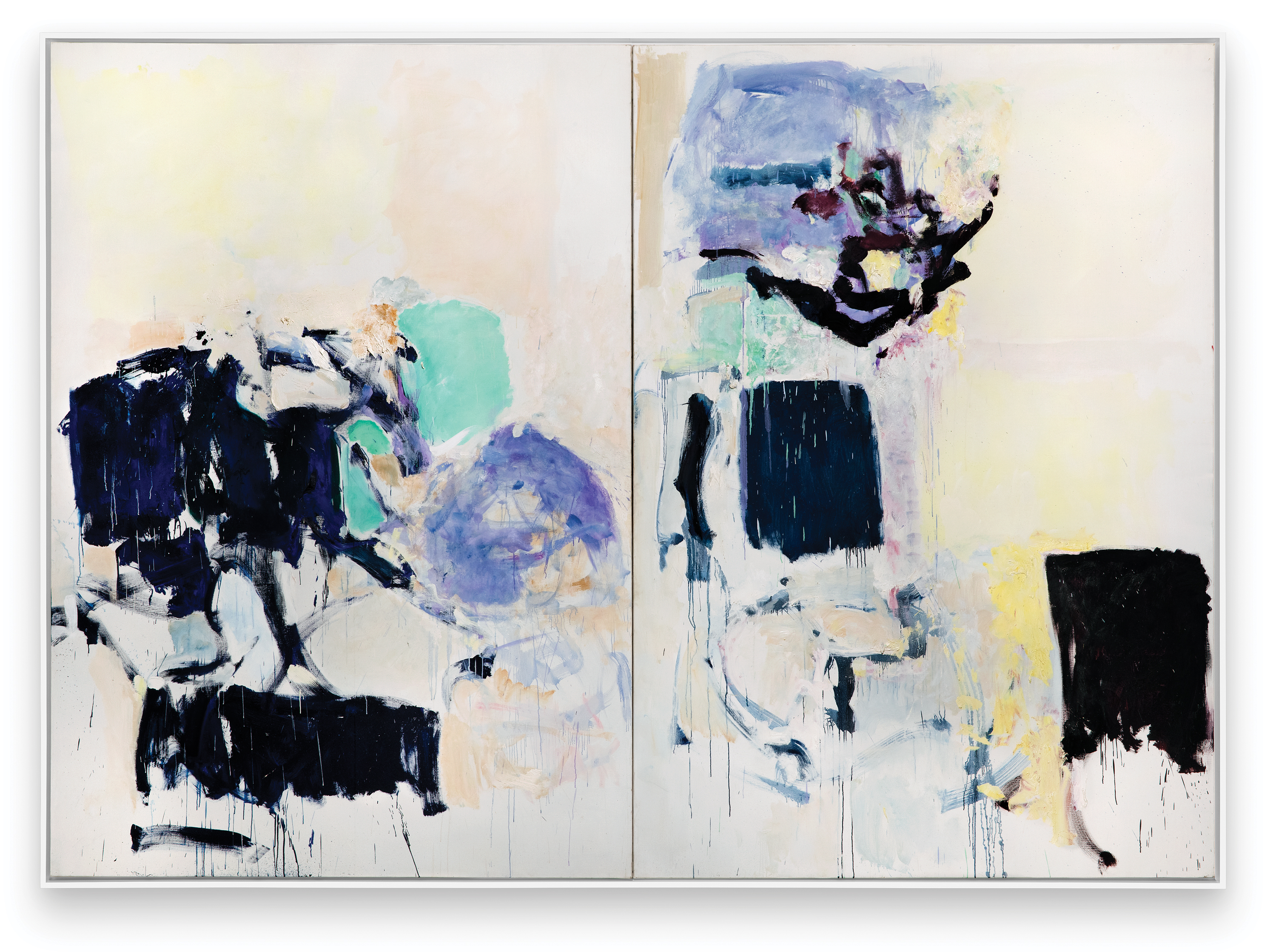
i stood for an hour and a half before the two-panel Preface for Chris (1973), in a state of uplifted contemplation with absolutely no idea who Chris was. It was a sunny, cool day in July. At the Cranbrook Art Museum, my Mitchell studies were again being helped by others: Madlyn Moskowitz, the museum’s registrar, who had recently supervised the diptych’s reframing, and Caitlin Haskell, a curator at the Art Institute of Chicago. In the left panel of Preface for Chris, vertical rectangles of dark blue and mint green are clumped together with a periwinkle cloud and calligraphic dark marks. On the right, space is more open. Each dark rectangle has its own area, and a similar periwinkle cloud, calligraphied through with oxblood, hovers at the top of the painting. Seen in person, the oblongs of deep blue and oxblood seemed book-shaped, or possibly like the clustered shape of a poem, floating in the sustained atmosphere of whites and pale yellows. I thought the two panels could be two pages, the join a spine. Or they could be letters sent back and forth across the breakages: Vétheuil to New York, Los Angeles, or Paris. Or, again, the correspondence could be interior, different states of talking to oneself.
At Cranbrook, Haskell pointed out a streak of mingled lavender and gray paint, where the brush had gone across the canvas with gaps so that one stroke was made up of eight broken individual touches. After I learned that Preface for Chris was named for Chris Larson, a poet whom Mitchell seems to have adored, and that Larson had a stutter when he spoke, I realized that Mitchell could have thought her brush was stuttering in that beautiful broken stroke.
In a letter to Mitchell dated on her birthday—February 12, 1973, the year Mitchell made Preface for Chris—Larson imagined her at work. Usually when I read letters, I think of them as prose, starting a new line whenever the writing reaches the right edge of the paper, but when I saw Larson’s red-inked calligraphic letters marching across the page, I suddenly heard and saw the intentional line breaks of a poem. Larson gave one of the best descriptions of Mitchell working in her studio, “wearing a sweater with holes in the sleeves.” If you read it as a poem, it continues:
wondering
whether the upper right area of your latest canvas
needs something or works as is; singing along
with rambunctious Verdi who thumbs his nose at
the Abyss and fills it with music; squeezing
innumerable tubes of paint, making squiggly turds
of color in pie-tins…and maybe, if today is a
good day, you’ll lose all track of time.
Larson was close friends with J. J. Mitchell, a poet who, around that time, became Joan Mitchell’s main collaborator on her poem-pastels. In an interview, she explained that she would ask J. J. Mitchell (or perhaps Larson) to type up a poem—sometimes one of his, often by another poet that struck her—and then she would work around the poem, making layers of pastel into a cloudy color atmosphere; she would, she said, “pastel them up.”
The archive holds a number of photographs that the artist must have taken of Larson and J. J. Mitchell outside after different summer lunches. Full of sun and wine, they could talk of poetry and poets. J. J. Mitchell had been Frank O’Hara’s boyfriend and had been there on the night in 1966 when O’Hara was killed by a dune buggy. They all would have known O’Hara’s letter-poems: “Poem Read at Joan Mitchell’s,” “Ode to Joy,” which Mitchell had made a three-panel painting about in 1970, and “Adieu to Norman, Bon Jour to Joan and Jean Paul,” which talks about visiting Mitchell and Riopelle. (Mitchell had helped to get O’Hara’s work published by Grove Press; she and Rosset remained in touch, though they were long since divorced. Nathan Kernan showed me a note Mitchell wrote to him in which she mentions that “I kept ‘forcing’ Barney Rosset to publish Frank.”) At the table in the garden after a summer lunch, there would have been imagining of future books. “If you write a book of poems,” J. J. Mitchell would say to Larson, “I’ll write the preface.” “No, no,” Joan Mitchell would say, “I will.”
we say that the words on a page move from left to right (in Western languages). But it’s more three-dimensional than that. For, really, don’t they lift off the page at the right to loop back around and land again at the left? If you hold a pen in your hand and work across the paper, you can feel the circling. The line breaks of a poem give the unwritten part of the loop an exactitude that is more approximate in prose. When Mitchell took the two panels of a diptych she was working on and reversed them, which she did all the time as she looked for the right arrangement, she might have thought about how the strokes on one canvas led not only across but around to those on the other.
Among the letters in the archive, there is an undated one from Mitchell to Molloy. It was written on a piece of paper that Mitchell had lying around; on the reverse is a xeroxed photo of the artist. She probably folded the picture of herself so that her image was inside and began the letter on the right-hand side of the page, but because she had more to say, when she came to the bottom right corner, she wrote “over,” then flipped it. If one looks at it spread out, the second part becomes the left of two “panels,” which I imagine she also would have realized, given how well she understood a sheet of paper:
the bridge was the first diptych, and the idea stayed with her, because she tried out another small diptych around four years later, likely in 1960, but the multi-panels really began in earnest after her father died in 1963. In 1966, a month after Mitchell turned forty-one, her mother died, and in 1967, Mitchell bought the property at Vétheuil, with the stone tower and land close to the Seine. Monet had once lived in the house just down the hill, and next to Mitchell’s property was the cemetery where his first wife was buried. Mitchell used her bridge money to move almost literally into the paintings she had loved since childhood.
Mitchell grew up in a luxurious apartment with a lake view, and she spent hours watching the blues and greens come and go across one another. Her father, James Herbert Mitchell, worked as a doctor and was a talented amateur draftsman. He used to take her to the Art Institute of Chicago regularly. By the time she was six, she was smitten with Van Gogh: “I was madly in love with Vinnie.” The Art Institute’s extraordinary French works—Monet’s haystacks and fogged bridges, Cézanne’s view of Auvers and the bay at Marseille, the whirling whites of Morisot’s Woman at Her Toilette, Matisse’s Woman Before an Aquarium, Van Gogh’s The Poet’s Garden—were well in place when she was young. Painting for Mitchell was French and the French landscape, and the colors that rippled over the canvases she made as an adult had their origins in strokes she had first taken in as a sensitive child.
Color was bound up with language. In late interviews, Mitchell told the philosopher Yves Michaud that when she was a child, each letter of the alphabet appeared to her as a color, a description that sounds like one of synesthesia. In kindergarten, she once stood up to protest that the illustrated alphabet tacked to the walls was the wrong colors. Her mother, Marion Strobel, was not only a poet but also, for two periods, an editor of the foundational, Chicago-based Poetry magazine. Illustrious poets were family friends: Strobel had had a liaison with William Carlos Williams and was in correspondence with Robert Frost, May Sarton, Carl Sandburg, and many others; they all came to parties and gave readings in the family living room. Writing letters to poets was part of the family business. Mitchell herself published a first poem, called “Autumn,” in Poetry at the age of ten, and corresponded with the poet George Dillon afterward. It echoes strongly in the poem that Mitchell’s mother was then going deaf; the poem’s last lines, which Mitchell could quote all her life, were “Bleakness, through the trees and branches, / Comes without sound.”
If Cézanne’s apples show you multiple sides of an apple at the same time, Mitchell’s multi-panels show you different sides of a feeling, a memory, a color experience.
Mitchell always said that her paintings were memories of landscape: “I carry my landscapes around with me.” Up until the death of her parents, her paintings had used both vertical and horizontal formats, and sometimes you can see that the horizontal ones were also worked on vertically, so the paint now appears to drip sideways. But in the mid-1960s, she stopped using the horizontal format. All her paintings were either vertical or got their horizontality from the assembling of multiple vertical panels. Vertical canvases are much more like people: you can take them in your arms; they stand upright in the proportions of a person. Several of them in a row are more like a person moving in a landscape than like a stretch of water, city, garden.
The panels were practical: she wanted to paint on a huge scale, and she could move sections around in her not-huge studio, get them in and out, and ship them in pieces. (Even so, the panels were often larger than her studio could accommodate; she could really see only two at once.) The panel work was also philosophical: “I also like the vertical—the cutting,” Mitchell said to the feminist art historian Linda Nochlin in 1986. Nochlin and Mitchell knew each other fairly well; Nochlin had stayed at Vétheuil and seen Mitchell’s process over time. “You like those divisions?” Nochlin asked. “Yeah,” Mitchell confirmed.
This was an understatement. Current research suggests that she made in the neighborhood of 80 triptychs, 20 quadriptychs, several five-panel paintings, and a whopping 150 diptychs (possibly more), as well as many works on paper that take multi-panel form. The most important recent Mitchell exhibition, the 2021 retrospective at the San Francisco Museum of Modern Art, was curated by Roberts before she joined the Joan Mitchell Foundation. In the exhibition catalogue, Roberts wrote that, in the multi-panel works, the divisions “force us into a sequential form of looking—first at the whole, then at each unit, and then at the dialogues among the units.” If Cézanne’s apples show you multiple sides of an apple at the same time, Mitchell’s multi-panels show you different sides of a feeling, a memory, a color experience.
Curiously, even paradoxically, sequences and time lags may create an effect of eternal presence. The similar present tenses of New York school poems and abstract expressionism are something people talk about—the poems with their verbs running on, the paintings with their wet strokes laid down so that you can feel the painter painting. Mitchell must have put that orange on after that blue, because it is on top; she must have used that white to erase something underneath, in the same way that a word struck through indicates a later point of view. Looking at Mitchell’s strokes, I feel as I do about James Schuyler within “The Morning of the Poem,” or O’Hara forever in his Lunch Poems—that she is having her night and day of painting, and that she is still having it within the pages of her painting.
iii. some more, 1980, triptych, cleveland museum of art, cleveland, ohio
each panel ofSome More is a little more than four feet high—relatively small among the Mitchells I’ve seen—with strong yellows, distinct orange marks, and currents of green; pronounced blacks undulate across the bottom. The total length is about nine and a half feet. I had seen the painting briefly a few years before and had often returned to the photos I’d taken of it. I knew its heavy marks and the wide smearing brush she had used. But in my earlier hurry, I had missed its feeling. This painting was raucous. Its colors clashed and fought. Standing in the study room, I thought, This is all wrong, I can’t write about this, I’ll write about the others, this one hurts my mind. The black in it seemed important but not spacious—it was as if it were coagulating.
After interviewing Mitchell in 1986 to prepare a retrospective, Bernstock paraphrased the artist on her state of mind in 1980: “She remarks that people did not perceive her extreme unhappiness during the period of her Yellow paintings because they associated warm colors exclusively with joy. The blacks and oranges in the painting of 1980 evoke the feeling of dying flowers, with which Mitchell was preoccupied.” I noticed a similarity between this pained yellow and that of Van Gogh, and I talked about this with Bill Scott, one of the younger artists who went out to visit Mitchell at Vétheuil in the summer of 1980. Later he lived there for a time, painting in her studio during the part of the day when she would sleep. Scott remembered that sometimes he would take a walk with Mitchell, and she would be especially happy if she’d had a dream of walking with “Vinnie” in the woods.
One reason Some More may have been so angry is that, not long before its painting, early in 1979, Riopelle had made a final break, leaving with one of Mitchell’s young assistants, the painter Hollis Jeffcoat. Around the time of their departure, Mitchell took a trip back to New York to see her psychoanalyst. She had been going to see Fried for about twenty-six years at that point; it was one of the most sustaining and enduring relationships of her life. “I loved her totally,” she told Bernstock. Naturally, she returned to her. You can see in Some More that more was almost too much to hold.
in her book The Courage to Change, Fried writes that certain patients, often ones who were isolated in their early years and subject to harshly conflicting demands, generate what she calls “a whirl” around them. This whirl—originally elicited in childhood by the chaos of “simultaneous, multidirectional, and partly-veiled messages” that arouse “extreme” feeling—can then become something a patient recreates around themselves: by refusing to slow down and pay attention to other people; by being brilliant and attractive to cover their own withdrawals; by driving around Paris late at night in a dangerous car and drinking too much and fighting with lovers; by being, with dinner guests, alternately probing, insightful, harshly demeaning, vengeful. In another letter to Molloy, Mitchell wrote, “Fried said to me years ago that she would never touch my ‘chaos’—only help me to get along with people.”
If Mitchell was one of Fried’s whirlers, she was also someone able to take that isolating and overwhelming simultaneity and transform it into something that could be shared. Part of what is nourishing in analysis is the sense of paying attention together, both looking at the same thing at the same time and really seeing it. Of her patients, Fried wrote that “the chances for recovery increase with simultaneity.” Because Mitchell’s panels let you watch her trying similar things two or three times, you know that you are seeing her seeing, and that she knows that. “While we cannot survey everything that goes on inside and around the individual at once,” Fried went on, “we can master the simultaneous review of several connected problems.” Mitchell’s polyptychs are a simultaneous review of several connected problems. Though she is long gone, you seem to see with her.
I think Mitchell must have read The Courage to Change as soon as it came out in 1980. She encouraged friends to buy it in paperback when it was issued the following year by Rosset’s Grove Press. Mitchell pressed all of Fried’s books on her friends and wrote long letters to Gisèle Barreau and others that tried to imagine what Fried’s advice to them would be. When Fried died late in 1981, the loss for Mitchell was terrible. She wrote, with poignant line breaks and interpellations, to Joanne Von Blon, one of her oldest friends:
Fried (my shrink died) broke my
her
heart – I’m sure my love for interfered
with my shrinkery but I couldn’t care
less – & I doubt if she did. Balls –
Fuck. Her daughter is a shrink & her
very nice
husband is alive – continuations but
of course not really.
Unlike other forms of therapy, analysis is defined from the outset as having a “termination”—stark word, but ends are what you practice for. Analysis, like Mitchell’s paintings, uses the formal divisions of sessions to create a recursive experience of time in which you perform the same actions repeatedly: enter by the door, lie on the couch, talk. You can go back to the memories of your childhood and your landscapes, and you can shift your point of view on them, in part through the combination of repetition and ends. Ends, of the individual hours and of the analytic process as a whole, are known to be coming.
The early 1980s were a very difficult time for Mitchell, as her losses grew greater. Her sister died in 1982, and now there was hardly anyone who had known her since the beginning. Gisèle Barreau’s beloved cousin died within two days of Mitchell’s sister’s death, and the two survivors drew closer together. In the later years, Mitchell again turned to poetry. “Rilke never left the painter’s side,” Barreau remembered. And Mitchell entered a new analysis with a French psychoanalyst, taking the train three days a week to Paris.
iv. edrita fried, 1981, quadriptych, joan mitchell foundation, new york, new york
in the viewing room, there were so many people and paintings and drawings at once. It was August, and we had gathered in New York to see works held by the Joan Mitchell Foundation. Caitlin Haskell, the curator from Chicago’s Art Institute, was there, along with Laura Morris, the archivist from the Joan Mitchell Foundation, and Bill Scott, the painter who had lived with Mitchell at Vétheuil. There were works from every period of Mitchell’s life—early student pieces, huge, demanding diptychs from 1977 and 1992, drawings and pastel series she had done over decades. And all along one wall: Edrita Fried. The foundation had put on an exhibition for us within a single room. Small paintings and works on paper were brought in and taken away again. I was trying to see Edrita Fried, but it was difficult to get to it—the table was in the way, and I couldn’t back up and get the perspective.
I did see it, though; the combination of its lake blues, its orange and lavender. I could see how in the rightmost panel, the orange arose from the blue and completely dominated that panel with an eruption of blazing strokes. Mitchell must have then circled back across to the leftmost panel, because a few orange touches dotted the very surface of the left panels. It is a painting of an endless cycle, as endless as the waters of Lake Michigan and the Seine, that blue of dawn and dusk that yields to or overtakes orange and purple to herald the day and bring the night.
Painting, she said, “is the only thing that is both continuous and still.”
Someone had said that the art handlers would clear away the works on paper so we could really sit with the paintings after lunch. But when we came back, the rightmost panel of Edrita Fried was already in a box on the floor, as if interred. They set it back up against the wall, still in its crate. We looked at Edrita Fried in this odd way, its last panel set apart by the wooden frame, tantalizingly close to reunion.
If we had decided to do a play in which we recreated Mitchell’s studio as she painted through the death of her analyst, what we would have come up with is exactly what we did that day. We would have made a whirl of emotion and activity. People and art handlers circling around, too many paintings on the walls, and no way to back up and see them properly. Lots of works on paper spread out on tables, and the dawning sense of a clear relation between the pages of paper and the panels of the paintings. A break for a long conversational lunch among people who were devoted to Mitchell and some who felt a powerful ambivalence toward her. Then, returning to the studio, we would have found that the final panel of our time with the analyst was already being packed up and sent away.
In January 1986, Mitchell said to Yves Michaud, the philosopher, almost the same thing about painting that she had said thirty years before. She made one significant change. Painting, she said, “is the only thing that is both continuous and still.” You could say that in those three decades, she had come to terms with painting as at once broken and continuous. When she spoke, she was thinking about the death of Fried. And also those of her sister and Barreau’s cousin, after which Mitchell and Barreau, in mourning, had gone together to see the Manet exhibition in Paris.
It was terrible, but seeing all these paintings, some from my Chicago childhood, with all that silence and no time involved, no terminations, was wonderful. There was no sadness, no death. It was still. Painting is the only art form except still photography which is without time.…It never ends, it is the only thing that is both continuous and still.
Grateful acknowledgment is given to the Joan Mitchell Foundation for access to archival materials and images.
Correction, December 17, 2025: Due to a technical error, an earlier version of this piece displayed the fourth and fifth paragraphs out of order.